
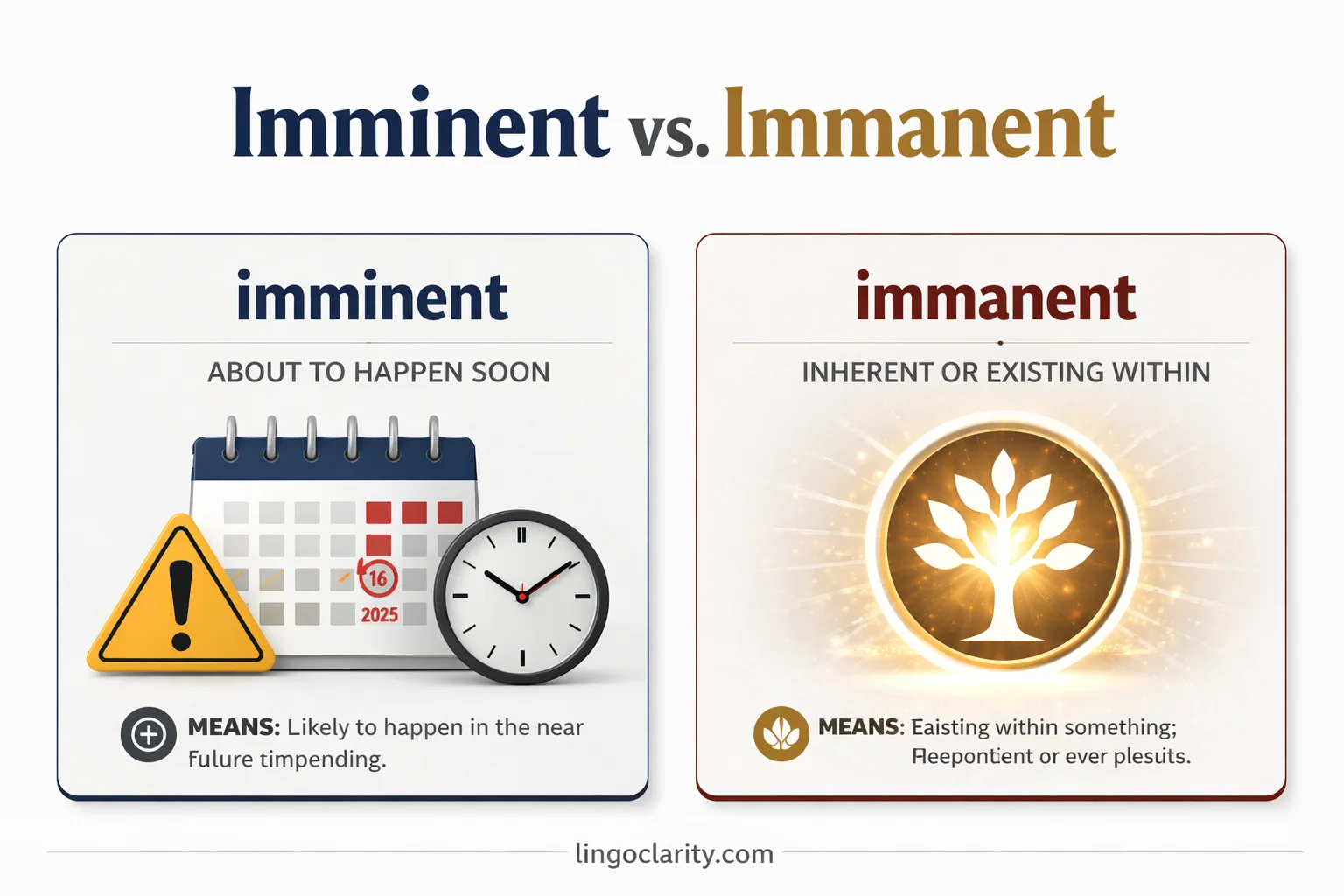
Imminent vs. immanent is a common word-choice problem because the two words look similar, sound similar, and mean very different things. The difference is simple: imminent means about to happen very soon, while immanent means existing within something or inherent in it. If a storm is almost here, it is imminent. If a quality is built into a system, it may be immanent. Once you understand imminent vs. immanent this way, it becomes much easier to choose the right word in real writing.
Quick Answer
Use imminent for something that is close in time.
Use immanent for something that exists within, pervades, or is inherent.
That is the whole distinction:
- Imminent = soon
- Immanent = within
If you remember that split, you will get most uses right.
Key Difference At A Glance
The easiest way to separate these words is to ask one question:
Are you talking about what is about to happen or what already exists within?
Choose imminent when the focus is time:
- an imminent deadline
- imminent danger
- imminent arrival
Choose immanent when the focus is internal presence or inherence:
- an immanent principle
- an immanent force
- a divine presence understood as immanent in the world
Major dictionaries define imminent as something ready to happen or likely to happen very soon, often with a sense of danger or urgency. They define immanent as indwelling, inherent, or existing within. In philosophy and theology, immanent is often contrasted with transcendent.
What Imminent Means
Imminent is the word you use for an event that is near at hand. It points forward. Something imminent has not happened yet, but it is expected very soon. Dictionaries also note that the word often appears in contexts involving danger, disaster, threat, or pressure, although it does not have to be negative. A deadline can be imminent. So can a vote, merger, launch, or arrival.
Natural examples:
- Evacuation orders were issued because flooding was imminent.
- With the filing deadline imminent, the legal team worked through the weekend.
- An official announcement seemed imminent after the board meeting ended.
In plain English, imminent often overlaps with words like impending, near, forthcoming, or about to happen. But imminent usually sounds a little more urgent than forthcoming, and a little more immediate than upcoming.
What Immanent Means
Immanent is much less common in everyday writing. It usually appears in formal, academic, philosophical, theological, or analytical contexts. The core idea is that something exists within something else as a natural, inherent, or indwelling part of it. Britannica defines immanence in contrast to transcendence, especially in theology, where it refers to being entirely within. Merriam-Webster and Collins also define immanent as inherent or indwelling.
Natural examples:
- Some traditions describe the divine as immanent in the world.
- The critic argued that contradiction was immanent in the political system.
- In the essay, moral worth is treated as immanent in every person.
That said, many sentences using immanent can be rewritten more clearly for general readers:
- “Trust is immanent in healthy teams” is correct, but “Trust is inherent in healthy teams” is plainer.
- “Order is immanent in nature” may work in philosophy, but “Order exists within nature” is easier for a broad audience.
Why These Words Are So Easy To Confuse
They look alike, sound alike, and are both adjectives. Merriam-Webster gives the same pronunciation for both words, which helps explain why the mistake is so common in writing. Some reference pages and comparison tools also present them as homophones or near-homophones.
But the meanings are not close at all.
One points to time. The other points to internal presence.
That is why “an immanent storm” is wrong if you mean the storm is coming soon. A storm can be imminent. It is not usually immanent.
How To Choose The Right Word Every Time
Use this quick test:
If you can replace the word with about to happen, choose imminent.
If you can replace it with inherent, built-in, indwelling, or existing within, choose immanent.
Try it:
- “A decision is about to happen.”
Better: “A decision is imminent.” - “A principle is inherent in the system.”
Better: “A principle is immanent in the system.”
That one substitution test solves most cases.
Tone, Formality, And Context
This is one of the biggest differences between the two words.
Imminent is common in everyday English. It works in journalism, business writing, academic writing, professional communication, and normal conversation. You can say:
- layoffs are not imminent
- a response is imminent
- the deadline is imminent
Immanent is not an everyday word for most US readers. It often appears in philosophy, theology, criticism, or abstract writing. That does not make it wrong. It just means you should use it with intention. If the audience is broad, a simpler word such as inherent, internal, built-in, or present within is often better. Major references consistently place immanent in philosophy or theology more than ordinary daily usage.
Common Mistakes And Better Rewrites
Wrong: The board expects an immanent vote.
Right: The board expects an imminent vote.
Wrong: A major announcement is immanent.
Right: A major announcement is imminent.
Wrong: Justice is imminent in the legal system.
Right: Justice is immanent in the legal system.
Better for general readers: Justice is inherent in the legal system.
Wrong: The hurricane is immanent.
Right: The hurricane is imminent.
Wrong: Compassion is imminent in her work.
Right: Compassion is immanent in her work.
Better: Compassion is deeply present in her work.
The recurring pattern is simple:
- approaching event = imminent
- embedded quality or presence = immanent
Real-World Examples In Natural US English
Here are examples that sound like something a real editor, reporter, professor, or manager might actually write.
Imminent
- The union warned that a strike was imminent if negotiations failed.
- Forecasters said landfall was imminent.
- With a final ruling imminent, investors watched the market closely.
- Her resignation looked imminent after the memo leaked.
Immanent
- The philosopher argued that freedom is immanent in human consciousness.
- In that tradition, the divine is understood as immanent rather than distant.
- The critic saw instability as immanent in the economic model itself.
- The novel treats grief as immanent in love, not separate from it.
Notice how imminent usually fits news, events, deadlines, danger, and timing, while immanent belongs more often to ideas, systems, meaning, spirituality, and theory. That split matches how major references explain their usage.
When A Simpler Word Is Better Than Immanent
A lot of writers reach for immanent because it sounds elevated. That is often a mistake.
If you are writing for a general audience, ask whether one of these is clearer:
- inherent
- intrinsic
- built-in
- internal
- present within
For example:
- “Risk is immanent in the strategy” is grammatical, but “Risk is built into the strategy” is clearer.
- “Beauty is immanent in the design” may work in criticism, but “Beauty is inherent in the design” is usually more natural.
Using the more specialized word is only worth it when you truly need its nuance.
Should You Also Watch Out For Eminent?
Yes. Even though your main choice here is between imminent and immanent, many readers also confuse both with eminent, which means distinguished, respected, or prominent. Several major and mid-tier comparison pages treat these three words as a confusion cluster, not just a pair.
A fast reset:
- eminent = famous or distinguished
- imminent = about to happen soon
- immanent = existing within
Examples:
- an eminent scholar
- an imminent decision
- an immanent principle
Easy Memory Tricks
These memory aids are simple, but they work.
For imminent, think immediate. Both start with immi-, and both point to nearness in time.
For immanent, think inherent or in. The idea is that something is in something else.
Another easy way to remember it:
- imminent is about the next moment
- immanent is about what is already inside
Use whichever mnemonic feels natural. The best one is the one you actually remember while writing.
Frequently Asked Questions
Is immanent the same as imminent?
No. Imminent means about to happen very soon. Immanent means inherent, indwelling, or existing within something.
Is immanent a common everyday word?
Not really. It is a real and useful word, but it is more common in philosophy, theology, and abstract analysis than in casual daily conversation.
Are imminent and immanent pronounced the same?
In major American dictionary treatment, they are typically pronounced the same, which is one reason people mix them up in writing.
Can I use immanent to mean internal or built-in?
Yes, but only when that more formal tone fits the sentence. In many cases, inherent, intrinsic, or built-in will sound more natural for a general audience.
Does imminent always mean something bad is coming?
No. It often appears in warnings, danger, or crisis contexts, but it can also refer to neutral or positive events, such as an imminent announcement, launch, or arrival.
What is the fastest way to remember the difference?
Use this test: if the idea is soon, choose imminent. If the idea is within, choose immanent.
The Bottom Line
The difference between imminent and immanent is simple once you stop focusing on how similar they look.
Use imminent when something is about to happen.
Use immanent when something exists within, inheres in, or pervades something else.
If you are writing about time, urgency, danger, deadlines, arrivals, or events, you almost certainly want imminent.
If you are writing about philosophy, theology, criticism, or an embedded quality within a system or thing, you may want immanent.
And if immanent feels too technical for the sentence, choose the clearer word. That is usually the best editorial decision.
