
People often come across the word inimical in school reading, opinion writing, formal emails, news coverage, academic work, and test prep. It is not an everyday word, which is exactly why it can cause trouble: when used well, it sounds precise and intelligent; when used poorly, it sounds stiff or confusing.
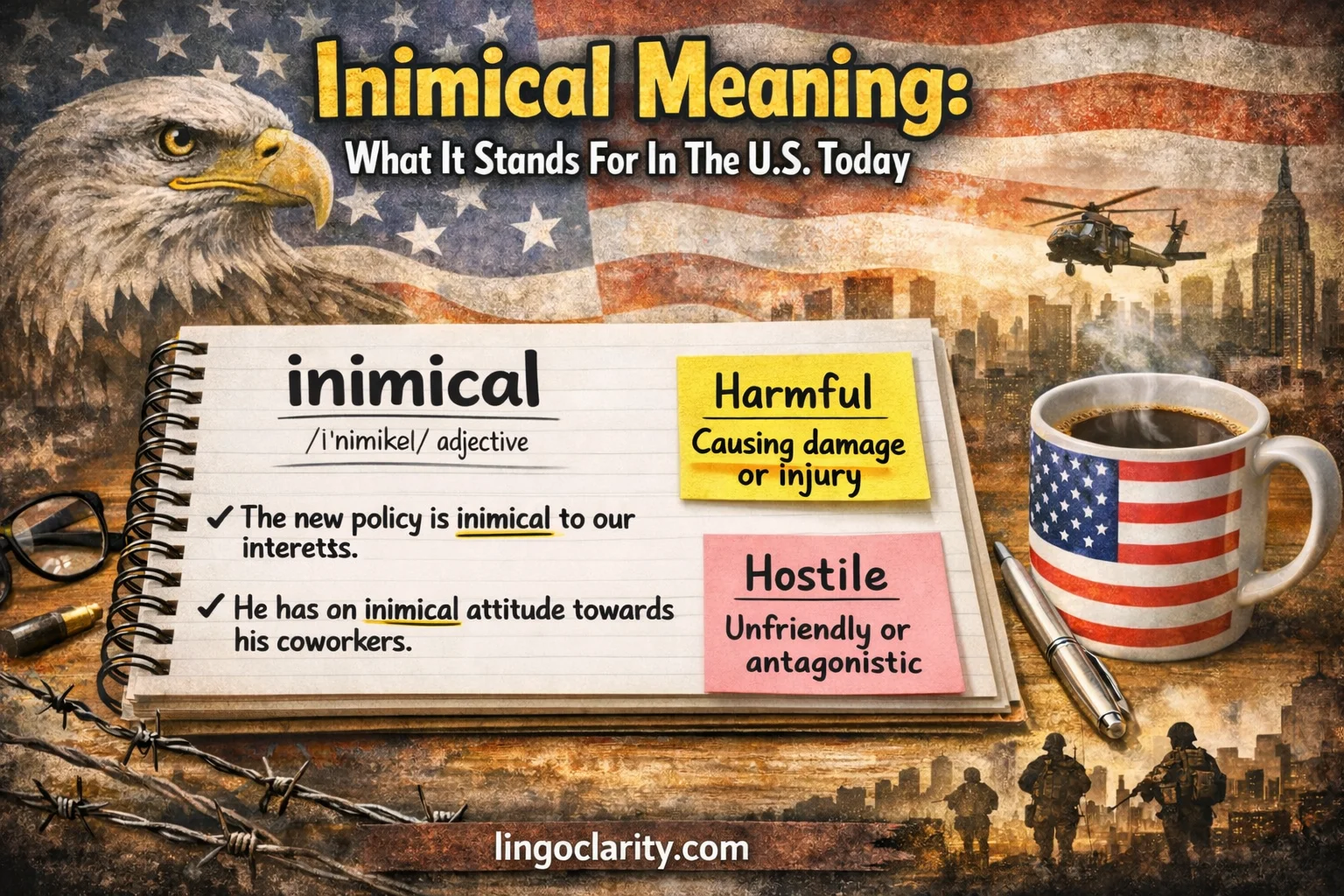
So what does inimical mean in plain English? Most often, it means harmful, hostile, or working against something. It is a formal adjective, and it commonly appears in the pattern inimical to. Dictionaries consistently define it along those lines, including “harmful,” “adverse,” and “not friendly.”
In this guide, you will learn the meaning of inimical, how to pronounce it, when to use it, when not to use it, and how it differs from similar words such as hostile, adverse, harmful, and inimitable.
Quick Answer
Inimical means harmful, hostile, or opposed to something. In most sentences, it describes something that works against a goal, interest, condition, or relationship.
Example:
Constant interruptions are inimical to deep focus.
Key Takeaways
- Inimical is an adjective.
- It usually means harmful, adverse, or hostile.
- The most common pattern is inimical to.
- It is more common in formal than casual English.
- It works especially well in essays, reports, commentary, and serious professional writing.
- It is often confused with inimitable, which has a completely different meaning.
What Does Inimical Mean?
Inimical is a formal adjective used for something that is bad for, opposed to, or unfriendly toward something else. In many contexts, it means a person, policy, condition, habit, or attitude has a negative effect on a goal or outcome. Major dictionaries define it as harmful, adverse, limiting, or not friendly.
In everyday English, you can usually translate inimical as one of these:
- bad for
- harmful to
- working against
- unfriendly toward
Here is how the meaning shifts by context:
- If something is inimical to health, it harms health.
- If a rule is inimical to progress, it blocks progress.
- If a workplace is inimical to trust, it makes trust harder to build.
- If a stare is inimical, it feels cold or hostile.
Simple Examples
- Late-night scrolling is inimical to good sleep.
- Constant sarcasm is inimical to teamwork.
- Smoke is inimical to healthy lungs.
- The new policy was inimical to small business growth.
- A culture of blame is inimical to honest feedback.
A practical memory trick helps: if you can replace inimical with bad for and the sentence still works, you are probably using it correctly.
How To Pronounce Inimical
In U.S. English, inimical is commonly pronounced ih-NIM-ih-kul, with the stress on the second syllable. Standard dictionary sources also give the pronunciation as /ɪˈnɪmɪkəl/.
Break it down like this:
- i
- NIM
- i
- cul
Keep the stress in the middle, not at the end.
Say It In Full Sentences
- The new schedule is inimical to family time.
- Fear can be inimical to honest discussion.
- Excess noise is inimical to concentration.
- His tone sounded inimical rather than constructive.
A common pronunciation mistake is over-stressing the last syllable. The strongest beat belongs on NIM.
What Kind Of Word Is Inimical?
Inimical is an adjective, meaning it describes a noun. It is also marked as formal in standard dictionary usage, which is why it appears more often in essays, editorials, policy writing, and serious commentary than in casual conversation.
It often describes:
- policies
- habits
- conditions
- effects
- attitudes
- environments
Examples By Use Case
- The policy was inimical to innovation.
- His reply carried an inimical tone.
- The office culture was inimical to creativity.
- Misinformation is inimical to public trust.
In a text message, inimical may sound overly stiff. In a research paper, article, or presentation, it often sounds exactly right.
How Inimical Works In A Sentence
The most common and natural sentence pattern is:
something + is/was + inimical to + noun or idea
That final to matters. It is the structure most dictionaries and usage examples support.
Common Combinations
- inimical to health
- inimical to progress
- inimical to trust
- inimical to safety
- inimical to learning
- inimical to democracy
- inimical to growth
- inimical to long-term success
Correct Examples
- Loud interruptions are inimical to concentration.
- Fake rumors are inimical to a person’s reputation.
- Extreme heat is inimical to some crops.
- Poor leadership is inimical to morale.
- Hidden fees are inimical to customer trust.
Common Error
Incorrect: This is inimical my goals.
Correct: This is inimical to my goals.
In formal writing, the word works best when the target is clear. Readers should be able to answer this question immediately: inimical to what?
How To Use Inimical In Writing
Even though inimical is formal, it still works well in modern English when the tone is serious and the meaning is specific.
It is especially useful when you want a sharper, more exact alternative to vague words like bad, negative, or unfriendly.
Strong, Natural Uses
- In a school essay: Cheating is inimical to fair learning.
- In a business report: High turnover is inimical to long-term stability.
- In a professional email: Repeated last-minute changes are inimical to planning.
- In a presentation: Poor data quality is inimical to sound decision-making.
- In opinion writing: Disinformation is inimical to public trust.
Everyday-Style Examples That Still Sound Natural
- Endless meetings can be inimical to deep work.
- A mocking tone is inimical to respectful debate.
- Unclear rules are inimical to good teamwork.
- Chronic stress can be inimical to sleep quality.
Use inimical when you want precision and formality. Skip it when a simpler phrase would serve the reader better.
Common Patterns And Practical Examples
Certain combinations appear often because they match the core idea of harm or opposition.
Frequent Collocations
- inimical to health
- inimical to progress
- inimical to growth
- inimical to trust
- inimical to safety
- inimical to peace
- inimical to learning
- inimical to creativity
- inimical to public confidence
Natural, Real-World Examples
- Doomscrolling is inimical to sleep and focus.
- A toxic classroom climate is inimical to learning.
- Short-term thinking is inimical to long-term planning.
- Public humiliation is inimical to healthy relationships.
- Dry, salty soil is inimical to many garden plants.
A simple test helps here too: ask, “What is this bad for?” If the sentence clearly answers that question, inimical may be a strong fit.
When Not To Use Inimical
Not every negative situation needs a formal word. Sometimes inimical sounds too heavy, too abstract, or simply less natural than a simpler alternative.
That is especially true in casual speech.
Cases Where A Simpler Word Works Better
- Casual chat: He was hostile sounds more natural than He was inimical.
- Everyday advice: That is bad for your health may be clearer than That is inimical to health.
- Friendly workplace communication: This may slow the project down sounds warmer than This is inimical to project progress.
- Conversation with children or beginners: harmful is usually easier to understand.
Awkward Vs Better
Awkward: My friend was inimical at lunch.
Better: My friend was rude at lunch.
Better: My friend was hostile at lunch.
Awkward: This app is inimical.
Better: This app is frustrating.
Better: This app hurts productivity.
Use inimical when the context is serious, the target is clear, and the tone supports a more formal word choice.
Inimical Vs Hostile, Adverse, Harmful, And Inimitable
These words overlap, but they are not interchangeable.
| Context | Best Word | Why |
|---|---|---|
| A person acts cold and aggressive | hostile | Focuses on attitude and behavior |
| A rule works against progress | inimical | Shows harmful effect or opposition |
| Conditions are unfavorable | adverse | Best for circumstances or external conditions |
| Something causes direct damage | harmful | Simple, direct, and widely understood |
| Someone’s style cannot be copied | inimitable | Means unique or impossible to imitate |
Key Distinctions
- Inimical vs hostile: Hostile usually focuses on open unfriendliness; inimical is broader and often describes harmful effects.
- Inimical vs adverse: Adverse often fits conditions, trends, or circumstances; inimical sounds more deliberate or more directly opposed.
- Inimical vs harmful: Harmful is simpler and more conversational.
- Inimical vs inimitable: These are often confused because they look similar, but inimitable means distinctive or impossible to copy, not negative.
Examples
- The comment was hostile.
- The policy was inimical to small businesses.
- The team faced adverse weather.
- Too much smoke is harmful.
- Her performance style is inimitable.
Synonyms, Antonyms, And Related Words
You do not need to use inimical every time. Sometimes a nearby word fits the sentence better.
Useful Synonyms
- hostile
- adverse
- harmful
- unfavorable
- antagonistic
- detrimental
- injurious
- opposed
Useful Antonyms
- beneficial
- favorable
- supportive
- helpful
- friendly
How The Alternatives Change Tone
- Detrimental sounds formal and often fits long-term damage.
- Harmful is the clearest everyday option.
- Antagonistic is stronger and more personal.
- Beneficial is a strong opposite when you mean “good for.”
- Supportive is a better opposite when the focus is people, culture, or attitude.
Examples
- Detrimental to health is close to inimical to health.
- Supportive of learning is the opposite of inimical to learning.
- Antagonistic tone is close to inimical tone, but sounds more personal.
- Beneficial to growth flips the meaning completely.
Common Mistakes And Easy Fixes
Writers often understand the negative feeling of inimical but miss the most natural grammar or tone.
Mistake 1: Leaving Out “To”
Wrong: This rule is inimical progress.
Correct: This rule is inimical to progress.
Mistake 2: Using It In Casual Conversation
Too formal: Your late replies are inimical to my patience.
More natural: Your late replies are frustrating.
Mistake 3: Using It Without A Clear Target
Weak: The policy is inimical.
Better: The policy is inimical to fair competition.
Mistake 4: Confusing It With “Inimitable”
Wrong: Her singing style is inimical.
Correct: Her singing style is inimitable.
Mistake 5: Using It Mostly For People
Possible but less common: He gave me an inimical stare.
More common overall: The system is inimical to innovation.
That last point matters. Inimical is often strongest when it describes systems, habits, conditions, or effects rather than everyday personal behavior.
Mini Quiz
Choose the best answer for each question.
1. Which Sentence Uses “Inimical” Best?
A. The pizza was inimical.
B. The new rule was inimical to student focus.
C. I inimical my homework.
Answer: B
2. Which Word Is Closest In Meaning To “Inimical”?
A. helpful
B. harmful
C. cheerful
Answer: B
3. Which Sentence Sounds More Natural In Casual Speech?
A. Your late replies are inimical to my patience.
B. Your late replies are frustrating.
Answer: B
4. Fill In The Blank
Too much noise is inimical ___ concentration.
Answer: to
Frequently Asked Questions
What does inimical mean?
It means harmful, hostile, or working against something. In many sentences, the simplest translation is bad for.
How do you use inimical in a sentence?
The most common pattern is inimical to + noun or idea, as in: False rumors are inimical to trust.
Is inimical the same as hostile?
No. Hostile usually refers to open unfriendliness, while inimical can also mean harmful in effect or opposed in principle.
Is inimical a negative word?
Yes. It almost always carries a negative meaning because it points to harm, opposition, or unfriendliness.
What is the opposite of inimical?
Common opposites include beneficial, favorable, supportive, and friendly. The best choice depends on the sentence.
Is inimical a formal word?
Yes. Dictionary usage notes label it as formal, which is why it appears more often in essays, reports, and serious commentary than in casual conversation.
How do you pronounce inimical?
A simple U.S. English guide is ih-NIM-ih-kul, with the stress on the second syllable.
Conclusion
The meaning of inimical is easier than it first appears: it usually means harmful, hostile, or working against something. The most useful pattern to remember is inimical to, as in inimical to progress, inimical to health, or inimical to trust.
Used carefully, it is a strong word. It makes writing sound more exact without becoming overly technical. When the tone is formal and the target is clear, inimical is an excellent choice.
Try it in one sentence from your own life:
Too much distraction is inimical to my best work.
