
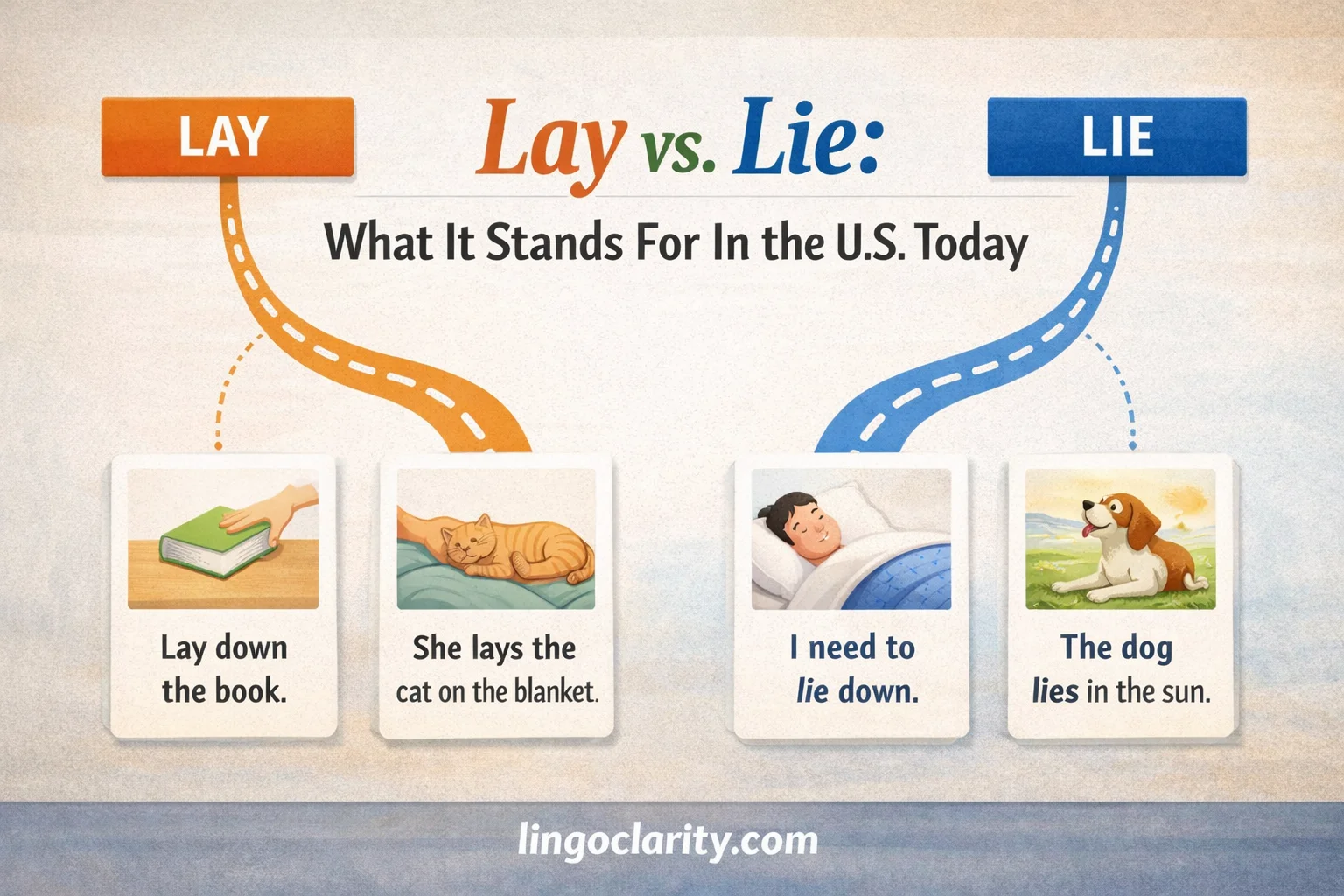
If you mean recline or rest, the standard US English choice is lie: I need to lie down. If you mean put something down, use lay: Please lay the phone on the table. The part that confuses almost everyone is that lay is also the past tense of lie, so Yesterday, I lay down for an hour is correct too. Major reference guides all point to the same core distinction: lay takes an object, and lie does not.
Quick Answer
Use lay when someone or something places an object somewhere.
Use lie when the subject rests, reclines, or is already in a flat position on its own.
That gives you these standard forms:
- Lay the files on my desk.
- I want to lie down.
- Yesterday, I lay down after lunch.
- I have lain awake half the night.
That last form, lain, is fully correct, though Cambridge notes that it can sound formal and is used less often in everyday speech than other forms in the set.
The Core Rule
The fastest way to choose the right word is to ask whether the verb has a direct object.
If someone is putting something somewhere, use lay.
If no object is being placed and the subject is simply resting, reclining, or staying flat, use lie.
Compare these two sentences:
- She laid the baby in the crib.
- The baby lay in the crib.
In the first sentence, baby is the object being placed. In the second, the baby is simply in that position. That one change flips both the grammar and the meaning. This is the same transitive-versus-intransitive distinction emphasized by Merriam-Webster, Grammarly, Purdue OWL, Cambridge, and other major grammar references.
The Verb Forms That Cause The Confusion
Most people do not struggle with the basic meanings. They struggle with the forms.
Here is the cheat sheet you actually need:
- Lay = to put or place something down
Forms: lay, laid, laid, laying - Lie = to recline, rest, or be in a flat position
Forms: lie, lay, lain, lying - Lie = to tell an untruth
Forms: lie, lied, lied, lying
That is why these are all correct:
- I lay the book on the table every night.
- Yesterday, I laid the book on the table.
- I lie down when I have a migraine.
- Yesterday, I lay down after the meeting.
- I have lain awake since 3 a.m.
- He lied about missing the deadline.
Purdue OWL, EnglishClub, ESLTeacher.org, Grammarly, and Merriam-Webster all present this three-verb contrast because it eliminates one of the most common errors: using lied when you mean reclining instead of deception.
The One-Second Test
When you are stuck, use a quick replacement test.
If put or place fits, use lay.
- Please lay the jacket on the chair.
→ Please place the jacket on the chair.
If rest, recline, or be fits, use lie.
- I need to lie down.
→ I need to rest.
This shortcut shows up in multiple strong guides because it works in real writing, not just in grammar exercises. YourDictionary uses place as a quick check, and newer SEO pages often build the same decision rule into scan-friendly memory tricks.
How To Use Lay Correctly
Use lay when someone puts, sets, arranges, or places something somewhere.
Present tense:
- Lay the charger by the laptop.
- I always lay my keys in the same bowl.
Past tense:
- She laid the contract on the conference table.
- He laid the blanket over the chair.
Past participle:
- We have laid the groundwork for the launch.
- The crew had laid the cables before dawn.
Progressive form:
- She is laying the folders out by department.
- They were laying tile in the kitchen all afternoon.
Notice the pattern: lay nearly always answers the question lay what? If you can point to the thing being placed, you are probably using lay correctly. That is the consistent rule across Merriam-Webster, Grammarly, Cambridge, Grammarist, and Britannica-style usage explanations.
How To Use Lie Correctly
Use lie when the subject rests, reclines, remains flat, or is situated somewhere without an object being placed.
Present tense:
- I want to lie down for twenty minutes.
- The dog usually lies by the window.
Past tense:
- After the flight, I lay on the hotel bed and stared at the ceiling.
- The towels lay untouched in the dryer.
Past participle:
- I have lain awake worrying about that email.
- The reports had lain unopened on his desk for days.
Progressive form:
- He is lying on the couch.
- The papers are lying under the chair.
You can also use lie to mean be located or remain situated:
- The town lies just north of the river.
- The problem lies in the timing, not the budget.
Cambridge, Grammarly, and EnglishClub all note that this reclining/location verb stays intransitive. It does not take a direct object.
Common Mistakes To Avoid
The most common error is using lay as the default word any time someone reclines.
Wrong: I’m going to lay down.
Standard edited US English: I’m going to lie down.
Wrong: She was laying on the beach.
Standard edited US English: She was lying on the beach.
Wrong: Yesterday, I laid on the couch all day.
Standard edited US English: Yesterday, I lay on the couch all day.
Wrong: I lied down after dinner.
Standard edited US English: I lay down after dinner.
Wrong: I have laid here since noon.
Standard edited US English: I have lain here since noon.
The logic behind each correction is simple once you isolate the verb family. Laid belongs to lay meaning place something. Lay is the past tense of lie meaning recline. Lied belongs only to lie meaning tell an untruth. Cambridge explicitly marks forms like I lied on the grass and the cat lays on the bed as errors, while Purdue OWL gives contrastive examples such as lay out my clothes versus lie down to rest.
Real Examples That Make The Difference Obvious
These pairs are useful because they change only one piece of grammar at a time.
- Lay the baby down gently.
The baby is now lying in the crib. - She laid the menu on the counter.
The menu lay open there all afternoon. - Please lay the towels by the pool.
We lay in the sun until sunset. - He is laying the tools on the bench.
He is lying under the car. - They had laid the documents in order before the meeting.
The documents had lain untouched for weeks before that.
These examples show why the issue is not just vocabulary. It is sentence structure. One version describes an action done to something. The other describes the position or state of the subject. That is exactly why authoritative guides keep returning to the object test.
Standard US English Vs. Casual Speech
Here is the nuance that matters in real life: many Americans do say lay down when standard edited grammar calls for lie down. Major references acknowledge that this mix-up is extremely common. Merriam-Webster even notes that speakers have struggled with the pair for centuries. But common is not the same as safest for edited writing. If you are writing for school, work, publishing, or any situation where correctness matters, lie down is the safer standard choice when no object is involved.
That means you can recognize casual speech without copying it into polished prose. In conversation, you will hear I’m gonna lay down for a bit. In careful standard US English, write I’m going to lie down for a bit. MasterClass makes the same practical distinction: everyday speech may blur the line, but formal writing still benefits from keeping the verbs straight.
A Simple Memory Trick That Actually Helps
A memory trick is useful only if it gets you to the right answer fast.
Try this:
- Lay = pLAce
- Lie = recLIne
Both patterns appear in well-performing guides because they map the sound and spelling to the meaning. Another easy reminder is this: if the verb is followed by a clear noun receiving the action, lay is often right. If the subject is simply resting, lie is often right.
Why “Lain” Feels Harder Than It Is
Many writers avoid lain because it sounds formal or old-fashioned. That feeling is understandable. Cambridge explicitly notes that the form can sound very formal and is used less often in everyday speech. But in standard grammar, it is still the correct past participle of lie meaning recline.
So these are correct:
- I have lain awake all night.
- She had lain on the sofa until noon.
- The package had lain in the hallway for two days.
In casual conversation, many people will rephrase to avoid it: I’ve been awake all night instead of I’ve lain awake all night. That is a style choice, not a grammar problem.
FAQ
Is “lay down” ever correct?
Yes. It is correct when lay means place something down, as in Lay down the folder. It is also correct when lay is the past tense of lie, as in Yesterday, I lay down early. What is usually nonstandard in edited writing is using lay down as a present-tense substitute for lie down when no object is involved.
Why is “I lay down for an hour” correct, but “I need to lay down” usually is not?
Because the first sentence is in the past tense. Lay there is the past tense of lie meaning recline. In the second sentence, you need the base form for the reclining verb, which is lie. So the standard form is I need to lie down.
Is “I’m laying on the couch” wrong?
In standard edited US English, yes, if you mean reclining. The standard form is I’m lying on the couch. Laying is for placing something: I’m laying the books on the shelf.
Is “lied down” ever correct?
Not when you mean resting or reclining. In that meaning, the past tense is lay, not lied. Lied belongs to the separate verb lie meaning tell an untruth.
Do Americans say “lay down” in casual speech?
Yes, many do. Major references acknowledge that the pair has been widely confused for a very long time, and informal speech often blurs the distinction. But if your goal is careful, standard US English, especially in edited writing, use lie down when no object is involved.
Do I really need to use “lain”?
If you are writing carefully and the grammar calls for the past participle of lie, then yes, lain is the correct form: I have lain awake. In conversation, many people rephrase to avoid it because it sounds formal, but the form itself is standard and correct.
Bottom Line
If something is being placed, use lay.
If the subject is resting, reclining, or already flat on its own, use lie.
Then remember the tense trap:
- lay / laid / laid = place something
- lie / lay / lain = recline
- lie / lied / lied = tell an untruth
That is the whole system. Once you separate the meanings and stop treating lay as the default choice for every “down” sentence, the confusion drops fast. In polished US English, write lie down in the present, lay down in the past, and have lain in the perfect tenses. That is the clearest, safest, and most publishable standard.
