
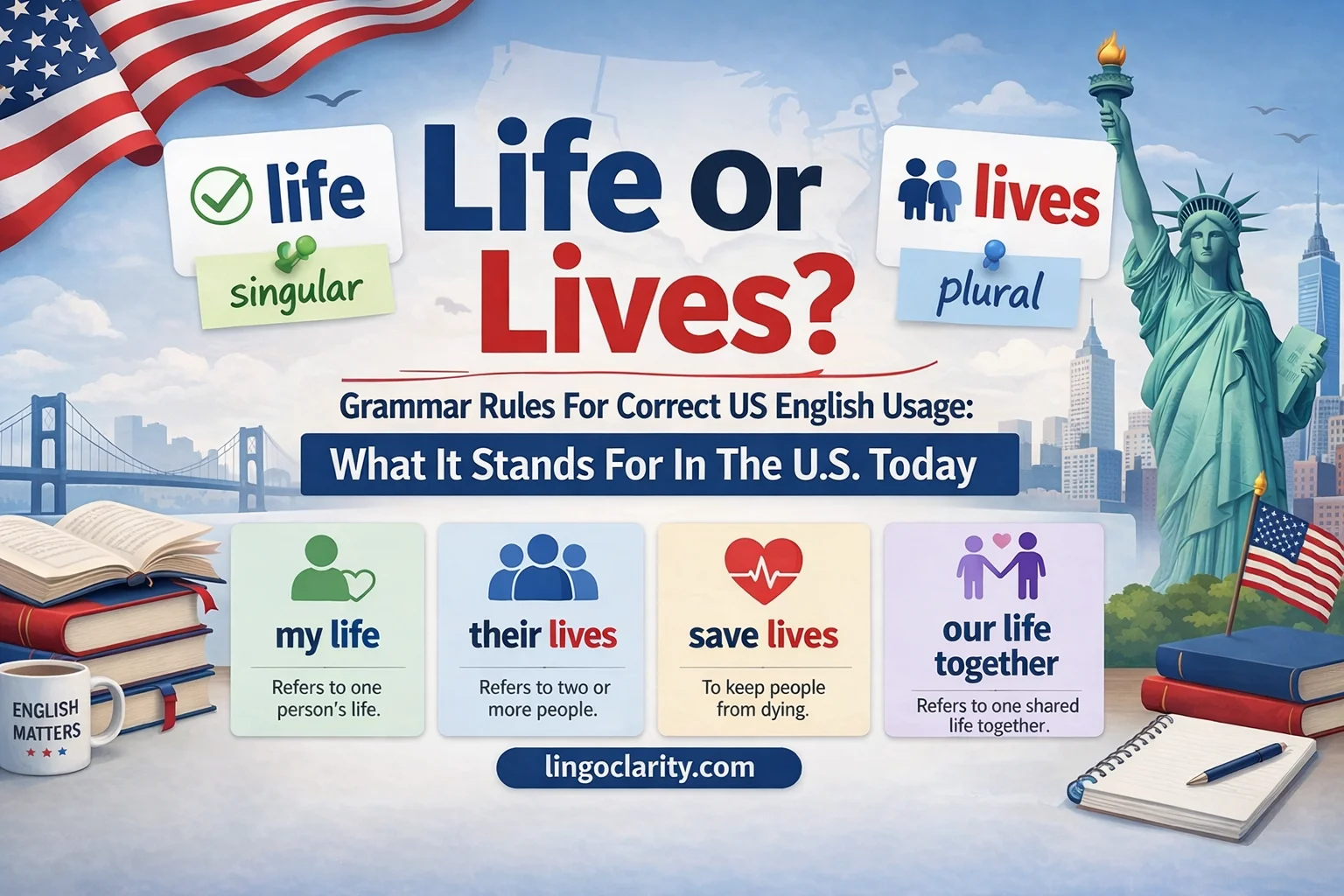
Many writers pause over life and lives because the choice looks small, but the meaning changes fast. In most cases, the rule is simple: life is singular, and lives is plural.
However, English adds one small twist. Sometimes life does not mean one separate person’s existence. Instead, it means a general condition, a shared experience, or a way of living. When that happens, singular life can still be correct, even in a sentence that mentions more than one person.
That is why this topic can feel harder than it first appears.
The good news is that standard US English follows a clear pattern. Once you know the core rule, the most common mistakes become easy to fix. This guide explains the difference in plain language, shows when each form works, and points out the few cases where both forms can be correct but mean different things.
Quick Answer
Use life when you mean:
• one person’s or one animal’s life
• life in a general sense
• a shared or collective way of living
Use lives when you mean:
• more than one separate life
• multiple people or animals as individuals
• clearly countable existences
So write:
• My life changed after college.
• The accident changed many lives.
• They built a new life together.
• The storm put hundreds of lives at risk.
The safest rule is this: if you can count separate people or separate beings, lives is usually the right choice.
Simple Definition
Here is the clearest way to understand the pair:
• Life = the singular form
• Lives = the plural form
Examples:
• one life
• two lives
• a difficult life
• many lives were affected
So the grammar issue is mainly about number. You are choosing between one and more than one.
Still, meaning matters too. The word life can be concrete or abstract. It can refer to one person’s existence, but it can also refer to human existence in general, daily experience, or a shared life as a unit. That is where writers need to slow down and think about meaning, not just counting.
What Is The Core Grammar Rule?
The core rule is straightforward:
• Use life for singular meaning.
• Use lives for plural meaning.
This is an irregular plural. English does not form the plural as lifes. The standard plural is lives.
Examples:
• He risked his life.
• The rescue team saved three lives.
This pattern works like other words that change f or fe to ves:
• wife → wives
• knife → knives
• leaf → leaves
So if you are ever tempted to write lifes, stop there. That form is not standard in US English.
When To Use Life
Use life when the sentence refers to one life, one person’s experience, or life as a broad idea.
Examples:
• Her life changed after the promotion.
• I want a quieter life.
• City life moves fast.
• Human life is precious.
• This was the best day of my life.
In each sentence, life stays singular because the meaning is singular or general.
You should also use life in many fixed expressions and common phrases:
• real life
• daily life
• work life
• student life
• family life
• private life
• life story
• life lesson
• life insurance
• quality of life
These phrases usually treat life as a broad concept, not as a countable noun.
For example:
• College can shape student life in major ways.
• Good parks improve city life.
• She keeps her private life off social media.
In these cases, life means a type of living or a general sphere of experience.
When To Use Lives
Use lives when you mean multiple separate people, animals, or beings.
Examples:
• The firefighters saved several lives.
• Wars destroy countless lives.
• Their lives changed after the move.
• Cats are said to have nine lives.
• Doctors work every day to protect lives.
This is the form you want when the sentence clearly points to individuals.
Here is a quick test. If you can replace the noun with people, persons, or individuals and the sentence still points to separate beings, lives is usually right.
For example:
• The policy affected workers’ lives.
• The flood disrupted thousands of lives.
These sentences focus on many separate people, so plural lives is the natural choice.
When Both Can Work But Mean Different Things
This is the part that causes most of the confusion.
Sometimes both life and lives can appear near plural people, but the meaning changes.
Compare these:
• The couple built a new life together.
• The divorce changed their lives.
In the first sentence, life means one shared life as a couple. In the second, lives means each person’s separate experience.
Here are more examples:
• The newlyweds are starting their life together in Chicago.
• The newlyweds know marriage will change their lives.
Again, life points to one shared unit. Lives points to two individual people.
Another useful contrast:
• School shapes student life.
• School shapes students’ lives.
The first sentence sounds general and collective. It talks about student life as a category or experience. The second sounds more personal and specific. It highlights actual students as individuals.
That distinction matters in good writing. If your point is broad, life may fit. If your point is personal and concrete, lives is usually stronger.
Why Lives Is Often Better In Real-World Writing
In everyday US English, plural lives is often the clearer choice when real people are affected.
Compare these:
• The program improved workers’ life.
• The program improved workers’ lives.
The second sentence is much better for most readers. It is more natural, more precise, and easier to understand.
The same is true here:
• Technology affects our life in many ways.
• Technology affects our lives in many ways.
The second version is the stronger everyday choice because it clearly refers to individual people.
So while singular life can sometimes work in abstract or collective meaning, lives is usually the safer form when you are writing about actual people and their experiences.
Real-Life Example
Imagine a local news report after a major storm.
A weak sentence might say:
• The storm changed many life.
That is incorrect because many requires a plural noun.
The correct sentence is:
• The storm changed many lives.
Now imagine a different sentence in a broader article:
• The storm changed daily life across the city.
This time, life is correct because the writer is not counting separate people. The sentence means daily living in general.
That is the difference in action:
• many lives = individual people
• daily life = general living conditions
Once you see that contrast, the rule becomes much easier.
Sentence Usage
Here are correct sentence patterns you can use as models.
With Life
• My life feels calmer now.
• She risked her life to save the child.
• Country life is quieter than city life.
• Retirement gave him a new life.
• Human life should always be treated with dignity.
With Lives
• Nurses save lives every day.
• The crash took two lives.
• Their lives improved after they moved.
• Social workers help rebuild lives after a crisis.
• The reform could affect millions of lives.
Where Meaning Changes
• They started a new life together.
• The experience changed their lives forever.
• Campus rules shape student life.
• Good teachers shape students’ lives.
These pairs show the grammar clearly and also show the shift in meaning.
Common Mistakes
Writers usually make the same few errors with this word pair.
1. Using Life After A Plural Word
Wrong:
• many life
• several life
• three life
Correct:
• many lives
• several lives
• three lives
If a number or plural marker comes before the noun, you almost always need lives.
2. Writing Lifes
Wrong:
• The game gives you extra lifes.
Correct:
• The game gives you extra lives.
Lifes is not the standard plural form.
3. Using Singular Life When Individuals Are Clearly Meant
Weak or less natural:
• The policy improved employees’ life.
Better:
• The policy improved employees’ lives.
When separate people are the focus, plural lives is stronger.
4. Confusing The Noun Lives With The Verb Lives
This mistake is common because lives has two jobs in English.
As a noun:
• The paramedics saved lives.
As a verb:
• She lives in Texas.
So always check what the word is doing in the sentence. Is it naming more than one life, or is it acting as the verb form of live?
Synonyms
These words are not perfect replacements in every sentence, but they can help you understand meaning.
For life, possible synonyms include:
• existence
• living
• lifetime
• way of life
• experience
Examples:
• She lived a hard life.
• She lived a hard existence.
• City life is expensive.
• Urban living is expensive.
For lives, possible context-based alternatives include:
• people
• persons
• human beings
• individuals
• existences
Examples:
• The medicine saved many lives.
• The medicine saved many people.
Still, remember this: life and lives are often the best and most natural choices. A synonym can help explain meaning, but it does not always replace the original word smoothly.
Opposites
There is no single opposite that fits every use of life or lives, but these words often act as contrasts depending on context:
• death
• deaths
• lifelessness
• destruction
Examples:
• The doctor fought to save life, not cause death.
• The rescue reduced injuries and prevented deaths.
In grammar terms, though, the real question is usually not about opposites. It is about singular versus plural meaning.
A Quick Comparison Table
| Form | Use It When | Example |
|---|---|---|
| life | one life or a general idea of living | My life changed. |
| lives | more than one separate life | The accident changed many lives. |
| life | a shared or collective experience | They built a new life together. |
| lives | individual people are the focus | Marriage changed their lives. |
How To Choose Fast
When you are editing, ask yourself these three questions:
• Am I talking about one life? Use life.
• Am I talking about more than one separate life? Use lives.
• Am I talking about a shared, general, or collective experience? Life may be correct.
That quick check will solve most cases in seconds.
Usage Notes For Clear US English
In clear US writing, choose the form that matches the meaning you actually want.
Use life when the idea is singular, broad, or shared.
Use lives when the sentence points to real people as separate individuals.
If you are unsure, plural lives is usually the safer choice when multiple people are involved. It sounds more natural and gives readers a clearer picture.
That is especially true in:
• academic writing
• workplace writing
• journalism
• public messages
• healthcare and safety writing
For example:
• The initiative improved the lives of veterans.
• The treatment saved lives.
• The scholarship changed students’ lives.
These all sound direct, specific, and professional.
FAQ
Which is correct: “life” or “lives”?
Both are correct. Use life for singular meaning or a general idea, and use lives for more than one separate life.
Is “lifes” ever correct?
No. Standard US English uses lives as the plural of life.
Can “their life” ever be correct?
Yes, but only when the meaning is singular or shared. For example, their life together is correct because it refers to one shared life. When you mean two or more individual experiences, use their lives.
Why does “lives” seem confusing?
Because lives can be either a plural noun or a verb. In They saved lives, it is a noun. In She lives nearby, it is a verb.
Should I write “changed my life” or “changed my lives”?
Write changed my life in normal usage. One person usually has one life. The plural form would only appear in unusual figurative writing.
Which is better: “student life” or “students’ lives”?
Both can be correct, but they mean different things. Student life is broad and general. Students’ lives focuses on individual students.
Is this mainly a grammar issue or a spelling issue?
It is mainly a grammar issue about singular and plural noun choice. However, many people notice it as a spelling problem because the plural form is irregular.
Conclusion
The main rule is simple: use life for one and lives for more than one.
That will solve most sentences right away.
The only nuance is that singular life can still be correct when it refers to a general condition, a way of living, or one shared experience. That is why phrases like student life, daily life, and their life together work.
Still, when your sentence clearly points to individual people, choose lives. It is more precise, more natural, and easier for readers to understand.
So if you are deciding fast, remember this:
• one life = life
• many separate people = lives
• one shared or general experience = often life
That choice will keep your grammar clean, natural, and correct in modern US English.
