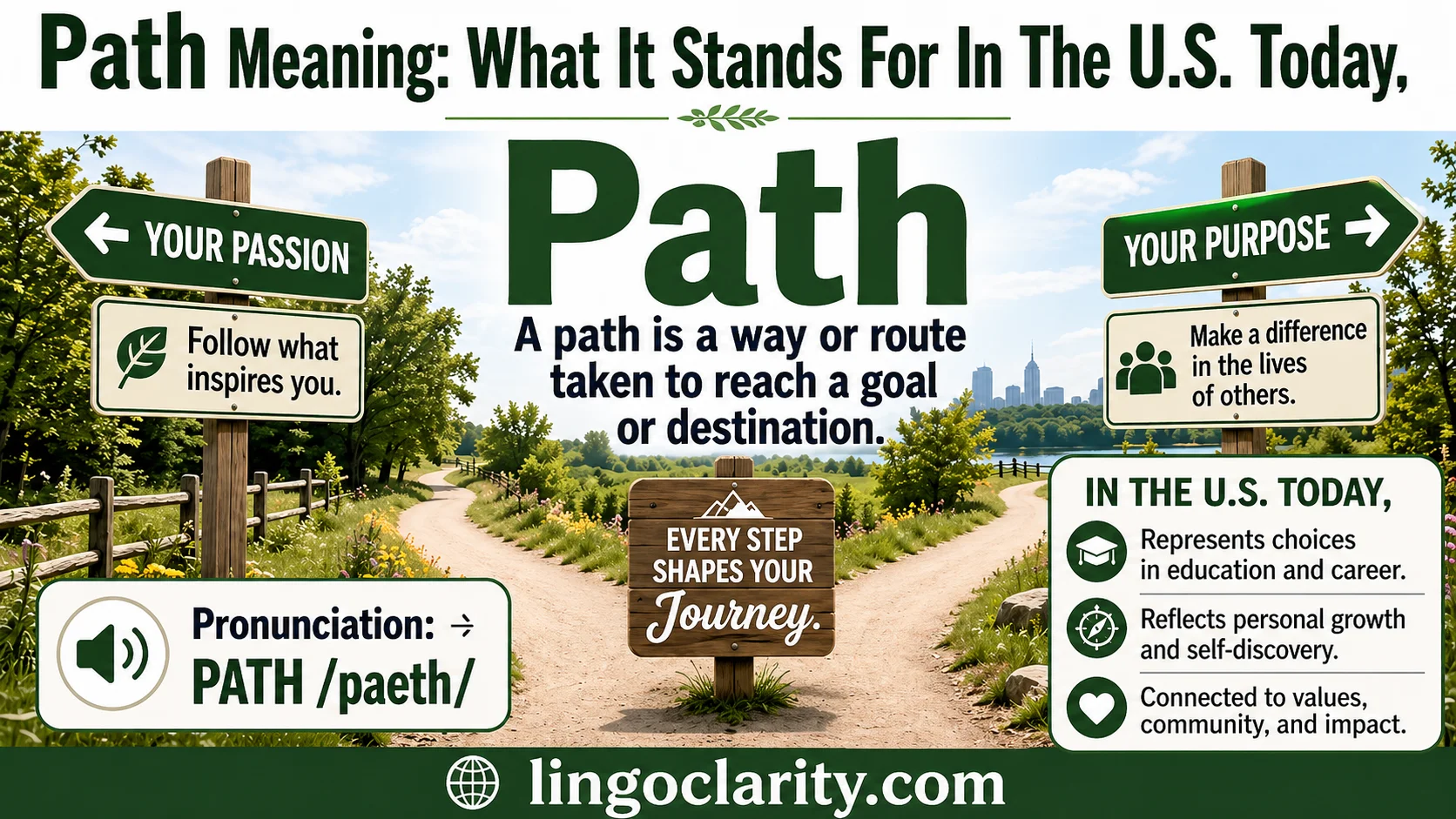
The word path means a way, route, track, or course that someone or something follows. It can describe a real place, such as a narrow trail through a park. However, it can also describe movement, progress, or a life direction.
For example, a person can walk along a garden path, a storm can follow a dangerous course, and a student can choose a career direction. Therefore, the meaning depends on context, but the main idea is always about a way forward.
Quick Answer: What Does Path Mean?
A path is a way, track, route, or course that someone or something follows.
In simple English, it can mean:
- a narrow way for walking: “We followed the trail through the park.”
- the direction something moves: “The ball rolled in front of a car.”
- a course of action or life direction: “She chose a new career direction.”
However, the main idea stays the same in every use. It refers to the way someone or something goes.ing goes.
Pronunciation In UK And US English
Path is a noun.
UK pronunciation: /pɑːθ/
US pronunciation: /pæθ/
Plural: paths
In UK English, the word usually has a long “ah” sound, similar to the vowel in “father.” In US English, however, it usually has the short “a” sound, like the vowel in “cat.”
The plural form is paths. Depending on the speaker, the final sound may be soft or sharp.
Main Meaning
The word describes a way from one place to another. It can refer to a real route you can see, such as a walking trail in a park. However, it can also refer to an invisible line of movement, such as the course of a storm.
In addition, it can describe a person’s choices, progress, or direction in life. For example, a career path means the direction someone’s working life takes over time.
Therefore, the meaning can be literal or figurative.
Examples:
“The trail through the woods was muddy.”
“The hurricane’s course changed overnight.”
“She is building a new direction for her future.”
A Real Route You Can Walk On
The most common meaning is a narrow route used for walking, biking, or moving through an area.
This kind of route may be natural, like a dirt track through a field. Alternatively, it may be built, like a paved walkway in a garden or park.
Examples:
“We walked along the trail beside the lake.”
“The garden walkway leads to the front door.”
“Please stay on the marked route.”
“The kids ran down the lane after school.”
In this meaning, the word usually suggests something smaller than a road. A road is often made for cars and other vehicles, while a smaller route is often made for people, bikes, or animals.
A Direction Something Follows
The word can also mean the direction that something takes while moving. This use is common in weather reports, science, travel, and safety warnings.
Examples:
“The storm moved along a dangerous course.”
“The plane stayed on its flight route.”
“The ball rolled into the way of a car.”
“Do not stand in front of the machine.”
In these examples, the route may not be a visible walkway. Instead, it means the line, course, or direction of movement.
A Life Direction Or Course Of Action
This word is often used in a figurative way. It can describe a person’s choices, goals, work, progress, or future direction.
Examples:
“She chose a different career path.”
“College is one route to success, but it is not the only one.”
“He found a new direction after losing his job.”
“The company is moving toward steady growth.”
In this sense, the word means a way forward. Moreover, it often suggests steps, decisions, and progress over time.
How To Use It In A Sentence
Use this word when you want to talk about a route, direction, or course. Also, use it when you want to describe progress toward a goal.
Examples:
“Take the route on the left.”
“The bike lane goes around the park.”
“The hikers lost the trail near the river.”
“The rocket followed a planned course into space.”
“She wants a career path with more freedom.”
“We need a clear way to finish this project.”
“The city is moving toward major growth.”
“The dog ran across the walkway and into the grass.”
Common Phrases And Expressions
Career Direction
A career path is the direction someone’s work life takes over time.
Example:
“Her career path began in teaching and later moved into school leadership.”
Route To Success
A path to success is a way or process that may lead to success.
Example:
“Hard work, patience, and good decisions can create a route to success.”
Way Forward
A path forward means a plan or direction for making progress. As a result, people often use this phrase after a problem, delay, or disagreement.
Example:
“After the meeting, the team agreed on a way forward.”
Flight Route
A flight path is the route an aircraft follows.
Example:
“The house is near a busy flight route.”
Walking Trail
A walking path is a route made or used for walking.
Example:
“The park has a walking trail around the lake.”
Bike Lane Or Route
A bike path is a route made for bicycles.
Example:
“The city added a new bike route downtown.”
In The Way Of
In the path of means directly where something is moving.
Example:
“Several towns were in the way of the storm.”
Cross Paths
To cross paths means to meet or encounter someone, often by chance.
Example:
“We crossed paths at a conference years later.”
Off The Beaten Track
Off the beaten path means away from common, popular, or crowded places.
Example:
“They found a quiet restaurant off the beaten track.”
Clear The Way
To clear a path means to make space so someone or something can move through.
Example:
“Workers cleared the way through the snow.”
Synonyms
Good synonyms depend on the meaning. Therefore, choose the replacement word based on the sentence.
When you mean a physical route, use:
- trail
- track
- walkway
- footpath
- lane
- route
If you mean movement or direction, use:
- course
- direction
- route
- trajectory
When you mean life, work, or progress, use:
- way
- course
- approach
- direction
- route
- way forward
Examples:
“Trail” works well for hiking: “We followed the trail up the mountain.”
“Route” is useful for travel: “This is the fastest route home.”
“Course” fits movement or action: “The ship changed course.”
“Approach” is best for methods: “We need a better approach.”
Antonyms And Opposite Ideas
There is no perfect single opposite. However, some words can work as opposites or contrasts depending on the sentence.
Possible opposite ideas include:
- barrier
- blockage
- obstacle
- dead end
- detour
- obstruction
Examples:
“The fallen tree became a barrier across the trail.”
“That plan led to a dead end.”
“Traffic forced us to take a detour.”
“The wall blocked their way.”
How It Differs From Similar Words
Road
A road is usually wider and made for vehicles. By contrast, the word in this article often suggests a narrower route for walking or biking.
Examples:
“We walked through the park.”
“Cars drove quickly along the road.”
Use road for a route used by cars, buses, and trucks.
Route
A route is the way you plan or take to get from one place to another. Meanwhile, the word path can describe the actual track, direction, or course followed.
Examples:
“Our route to the cabin included a narrow trail through the woods.”
“This is the shortest route to the airport.”
Use route when focusing on travel planning.
Trail
A trail is often a natural or marked route used for hiking, biking, or outdoor travel. However, path is more general.
Examples:
“The hiking trail became steep.”
“The garden walkway was lined with flowers.”
Use trail for outdoor routes, especially in nature.
Track
A track can mean marks left behind, a racing course, or a rough route. In contrast, path usually means a way that someone or something follows.
Examples:
“Animal tracks crossed the trail.”
“The runner stayed in her lane.”
Use track for marks, racing lanes, or rough routes.
Way
Way is broader and more general. It can mean a method, direction, route, or manner of doing something. However, path is more specific and often suggests a clearer course.
Examples:
“There are many ways to learn English.”
“Daily practice is a strong route to improvement.”
Use way for a general method or direction.
Common Mistakes
Using It When Road Is Clearer
Incorrect:
“Cars were speeding down the path.”
Better:
“Cars were speeding down the road.”
Use road when you mean a vehicle route.
Using It When Plan Is Clearer
Incorrect:
“Our path is to call three clients today.”
Better:
“Our plan is to call three clients today.”
Use plan for specific actions. However, use path for a broader direction or long-term course.
Thinking There Is One Exact Opposite
Incorrect:
“The opposite of path is barrier.”
Better:
“Path has no single exact opposite. Depending on context, barrier, obstacle, blockage, or dead end may work.”
Being Too Vague
Weak:
“This is a good path.”
Better:
“This is a realistic way to finish the project on time.”
When needed, explain where the direction leads. That way, the sentence becomes clearer and more useful.
More Examples In English
“The shortcut behind the school is faster.”
“The stone walkway leads to the garden.”
“Joggers use this trail every morning.”
“The dog ran across the route.”
“The storm’s course moved closer to the coast.”
“The driver did not see the child in front of him.”
“She followed a difficult road to success.”
“He left law school and chose a creative direction.”
“The company needs a route to profitability.”
“We crossed paths at the airport.”
“Stay on the trail until you reach the bridge.”
“The new program gives students a clear route to graduation.”
Word History
Path is an old English word connected to the idea of a trodden way, track, or route. Over time, its basic meaning has stayed mostly the same.
Because of that history, the word feels simple and natural in modern English. It is not slang, technical jargon, or a trendy expression. Instead, it is a common everyday word used in speech, writing, school, work, travel, news, and literature.
FAQ
What does path mean in simple words?
A path is a way to go. It can be a physical route, such as a walking trail. However, it can also be a figurative direction, such as a career direction.
Is path a noun or a verb?
Path is mainly a noun. It names a route, track, direction, or course.
What is the plural of path?
The plural of path is paths.
What is the difference between path and road?
A path is usually narrow and often used for walking or biking. A road, however, is usually wider and made for vehicles.
What does career path mean?
A career path is the direction someone’s work life takes over time. For example, a person may start as an assistant, become a manager, and later become a director.
What does path forward mean?
A path forward is a way to make progress after a problem, delay, or decision. For example, “The team agreed on a way forward” means the team decided what to do next.
What does in the path of mean?
In the path of means directly where something is moving. For example, “The town was in the path of the storm” means the storm was moving toward or through the town.
What is another word for path?
Another word for path may be trail, route, track, walkway, course, or way, depending on the meaning.
