
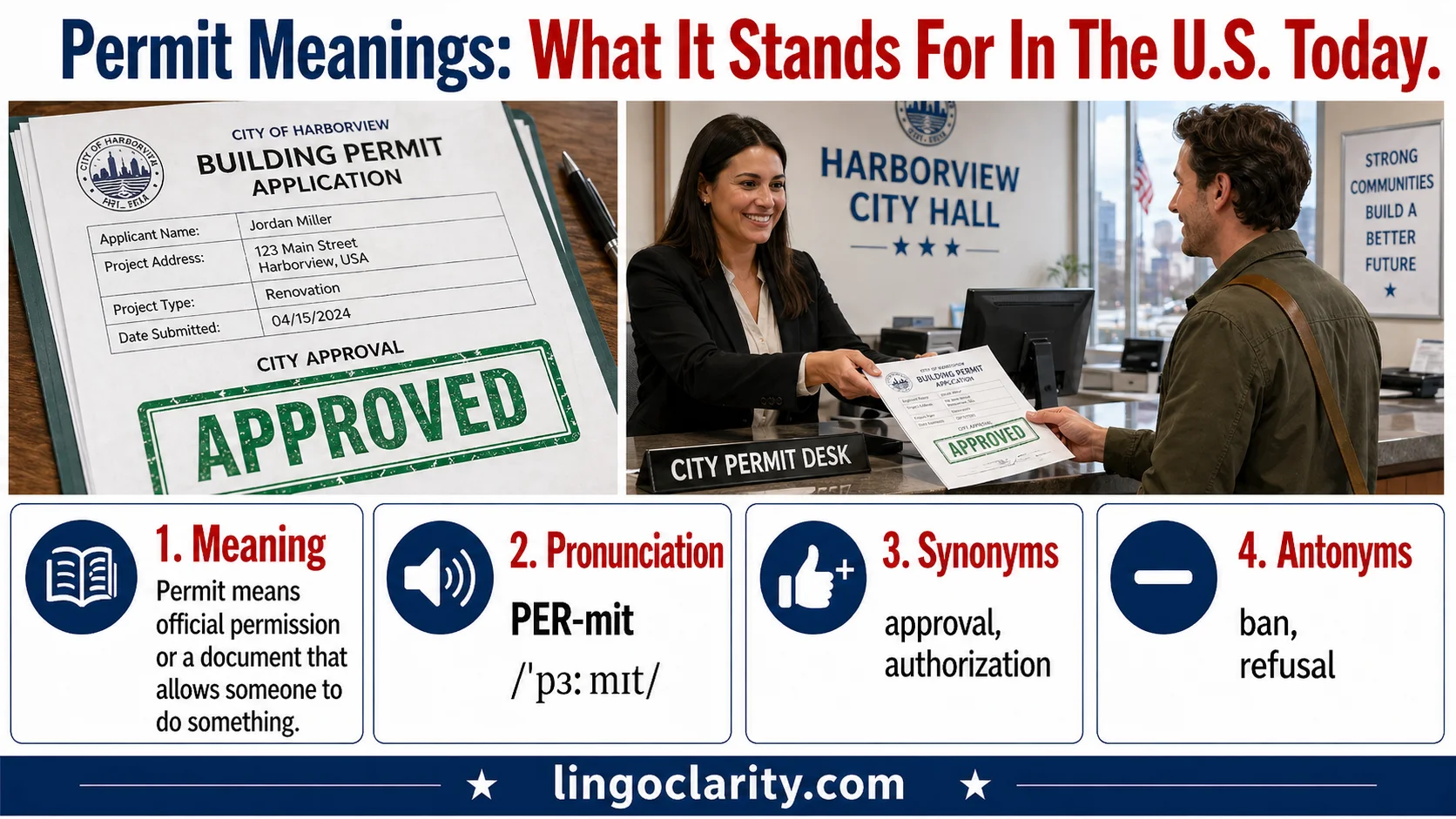
Permit has two main meanings in American English.
As a verb, permit means to allow something, approve something, or make something possible.
Example: “The school does not permit students to leave campus during lunch.”
As a noun, a permit is an official document, card, license, or record that shows someone has permission to do something.
Example: “You need a parking permit to leave your car in this lot.”
In other words, to permit means to allow, while a permit is proof that something is allowed.
What Does Permit Mean?
Permit is a common English word connected to permission, approval, rules, and authority. Most often, it describes either the act of allowing something or the official document that proves something has been allowed.
For example, when a rule says, “The park permits dogs on leashes,” the word permits means “allows.” However, when someone says, “I need a permit to park here,” the word permit means an official document or approval.
Because of this, the meaning depends on how the word is used in the sentence. If permit shows action, it is usually a verb. If it names a document, card, pass, or approval, it is usually a noun.
Permit As A Verb
As a verb, permit means to allow, to give permission, to approve, or to make something possible.
For instance, a school might permit students to bring water bottles to class. Similarly, a company might permit employees to work from home two days a week. In both examples, an authority allows something.
The verb often appears in formal or rule-based contexts. Therefore, you are more likely to see permit in policies, signs, applications, legal notices, and official instructions than in casual conversation.
Common patterns include:
| Pattern | Example | Meaning |
|---|---|---|
| permit something | “The law permits short-term rentals.” | The law allows them. |
| permit someone to do something | “The pass permits employees to enter.” | The pass gives permission. |
| be permitted to do something | “Visitors are permitted to take photos.” | Visitors are allowed. |
| if time permits | “If time permits, we’ll answer questions.” | If there is enough time. |
| weather permitting | “The event will be outside, weather permitting.” | If the weather allows it. |
As a result, permit is especially useful when permission depends on a rule, policy, condition, or official decision.
Permit As A Noun
As a noun, a permit is an official document, card, license, approval, or digital record that shows someone is allowed to do something.
For example, a parking permit allows someone to park in a specific place. Likewise, a building permit allows construction or renovation to begin. In the same way, a work permit may allow a person to work legally.
Common examples include:
Parking permit: permission to park in a specific area.
Building permit: permission to build, remodel, or renovate.
Work permit: permission to work legally.
Learner’s permit: permission for a new driver to practice driving under restrictions.
Fishing permit: permission to fish in a certain place or season.
Event permit: permission to hold a public or organized event.
Usually, a permit suggests that someone had to apply, qualify, pay a fee, pass a test, or receive approval from an authority. Therefore, it often sounds more official than simple permission.
How To Pronounce Permit
The pronunciation of permit often changes depending on whether it is used as a verb or a noun.
As a verb, the stress is usually on the second syllable: per-MIT.
Example: “The rules per-MIT guests to enter after 8 a.m.”
As a noun, the stress is usually on the first syllable: PUR-mit.
Example: “She showed her parking PUR-mit.”
This difference matters because stress can help listeners understand the meaning. In short, per-MIT usually refers to the action of allowing, while PUR-mit usually refers to the official document or approval.
Permit Vs. Permission
Although permit and permission are closely related, they are not always interchangeable.
A permit is usually a countable object, such as a document, pass, license, card, certificate, or official record.
Example: “I need a permit to park here.”
By contrast, permission is usually uncountable. It refers to the state of being allowed to do something.
Example: “I need permission to leave early.”
Therefore, do not say, “I need a permission.” Instead, say, “I need permission.”
Likewise, do not say, “I asked my teacher for a permit,” unless you mean an official document. In most everyday situations, say, “I asked my teacher for permission.”
Permit Vs. Allow Vs. Let Vs. Authorize
Permit, allow, let, and authorize all relate to permission. However, they differ in tone and context.
| Word | Tone | Best Use | Example |
|---|---|---|---|
| let | casual | Everyday speech | “My boss let me leave early.” |
| allow | neutral | General speech and writing | “The app allows users to reset passwords.” |
| permit | formal or rule-based | Policies, laws, notices, official contexts | “The policy permits remote work on Fridays.” |
| authorize | very official | Legal, business, security, or financial approval | “Only a manager can authorize the payment.” |
For casual speech, let is usually the most natural choice.
Example: “My parents let me borrow the car.”
For neutral writing, allow often works best.
Example: “The software allows users to upload files.”
However, when the situation involves rules, signs, legal language, or official approval, permit is usually stronger.
Example: “The city permits vendors to operate with a valid license.”
Finally, use authorize when someone has formal power to approve something.
Example: “The director authorized the purchase.”
When To Use Permit In American English
Use permit when the permission feels formal, official, legal, written, rule-based, or conditional.
For example, permit sounds natural in school rules, workplace policies, government forms, public notices, safety instructions, and legal documents.
You might see or hear sentences such as:
“The school permits students to bring water bottles.”
“The company permits hybrid work two days a week.”
“The city requires a permit before construction begins.”
“Permit parking only.”
“No entry is permitted beyond this point.”
“The festival needs an event permit.”
“She applied for a temporary work permit.”
“Weather permitting, the game will begin at noon.”
In casual conversation, however, permit may sound too stiff. For instance, “My friend permitted me to use his phone” is grammatically correct, but most Americans would say, “My friend let me use his phone.”
Common Phrases With Permit
Several common phrases use permit in everyday American English. Because many of these phrases appear in official contexts, they are useful for school, work, travel, driving, housing, and government paperwork.
Building Permit
A building permit is official approval to build, remodel, or make certain structural changes.
Example: “The contractor cannot begin until the building permit is approved.”
Parking Permit
A parking permit allows someone to park in a specific place.
Example: “Students must display a parking permit on campus.”
Work Permit
A work permit gives official approval to work.
Example: “She received her work permit before starting the job.”
Learner’s Permit
A learner’s permit allows a new driver to practice driving under certain restrictions.
Example: “He got his learner’s permit before taking driving lessons.”
Fishing Permit
A fishing permit gives permission to fish in a certain area.
Example: “You need a fishing permit for this lake.”
Permit Application
A permit application is a form used to request a permit.
Example: “The permit application must include proof of insurance.”
Permit Holder
A permit holder is the person or organization that has the permit.
Example: “The permit holder must follow all safety rules.”
Permit Required
This phrase means official permission is needed.
Example: “The sign says permit required after 6 p.m.”
Permit Me To
This formal phrase means “allow me to.”
Example: “Permit me to explain the situation.”
Weather Permitting
This means “if the weather allows it.”
Example: “We will eat outside, weather permitting.”
If Time Permits
This means “if there is enough time.”
Example: “If time permits, we will review the final section.”
Clear Examples Of Permit As A Verb
The following examples show permit as a verb. In each sentence, it means “allow” or “make possible.”
“The rules permit one guest per member.”
“The museum permits photography but does not permit flash.”
“The software permits users to download reports.”
“The policy permits employees to work remotely on Fridays.”
“Local law permits food trucks in this area.”
“The teacher permitted the students to leave five minutes early.”
“The new ramp permits easier access to the entrance.”
“If my schedule permits, I’ll call you after lunch.”
“Weather permitting, the ceremony will be held outdoors.”
“Only trained staff are permitted to enter the storage room.”
As these examples show, permit often sounds formal. Therefore, it works especially well when the sentence sounds like a rule, policy, notice, or official decision.
Clear Examples Of Permit As A Noun
The following examples show permit as a noun. In each case, it refers to a document, approval, pass, or official record.
“She applied for a parking permit.”
“The city issued a permit for the renovation.”
“Your permit expires at the end of the month.”
“He showed his learner’s permit to the driving instructor.”
“The company helped him renew his work permit.”
“You cannot park here without a permit.”
“The event permit must be approved before tickets go on sale.”
“The permit holder is responsible for following the rules.”
“The restaurant needs a permit to serve food outdoors.”
“The construction crew posted the building permit near the entrance.”
In these examples, permit names something official. As a result, it is different from the general idea of permission.
Common Mistakes With Permit
Even advanced English learners sometimes misuse permit. Fortunately, the most common mistakes are easy to fix.
Mistake 1: Using Permit When Permission Is Better
Incorrect: “I need a permit to use your pen.”
Correct: “I need permission to use your pen.”
Use permit when you mean an official document or approval. However, use permission when you simply mean being allowed.
Mistake 2: Using Let In Passive Voice
Awkward: “Students are let to leave early.”
Correct: “Students are allowed to leave early.”
Correct: “Students are permitted to leave early.”
In English, permit and allow work naturally in passive voice. By contrast, let usually does not.
Mistake 3: Choosing Permit For Very Casual Speech
Stiff: “My sister permitted me to borrow her sweater.”
Natural: “My sister let me borrow her sweater.”
Although the first sentence is grammatically correct, it sounds too formal for everyday conversation.
Mistake 4: Confusing Permit And License
A permit often gives approval for a specific activity, place, time, or project. A license, however, often gives broader or continuing legal authority.
For example, a building permit may allow one construction project. Meanwhile, a contractor’s license may show that a person or business is legally qualified to do contracting work.
The words can overlap, but they are not always identical.
Mistake 5: Missing The Pronunciation Shift
For the verb, say per-MIT.
For the noun, say PUR-mit.
This shift is common in English noun-verb pairs. Therefore, learning the stress pattern can make your speech clearer.
Synonyms Of Permit
The best synonym for permit depends on meaning and tone.
For the verb permit, common synonyms include:
Allow
Authorize
Approve
Let
Enable
Consent to
Make possible
Give permission for
However, these words are not identical. Let is casual. Allow is neutral. Permit is formal or rule-based. Authorize is very official.
For the noun permit, possible alternatives include:
License
Authorization
Pass
Certificate
Written approval
Official approval
Clearance
Again, the best choice depends on context. For example, a parking permit is not always the same as a license, and a security clearance is not usually called a permit.
Antonyms Of Permit
For the verb permit, common opposites include:
Forbid
Ban
Prohibit
Deny
Disallow
Refuse
Block
Prevent
For example:
“The policy permits remote work on Fridays.”
“The policy prohibits remote work on Fridays.”
For the noun permit, there is no single perfect opposite. Depending on the situation, you might use:
Denial
Refusal
Rejection
Revocation
Suspension
Cancellation
For example:
“Her permit was approved.”
“Her permit was denied.”
“His permit was revoked after repeated violations.”
Word Forms Related To Permit
Several related words come from the same word family. Understanding them can help you use permit more accurately.
Permit
Verb or noun.
Example: “The rules permit visitors.” / “You need a permit.”
Permitted
Past tense or adjective meaning allowed.
Example: “Only permitted items may be brought inside.”
Permitting
Present participle.
Example: “Weather permitting, we will start at noon.”
Permission
The state of being allowed.
Example: “You need permission to enter.”
Permissible
Allowed under rules or standards.
Example: “That behavior is not permissible.”
Permissive
Too willing to allow behavior, often with few limits.
Example: “The policy was criticized as too permissive.”
Word Origin Of Permit
Permit comes from older forms connected to the idea of letting something pass or go through. This history fits the modern meaning well because permission often means allowing something to move from “not allowed” to “allowed.”
However, you do not need to know the word origin to use permit correctly. In modern English, the most important point is simple: as a verb, permit means “allow,” and as a noun, a permit is official proof of permission.
Usage Table
| Situation | Natural Sentence | Why Permit Fits |
|---|---|---|
| Workplace policy | “The company permits remote work twice a week.” | Formal policy language. |
| School rule | “Students are not permitted in the lab without supervision.” | Rule-based restriction. |
| Parking | “A permit is required to park here.” | Official approval. |
| Construction | “The city issued a building permit.” | Government approval. |
| Schedule | “If time permits, we’ll take questions.” | Means “if time allows.” |
| Weather | “The picnic will be outside, weather permitting.” | Means “if the weather allows.” |
| Casual speech | “My dad let me use the car.” | Let sounds more natural than permit. |
| Legal notice | “No entry is permitted on the property.” | Formal, official wording. |
Frequently Asked Questions
What does permit mean?
Permit means to allow, approve, or make something possible when used as a verb. As a noun, a permit is an official document, card, license, or record that shows permission.
Is permit a noun or a verb?
Permit can be both. In “The rules permit guests,” it is a verb. In “You need a parking permit,” it is a noun.
How do you pronounce permit?
As a verb, permit is usually pronounced per-MIT, with stress on the second syllable. As a noun, it is usually pronounced PUR-mit, with stress on the first syllable.
What is the difference between permit and permission?
A permit is usually a document or official approval. Permission is the state of being allowed. Therefore, say “I need permission to leave,” but “I need a permit to park here.”
What is the difference between permit and allow?
Permit is more formal and often appears in rules, policies, signs, and official contexts. Allow is more neutral and works in both everyday and formal writing.
What is the difference between permit and let?
Let is more casual. Permit is more formal. For example, “My parents let me go” sounds natural in conversation, while “The policy permits students to leave early” sounds natural in a rule or official notice.
What is an example of permit in a sentence?
As a verb: “The museum permits photos but not flash photography.”
As a noun: “You need a permit to park in that garage.”
Does a permit always mean legal permission?
Not always. However, it often suggests official or rule-based permission from a government office, school, employer, property owner, event organizer, or other authority.
What does weather permitting mean?
Weather permitting means “if the weather allows it.” For example, “The game will be played outside, weather permitting” means the game will be outside if the weather is good enough.
What does if time permits mean?
If time permits means “if there is enough time.” For example, “If time permits, we will review the last chapter” means the review will happen only if time is available.
Final Takeaway
Permit is a practical word for permission, rules, approval, and official documents. As a verb, it means to allow or make possible. As a noun, it means an official document or approval that shows someone is allowed to do something.
In general, use permit when the situation sounds formal, official, legal, written, or rule-based. Use let for casual speech and allow for a more neutral tone. Finally, remember the pronunciation difference: per-MIT for the verb and PUR-mit for the noun.
