
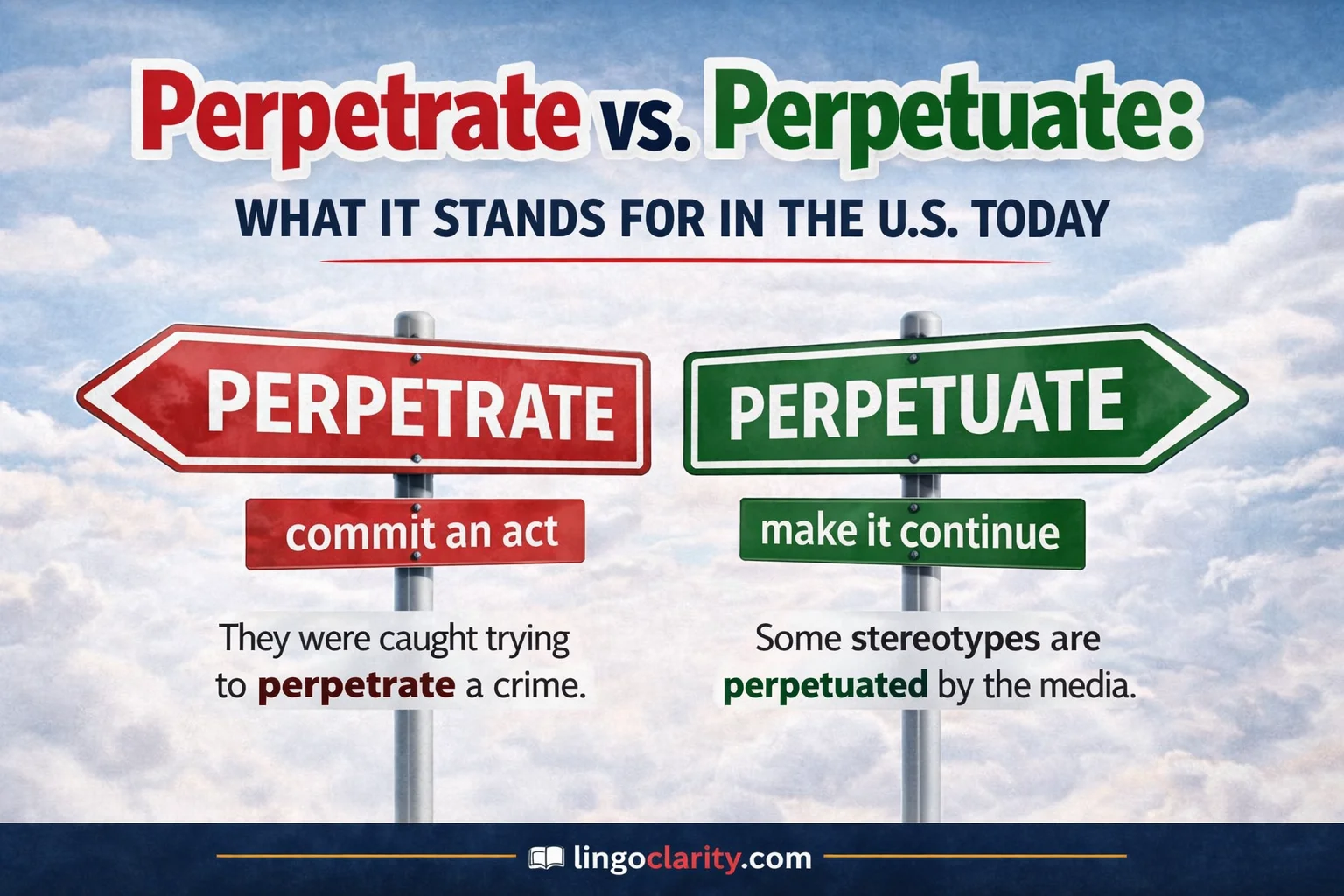
Perpetrate vs. Perpetuate is a common English word confusion because both verbs look similar, sound alike, and often appear in formal writing. However, they have completely different meanings and cannot be used interchangeably.
The simplest difference is:
- Perpetrate means to commit or carry out an action, usually something harmful, illegal, or deceptive.
- Perpetuate means to make something continue over time.
For example:
- A criminal can perpetrate a crime.
- A rumor can perpetuate misinformation.
The first example focuses on the person who performs an action, while the second focuses on something that continues or spreads. Understanding this difference helps you choose the right word in professional, academic, and everyday writing.
Perpetrate vs. Perpetuate: Quick Answer
Use perpetrate when you mean to commit or carry out an act, especially a crime, scam, deception, or harmful action.
Examples:
- perpetrate a robbery
- perpetrate fraud
- perpetrate a scam
- perpetrate a hoax
Use perpetuate when you mean to cause something to continue, remain, or last longer.
Examples:
- perpetuate a myth
- perpetuate a stereotype
- perpetuate a tradition
- perpetuate confusion
A simple memory trick:
- You perpetrate an act.
- You perpetuate a pattern.
Or:
- Perpetrate = commit
- Perpetuate = continue
Why People Confuse Perpetrate and Perpetuate
The confusion between these words is understandable. Both begin with perp-, both contain similar sounds, and both are commonly used in formal or serious discussions.
However, their meanings developed in different directions.
Perpetrate is connected with performing or carrying out an action. In modern English, it is most often associated with crimes, wrongdoing, or deception.
Perpetuate is connected with continuation. It describes something that keeps an idea, condition, belief, or situation alive over time.
Compare:
- The criminals perpetrated the fraud.
- The false information perpetuated the fraud for years.
The first sentence describes the action itself. The second describes what allowed the situation to continue.
Perpetrate: Meaning and Usage
Perpetrate means to commit, carry out, or perform an action. In modern American English, it is usually used for negative actions such as crimes, scams, violence, deception, or wrongdoing.
Examples:
- The suspect was accused of perpetrating a robbery.
- The company allegedly perpetrated financial fraud.
- Criminals used fake websites to perpetrate scams.
- The group was responsible for perpetrating violence.
In these sentences, the focus is on the person or group responsible for carrying out the action.
The related noun perpetrator follows the same idea:
- The police identified the perpetrator of the crime.
A perpetrator is the person who commits an act, which makes it easier to remember the connection:
Perpetrator → Perpetrate → Commit an action
Can Perpetrate Be Used for Something Funny?
Yes. Although perpetrate is usually connected with serious wrongdoing, it can sometimes be used humorously for harmless actions.
Examples:
- Who perpetrated that terrible joke?
- Someone perpetrated another embarrassing office prank.
The humor comes from treating a small mistake or silly action as if it were a serious offense.
Perpetuate: Meaning and Usage
Perpetuate means to cause something to continue, remain, or last over time. Unlike perpetrate, which focuses on the person who performs an action, perpetuate focuses on the continuation of an idea, condition, belief, or situation.
The word is commonly used with:
- myths
- stereotypes
- traditions
- misinformation
- problems
- systems
- beliefs
- cycles
Examples:
- The article unintentionally perpetuates a myth about success.
- Repeating false claims can perpetuate misinformation.
- Certain policies may perpetuate inequality.
- Families often perpetuate traditions across generations.
In each example, something is being kept alive or extended rather than directly created through a single action.
A useful memory connection is the word perpetual, which means continuing for a long time.
Perpetual → Perpetuate → Continue
Can Perpetuate Be Positive?
Yes. Many people think perpetuate always has a negative meaning because it often appears in phrases like:
- perpetuate stereotypes
- perpetuate injustice
- perpetuate misinformation
However, the basic meaning is simply to cause something to continue. It can describe positive, neutral, or negative things.
Positive examples:
- The museum works to perpetuate cultural traditions.
- The foundation was created to perpetuate her legacy.
- Teachers help perpetuate a love of learning.
Negative examples:
- False rumors can perpetuate fear.
- The article may perpetuate harmful stereotypes.
The meaning depends on what is being continued.
Perpetrate vs. Perpetuate: Key Difference
| Word | Meaning | Focus | Common Examples |
|---|---|---|---|
| Perpetrate | To commit or carry out an action | The person doing something | perpetrate a crime, fraud, scam |
| Perpetuate | To cause something to continue | The thing being maintained | perpetuate a myth, tradition, belief |
Simple comparison:
- Criminals perpetrate crimes.
- Rumors perpetuate confusion.
- A person perpetrates an act.
- A pattern perpetuates itself.
Perpetrate vs. Perpetuate Examples
Crime Example
Incorrect: The thief perpetuated the robbery.
Correct: The thief perpetrated the robbery.
Why? The thief performed the criminal action.
Rumor Example
Incorrect: Social media users perpetrated the rumor.
Better: Social media users perpetuated the rumor.
Why? They helped the rumor continue spreading.
Fraud Example
Both words can appear with fraud, but the meaning changes.
- The criminals perpetrated the fraud by creating fake documents. → They committed the fraud.
- Poor oversight perpetuated the fraud for several years. → It allowed the fraud to continue.
This is the main difference between the two verbs.
Common Uses of Perpetrate
Perpetrate is commonly paired with actions that involve wrongdoing.
Common phrases:
- perpetrate a crime
- perpetrate fraud
- perpetrate a scam
- perpetrate an attack
- perpetrate violence
- perpetrate abuse
- perpetrate a hoax
Examples:
- The suspects allegedly perpetrated a financial scam.
- The attackers perpetrated violence against innocent people.
- Someone perpetrated a fake story online.
The related noun is perpetrator:
- Police identified the perpetrator of the crime.
A perpetrator is the person who commits an action, which makes the connection easy:
Perpetrator → Perpetrate → Commit
Common Uses of Perpetuate
Perpetuate is commonly paired with things that continue over time.
Common phrases:
- perpetuate a myth
- perpetuate a stereotype
- perpetuate misinformation
- perpetuate a cycle
- perpetuate inequality
- perpetuate tradition
- perpetuate a legacy
Examples:
- The advertisement may perpetuate stereotypes.
- The story helped perpetuate a false belief.
- The organization works to perpetuate local traditions.
The focus is always continuation.
Common Mistakes to Avoid
Mistake 1: Using Perpetrate With Stereotypes
Wrong: The movie perpetrates a stereotype.
Better: The movie perpetuates a stereotype.
A stereotype is maintained or reinforced, not committed.
Mistake 2: Using Perpetuate for Crimes
Wrong: The criminal perpetuated the robbery.
Correct: The criminal perpetrated the robbery.
The criminal carried out the action.
Mistake 3: Thinking Perpetuate Is Always Negative
Wrong idea: Perpetuate always means something harmful.
Correct: Perpetuate means to continue something.
Examples:
- The family perpetuated a tradition. ✅
- The rumor perpetuated confusion. ✅
A Simple Memory Rule
When choosing between these words, ask:
Is someone doing something? Use perpetrate.
- Example: They perpetrated a crime.
Is something continuing over time? Use perpetuate.
- Example: The belief perpetuated fear.
The shortest rule:
- Perpetrate = Commit
- Perpetuate = Continue
Pronunciation Guide: Perpetrate vs. Perpetuate
Pronunciation can help you separate these two words mentally.
Perpetrate
Pronounced: PER-puh-trayt
Meaning: To commit or carry out an action, usually something harmful or illegal.
Example: The suspect perpetrated the crime.
Perpetuate
Pronounced: per-PETCH-oo-ate
Meaning: To cause something to continue over time.
Example: The rumor perpetuated confusion.
The different middle sounds can serve as a reminder that these words have different meanings.
How to Use These Words in Strong Writing
Both perpetrate and perpetuate are formal words, but they should only be used when they add accuracy.
In simple writing, easier words may sometimes work better.
Perpetrate → Commit
- Simple: The suspect committed fraud.
- Formal: The suspect perpetrated fraud.
Perpetuate → Continue or keep alive
- Simple: The rumor continued spreading.
- Formal: The rumor perpetuated misinformation.
The best writers do not use complicated words just to sound advanced. They choose the word that expresses the exact meaning.
Use perpetrate when the focus is on responsibility for an action, and perpetuate when the focus is on something continuing over time.
Perpetrate vs. Perpetuate: Quick Memory Trick
If you forget the difference, remember these two connections.
Perpetrate → Perpetrator. A perpetrator is someone who commits an act.
- Example: The perpetrator was arrested.
- Therefore: A person perpetrates an action.
Perpetuate → Perpetual. Perpetual means continuing for a long time.
- Therefore: Something perpetuates when it continues.
The easiest rule:
- Perpetrate = Commit
- Perpetuate = Continue
Frequently Asked Questions
Usually, yes. In modern English, perpetrate commonly means to commit or carry out an action, especially a crime, fraud, or harmful act.
He committed fraud.
He perpetrated fraud.
Both sentences express a similar idea.
No. They have different meanings.
Perpetrate refers to performing an action: The criminals perpetrated the attack.
Perpetuate refers to causing something to continue: The article perpetuated a false belief.
They may appear in similar topics, but they cannot replace each other.
Use perpetuate.
Correct: The advertisement perpetuates stereotypes.
A stereotype is something that is reinforced or continued over time.
Incorrect: The advertisement perpetrates stereotypes. This suggests the advertisement committed the stereotype like an action.
Use perpetrate when you mean someone committed the crime.
The criminals perpetrated the fraud.
The suspect perpetrated the robbery.
Use perpetuate only when you mean something helped the crime continue.
Poor monitoring allowed the fraud to perpetuate for years.
Yes, but the meaning is different.
Perpetrate a fraud means to commit the fraud: The company executives perpetrated a financial fraud.
Perpetuate a fraud means to keep the fraud going: False reports helped perpetuate the fraud.
Yes. Although it often appears in negative contexts, perpetuate simply means “cause something to continue.” It can describe positive things as well.
The museum helps perpetuate cultural traditions.
The family hopes to perpetuate its legacy.
Final Conclusion
The difference between perpetrate vs. perpetuate becomes easy once you focus on the main idea.
Use perpetrate when someone commits or carries out an action, especially a crime, scam, deception, or harmful act:
- perpetrate a crime
- perpetrate fraud
- perpetrate a hoax
Use perpetuate when something causes an idea, condition, belief, tradition, or problem to continue over time:
- perpetuate a myth
- perpetuate a stereotype
- perpetuate a tradition
The simplest rule to remember is:
- You perpetrate an act.
- You perpetuate a pattern.
Once you understand whether your sentence is about doing something or keeping something going, choosing the correct word becomes much easier.
