
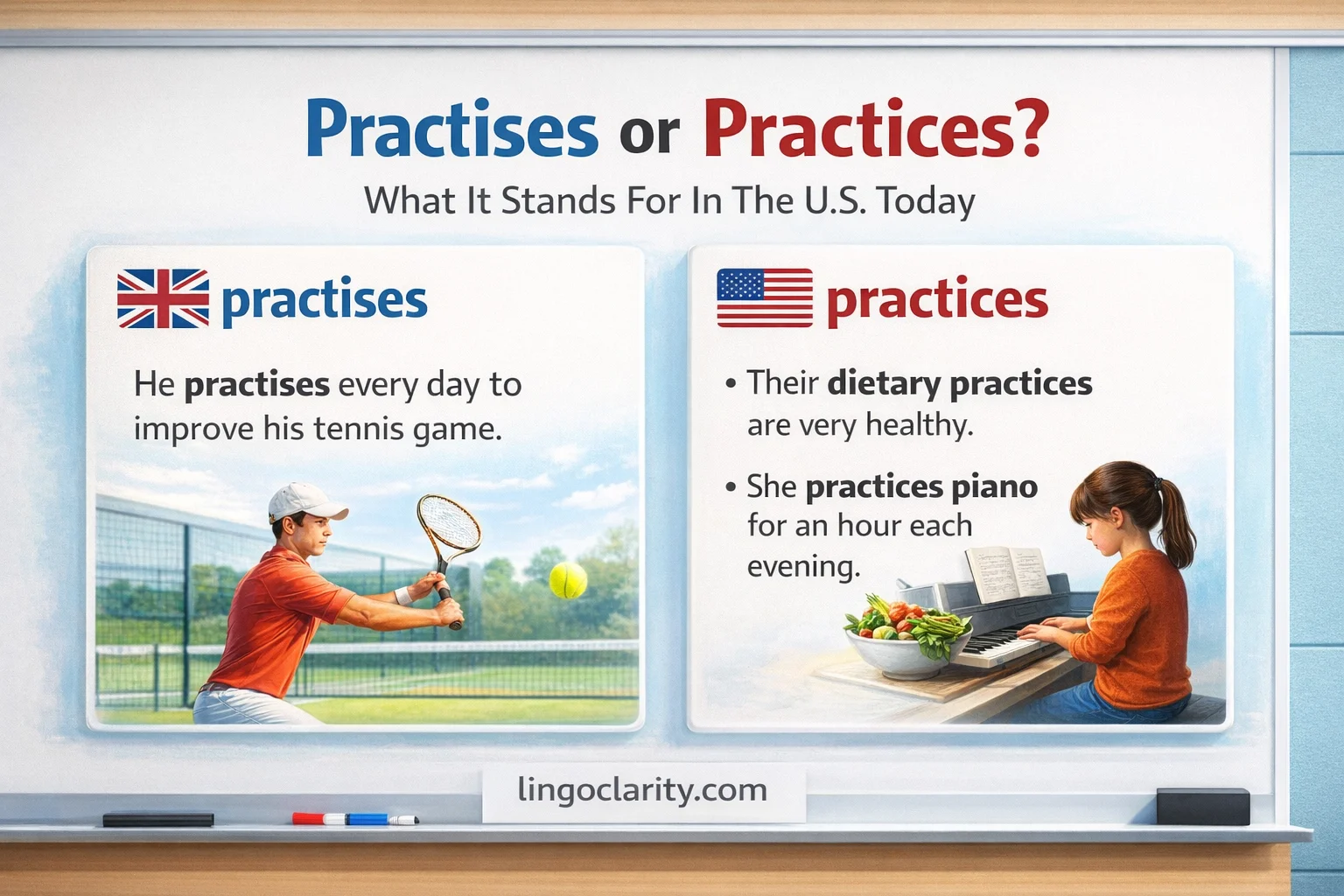
If you are writing for an American audience, the safer choice is almost always practices. That is the form US readers expect when you mean that someone does something regularly, trains for something, or works in a profession. It is also the correct plural noun when you mean methods, routines, or standard ways of doing things. By contrast, practises is mainly a British English verb form, not the normal American spelling. That is why this pair confuses so many writers: the words sound the same, look closely related, and both appear in real English, but they do not belong to the same system in US usage. Once you see the pattern, though, the choice becomes much easier.
Quick Answer
For US English, use practices.
Use practises only when you are deliberately writing in British English and you need the verb form, especially with he, she, or it. In both US and UK English, practices is also the plural noun form of practice, as in business practices, hiring practices, or safety practices.
TL;DR
- Practices is the normal US choice.
- Practises is chiefly a UK verb spelling.
- Practices can be a verb in American English: She practices piano every night.
- Practices can also be a plural noun in both varieties: The company updated its hiring practices.
- If your audience is American, do not use practises unless you have a special reason to keep British style.
What Is The Difference Between Practises And Practices?
The difference is not really about formality, tone, or correctness in the abstract. Instead, it is about regional spelling and grammar function. In British English, Cambridge Grammar explicitly treats practise as the verb and practice as the noun. Meanwhile, Cambridge Dictionary labels practise as UK and points American users to practice instead. That means practises belongs to the British verb system, while practices belongs to the American verb system and also serves as the plural noun in both US and UK English.
Another reason this topic feels tricky is that practises and practices are not true one-to-one alternatives in every sentence. Practises is only a verb form. Practices, however, can do two jobs: it can be the American third-person singular verb, and it can be the plural noun. So when people compare these two spellings, they are often comparing a British verb form with an American verb form or with a noun plural. That is why the confusion keeps showing up in schoolwork, marketing copy, business writing, and edited articles.
Simple Definition
Practises means does regularly, trains, or works in a profession, but it is mainly a British English spelling. For example, a British sentence may say, She practises the violin every day.
Practices has two common meanings. First, in American English, it is the normal verb form in sentences like She practices law or He practices daily. Second, in both US and UK English, it is the plural noun form meaning methods, routines, customs, or standard ways of doing things, as in ethical practices or safety practices.
Which Form Is Correct In US English?
For US English, practices is correct when the subject is he, she, or it. That follows the regular present-simple pattern Cambridge Grammar describes: regular verbs take -s in the third-person singular. American dictionaries then list practice as the verb, which gives you forms like I practice, you practice, we practice, they practice, and she practices.
That means these sentences are correct in American English:
- She practices piano before school.
- He practices law in Chicago.
- The company updated its hiring practices.
- Good safety practices protect workers.
All four are natural in US writing. The first two use practices as a verb. The last two use practices as a plural noun.
By contrast, these look off in standard US copy:
- She practises piano before school.
- He practises law in Chicago.
- The company changed its hiring practises.
The first two look British, not American. The third is wrong even in British English because the sentence needs a plural noun, not a verb form.
How British English Changes The Answer
British English keeps a clearer split between verb and noun spellings. Cambridge Grammar gives practise (verb) and practice (noun) as a standard example of that pattern. So in British English, you might see:
- I practise every day.
- She practises medicine in London.
- The hospital follows strict hygiene practices.
That third sentence matters. Even in British English, the plural noun is still practices, because the base noun is practice. In other words, British English changes the verb spelling, but it does not turn the plural noun into practises.
This is also why phrases like best practices, business practices, and ethical practices keep the -ces spelling. They are noun phrases, not verb phrases. Merriam-Webster’s entry for best practice lists the plural as best practices, which supports the same rule.
Why People Mix Them Up
First, the two words sound the same. Cambridge gives practice and practise the same pronunciation pattern, so your ear does not help much here. You hear one sound, but the spelling changes with region and grammar.
Second, practices pulls double duty. In American English, it works as a verb and as a plural noun. That makes it look very flexible, because it is. Meanwhile, practises has a narrower job. It belongs to British verb usage, not to standard American spelling and not to the noun plural.
Third, online readers often see British and American content mixed together. A UK article may say She practises medicine, while a US article says She practices medicine. Both can be right in their own systems. Trouble starts when a writer copies one spelling into the wrong regional style.
A Fast Way To Choose The Right Form
Use this quick test:
Step 1: Check your audience.
If you are writing for US readers, default to practice / practices. If you are writing in British English, the verb may be practise / practises.
Step 2: Check the job of the word.
If the word means methods, routines, standards, or customs, you need the plural noun practices.
Step 3: Check the subject.
If the sentence is in the present simple with he, she, or it, American English uses practices. British English uses practises if the verb base is practise.
That is the whole system. Once you separate audience, word class, and subject, the answer usually becomes obvious.
Real-Life Example
Imagine you are editing a US law firm website and you see this sentence:
Maria practises family law in Texas and follows client-first practises.
That line has two problems for American English. The first practises should become practices, because US English uses practice as the verb base and practices for third-person singular. The second practises should also become practices, but for a different reason: now the word is a plural noun meaning methods or standards. So the polished US version is:
Maria practices family law in Texas and follows client-first practices.
That example shows why this issue matters in real writing. A single spelling slip can make polished US copy look imported, inconsistent, or simply wrong. In business, legal, education, and healthcare content, that kind of mismatch stands out fast.
Sentence Usage
American Verb Examples
- She practices piano every evening.
- My brother practices basketball after class.
- The attorney practices in Boston.
- He practices patience when customers are upset.
These examples all use practices as the standard American third-person singular verb.
Plural Noun Examples
- The company reviewed its remote-work practices.
- Good hiring practices save time and money.
- The clinic improved its patient-care practices.
- Strong study practices help students stay organized.
Here, practices means methods, routines, or standard ways of doing something.
British Verb Examples
- She practises the violin every morning.
- He practises medicine in London.
- The team practises twice a week.
These are normal British verb examples, not standard American spellings.
Synonyms
For the verb sense, useful plain-English alternatives include trains, rehearses, does regularly, carries out, and, in professional contexts, works in. Those choices depend on the sentence. For example, a musician might rehearse, while a doctor works in or practices medicine. Merriam-Webster defines the verb broadly as doing something repeatedly, carrying it out, or being professionally engaged in it.
For the noun sense, close alternatives include methods, routines, procedures, customs, habits, and standards. Merriam-Webster and Britannica both describe noun uses tied to repeated action, usual ways of doing something, and customary behavior.
Opposites
There is no single perfect opposite for every sense of practices or practises, so context matters.
For the verb sense, the closest opposites are often:
- neglects
- avoids
- abandons
- ignores
For the noun sense, the nearest opposites may be:
- disorder
- inconsistency
- improvisation
- carelessness
Those are not exact dictionary opposites in every sentence, but they are practical contrasts that help writers understand the meaning.
Common Mistakes
Mistake 1: Using practises in US writing
This is the most common error. In American English, practises looks British. Use practices instead.
Mistake 2: Using practises as a plural noun
This is wrong. If the sentence means methods, routines, or standards, the word must be practices.
Mistake 3: Thinking practices is only a noun
It is not. In American English, practices is also the third-person singular verb form.
Mistake 4: Forgetting the base-form difference
Many writers focus only on practises and practices, but the real system starts one step earlier: British English commonly uses practise as the verb and practice as the noun, while American English generally uses practice for both base forms.
Mistake 5: Mixing US and UK spelling in one piece
A page that says She practises law in New York and later The firm follows best practices may feel inconsistent unless the whole piece is intentionally in British English. Pick one style and keep it throughout.
Mistake 6: Writing best practises
Do not do this. The standard noun phrase is best practices when plural is intended. Merriam-Webster records best practice as a noun and gives the plural as best practices.
Why This Matters In Professional Writing
This spelling choice is small, but it sends a strong signal about editorial control. On a US website, brochure, article, or resume, practises can distract readers because it looks like an imported spelling or a proofreading miss. Meanwhile, using practices correctly keeps your writing aligned with American expectations. That matters even more in fields like law, medicine, education, consulting, and HR, where readers notice terminology and style consistency quickly.
FAQs
Is practises ever correct?
Yes. Practises is correct in British English when it is used as a verb, especially in forms like she practises or he practises. It is not the standard spelling for normal US English writing.
Why is practices correct in US English?
Because American English generally uses practice as the verb base and adds -s in the third-person singular, which gives practices. It also uses practices as the plural noun of practice.
Is practices a noun or a verb?
It can be both. In US English, practices may be a verb (She practices law) or a plural noun (The firm changed its billing practices).
Can I write best practises?
No. If you mean the noun phrase, write best practices. The noun is practice, and the plural is practices.
What if my audience is international?
Choose one house style and stay consistent. If the brand uses American English, write practices. If the brand uses British English, use practise/practises for the verb but still keep practice/practices for the noun.
Is there an easy memory trick?
Yes: for US English, think practice → practices. For British English, remember the split: practise is the verb, practice is the noun. That simple distinction solves most cases.
Final Verdict
If your audience is American, the answer is straightforward: use practices. It is the correct US spelling when he, she, or it does something regularly, and it is also the correct plural noun when you mean methods, routines, or standards. Use practises only when you are intentionally writing in British English and the word is acting as a verb. Once you know that practices belongs to American usage and practises belongs mainly to British verb usage, the confusion disappears. For US-facing writing, practices is the form you can trust.
