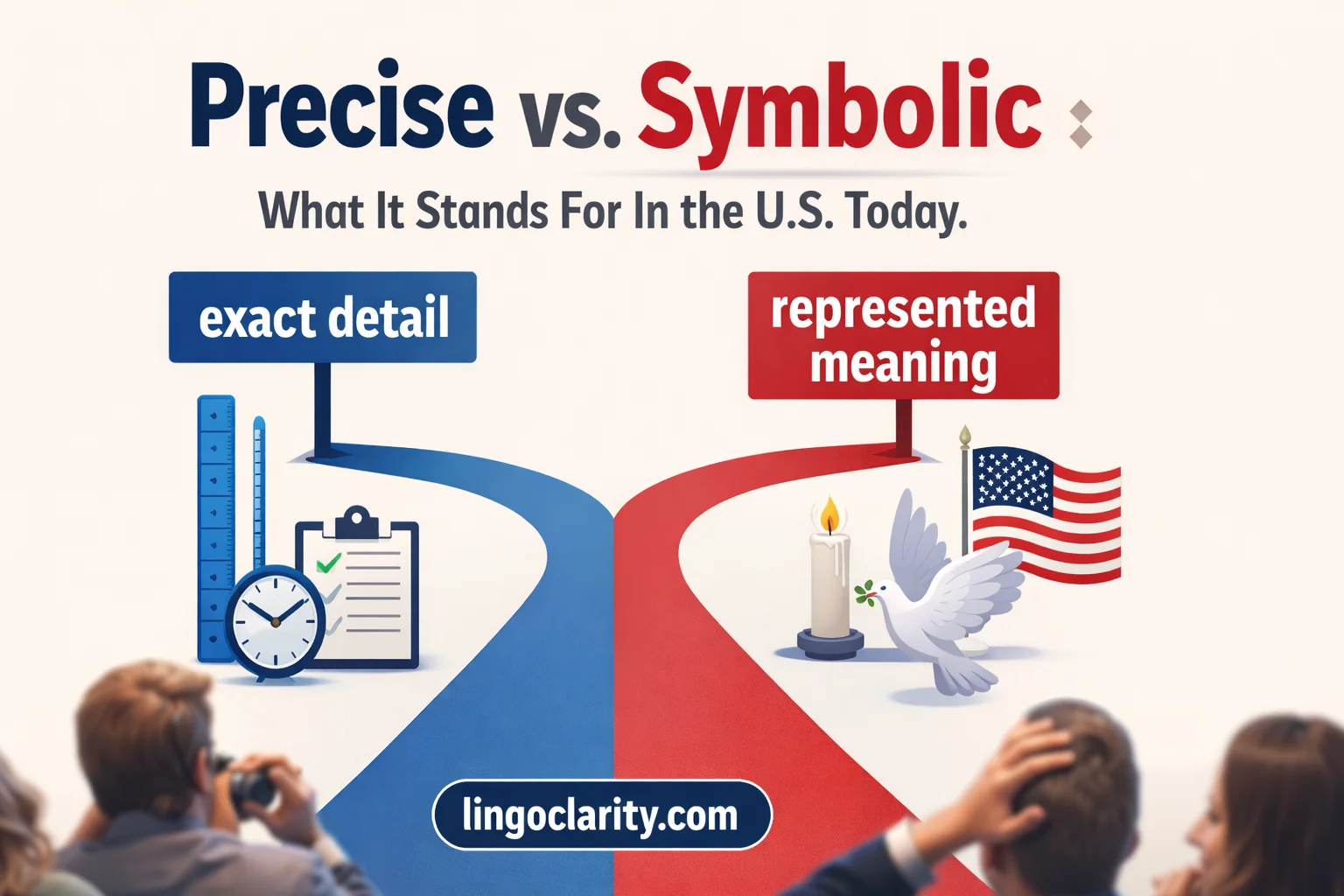
Use precise when you mean exact, specific, sharply defined, or carefully accurate. Use symbolic when you mean representing something beyond the literal object, action, or wording. That is the core difference in plain US English. Authoritative dictionaries consistently define precise around exactness and accuracy, while symbolic centers on representing or serving as a symbol.
So if you are choosing between them, the test is simple:
- If the focus is accuracy, choose precise.
- If the focus is meaning through representation, choose symbolic.
A precise instruction tells someone exactly what to do.
A symbolic gesture expresses an idea, value, or feeling beyond the action itself.
What Precise Means
Precise describes something that is exact, clearly stated, closely measured, or carefully accurate. It works especially well for language, numbers, time, location, measurements, instructions, definitions, and distinctions. Merriam-Webster defines it as exactly or sharply defined or stated; Cambridge emphasizes exactness and accuracy in form, time, detail, or description; Collins and Dictionary.com add senses such as strictly correct, particular, and exact in measuring or recording.
In real writing, precise usually suggests that vagueness would be a problem. You want a precise date, a precise diagnosis, a precise quote, or a precise explanation because being loosely right is not good enough.
Examples:
- “Please send the precise dimensions before production starts.”
- “Her summary was brief but precise.”
- “We need the precise wording from the contract, not a paraphrase.”
There is also a common idiom: to be precise. Oxford notes that it is used when the speaker wants to give more detailed and accurate information than what they just said. Example: “The shelf is about a meter long, or 98 centimeters, to be precise.”
What Symbolic Means
Symbolic means that something functions as a symbol, expresses a larger idea, or carries meaning beyond the literal thing itself. Merriam-Webster defines it as using or exhibiting a symbol; Collins frames it as serving as a symbol or being characterized by symbolism; Cambridge defines it as representing something else and also uses it for actions that express meaning more than practical effect.
That means symbolic often belongs in discussions of art, religion, literature, memorials, public rituals, color meaning, branding, and politics.
Examples:
- “The dove is symbolic of peace.”
- “The candle-lighting ceremony was symbolic.”
- “The vote was mostly symbolic, but it still sent a clear message.”
That last example matters. In public and political language, symbolic often suggests that an action expresses position, solidarity, or intent without producing much immediate practical change. Collins explicitly reflects that nuance.
Why People Confuse These Words
People confuse precise and symbolic because both words can appear in serious, formal, or intellectual contexts. You may see them near each other in writing about literature, philosophy, law, religion, politics, or mathematics. But they still point to different qualities.
A statement can be precise without being symbolic:
- “The meeting starts at 3:17 p.m.”
A statement can be symbolic without being precise:
- “The black ribbon stood for collective grief.”
And sometimes something can be both:
- A memorial design may use a very precise geometric layout while also carrying deeply symbolic meaning.
Another reason for confusion is that symbolic systems can sometimes increase exactness. Dictionary.com’s entry for symbolic language notes that in fields such as logic or mathematics, symbols can be used to achieve greater exactitude. So a system may be symbolic in form and precise in function.
Precise Vs. Symbolic: The Real Difference
The easiest way to separate the words is to ask what question the sentence is trying to answer.
Precise answers:
“What is the exact detail?”
Symbolic answers:
“What does this stand for?”
That is why these combinations sound natural:
- precise wording
- precise measurements
- precise timing
- symbolic meaning
- symbolic gesture
- symbolic value
And these usually do not:
- symbolic measurements
- precise mourning
- symbolic street address
The problem is not grammar. It is fit. The adjective has to match the kind of meaning you are describing.
When To Use Precise
Choose precise when exactness matters more than mood, suggestion, or interpretation.
Use it for:
Writing And Editing
Use precise when you want wording that leaves little room for misunderstanding. Editors often prefer precise language because it cuts ambiguity and makes the writer’s meaning easier to verify.
Numbers And Measurements
Use precise for amounts, dimensions, timing, and quantities: a precise temperature, a precise location, a precise figure.
Instructions And Procedures
In recipes, contracts, safety manuals, and technical documents, precise signals that the details must be followed carefully.
Definitions And Distinctions
Use precise when you need a term to be narrowly and clearly defined.
Examples:
- “The doctor gave precise instructions for recovery.”
- “That summary is good, but it is not precise enough for the report.”
- “Please be more precise about which file you mean.”
When To Use Symbolic
Choose symbolic when representation matters more than literal function.
Use it for:
Art And Literature
A bird, rose, mirror, flame, or color can be symbolic when it points to a deeper idea.
Ceremony And Ritual
Flags, candles, flowers, and moments of silence are often symbolic because they express memory, grief, respect, or unity.
Politics And Public Life
A measure can be symbolic if it sends a message but does not create much immediate practical change.
Branding And Public Messaging
Logos, colors, monuments, and gestures often work symbolically because they stand for larger values or identities.
Examples:
- “The empty chair was symbolic of everyone who was missing.”
- “The redesigned seal is symbolic of the city’s history.”
- “His apology felt symbolic because nothing actually changed.”
Examples That Make The Difference Clear
Here are paired examples that show the contrast in real use:
- “We need the precise address before delivery.”
“The old house key became symbolic of their childhood.” - “Her answer was polite but not precise.”
“The white flowers were symbolic of remembrance.” - “Use precise wording in the policy update.”
“The ribbon-cutting was largely symbolic.” - “The engineer asked for precise measurements.”
“The mural is symbolic, not literal.” - “Give me the precise time of the flight.”
“The folded flag was symbolic of national service.”
Those examples show the pattern clearly: precise narrows meaning; symbolic expands meaning.
Can Something Be Both Precise And Symbolic?
Yes. The words are different, but they are not opposites.
A courtroom oath can be precise in wording and symbolic in meaning.
A religious ceremony can follow a precise sequence while remaining deeply symbolic.
A poem can use precise imagery to create a symbolic effect.
A logo can have precise lines, proportions, and color values while still being symbolic of a brand’s identity.
This matters because many readers mistakenly treat the words as if one excludes the other. It does not. A thing can be exact in form and representative in meaning at the same time.
Common Mistakes To Avoid
One mistake is using symbolic when you only mean important. Something is not symbolic just because it matters. It is symbolic when it stands for something larger.
Another mistake is using precise as a fancier version of specific in every situation. Sometimes specific is enough. Precise is strongest when exactness, narrow definition, or careful accuracy is genuinely part of the point.
A third mistake is treating the words as opposites. They are not. For precise, the natural contrast is usually vague, indefinite, or imprecise. For symbolic, the natural contrast is often literal, actual, or nonsymbolic.
Better Synonyms For Precise
Depending on context, useful alternatives include:
- exact
- specific
- accurate
- well-defined
- clear
- particular
But they are not always interchangeable. Exact is often the closest match. Specific is broader and less demanding. Accurate focuses on correctness. Precise suggests careful, narrow, exact expression. Merriam-Webster, Cambridge, Collins, and Dictionary.com all cluster the word around those ideas, even though each frames the nuance slightly differently.
Better Synonyms For Symbolic
Depending on context, useful alternatives include:
- representative
- emblematic
- figurative
- allegorical
- token
- ceremonial sometimes
Merriam-Webster’s thesaurus especially points toward representative and emblematic as close matches, while the antonyms include actual and literal. That helps explain why symbolic often belongs in interpretive or representational contexts rather than factual ones.
Precise Vs. Symbolic In Everyday Writing
In everyday writing, choose precise when the reader needs exact information and symbolic when the reader needs interpretive meaning.
A customer support article should be precise.
A poem may be highly symbolic.
A legal clause should be precise.
A candle in a memorial image may be symbolic.
A newsroom correction needs precise wording.
A public gesture by a mayor may be mostly symbolic.
That is why the two words belong to different editorial jobs. One improves accuracy. The other interprets meaning.
Final Verdict
Use precise for what is exact, specific, sharply defined, and carefully accurate. Use symbolic for what represents, suggests, or expresses a larger meaning beyond the literal thing itself. That is the difference most writers need to remember.
If your sentence is about detail, choose precise.
If your sentence is about representation, choose symbolic.
That rule will get you to the right choice almost every time.
FAQ
Is symbolic the opposite of precise?
No. The usual opposite of precise is vague or imprecise. The more natural opposite of symbolic is literal, actual, or nonsymbolic.
Can writing be both precise and symbolic?
Yes. A poem, speech, or memorial statement can be very precise in wording while also being symbolic in meaning. Exact language and representational meaning can work together.
Is a symbolic gesture always meaningless?
No. A symbolic gesture can still matter politically, emotionally, or culturally. The point is that its force often comes from what it expresses, not from direct material effect.
What is a simple example of precise vs. symbolic?
“Meet me at 2:05 p.m.” is precise because the time is exact. “The candle was symbolic of hope” is symbolic because the candle represents something larger than itself.
Which word should I use in formal writing?
Use either one when it fits the meaning. In formal writing, precise is common in technical, legal, academic, and instructional contexts. Symbolic is common in literary, cultural, historical, religious, and political analysis.
