
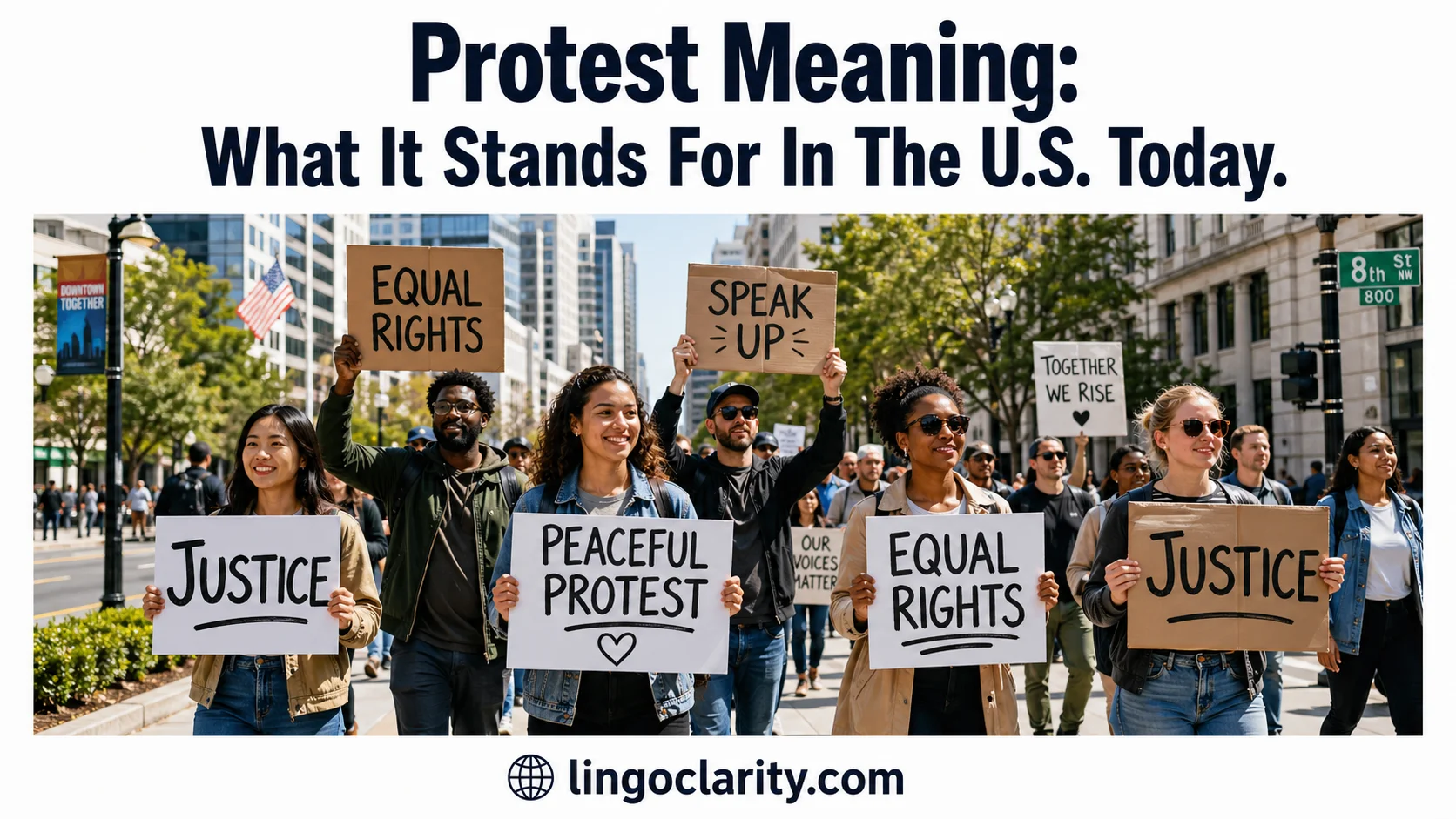
Protest different meanings include a public demonstration, a strong objection, a formal challenge, and a forceful statement of disagreement. In simple terms, protest means to show, say, or officially declare that you disagree with something.
In simple terms, protest means “to say or show that you disagree.”
Most people hear the word protest and think of a public gathering: people marching, holding signs, chanting, or standing outside a government building, school, workplace, courthouse, or company office. That is one common meaning, but it is not the only one. A person can protest a fee, a sports call, a school rule, a court decision, a company policy, or an unfair accusation.
The word is neutral by itself. A protest can be peaceful, loud, organized, spontaneous, legal, unlawful, public, private, formal, or informal. The surrounding words tell you what kind of protest it is.
Quick Definition of Protest
| Form | Meaning | Example |
|---|---|---|
| Noun | An action, statement, event, or formal objection that shows disagreement | The students held a protest outside the school. |
| Verb | To object strongly or speak against something | Residents protested the new parking rule. |
| Formal Verb | To challenge something officially | The company protested the contract award. |
| Speech Verb | To insist strongly that something is true | He protested that he had done nothing wrong. |
Merriam-Webster defines protest as both a declaration of dissent and an act of objecting, including organized public demonstrations and formal objections in legal, financial, and sports contexts.
Protest as a Noun
As a noun, protest names the act or expression of disagreement.
Examples:
- The workers held a protest outside the factory.
- Her resignation was a protest against the board’s decision.
- The announcement caused a storm of protest.
- He paid the fine under protest.
- The coach filed a protest after the referee’s call.
A protest can be one person’s objection or a large public demonstration. It can be spoken, written, symbolic, or physical. Oxford Learner’s Dictionaries lists protest as both countable and uncountable, with common phrases such as “hold a protest,” “organize a protest,” “join a protest,” “under protest,” and “storm of protest.”
Public Protest
A public protest is an open action meant to show disagreement and attract attention. It may involve a rally, march, sit-in, walkout, demonstration, strike, or sign-holding event.
Examples:
- Thousands joined a peaceful protest downtown.
- The group organized a protest march near the state capitol.
- Parents held a protest outside the school board meeting.
A public protest often focuses on laws, public policies, court decisions, labor issues, civil rights, environmental concerns, war, policing, education, housing, or local government decisions.
Personal Protest
A protest does not have to involve a crowd. One person can protest a decision, rule, charge, accusation, or treatment.
Examples:
- She made a small protest when her shift was changed.
- The customer wrote a letter of protest about the extra fee.
- No one raised a protest when the meeting ended early.
In personal use, protest is stronger than a casual complaint. A complaint often focuses on dissatisfaction. A protest suggests firmer opposition.
Formal Protest
In official settings, a protest can be a formal challenge or written objection. Businesses, lawyers, taxpayers, sports teams, and organizations may file protests when they believe a rule, decision, charge, award, call, or procedure was wrong.
Examples:
- The contractor filed a protest after losing the government bid.
- The taxpayer paid the assessment under protest.
- The team submitted a protest after the disputed call.
Collins includes several formal meanings, including objections involving tax assessments, bills of exchange, promissory notes, and notarial statements.
Protest as a Verb
As a verb, protest means to object strongly, speak out against something, or say forcefully that something is true.
Examples:
- Residents protested the proposed zoning change.
- Students protested against the tuition increase.
- She protested that the decision was unfair.
- The defendant protested his innocence.
- Fans protested the referee’s call.
Britannica notes both major verb uses: showing strong disagreement and saying something forcefully when others may not believe or accept it.
Protest Something
In US English, it is common to use protest directly before the thing being opposed.
Examples:
- Workers protested the new schedule.
- Voters protested the tax increase.
- The coach protested the call.
This pattern is direct and efficient. It is especially common in news, civic writing, sports, and American English.
Protest Against Something
Protest against is also common, especially when the sentence emphasizes opposition to a policy, action, event, or injustice.
Examples:
- People protested against the new law.
- The union protested against unsafe working conditions.
- Activists protested against the proposed pipeline.
Protest About or Over Something
Protest about and protest over often point to the issue causing anger or disagreement.
Examples:
- Parents protested about the school closure.
- Residents protested over rising utility bills.
- Customers protested about hidden fees.
Protest That
Use protest that when someone insists on a statement, often because another person doubts it.
Examples:
- He protested that he had followed the rules.
- She protested that the report was incomplete.
- They protested that the policy would harm small businesses.
Protest Innocence
To protest your innocence means to insist strongly that you are not guilty or not responsible.
Examples:
- The suspect protested his innocence.
- She continued to protest her innocence after the verdict.
This meaning comes from the older sense of protest as a solemn declaration, not just public disagreement.
How To Pronounce Protest
Protest has two common pronunciations in US English.
| Part of Speech | Common Stress | Simple Pronunciation | Example |
|---|---|---|---|
| Noun | First syllable | PRO-test | They held a PRO-test. |
| Verb | Second syllable | pro-TEST | They plan to pro-TEST the rule. |
WordReference’s usage guide notes that protest can be a noun or verb with different pronunciations.
Some speakers may stress the first syllable for the verb in certain contexts, especially when referring to taking part in an organized protest. Still, the safest learning rule is simple: noun = PRO-test, verb = pro-TEST.
Different Meanings of Protest
The different meanings of protest all share one idea: someone is making disagreement known.
A Public Demonstration
This is the meaning most people recognize first.
Example:
- The march became one of the largest protests in the city’s history.
A Strong Objection
This meaning can be public or private.
Example:
- Her protest was ignored by the committee.
A Formal Challenge
This meaning appears in law, government, business, finance, and sports.
Example:
- The company filed a protest after the bidding process.
A Strong Declaration
This older meaning survives in phrases such as protest innocence and protest that.
Example:
- He protested that he had never seen the document.
Protest Is Not the Same as Riot
A protest is an expression of disagreement. A riot involves violent public disorder, damage, or threats of harm. A protest can become disorderly, but the word protest does not mean violence by itself.
This distinction matters. Calling every protest a riot is inaccurate and loaded. Merriam-Webster defines riot as violent public disorder and, in legal use, a disturbance that creates danger of injury or property damage.
Correct:
- The peaceful protest ended at sunset.
- A small group later started a riot several blocks away.
Incorrect:
- The peaceful riot ended at sunset.
Use protest when the focus is objection or public disagreement. Use riot only when the situation involves violence, public disorder, or serious danger.
Protest, Complaint, Objection, Demonstration, Strike, and Boycott
These words overlap, but they are not identical.
| Word | Best Meaning | Example |
|---|---|---|
| Protest | Strong disagreement shown publicly, personally, or formally | Residents protested the rent increase. |
| Complaint | A statement that something is wrong or unsatisfactory | She filed a complaint about the service. |
| Objection | A reason for disagreeing or opposing something | The lawyer raised an objection. |
| Demonstration | A public gathering to support or oppose something | Thousands attended the demonstration. |
| Strike | A work stoppage used as pressure | Teachers went on strike. |
| Boycott | Refusal to buy, use, or support something | Customers boycotted the company. |
| Dissent | Disagreement, especially with an official or majority view | The judge wrote a dissent. |
Choose protest when the emphasis is strong opposition. Demonstration works best when you mean the public event itself. Complaint fits a personal dissatisfaction or problem. Objection is better when the disagreement is formal, logical, or procedural.
Common Phrases With Protest
Peaceful Protest
A peaceful protest is a public expression of disagreement without violence.
Example:
- The group held a peaceful protest outside city hall.
In the United States, the First Amendment protects the right of people to peaceably assemble and petition the government for a redress of grievances. The ACLU also notes that the First Amendment protects the right to assemble and express views through protest, although narrow restrictions may apply.
Public Protest
A public protest is an open action visible to the community, media, officials, or decision-makers.
Example:
- The mayor faced public protest after announcing the cuts.
Protest March
A protest march is a group walk meant to show opposition.
Example:
- The protest march moved from the courthouse to the capitol.
Protest Rally
A protest rally is a gathering where people assemble, speak, chant, or listen to speakers.
Example:
- The union planned a protest rally for Friday.
Protest Song
A protest song criticizes injustice, war, inequality, corruption, or another social problem.
Example:
- The song became an anthem of protest during the movement.
Protest Vote
A protest vote is a vote meant to show dissatisfaction rather than strong support for a candidate or option.
Example:
- Some voters cast a protest vote against both major parties.
Under Protest
Under protest means someone does something unwillingly after making clear that they object.
Examples:
- She signed the form under protest.
- He paid the fine under protest.
Storm of Protest
A storm of protest is a large, intense public reaction against something.
Example:
- The decision caused a storm of protest from residents.
Protest Too Much
To protest too much means to deny something so strongly that the denial may sound suspicious.
Example:
- He said he did not care about the criticism, but he seemed to protest too much.
Protester or Protestor
Both protester and protestor are used for a person who protests. Protester is more common in modern US English and is usually the safer choice for general writing.
Examples:
- Protesters gathered outside the courthouse.
- Several student protesters spoke at the meeting.
Use one spelling consistently within the same article, document, or publication.
Word History of Protest
Protest comes from older words connected with public declaration and testimony. Etymonline traces the noun to Old French protest and Latin protestari, meaning “declare publicly” or “testify.”
That origin explains why protest has two related meanings today. It can mean to object strongly, as in “They protested the law.” It can also mean to declare strongly, as in “He protested his innocence.” Both meanings involve making a position known.
Examples of Protest in Sentences
Noun Examples
- The protest began outside the courthouse.
- A wave of protest followed the announcement.
- The workers staged a protest over unsafe conditions.
- She resigned in protest after the vote.
- The policy change sparked protests across the state.
- He paid the charge under protest.
- The coach submitted a protest after the game.
- There were no protests when the plan was approved.
Verb Examples
- Students protested the new dress code.
- Residents protested against the road closure.
- Parents protested about the lack of bus service.
- The union protested over unpaid wages.
- She protested that the report was misleading.
- He protested his innocence throughout the trial.
- The player protested the referee’s decision.
- Customers protested the sudden price increase.
Common Mistakes With Protest
Mistake 1: Using Protest as a Synonym for Riot
A protest may be peaceful. A riot involves violence or serious public disorder.
Better:
- The protest was peaceful until a separate group damaged property.
Not:
- The peaceful riot was held downtown.
Mistake 2: Forgetting What Is Being Protested
A sentence is clearer when it names the issue.
Weak:
- Workers protested.
Better:
- Workers protested the new overtime policy.
Mistake 3: Treating Protest as Only Political
Protest often appears in politics, but it is not limited to politics.
Examples:
- Fans protested the trade.
- Customers protested the fee.
- Students protested the schedule change.
- The company protested the contract decision.
Mistake 4: Choosing the Wrong Synonym
Do not replace protest with complaint, demonstration, or riot unless the meaning truly fits.
- Use complaint for dissatisfaction.
- Use objection for a specific disagreement.
- Use demonstration for a public event.
- Use riot for violent public disorder.
- Use protest for strong opposition or public objection.
Mistake 5: Mixing Pronunciation Stress
In careful speech, stress the noun on the first syllable and the verb on the second.
- Noun: They held a PRO-test.
- Verb: They will pro-TEST.
FAQ
What does protest mean in simple words?
Protest means to show or say that you strongly disagree with something. As a noun, it can be an event, statement, objection, or formal challenge. As a verb, it means to object strongly or speak out against something.
Is protest a noun or a verb?
Protest is both a noun and a verb. As a noun, it names an act of disagreement: “They held a protest.” As a verb, it describes the action of objecting: “They protested the decision.”
Is a protest always public?
No. A protest can be public, like a march or rally, but it can also be private, personal, written, spoken, or formal. A customer can protest a charge, a student can protest a grade, and a company can protest a contract award.
Is protest always political?
No. Protest is common in political contexts, but it can also apply to schools, workplaces, sports, courts, businesses, family decisions, fees, rules, and policies.
What is the difference between a protest and a riot?
A protest is an expression of disagreement. A riot is violent public disorder. A protest can be peaceful; a riot, by definition, involves violence, disorder, or danger.
Do you say protest against or protest about?
Both can be correct. Use protest against when emphasizing opposition: “They protested against the law.” Use protest about or protest over when naming the issue: “They protested about the fee” or “They protested over the closure.” In US English, you can also use a direct object: “They protested the decision.”
What does under protest mean?
Under protest means doing something only after making clear that you disagree. For example, “She paid the fine under protest” means she paid it, but she objected to it.
What does protest too much mean?
Protest too much means to deny something so strongly that the denial may seem suspicious. For example, “He says he does not care, but he protests too much.”
Which is correct: protester or protestor?
Both are accepted, but protester is more common and usually preferred in modern US English.
Final Usage Rule
Use protest when someone clearly objects to something and wants that objection known. For the clearest sentence, name who is protesting, what they are protesting, and why.
Clear:
- Residents protested the new parking rule because it removed overnight spaces.
Less clear:
- Residents protested.
The strongest use of protest is specific, direct, and grounded in context. It can describe a peaceful public march, a formal legal challenge, a personal objection, a sports dispute, or a forceful declaration of innocence.
