
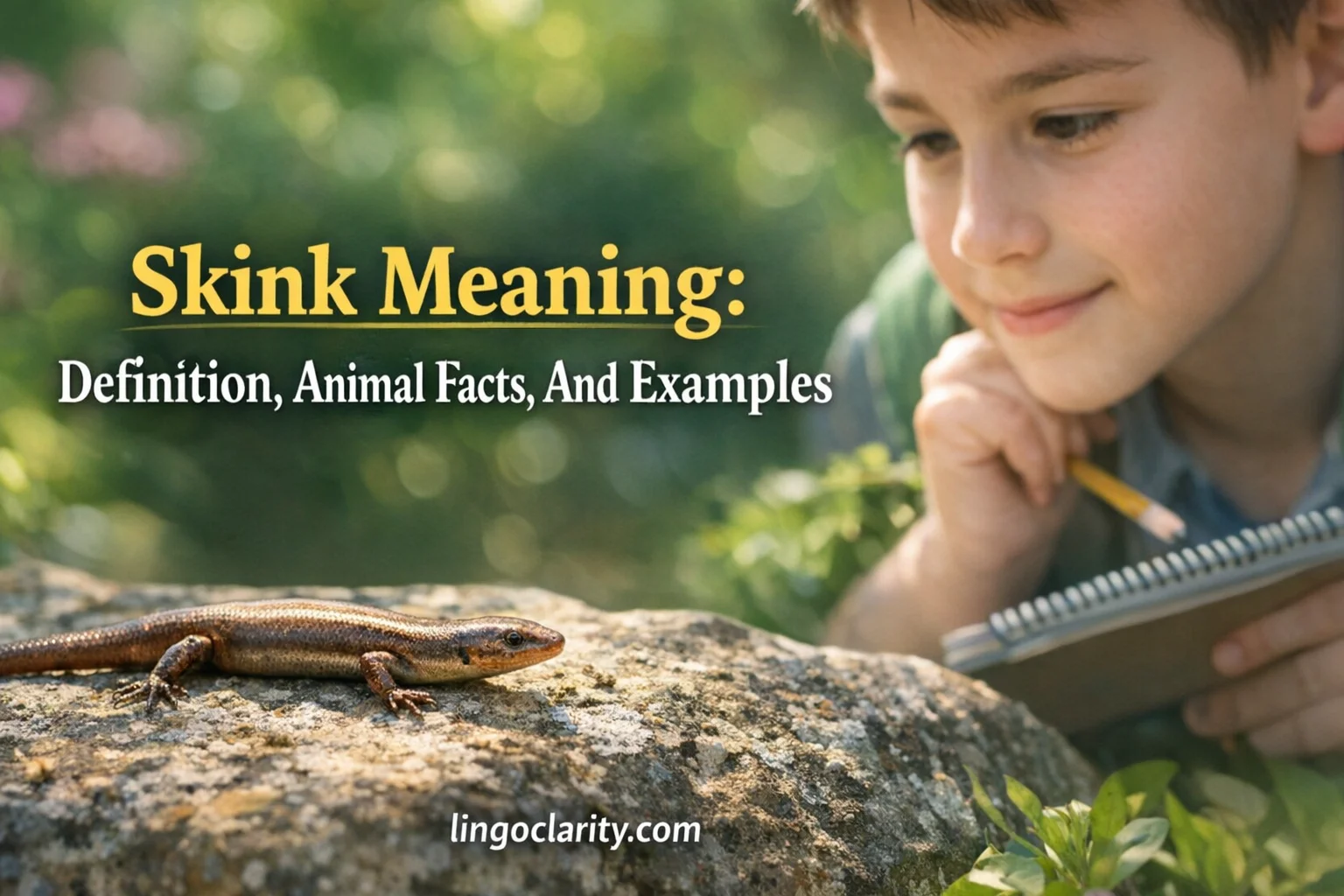
Skinks show up in the places you least expect, on a sunny garden wall, under a stepping stone, or flashing across a trail like a quick little shadow. But the skink meaning is not “one specific lizard.” In science and everyday wildlife talk, skink is the name for a big family of lizards (Scincidae) found around the world. Many skinks share the same look: smooth, shiny scales, a long, sleek body, and small legs (sometimes so tiny they seem almost snake-like).
In this guide, you’ll get a clear, plain-English definition of skink, the correct pronunciation, and the practical facts people actually want—where skinks live, what they eat, why they drop their tails, and how to tell a skink from other common lizards—with real examples that make the word easy to use correctly.
Quick Answer
A skink is a type of lizard in the family Scincidae—typically small to medium-sized, usually smooth-scaled, often long-bodied, and commonly insect-eating.
Skink Meaning In English
In plain English, skink means a lizard from the skink family (Scincidae). It does not mean one single species. It’s a large family with well over a thousand species, and different skinks can look surprisingly different from each other.
You’ll often recognize a skink by these common traits:
- Smooth, shiny-looking scales
- A long, tapering body
- Short legs (and in some species, very reduced legs)
How To Pronounce Skink
Skink is one syllable and is pronounced /skɪŋk/—rhymes with link, think, and sink.
What Animal Is A Skink?
A skink is a reptile and a lizard (order Squamata), specifically in the family Scincidae. Skinks live across most of the world, especially in warm regions, and many are secretive ground-dwellers or burrowers.
Key Characteristics Of Skinks
While skinks vary a lot by species, many share a similar “sleek” look and lifestyle.
Common Physical Traits
- Cylindrical or streamlined body
- Smooth, glossy scales
- Cone-shaped head in many species
- Long tail (often important for survival)
Common Behaviors
- Quick bursts of speed
- Hiding under rocks, logs, leaf litter, or in burrows
- Digging and burrowing in many species
Where Do Skinks Live?
Skinks live in a wide range of habitats, including:
- Forest floors
- Grasslands
- Deserts
- Tropical regions
- Gardens and parks
They are found on most continents, but not in Antarctica, and they tend to be most common in warmer climates.
What Do Skinks Eat?
Many skinks are insectivores, meaning insects make up a big part of their diet. Depending on the species and size, skinks may eat:
- Crickets, beetles, and other insects
- Spiders
- Worms
- Snails and slugs
- Occasionally, small vertebrates (in larger species)
In gardens, skinks can be helpful because they often eat pests.
Why Do Skinks Drop Their Tails?
Many skinks can escape predators using tail autotomy—they can shed (drop) part of the tail if grabbed. The detached tail often wiggles and distracts the predator long enough for the skink to run away. Many lizards can regrow a tail, though the replacement may not be identical to the original.
Common Skink Examples
Here are a few well-known skinks people commonly read about:
Blue-Tongue Skink
A larger skink that’s well known in reptile education and pet contexts.
Five-Lined Skink
A common North American skink. Juveniles are especially famous for their bright blue tails.
Fire Skink
Known for bold coloring and a striking pattern.
(Important note: these are examples of skinks, not the definition—“skink” still means the whole family group.)
Skink Vs Other Lizards
Skinks are lizards, but their look can confuse people—especially because some have reduced legs and snake-like movement.
Here’s a quick clarity check:
- Skink: smooth scales, often short legs, many are ground-dwellers
- Gecko: often known for toe pads and climbing
- Iguana: generally larger, often plant-eating
- Chameleon: specialized eyes and color-change abilities
If you see a small, shiny-looking lizard darting into leaf litter or under a rock, a skink is a strong possibility—depending on your region.
How The Word Skink Is Used In Sentences
Examples In Context
- “A skink ran across the patio and disappeared under the flower pot.”
- “We learned that skinks are lizards in the family Scincidae.”
- “The documentary showed a skink hunting insects.”
Common Mistake
Incorrect: “A skink is a snake.”
Correct: “A skink is a type of lizard.”
Some skinks look snake-like because of their long bodies and reduced legs, but they are still lizards.
Other Meanings Of Skink
Most people mean the lizard when they say “skink.” However, skink can also be a verb in older or dialect use meaning to pour or serve a drink. If you see skink used in an old text about serving alcohol, it may be that verb—not the reptile.
Mini Quiz
- What kind of animal is a skink?
- What family do skinks belong to?
- Why do many skinks drop their tails?
Answer Key
- A lizard (reptile)
- Scincidae
- To distract predators and escape
FAQs
What is a skink lizard?
A skink is any lizard in the family Scincidae. Many skinks are small, smooth-scaled, and insect-eating, but the family includes a wide variety of species.
Are skinks dangerous to humans?
Skinks are generally harmless to people and usually avoid humans. Like most wild animals, they may bite if handled, but they are not typically dangerous.
Where do skinks live?
Skinks live in many habitats worldwide, especially warm regions—forests, grasslands, deserts, and even gardens.
What do skinks eat?
Many skinks eat insects and other small invertebrates, and some larger species may eat small animals too.
Why do skinks lose their tails?
Many skinks can drop their tails (autotomy) to distract predators and escape. The detached tail can wriggle, drawing attention away from the skink.
How do you pronounce skink?
Skink is pronounced /skɪŋk/, rhyming with link and think.
Conclusion
The skink meaning is simple: a skink is a lizard in the family Scincidae. Skinks are widely distributed, often smooth-scaled and quick-moving, and many eat insects and use tail-dropping as a defense.
Next time you spot a small, sleek lizard slipping under leaves or sprinting across a warm path, you may have just seen a skink.
