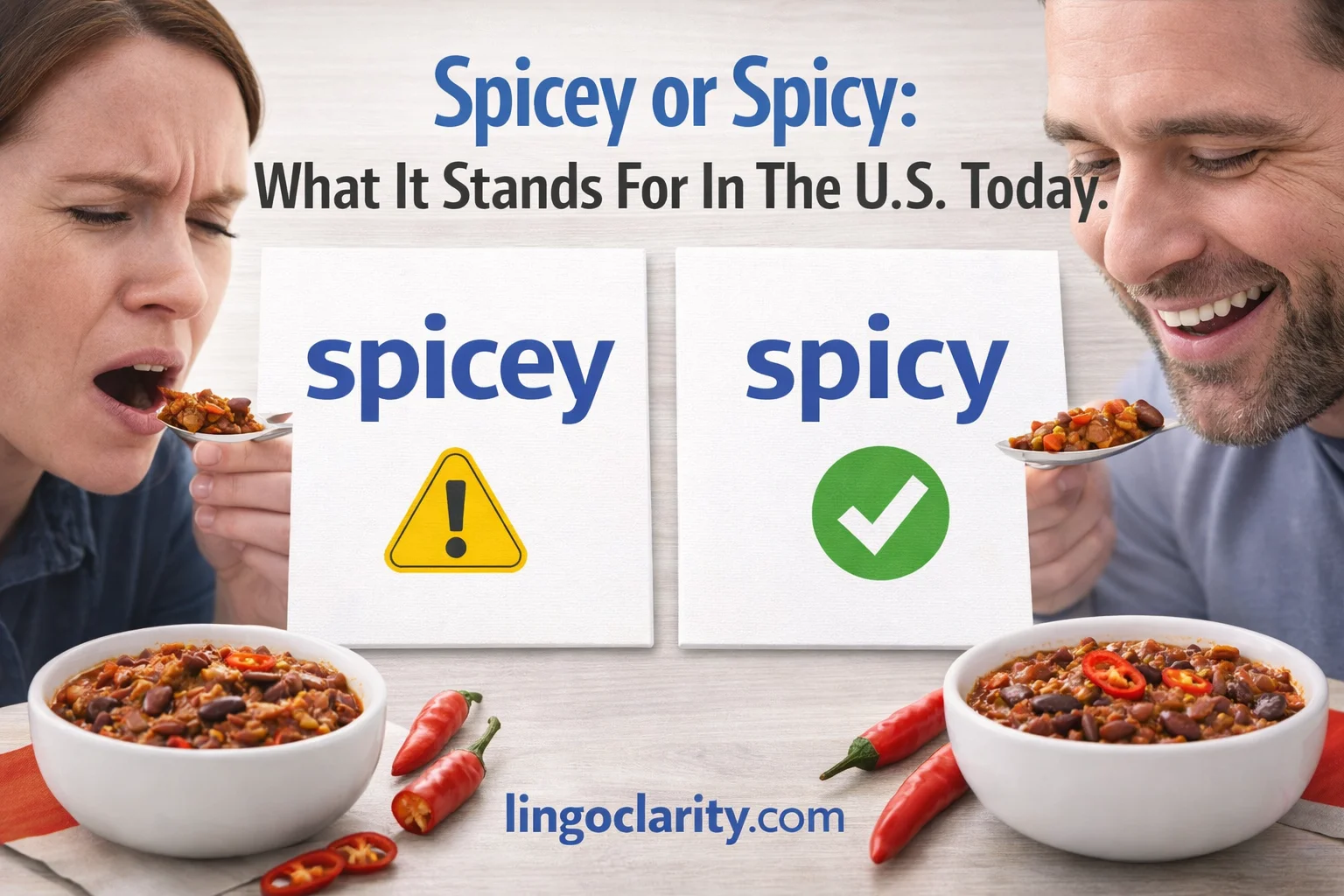
A lot of writers pause over this word because spicey looks logical at first. The base noun is spice, so it feels natural to think the adjective might keep that full spelling. But when you check current dictionaries and standard edited English, the form you find as the main entry is spicy, not spicey. Merriam-Webster lists spicey as a variant spelling of spicy, while Cambridge and Oxford list spicy as the standard adjective entry.
That leads to the real question. Is spicey completely wrong, or is it a real spelling that has simply fallen out of favor? The best current answer is this: spicy is the standard spelling you should use in normal US English, while spicey is a recorded variant in some dictionaries but not the preferred modern form for everyday writing.
Quick Answer
As of March 25, 2026, the spelling you should use in normal US English is spicy. Merriam-Webster gives spicey as a variant spelling, and Collins also redirects spicey to spicy, but major standard dictionary entries present spicy as the main form. In school writing, work writing, recipes, articles, product descriptions, and everyday messages, spicy is the safe and expected choice.
Tl;dr
• Spicy is the standard modern spelling.
• Spicey is a recorded variant, not a separate word.
• They point to the same meaning when people use them.
• This is not a US-versus-UK spelling split.
• In normal writing, choose spicy.
Why Writers Hesitate Between Spicey And Spicy
The confusion makes sense. English often looks pattern-based until it suddenly does not. A writer sees spice, adds -y, and expects spicey to work.
Other words make the confusion stronger. Forms like dicey and pricey can make spicey look familiar, even natural. That visual familiarity is exactly why many people hesitate.
But familiar-looking is not the same as standard. In this case, current dictionary treatment points clearly to spicy as the form readers expect. Merriam-Webster lists spicey only as a variant, while Cambridge and Oxford present spicy as the ordinary dictionary entry.
Are Spicey And Spicy Different Words?
No. They are not different words with different meanings. When someone writes spicey food, they almost always mean the same thing they would mean by spicy food. The difference is not meaning. The difference is spelling status. Merriam-Webster explicitly labels spicey a variant spelling of spicy, and Collins treats spicey as “see spicy.”
That point matters because many spelling comparisons are really meaning comparisons. This one is not. You are not choosing between two words with separate uses. You are choosing between the standard modern spelling and a nonpreferred variant spelling.
Which Spelling Is Standard In US English?
In modern US English, the spelling to use is spicy. Cambridge’s American Dictionary entry gives spicy as the adjective for food flavored with spices that are hot to the taste, and Oxford’s American English entry also lists spicy as the adjective form. Merriam-Webster uses spicy as the full main entry and sends spicey to it as a variant.
That is why spicy is the better choice in almost every normal setting:
• school essays
• business writing
• restaurant menus
• food blogs
• social captions
• product copy
• edited articles
In all of those places, spicy looks standard, polished, and immediately correct.
Is This A US-Versus-UK Difference?
No. This is not a real American-versus-British split. Cambridge lists spicy in both its general English and American dictionary views, and Oxford lists spicy in both its standard learner’s entry and its American English entry. That supports the practical conclusion that spicy is the standard choice on both sides of the Atlantic.
So you should not tell readers that spicey is the British spelling. That would be misleading. The more accurate explanation is simpler: spicy is the standard current spelling, and spicey survives as a variant noted by some dictionaries.
Why Spicy Is The Better Everyday Choice
A spelling can be documented and still be the wrong choice for most modern writing. That is exactly what is happening here.
Because spicy is the form used as the main dictionary entry, it is the form readers recognize fastest. It does not interrupt the sentence. It does not make readers wonder whether you made a typo. It just delivers the meaning and moves on.
By contrast, spicey often creates friction. Even if it has dictionary support as a variant, many readers will still treat it as a misspelling because it is not the standard form they are trained to expect. That alone is a strong reason to avoid it in polished writing. The goal is not merely to be defensible. The goal is to be clear on first reading.
When You May Still See Spicey
You may still run into spicey in a few situations.
One is when a dictionary records variant spellings for historical or continuing use. Merriam-Webster and Collins both do that here. Another is when a writer preserves an older spelling, keeps a quotation exact, or uses a brand or stylized name that intentionally chooses spicey.
That means spicey is not an invented fake form. It is documented. But being documented is not the same as being recommended for normal modern usage. In practical writing advice, the rule stays the same: write spicy unless you have a special reason to keep spicey.
How Spicy Works In Real English
One reason this word matters is that spicy is used in more than one sense. Cambridge and Merriam-Webster both show the food sense, and both also record figurative uses such as exciting, provocative, lively, or somewhat scandalous. Cambridge also includes a newer informal sense for tense or aggressive situations, as in “the game got a little spicy.”
That gives the word real range in modern English:
• food: spicy noodles, spicy wings, spicy salsa
• figurative tone: spicy gossip, spicy details, a spicy comment
• informal energy or conflict: things got spicy in the meeting
Those are all reasons the standard spelling matters. This is not a rare adjective. It is common across food writing, entertainment writing, and casual speech.
Common Mistakes Writers Make
The first common mistake is assuming the adjective should keep the full spelling of the noun spice. English spelling does not always work by simple visual logic, and this is one of those cases.
The second mistake is assuming that once a dictionary records a variant, both forms are equally strong. They are not always equal in recommendation, frequency, or reader expectation. Here, current dictionary structure shows that spicy is the main form and spicey is secondary.
The third mistake is using spicey in polished writing because it “looks right enough.” That is risky. In published or professional contexts, you usually want the spelling that no reader will question. That spelling is spicy.
Fast Fixes You Can Use Right Away
Use this simple rule set:
• If you are writing about food, flavor, heat, gossip, tone, or bold language, use spicy.
• If you are quoting a source that already says spicey, keep the original spelling.
• If you are writing about the spelling issue itself, you may mention both forms.
• If you want the safest everyday choice, choose spicy every time.
That rule will keep you out of trouble in almost every context.
Real Sentence Examples
Here are natural modern examples with the standard spelling:
• I ordered the spicy chicken sandwich because the regular one felt too plain.
• This curry is rich, warm, and pleasantly spicy.
• The interview turned spicy when the host asked about the rumor.
• Her post included a few spicy details that got everyone talking.
• Things got a little spicy in the comments section after the announcement.
Now compare that with this sentence:
• I ordered the spicey chicken sandwich.
A reader will usually understand it. But many readers will pause, and some will assume it is an error. That pause is exactly what good editing tries to remove.
Word Family: Spice, Spicy, Spiciness, And Spice Up
It also helps to see where this adjective sits in the word family. Cambridge lists spice as the noun for a plant-based substance used to flavor food. Merriam-Webster gives spicy as the adjective and also lists the derived forms spicily and spiciness. Oxford separately lists spice as a verb, which supports standard expressions such as spice the soup or spice up the story.
That leads to another useful writing point. Spicy and spicey are not verbs. If you need a verb, English uses spice or spice up, not spicy. If you need the noun for the quality, use spiciness.
Examples:
• Add garlic and pepper to spice up the sauce.
• The stew gets its spiciness from fresh chilies.
• Cinnamon is a common spice in sweet baking.
A Brief Note On History
Merriam-Webster dates spicy back to 1543, which shows that it is an old and well-established English adjective. The fact that standard dictionaries still record spicey as a variant also shows that the form has some historical or continuing presence. But current recommendation still points toward spicy as the standard modern spelling.
History can explain why a form exists. It does not automatically make that form the best modern choice.
Conclusion
If your question is practical, the answer is simple: use spicy.
If your question is technical, the fuller answer is this: spicey is not a different word with a different meaning, and some dictionaries still record it as a variant. But in modern US English, spicy is the standard spelling presented as the main dictionary form, and it is the spelling readers expect in edited writing.
So the best rule to remember is easy. Write spicy in everyday use. Keep spicey only when you are quoting, preserving a stylized name, or discussing the spelling issue itself.
Faqs
Is spicey ever correct?
Yes, in a limited sense. Merriam-Webster records spicey as a variant spelling of spicy, and Collins also treats it as a variant. So it is not an imaginary form. But it is still not the preferred choice for normal modern US writing.
Is spicy the correct spelling in American English?
Yes. Current American dictionary treatment supports spicy as the standard spelling. Cambridge’s American Dictionary and Oxford’s American English entry both use spicy as the main adjective form.
Is spicey the British spelling?
No. There is no strong evidence that this is a US-versus-UK split. Cambridge and Oxford both use spicy in their standard English and American entries.
Do spicey and spicy mean different things?
No. When people use them, they are pointing to the same adjective meaning. The difference is spelling status, not core meaning.
Use spicy. It is the standard form, it looks polished, and it is the version readers expect right away.
Can spicy be used outside food writing?
Yes. Current dictionary entries also use spicy for meanings such as provocative, lively, shocking, or tense, not just food-related heat.
