
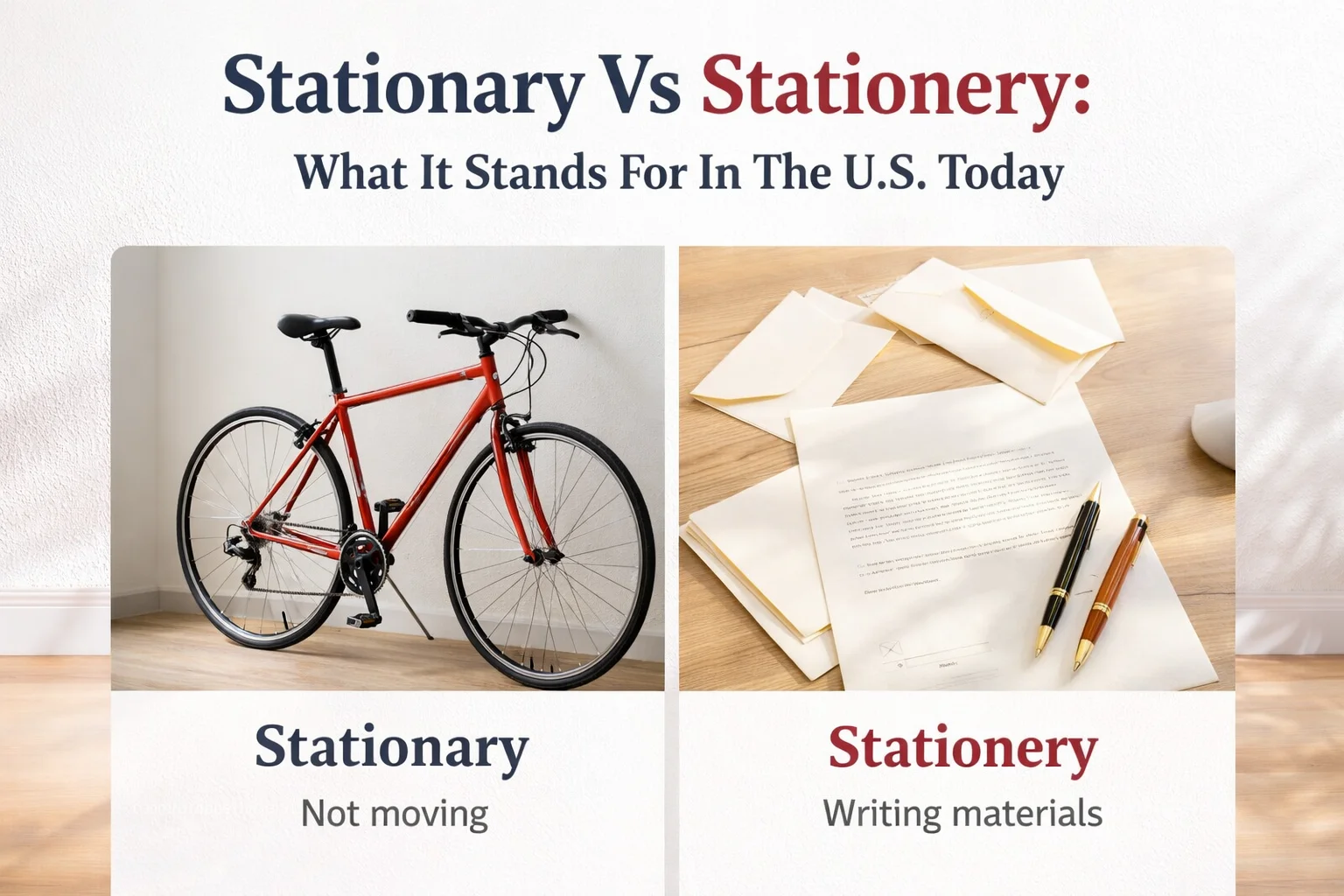
Many English word pairs cause confusion, but stationary and stationery are among the easiest to mix up. They sound almost exactly alike, they differ by just one letter, and they often appear in writing where spelling mistakes are easy to spot.
Even so, these two words do not mean the same thing.
One refers to something that is not moving. The other refers to writing materials, such as paper, envelopes, and related supplies. Because the words are so close in spelling and pronunciation, writers regularly swap them by accident. That small error can make polished writing look careless, especially in business communication, school assignments, marketing copy, invitations, or professional correspondence.
The good news is that the difference is actually simple once you see how each word works in context.
In this guide, you will learn the exact meaning of stationary and stationery, the grammar role of each word, the most common mistakes people make, and how to remember the difference quickly. You will also see real examples, practical usage tips, and a clear memory trick that makes the correct choice much easier.
Quick Answer
Use stationary when something is not moving, fixed in place, or staying mostly unchanged.
Use stationery when you mean writing paper, envelopes, note cards, letterhead, or related writing supplies.
Here is the difference in one glance:
- stationary = still, fixed, unmoving
- stationery = paper goods and writing materials
Examples:
- The car remained stationary at the intersection.
- We ordered new branded stationery for the office.
If you are talking about a bike, a car, a traffic jam, a weather front, or anything staying still, the correct word is stationary. If you are talking about invitations, thank-you cards, letterhead, or note paper, the correct word is stationery.
Why These Two Words Are So Often Confused
There are three main reasons people mix up stationary and stationery.
First, they are pronounced the same way by most speakers in everyday American English. When two words sound alike, spelling mistakes become much more likely, especially in casual writing.
Second, the spelling difference is tiny. The only real visual distinction is the a in stationary and the e in stationery. When you are typing quickly, proofreading lightly, or relying on memory instead of meaning, that one-letter difference is easy to miss.
Third, the words belong to different grammar categories. Stationary is mainly an adjective, while stationery is a noun. That means they do different jobs in a sentence, even though they look like a matched pair.
Because of all this, people often choose the word that “looks right” instead of the word that actually fits the meaning.
Key Difference At A Glance
| Context | Correct Word | Why |
|---|---|---|
| A car waiting at a red light | stationary | It means not moving |
| A bike that stays in one place | stationary | It describes something fixed |
| Wedding invitations and envelopes | stationery | These are writing materials |
| Company letterhead and note cards | stationery | This refers to paper goods |
| A weather front that is not moving | stationary | It describes a fixed condition |
| Personalized thank-you paper | stationery | It refers to writing supplies |
That is the whole distinction. Once you know whether you are describing a condition or naming a set of materials, the choice becomes much easier.
Stationary Meaning And Usage
Stationary is mainly an adjective. It describes something that is not moving, not changing position, or sometimes not changing much over time.
This word often appears in contexts involving motion, transportation, weather, science, data, or physical position.
Common uses include:
- stationary car
- stationary bike
- stationary target
- stationary front
- remain stationary
In each of these examples, the idea is the same: something is staying still.
Consider these sentences:
- The bus remained stationary for several minutes after the accident.
- During the workout, she used a stationary bike instead of running outdoors.
- The storm system stayed stationary over the coastline overnight.
- For most of the afternoon, the drone appeared nearly stationary in the air.
The word can also be used more broadly to suggest little or no change, not just physical stillness.
For example:
- Prices remained relatively stationary during the final quarter.
- The population stayed largely stationary for several years.
In those cases, stationary still carries the idea of not moving, but in a more abstract sense.
Stationery Meaning And Usage
Stationery is a noun. It refers to writing materials, especially paper goods used for correspondence, communication, and professional presentation.
Typical examples of stationery include:
- writing paper
- envelopes
- note cards
- letterhead
- thank-you cards
- invitation sets
- personalized paper goods
In some contexts, people use stationery broadly to include related supplies, but the central idea is still paper-based writing or correspondence materials.
Examples:
- She bought elegant floral stationery for her handwritten notes.
- The company redesigned its stationery after the rebrand.
- Our office keeps plain stationery for formal letters and printed memos.
- They chose cream-and-gold stationery for their wedding invitations.
Unlike stationary, which describes a condition, stationery names a thing or category of things.
That difference matters because it affects sentence structure.
Compare these:
- The train is stationary.
- The office ordered new stationery.
In the first sentence, the word describes the train. In the second sentence, the word names the materials being ordered.
Grammar Difference: Adjective Vs. Noun
One of the easiest ways to separate these two words is to look at their grammar role.
| Word | Part Of Speech | Meaning | Example |
|---|---|---|---|
| Stationary | Adjective | Not moving; fixed; unchanged | The truck remained stationary. |
| Stationery | Noun | Writing materials; paper goods | She bought new stationery. |
If the word is describing a noun, stationary may be correct.
If the word itself is the thing being discussed, stationery may be correct.
Here is a quick test:
- Can you replace the word with still, fixed, or motionless? Use stationary.
- Can you replace the word with writing paper, letterhead, or paper goods? Use stationery.
This simple grammar check prevents most mistakes.
How To Remember The Difference
The best memory trick is this:
Stationery has an e, just like envelope.
That works because envelopes are a classic example of stationery.
You can also remember it this way:
- stationary = stays still
- stationery = supplies for letters
Both tricks are practical, easy to recall, and useful when you are writing quickly.
When To Use Stationary
Use stationary when the main idea is stillness, lack of movement, or a fixed condition.
You should choose stationary in sentences about:
- vehicles not moving
- fitness equipment that stays in one place
- weather systems that do not shift
- objects remaining fixed
- trends or conditions showing little change
Examples:
- The vehicle stayed stationary at the curb.
- He exercises on a stationary bike every morning.
- The front remained stationary, bringing hours of rain.
- The statue stood completely stationary in the center of the plaza.
- After the sharp drop, prices were mostly stationary.
In each case, the focus is on stillness or minimal change.
When To Use Stationery
Use stationery when you are referring to physical writing materials, especially in personal, business, ceremonial, or retail contexts.
You should choose stationery in sentences about:
- business letterhead
- note cards
- invitations
- branded paper goods
- personalized writing paper
- office correspondence materials
Examples:
- The assistant ordered fresh stationery for the reception desk.
- I prefer thick cotton stationery for thank-you notes.
- Their wedding stationery matched the color palette perfectly.
- The nonprofit mailed donors a letter printed on custom stationery.
- She collects vintage stationery with embossed borders.
Here, the word refers to actual materials, not a condition.
Common Mistakes Writers Make
Even careful writers mix these up. Here are the most common mistakes and how to fix them.
Using Stationary For Paper Goods
Incorrect:
We ordered new company stationary.
Correct:
We ordered new company stationery.
Why it is wrong: Company paper goods, envelopes, and letterhead are stationery, not something fixed in place.
Using Stationery For Something That Is Not Moving
Incorrect:
The bus remained stationery for ten minutes.
Correct:
The bus remained stationary for ten minutes.
Why it is wrong: A bus that is not moving is being described, so the adjective stationary is needed.
Treating Stationery Like A Normal Plural Count Noun
In standard usage, stationery is usually noncount.
More natural:
- some stationery
- personalized stationery
- a set of stationery
Less natural in ordinary usage:
- three stationeries
When in doubt, treat stationery like a material noun rather than a simple item count.
Real-World Examples In Everyday Writing
Seeing the words in realistic settings makes the difference clearer.
In Business Writing
A marketing assistant might write:
- We need to reorder branded stationery before the conference.
- The delivery truck remained stationary behind the loading dock.
Both sentences are correct, but they use completely different words because the meanings are different.
In Personal Writing
Someone planning an event might say:
- I found beautiful stationery for the bridal shower invitations.
- Traffic was completely stationary on the bridge.
Again, one sentence refers to paper goods, and the other describes a lack of movement.
In Professional Editing
Editors often catch mistakes like these:
- incorrect website copy saying “custom stationary available”
- incorrect brochure text saying “all vehicles must remain stationery”
These errors are small, but they can weaken trust, especially in polished public content.
Phrases You Will Commonly See
Here are standard phrases that make the distinction easy to remember.
With Stationary
- stationary bike
- stationary vehicle
- stationary target
- stationary front
- remain stationary
With Stationery
- business stationery
- wedding stationery
- personal stationery
- office stationery
- custom stationery
If a phrase sounds familiar, that can help. For example, most people have seen stationary bike many times, while wedding stationery is common in event planning and retail.
Tone, Context, And Formality
Neither word is more formal or more correct in general. Each is correct only when used in the right context.
Stationary is straightforward descriptive English. It works in casual writing, news reporting, technical writing, weather reports, and everyday conversation.
Stationery can feel slightly more traditional or polished because it is often linked to handwritten communication, invitations, and formal paper goods. Even so, it is still a normal modern word, especially in business, design, branding, and retail settings.
For example:
- “The equipment remained stationary throughout the test” sounds technical and precise.
- “The brand introduced a premium stationery collection” sounds polished and commercial.
Both are standard. The context determines the word.
Why The Difference Matters In Professional Writing
Some spelling mistakes are easy for readers to forgive. This one often is not.
Because stationary and stationery are common confusion words, using the wrong one can stand out immediately in resumes, websites, brochures, presentations, emails, product descriptions, and classroom writing.
A business that advertises “luxury stationary” may appear careless, even if the rest of the content is strong. In the same way, a report that says traffic was “stationery” may distract the reader and weaken confidence in the writing.
Using the right form shows attention to detail.
That matters in:
- content marketing
- academic writing
- business communication
- client-facing materials
- invitation copy
- educational content
- SEO articles and blog posts
A Simple Final Test Before You Publish
If you want one last proofreading trick, use this check:
Ask yourself, Am I describing something that stays still, or am I naming writing materials?
If it stays still, use stationary.
If it is paper goods, use stationery.
You can also swap in a quick replacement:
- “The bike is still” = stationary
- “The set includes envelopes” = stationery
That fast test works in almost every case.
FAQs
What is the difference between stationary and stationery?
Stationary means not moving or staying fixed. Stationery means writing paper, envelopes, and related materials. The first is mainly an adjective, and the second is a noun.
Is it stationary bike or stationery bike?
The correct phrase is stationary bike because the bike stays in one place while you use it.
Does stationery only mean paper?
Usually, stationery refers mainly to paper goods used for writing or correspondence, such as letterhead, note cards, and envelopes. In broader use, it can also include related writing supplies.
Why do people confuse stationary and stationery?
People confuse them because they sound alike, look very similar in spelling, and differ by only one letter.
How do I remember which spelling is correct?
Remember this: stationery has an e for envelope. If you are talking about writing materials, that is the correct word.
Can stationary mean unchanged, not just still?
Yes. Although it often describes something physically not moving, stationary can also describe something that remains largely unchanged over time.
Conclusion
The difference between stationary and stationery is simple once you focus on meaning.
Choose stationary when something is still, fixed, or not changing much.
Choose stationery when you mean writing materials, paper goods, envelopes, or letterhead.
If you remember one quick rule, make it this:
Stationery goes with envelopes. Stationary goes with staying still.
That one line is usually enough to keep the two words straight.
