
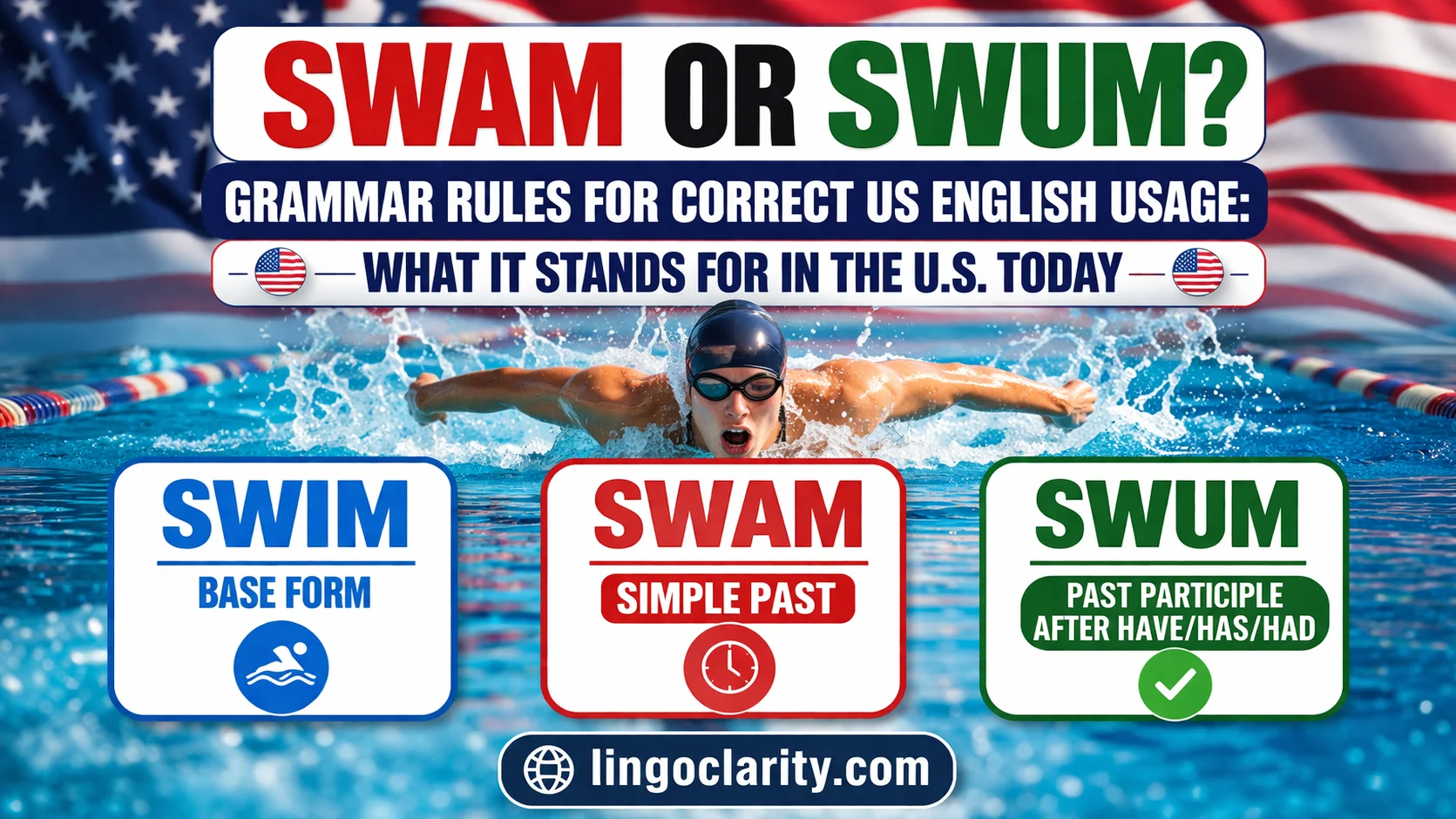
Swam or swum trips up English learners and native speakers alike, because both forms are real, both come from the irregular verb swim, and both point to an action already finished. They are not interchangeable. In standard US English, swam is the simple past form and swum is the past participle, so the correct choice depends on the grammar pattern around the verb, not simply on the fact that the action happened before now. Major dictionary and grammar references, including Merriam-Webster and Cambridge, agree on this split.
That is why “I swam in the lake yesterday” is correct, while “I have swam in that lake before” is not standard in edited US English. Add have, has, or had and you need the past participle: “I have swum in that lake before.” Perfect tenses use have plus a past participle, and passive structures use be plus a past participle, which is exactly where swum belongs.
TL;DR
- Swam = simple past. No helping verb. I swam.
- Swum = past participle. Needs have, has, had, or a form of be. I have swum.
- The verb pattern is swim – swam – swum (present – simple past – past participle).
- If you can delete a helping verb from the sentence, you want swam. If a helping verb is doing work, you want swum.
- “Have swam” and “had swam” are the two most common errors in edited US English.
Quick Answer
Swam or swum? Use swam for the simple past, with no helping verb attached. Use swum after a helping verb such as have, has, or had, and inside passive constructions built with a form of be.
Correct examples:
- I swam yesterday.
- She swam after class.
- I have swum there before.
- They had swum two laps before lunch.
- The final leg was swum by the anchor.
A fast memory trick:
- No helping verb? Usually swam
- Have, has, or had? Use swum
- Be plus past participle in passive voice? Use swum
Swam vs Swum at a Glance
| Swam | Swum | |
|---|---|---|
| Verb form | Simple past | Past participle |
| Helping verb needed? | No | Yes (have/has/had or be) |
| Typical tenses | Simple past | Present perfect, past perfect, passive |
| Correct example | She swam across the bay. | She has swum across the bay twice. |
| Common error | “I have swam” | “I swum yesterday” |
| US English status | Standard | Standard |
Simple Definition
Here is the simplest way to think about it:
- Swam = the form you use for a completed action in the past
- Swum = the form you use after have, has, or had
In other words, swam stands on its own, while swum usually needs a helper.
Compare these:
- I swam across the pool.
- I have swum across that pool many times.
Both sentences are correct. The difference is grammatical, not a change in the basic meaning of swim. The verb still means to move through water by using your body.
The Core Grammar Rule
The core rule is straightforward:
Use swam as the past tense of swim. Use swum as the past participle of swim.
That leads to these standard patterns:
- I swam
- She swam
- We swam
- I have swum
- She has swum
- They had swum
- The race was swum
The first group uses the past tense. The second and third groups use the past participle. English perfect tenses are built with have + past participle, and passive forms are built with be + past participle. That is why swum belongs there.
Why Writers Mix Them Up
This mistake is common for a few reasons.
First, many irregular verbs in English are hard to remember because they do not follow one neat pattern. Second, swum can sound formal or unusual to some speakers, especially in casual conversation. Third, some people hear nonstandard spoken forms such as have swam and then carry them into writing. Merriam-Webster notes that these spoken patterns exist, but it still treats swum as the standard participle in careful writing.
That point matters because conversation and edited writing are not always identical. A phrase may be heard in everyday speech and still be considered nonstandard for school, business, and formal publishing.
When To Use Swam
Use swam when you are talking about a finished action in the past and there is no helping verb such as have, has, or had.
You will often see swam with time markers like these:
- yesterday
- last night
- last summer
- an hour ago
- this morning
- in 2024
Examples:
- I swam before breakfast.
- She swam across the lake last summer.
- We swam at the hotel pool after dinner.
- My daughter swam in her first meet on Saturday.
In each sentence, swam works by itself as the main verb in the simple past. That is the normal and expected pattern in US English.
When To Use Swum
Use swum when the sentence needs the past participle.
Most often, that means it appears after:
- have
- has
- had
- will have
Examples:
- I have swum in that pool before.
- She has swum competitively since high school.
- They had swum three laps before the coach stopped practice.
- By next month, he will have swum in every regional meet.
This pattern follows a broader English rule, not a special exception for this verb. Perfect tenses use a form of have plus the past participle. Since swum is the past participle of swim, it is the correct choice there.
Can Swum Appear Without Have, Has, Or Had?
Yes, but usually in passive voice.
Examples:
- The final lap was swum in record time.
- The opening heat was swum in calm water.
- The relay was swum by the strongest team.
These sentences are grammatical because the passive is formed with be + past participle. Since swum is the past participle, it fits. That said, this structure is less common in everyday conversation than the perfect-tense pattern.
Real-Life Example
Imagine a student describing a weekend swim lesson:
- Yesterday, I swam for thirty minutes before lunch.
- I have swum at that pool for three summers now.
- By the time practice ended, I had swum ten laps.
These three sentences all talk about swimming, but each uses a different time frame.
The first sentence points to one finished event in the past, so swam is right.
The second sentence connects past experience to the present, so have swum is right.
The third sentence places one past action before another past moment, so had swum is right. English grammar sources explain that both the present perfect and past perfect use the past participle, which is why swum appears in those patterns.
Meaning And Tense Difference
The difference between swam and swum is mostly about grammar structure, but that structure can create a small difference in time focus.
- I swam there last year.
This points to one finished action at a clear past time. - I have swum there before.
This describes past experience that matters now. - I had swum there before college.
This places the swimming before another past point.
So the choice is not about one form being stronger, fancier, or more formal. It is about matching the correct tense pattern.
Sentence Usage
Here are more natural sentence examples you can model in your own writing.
Simple Past With Swam
- I swam after work.
- We swam in the ocean during our trip.
- He swam faster than anyone else in his lane.
- They swam for an hour before the storm arrived.
Perfect Tenses With Swum
- I have swum in colder water than that.
- She has swum since childhood.
- We had swum long enough to feel tired.
- By July, they will have swum in three state finals.
Passive Voice With Swum
- The final heat was swum indoors.
- The race was swum under difficult conditions.
These examples all follow the same verified rule: swam for simple past, swum for the participle.
Synonyms And Opposite Ideas
Because this article focuses on grammar, the main issue is verb form, not vocabulary. Still, some readers also want a quick meaning guide.
The base verb swim means to move through water by using your body. Depending on context, close substitutes can include phrases such as go swimming, take a dip, or sometimes paddle or float, though those do not always mean exactly the same thing.
There is no perfect one-word opposite of swim in every context. However, opposite ideas may include:
- sink
- stay on land
- avoid the water
Use these carefully, because they are not strict grammar opposites. They are only contrast ideas. Some thesaurus entries also list sink among opposites in certain contexts.
Common Mistakes
Here are the mistakes that show up most often.
Mistake 1: Using Swam After Have, Has, Or Had
Wrong: I have swam in that river before.
Right: I have swum in that river before.
Why it is wrong: perfect tenses need the past participle, and the past participle is swum, not swam.
Mistake 2: Using Swum As A Stand-Alone Past Tense
Wrong: We swum after dinner.
Right: We swam after dinner.
Why it is wrong: the simple past form is swam. Swum does not usually stand alone unless it appears in a passive construction.
Mistake 3: Writing Swimmed
Wrong: She swimmed across the lane.
Right: She swam across the lane.
Why it is wrong: swim is irregular. Standard English does not use swimmed. Merriam-Webster specifically warns against it.
Mistake 4: Choosing By Sound Instead Of Structure
Many writers choose the form that sounds more natural to them. That is risky with irregular verbs. A better method is to check the sentence structure first:
- no helper = likely swam
- have / has / had = swum
- passive with be = swum
That quick check prevents most errors.
A Quick Memory Trick
Use this short formula:
Yesterday, I swam.
In my life, I have swum.
The first sentence sounds like a completed past event. The second sounds like experience connected to the present. Once you memorize those two patterns, the rule becomes much easier to apply.
Another easy test is this: look for a helping verb.
- No helping verb? Pick swam
- Helping verb present? Pick swum
Why This Matters In US English Writing
This is a small grammar point, but it affects clarity and polish. In casual speech, many listeners may understand both forms. In edited writing, though, the difference matters because it signals control of tense and sentence structure. That is especially important in school papers, resumes, emails, workplace writing, and online publishing.
Readers may not always explain the error, but they often notice when a verb form sounds off. Choosing the standard form keeps your writing smoother and more credible.
Frequently Asked Questions
Is “I have swam” ever correct?
Not in standard written US English. The correct form is I have swum because the present perfect uses have + past participle, and swum is the past participle of swim. Merriam-Webster notes that have swam may appear in casual speech, but it is still nonstandard for careful writing.
Is “I had swam” correct?
No. The correct past perfect form is I had swum. Past perfect uses had + past participle, so swum is required.
Can swum be used without have, has, or had?
Yes. It can appear in passive voice, as in “The final lap was swum by the captain.” Passive structures use be + past participle, so swum is correct there.
Is swimmed a real standard form?
No. Standard English uses the irregular pattern swim, swam, swum. Swimmed is not the accepted standard form.
Why do some people say swam after have?
Usually because spoken language is flexible, and nonstandard patterns often spread through habit, region, or informal speech. Even so, standard dictionaries and grammar references still treat swum as the correct participle after have, has, and had.
Which form is safer for formal writing?
Use swam for simple past and swum for the participle. That is the safest and most widely accepted choice in formal US English.
Final Verdict
Both swam and swum are correct, but they are not interchangeable.
Use swam when you need the simple past:
- I swam yesterday.
- We swam after class.
Use swum when you need the past participle:
- I have swum there before.
- She had swum two laps already.
- The race was swum indoors.
That is the rule standard US English follows. Once you remember that swam stands alone and swum needs a helper or passive structure, the choice becomes much easier.
For most writers, the cleanest way to remember it is this:
I swam yesterday.
I have swum there before.
That pair covers the rule, the tense pattern, and the usage difference in one quick glance.
