
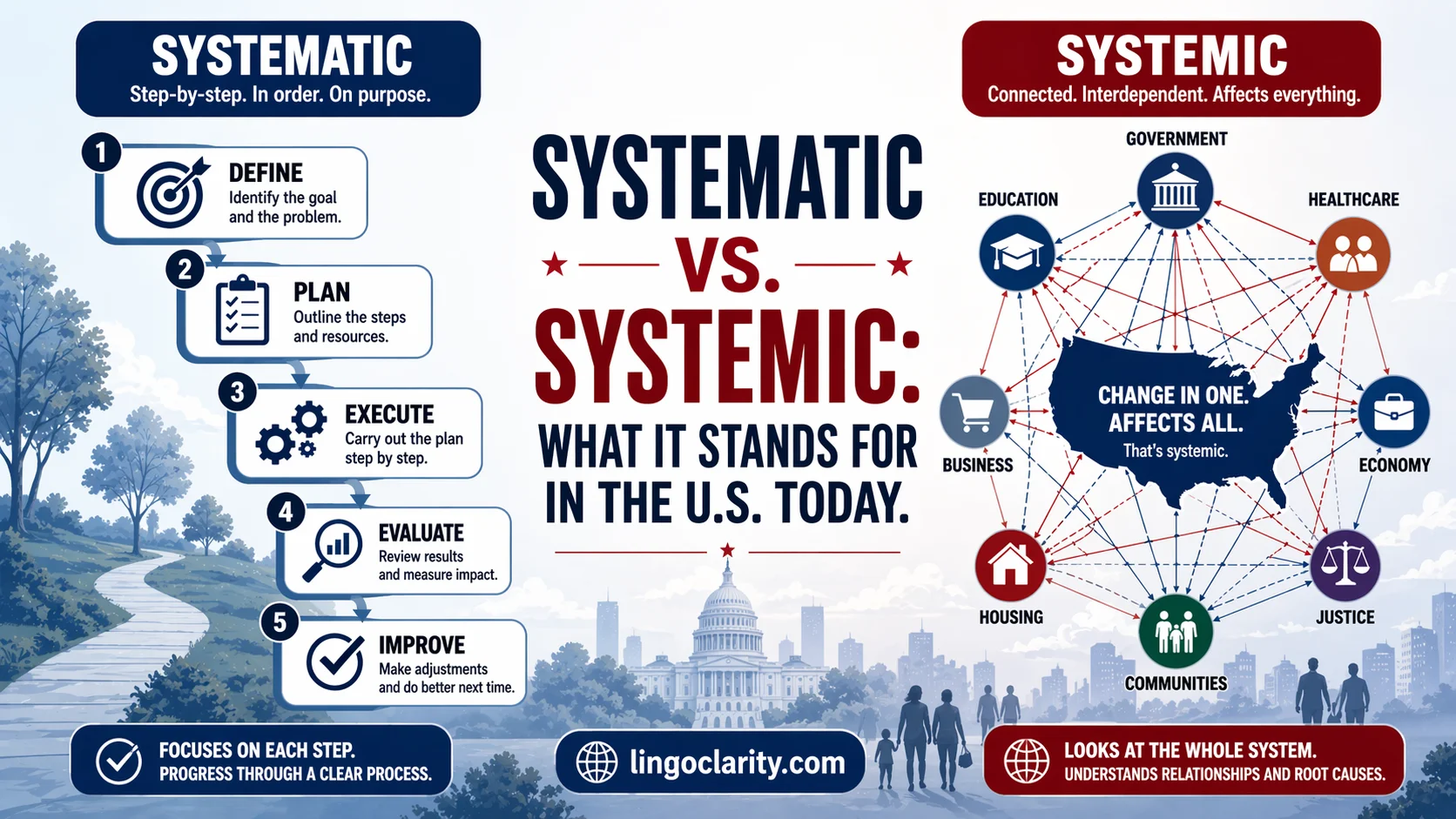
Use systematic when you mean organized, methodical, or done according to a plan. Use systemic when you mean connected to an entire system, spread through it, or built into it. That is the core distinction used by major dictionaries and usage guides.
So if a team follows a careful checklist, that is systematic. If a company has a problem rooted in how the whole organization works, that is systemic.
Systematic Vs. Systemic At A Glance
| Context | Right Word | Why |
|---|---|---|
| A step-by-step hiring process | Systematic | The focus is method and order |
| A structured literature review | Systematic | The focus is explicit method |
| Bias built into an institution | Systemic | The issue is rooted in the wider system |
| A disease affecting the whole body | Systemic | The effect is body-wide |
| A careful audit plan | Systematic | The process is organized |
| A deep failure across a school district | Systemic | The problem affects the whole structure |
If you only remember one rule, make it this: systematic describes how something is done; systemic describes where a condition exists or how broadly it spreads.
What Systematic Means
Systematic usually means done according to a system, plan, or organized method. It often carries the sense of being careful, orderly, thorough, or step by step. Merriam-Webster and Cambridge both define it around an agreed method or system rather than a whole-system condition.
That is why systematic commonly appears with words like:
- approach
- process
- method
- review
- search
- training
- analysis
- checklist
Examples:
- The editors used a systematic process to fact-check every quote.
- She took a systematic approach to reorganizing the archive.
- The lab followed a systematic testing procedure.
In all three examples, the spotlight is on method. The sentence tells you something about procedure, not about a whole system being affected.
What Systemic Means
Systemic means relating to a system as a whole, affecting the whole system, or being embedded in it. In medicine, it often means affecting the entire body rather than one local area. In organizational, social, and political writing, it often means a problem is structural rather than isolated. Merriam-Webster, Cambridge, and the National Cancer Institute all support that whole-system or whole-body sense.
That is why systemic commonly appears with words like:
- problem
- issue
- change
- risk
- bias
- inequality
- failure
- disease
Examples:
- The investigation found systemic weaknesses in the approval chain.
- The lawsuit alleges systemic discrimination, not a single bad decision.
- Doctors ruled out a systemic infection because the symptoms stayed local.
In each sentence, the scope is broad. The issue is not just one action or one part. It reaches through the larger system.
The Core Difference
A simple way to separate the two words is to ask one of these questions:
- How is it being done? If that is the question, you probably want systematic.
- Where does the problem or effect exist? If that is the question, you probably want systemic.
Compare these:
- The company introduced a systematic onboarding plan.
The focus is the method. - The company has a systemic communication problem.
The focus is the condition of the organization itself.
That distinction sounds small, but it changes meaning fast. A systematic failure would suggest a repeated, patterned, or method-driven failure. A systemic failure suggests a failure built into the whole system.
When To Use Systematic
Choose systematic when you mean any of the following:
- planned
- methodical
- structured
- organized
- consistent
- step by step
It is often close in meaning to methodical, organized, or structured.
Examples in natural US English:
- We need a systematic way to review customer complaints every Friday.
- The professor designed a systematic framework for evaluating sources.
- Police carried out a systematic search of the area.
- The team made systematic improvements instead of random changes.
One especially important phrase is systematic review. In research and evidence-based fields, that is the standard term for a review that uses explicit, preplanned methods to identify, assess, and synthesize evidence. Cochrane uses the term in exactly that formal sense.
So if you are writing about academic research, healthcare evidence, or literature review methods, systematic review is the correct phrase, not systemic review.
When To Use Systemic
Choose systemic when you mean any of the following:
- system-wide
- structural
- built in
- embedded
- affecting the whole
- spread through the system
It is often close in meaning to system-wide or, in some contexts, structural.
Examples:
- The audit exposed systemic problems in procurement.
- The city is trying to address systemic transit failures, not just one delayed line.
- Investors worried about systemic risk after the collapse.
- The medication is systemic, so it affects the body more broadly.
In medicine, systemic is standard when a disease, drug, or effect involves the whole body. The NCI definition is straightforward: systemic means affecting the entire body. Cambridge uses the same whole-body idea for disease, drugs, and poison.
Special Cases That Trip Writers Up
Systematic Review Vs. Systemic Review
This one is easy once you know what matters. A review is a method, so the standard term is systematic review. The point is that the evidence is gathered and assessed in a structured, transparent way. Cochrane treats that method as foundational.
Systemic Problem Vs. Systematic Problem
Most of the time, writers mean systemic problem when they are talking about a problem rooted in institutions, structures, or policies. That is why phrases like systemic racism, systemic inequality, and systemic failure are so common in modern usage. Merriam-Webster explicitly notes that systemic is used for conditions fundamental to a dominant social, economic, or political practice.
That said, systematic problem is not impossible. It can make sense if the meaning is regular, patterned, or methodical, not necessarily system-wide. This is exactly why rigid “always wrong” advice can mislead writers.
Systematic Bias Vs. Systemic Bias
These are not the same phrase. In research and testing, systematic bias is a technical term for bias caused by the design or method of a study or instrument. Cambridge specifically defines systematic bias that way. Systemic bias, by contrast, points to bias embedded across a larger institution or structure.
Can Both Words Work In The Same Topic?
Yes. They can even appear in the same sentence if they describe different things.
Example:
“The researchers used a systematic review process to study systemic inequality in housing.”
That sentence is perfectly clear because each word is doing a different job.
Common Mistakes To Avoid
The most common mistake is choosing systematic just because the sentence contains the word system. That is not the test. The real test is meaning.
Wrong idea:
- “It has something to do with a system, so I’ll use systematic.”
Better test:
- Is this about a method? Use systematic.
- Is this about the whole system? Use systemic.
Another common mistake is reaching for systemic just because it sounds heavier or more serious. Serious tone is not the issue. Meaning is.
- “We need a systematic process for storing contracts.”
Correct, because this is about procedure. - “We found systemic failures in contract oversight.”
Correct, because this is about a broader institutional problem.
A third mistake is assuming one word is more formal than the other. Both are standard and fairly formal. The better choice depends on meaning, not prestige.
A Fast Way To Choose The Right Word
Use this quick test when you are stuck:
- If methodical fits, choose systematic.
- If system-wide or structural fits, choose systemic.
Examples:
- a systematic filing method = a methodical filing method
- a systemic governance issue = a system-wide governance issue
That shortcut is not perfect in every edge case, but it works in most everyday writing.
Real-World Examples
Here are clean examples you can model:
- The hospital adopted a systematic screening process for new patients.
- The board report described systemic governance failures.
- Her notes were so systematic that anyone on the team could follow them.
- The reform effort targets systemic barriers in housing access.
- Researchers completed a systematic review of the evidence.
- The doctor explained that the infection was local, not systemic.
- We need a systematic training plan before the rollout.
- The memo argues that the issue is systemic, not the fault of one manager.
FAQ
Is systemic the same as systematic?
No. Systematic means organized or methodical. Systemic means relating to or affecting an entire system. Major dictionaries treat them as related but distinct words.
Why is it systematic review and not systemic review?
Because a review is a method. A systematic review follows explicit, structured steps for finding and evaluating evidence. That is the standard research term used by Cochrane and other evidence-based sources.
What does systemic mean in medicine?
In medicine, systemic usually means affecting the whole body, not just one part. That is the standard definition used by medical reference sources such as the NCI and Cambridge.
Can a problem be both systemic and systematic?
Sometimes, yes, but only if you mean two different things at once. A problem can be systemic because it is built into a larger institution, and the same problem can be systematic if it happens in a regular, patterned, or method-driven way. The words are not synonyms, but they can describe different aspects of the same situation.
Is systemic always negative?
No. It often appears in discussions of deep problems, but it can also be neutral or positive. You can talk about systemic change, systemic reform, or a systemic treatment in medicine. The word itself is not negative; the surrounding context often is.
What is the easiest way to remember the difference?
Remember it this way: systematic = step by step; systemic = system-wide. If you are describing a process, choose systematic. If you are describing a condition of the whole system, choose systemic.
Final Takeaway
The difference is simple once you frame it the right way.
Choose systematic for a method.
Choose systemic for a whole system.
That covers the vast majority of cases in modern US English. If your sentence is about process, order, or a planned approach, go with systematic. If it is about a condition embedded in a structure or spread across an entire body, institution, or network, go with systemic.
