
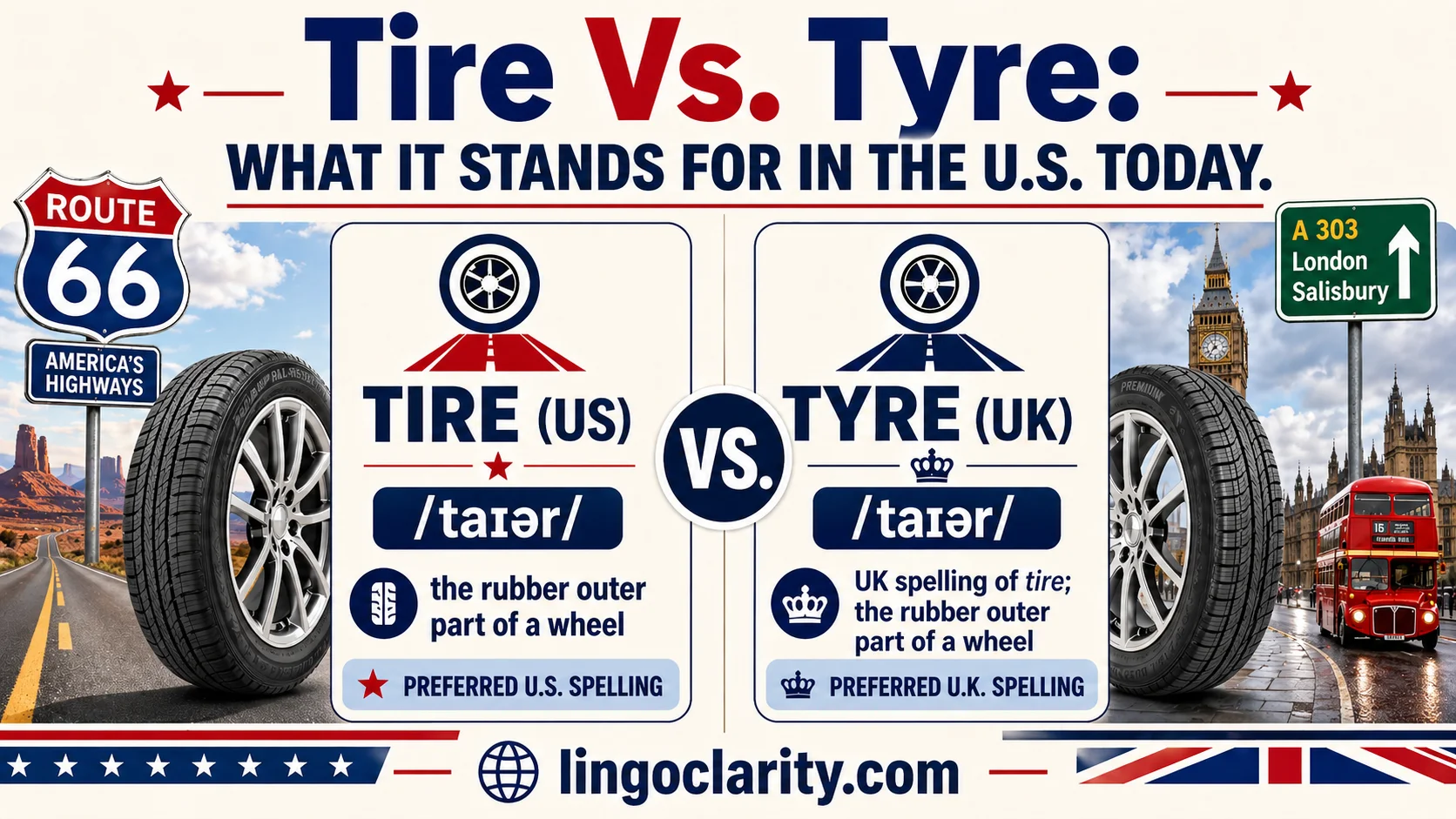
Use tire for American English. Use tyre for British English.
Tire vs. Tyre is a regional spelling difference: use tire in American English and tyre in British English when referring to the rubber part fitted around a car, truck, motorcycle, or bicycle wheel. The two words mean the same thing, but the correct spelling depends on your audience. Therefore, if you are writing for readers in the United States, tire is the natural and correct choice.
The difference is not about pronunciation, product type, quality, or function. Instead, it is a regional spelling difference. In other words, a tire and a tyre are the same wheel part, but the spelling changes from one audience to another.
Quick Answer
For US readers, write tire.
For British readers, write tyre.
Correct in American English:
- I need a new tire.
- The tire pressure light came on.
- She got a flat tire on the highway.
- The mechanic replaced both front tires.
Correct in British English:
- I need a new tyre.
- The tyre pressure warning came on.
- She got a flat tyre on the motorway.
- The garage replaced both front tyres.
Although both words describe the same object, they do not belong in the same style of writing. As a result, switching between tire and tyre in one article can make the writing look careless.
Tire Vs. Tyre: What Is The Difference?
Tire is the standard American spelling for the wheel noun. Tyre is the standard British spelling for the same wheel noun.
For example, an American driver would usually say:
- I have a flat tire.
By contrast, a British driver would usually say:
- I have a flat tyre.
The meaning is the same. However, the spelling tells readers which variety of English the writer is using.
| Context | Correct Choice | Example |
|---|---|---|
| American English | tire | The shop replaced one damaged tire. |
| British English | tyre | The garage replaced one damaged tyre. |
| US automotive content | tire | Check your tire pressure monthly. |
| UK automotive content | tyre | Check your tyre pressure monthly. |
| Verb meaning “become tired” | tire | Long drives can tire your eyes. |
| Brand or company name | Keep the official spelling | Do not change a business name that uses “Tire” or “Tyre.” |
| Direct quotation | Keep the original spelling | Do not silently change quoted British text to American spelling. |
In most everyday speech, tire and tyre are pronounced the same way: TY-er, rhyming with higher. Therefore, this is mainly a writing issue, not a speaking issue.
Which Spelling Should US Writers Use?
US writers should use tire when they mean the rubber part around a wheel.
That applies to everyday writing, school assignments, news articles, repair guides, ecommerce pages, product descriptions, insurance claims, driving-safety content, and automotive service pages. In addition, it applies to related terms such as tire pressure, tire tread, spare tire, and flat tire.
Correct US examples:
- The mechanic patched the tire.
- The car needs four new tires.
- Low tire pressure can affect handling.
- Keep a spare tire in the trunk.
- My bike tire keeps losing air.
- The front tire has uneven tread wear.
For an American audience, tyre usually looks like a typo. However, there are a few exceptions. You may keep tyre when it appears in a British company name, a direct quotation, a book title, a source title, or a product name that officially uses British spelling.
For example, do not rewrite a UK company’s name just to match American style. Likewise, do not change the spelling inside a direct quotation unless your publication’s style guide specifically allows it and you clearly indicate the change.
When To Use Tyre
Use tyre when you are writing in British English or following a British-style editorial guide.
For example:
- The rear tyre is worn.
- Check the tyre pressure before a long journey.
- The garage fitted winter tyres.
- The spare tyre is stored under the boot floor.
- The cyclist repaired a punctured tyre.
You may also see tyre in writing from countries that often follow British spelling conventions, including the UK, Ireland, Australia, New Zealand, South Africa, India, and Pakistan. However, usage can vary by country, company, and publication. Therefore, the safest rule is to match the style expected by your target audience.
If you are writing for a UK readership, tyre will usually feel normal and polished. By contrast, tire may look noticeably American when it refers to the wheel part.
Tire As A Verb
The word tire also has a second meaning. As a verb, tire means “to become tired” or “to make someone tired.”
For example:
- Long meetings tire me out.
- Driving all night can tire your eyes.
- The hike will tire the kids before dinner.
- Repetitive work can tire your hands.
- Too much screen time can tire your eyes.
This verb is spelled tire in standard English. Therefore, you should not write tyre when you mean “become tired.”
Incorrect:
- The long commute began to tyre me out.
Correct:
- The long commute began to tire me out.
This rule also matters in British English. For instance, a British-style sentence can correctly use both spellings:
- The long drive began to tire him, and then he noticed a flat tyre.
In that sentence, tire is the verb. Meanwhile, tyre is the wheel noun.
Tires Vs. Tyres: Plural Forms
The plural follows the same regional rule.
Use tires in American English:
- We bought four new tires.
- The tires were rotated during the oil change.
- Winter tires can improve traction in snow.
- The rear tires are wearing unevenly.
Use tyres in British English:
- We bought four new tyres.
- The tyres were checked before the trip.
- Winter tyres can improve grip in cold weather.
- The rear tyres are wearing unevenly.
However, do not mix the two forms without a reason.
Mixed and awkward:
- The car needs new tires, but one tyre still has good tread.
Consistent US version:
- The car needs new tires, but one tire still has good tread.
Consistent British version:
- The car needs new tyres, but one tyre still has good tread.
Consistency matters because readers notice spelling shifts, especially in short educational articles. As a result, one inconsistent word can make an otherwise helpful page feel unedited.
Common Phrases In American And British English
Many automotive phrases change spelling by region. However, the meaning stays the same.
| American English | British English |
|---|---|
| flat tire | flat tyre |
| spare tire | spare tyre |
| tire pressure | tyre pressure |
| tire tread | tyre tread |
| tire rotation | tyre rotation |
| tire shop | tyre shop |
| winter tires | winter tyres |
| all-season tires | all-season tyres |
| low tire pressure | low tyre pressure |
| tire pressure monitoring system | tyre pressure monitoring system |
For a US article, use phrases such as:
- How to change a flat tire
- What low tire pressure means
- When to replace worn tires
- How often to rotate your tires
- Why your tire pressure light is on
For a UK article, use phrases such as:
- How to change a flat tyre
- What low tyre pressure means
- When to replace worn tyres
- How often to rotate your tyres
- Why your tyre pressure warning is on
In addition, match nearby automotive terms to the same language variety. For example, US readers expect trunk, while UK readers often expect boot. Similarly, US readers expect highway, while UK readers may expect motorway. Although this article focuses on tire and tyre, those surrounding word choices can also affect how natural the writing feels.
Common Mistakes And Quick Fixes
Using Tyre In A US Article
Incorrect for US readers:
- I bought new tyres for my SUV.
Correct for US readers:
- I bought new tires for my SUV.
Because the audience is American, tire is the better spelling.
Using Tire In A British-Style Article
Incorrect for UK style:
- The tire pressure is too low.
Correct for UK style:
- The tyre pressure is too low.
Here, the surrounding style is British, so tyre fits better.
Using Tyre As A Verb
Incorrect:
- The long commute began to tyre me out.
Correct:
- The long commute began to tire me out.
Even in British English, the verb is normally tire.
Switching Spellings In One Document
Mixed:
- Replace your tires if the tyre tread is low.
Correct US version:
- Replace your tires if the tire tread is low.
Correct British version:
- Replace your tyres if the tyre tread is low.
Unless you are quoting another source, choose one spelling system and stay with it.
Changing Official Names
Do not change official names, brand names, article titles, book titles, or quoted text.
For example, if a UK company uses Tyres in its official name, keep that spelling. Likewise, if an American company uses Tire, do not change it to Tyre for a UK article unless the company itself has a localized brand name.
US, UK, And Global Publishing Guidance
For a single-country audience, the decision is simple. Use the spelling that matches the reader.
For a US audience, use tire. For a UK audience, use tyre. However, global websites need a more deliberate approach.
If your brand uses American English across the whole site, tire is usually the best default. On the other hand, if your brand uses British English, tyre is usually the better choice. Still, a large international website may need localized pages.
For example:
- US page: tire
- UK page: tyre
- Canadian page: often tire, depending on the style guide
- Australian page: usually tyre
- New Zealand page: usually tyre
This choice affects more than grammar. It can influence search behavior, category names, internal links, product filters, and user trust. For instance, an American shopper searching for “all-season tires” may find “all-season tyres” less familiar. Conversely, a British shopper may feel that “car tires” looks imported or not fully localized.
Therefore, publishers should not treat tire and tyre as interchangeable on commercial pages. Instead, they should choose the form that matches local search intent.
Is Tyre Wrong In American English?
Tyre is not wrong as a word. However, it is usually wrong for standard American-English writing.
That distinction matters. A US editor should not claim that tyre is misspelled everywhere. It is a valid British spelling. Nevertheless, if the article is written for American readers, tire is the expected choice.
Good US sentence:
- The front tire has a slow leak.
Good British sentence:
- The front tyre has a slow leak.
The sentence means the same thing either way. However, only one version will feel natural to a specific audience.
Word History In Brief
The history of tire and tyre is useful, but it should not distract from the modern rule. The wheel-related word is connected to older uses referring to a covering or band around a wheel. Over time, American English kept tire for the wheel noun, while British English settled on tyre for that same noun.
Meanwhile, tire remained the standard verb meaning “to become tired” or “to make someone tired.” Therefore, modern writers need to remember two practical rules:
- Use tire for the wheel noun in American English.
- Use tyre for the wheel noun in British English.
- Use tire for the verb meaning “become tired.”
In short, the spelling history explains why both forms exist, but audience should decide which one you use today.
Examples By Writing Situation
Everyday US Messages
- I got a flat tire on the way home.
- Can you check the tire pressure?
- My bike tire needs air.
- We need new tires before the road trip.
These examples use tire because they are written for American readers.
US Repair Notes
- Replaced front passenger-side tire.
- Rotated all four tires.
- Found uneven tire wear on the rear axle.
- Checked tire pressure after installation.
Repair notes are often short. However, the spelling still needs to match the market.
British-Style Repair Notes
- Replaced front passenger-side tyre.
- Rotated all four tyres.
- Found uneven tyre wear on the rear axle.
- Checked tyre pressure after installation.
Because these examples follow British style, tyre is the better spelling.
US Product Page Copy
- This all-season tire is designed for wet and dry roads.
- Choose the right tire size before checkout.
- Compare tread life, warranty, and tire type.
- This tire offers reliable performance for daily driving.
For US ecommerce pages, tire also aligns with how American shoppers search.
UK Product Page Copy
- This all-season tyre is designed for wet and dry roads.
- Choose the right tyre size before checkout.
- Compare tread life, warranty, and tyre type.
- This tyre offers reliable performance for daily driving.
For UK ecommerce pages, tyre sounds more natural and locally appropriate.
Verb Examples
- Too much screen time can tire your eyes.
- The long presentation began to tire the audience.
- Heavy traffic can tire even experienced drivers.
- A full day of driving will tire most people.
These sentences are not about wheel parts. Instead, they use tire as a verb.
Editorial Checklist
Before publishing, ask these questions:
- Who is the primary audience?
- Is the article written in American or British English?
- Are all wheel-related uses spelled consistently?
- Are plural forms consistent: tires or tyres?
- Is tire used correctly as the verb meaning “become tired”?
- Are brand names and direct quotes preserved exactly?
- Do product categories and internal links match local search behavior?
For a US article, the final check is simple: use tire for the wheel noun, tires for the plural, and tire for the verb.
For a British-style article, use tyre for the wheel noun, tyres for the plural, and tire for the verb.
FAQ
Is tire or tyre correct in American English?
Tire is correct in American English when you mean the rubber part around a wheel. Therefore, US writers should use phrases such as flat tire, spare tire, tire pressure, and new tires.
Is tyre wrong in the United States?
Tyre is a valid British spelling. However, it is not the standard choice for American readers. In most US writing, tyre looks like a typo unless it appears in a British quote, title, brand name, or official source name.
Do tire and tyre mean the same thing?
Yes. As wheel nouns, tire and tyre mean the same thing. The difference is regional spelling, not meaning. In other words, a car tire in the United States is the same basic object as a car tyre in the United Kingdom.
Is tire also a verb?
Yes. Tire can mean “to become tired” or “to make someone tired.” For example, “The long drive will tire you out” uses tire as a verb, not as a wheel noun.
What is the plural of tire and tyre?
The American plural is tires. The British plural is tyres. Therefore, write “four new tires” for US readers and “four new tyres” for British readers.
Should I use tire or tyre on a global website?
Use the spelling that matches your house style or localize by market. For example, a US page should use tire, while a UK page should use tyre. If your website serves multiple countries, localized pages are usually clearer than one mixed-spelling page.
Should I change tyre in a British company name?
No. Keep official names as written. For example, if a company uses Tyre or Tyres in its legal or brand name, do not change it to Tire or Tires just because the surrounding article uses American English.
Why do British writers use tyre?
British English uses tyre for the wheel noun to distinguish it from tire, the verb meaning “become tired.” However, American English uses tire for both the wheel noun and the verb, with context making the meaning clear.
Bottom Line
For American English, write tire.
For British English, write tyre.
Both words refer to the same wheel part. However, the correct spelling depends on the audience. Therefore, if you are writing for US readers, tire is the natural, correct, and safest choice.oice.
