
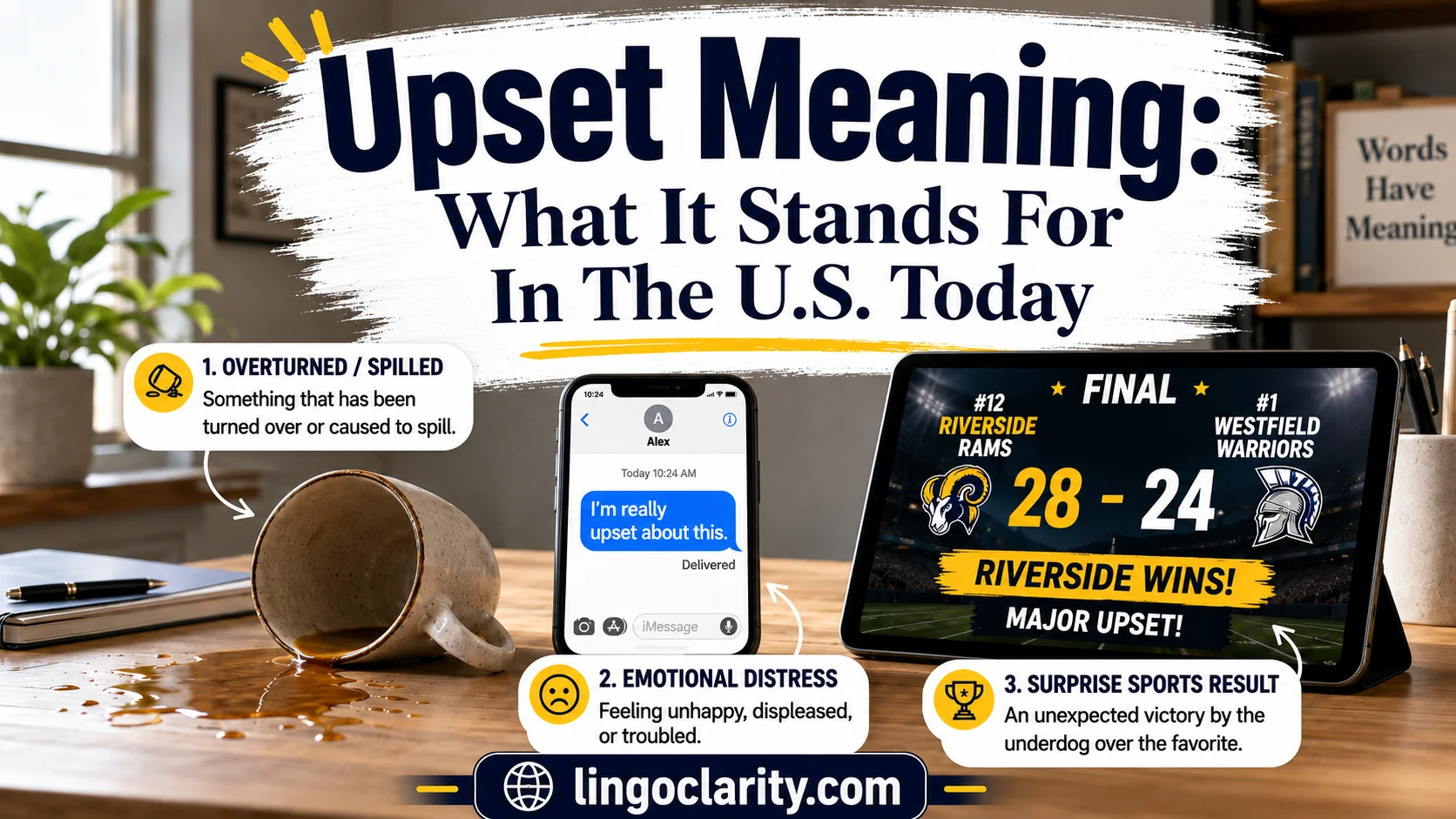
Upset meaning usually refers to feeling emotionally bothered, unhappy, worried, angry, disappointed, or shaken. However, “upset” has several common meanings in English, so the sentence around it matters.
In simple terms, upset means something has moved away from a calm, normal, comfortable, or expected state. For example, bad news can upset a person. Similarly, a delay can upset a schedule. In addition, certain foods can upset your stomach. In sports, an underdog can upset a stronger team.
Quick Answer
Upset usually means emotionally bothered or distressed.
For example, “She felt upset about the delay” means the delay made her feel unhappy, worried, angry, or disappointed. However, the exact emotion depends on the situation.
“Upset” can also work as a verb. For instance, “The news upset him” means the news made him feel bad. In contrast, “The storm upset our plans” means the storm disrupted the plans.
Upset Meaning In Plain English
In plain English, upset means bothered, unsettled, disrupted, or thrown off.
Most commonly, people use it to describe emotions. However, they also use it for disrupted plans, stomach discomfort, overturned objects, and unexpected results.
Because the word has several meanings, look at what the sentence describes. When the sentence talks about a person, “upset” usually refers to emotion. A plan, schedule, or system points to disruption. Food or the stomach points to physical discomfort. Meanwhile, a game, election, or competition often points to a surprise win.
Main Meanings Of Upset
| Use | Meaning | Example |
|---|---|---|
| Emotion | Feeling sad, angry, worried, hurt, or disappointed | “She felt upset about the message.” |
| Verb | To make someone feel bad | “The comment upset him.” |
| Plans Or Order | To disrupt or disturb something | “The delay upset our schedule.” |
| Stomach | To cause stomach discomfort | “The food upset my stomach.” |
| Object | To knock something over | “He upset the cup.” |
| Sports Or Politics | A surprise win against expectations | “The underdog pulled off an upset.” |
As you can see, all of these meanings share one idea: something no longer feels calm, steady, normal, or expected.
Upset As An Emotional Word
When upset describes a person, it means the person feels emotionally affected in a negative way. However, it does not always mean angry.
A person may feel upset because of sadness, worry, embarrassment, disappointment, hurt, shock, or frustration. For example, someone may feel upset after an argument. Likewise, someone may feel upset after disappointing news.
Examples:
- “I feel upset about what happened.”
- “She looked upset after the meeting.”
- “He felt upset when nobody called.”
- “The sudden change upset them.”
- “I didn’t mean to upset you.”
Therefore, “upset” works well when the exact emotion feels mixed or unclear.
Upset As A Verb
As a verb, upset means to make someone feel bad or to disrupt something.
For example, “The message upset her” means the message made her feel unhappy, worried, hurt, or angry. However, “The delay upset our routine” means the delay disrupted the routine.
Examples:
- “The news upset the whole family.”
- “His rude comment upset me.”
- “The announcement upset several employees.”
- “The storm upset our travel plans.”
- “A technical issue upset the schedule.”
In this use, “upset” often shows cause and effect. Something happens, and as a result, a person, plan, or system loses its normal calm or order.
Upset As A Noun
As a noun, an upset often means a surprising result, especially in sports, elections, or competitions.
For example, if a weaker team beats a stronger team, people call that result an upset. Similarly, if a political challenger defeats a heavily favored candidate, commentators may call the result a political upset.
Examples:
- “The smaller team pulled off a major upset.”
- “The election result shocked voters as a political upset.”
- “The tournament ended with a stunning upset.”
- “Fans celebrated the underdog’s upset win.”
In this meaning, “upset” does not describe emotion. Instead, it describes an unexpected reversal.
Upset Stomach Meaning
An upset stomach means stomach discomfort. It may include nausea, indigestion, mild pain, bloating, or the feeling that you might vomit.
For example, “That food upset my stomach” means the food made your stomach feel uncomfortable. Also, “I have an upset stomach” refers to physical discomfort, not an emotional mood.
Correct examples:
- “I have an upset stomach.”
- “My stomach feels upset.”
- “Spicy food can upset my stomach.”
- “He stayed home because his stomach hurt.”
Incorrect example:
- “I am upset stomach.”
Instead, say, “I have an upset stomach” or “My stomach feels upset.”
Upset Meaning To Knock Something Over
“Upset” can also mean to knock something over or turn something out of its normal position. However, this meaning sounds less common in everyday conversation than “knock over” or “tip over.”
Examples:
- “The dog upset the water bowl.”
- “She upset the vase by accident.”
- “A wave upset the small boat.”
- “He bumped the table and upset the cup.”
In casual US English, people usually say “knocked over.” Still, “upset” remains correct in this physical sense.
Upset Pronunciation
In American English, speakers usually stress upset differently depending on the part of speech.
| Part Of Speech | Pronunciation | Stress |
|---|---|---|
| Verb | up-SET | Second syllable |
| Adjective | up-SET | Second syllable |
| Noun | UP-set | First syllable |
For example, in “The news upset me,” stress set. Likewise, in “I feel upset,” stress set.
However, in “That game was a major upset,” speakers often stress up.
Part Of Speech And Word Forms
“Upset” can work as an adjective, verb, or noun. Therefore, its grammar changes with the sentence.
| Part Of Speech | Use | Example |
|---|---|---|
| Adjective | Describes a feeling or condition | “She feels upset.” |
| Verb | Shows what causes distress or disruption | “The news upset her.” |
| Noun | Names a surprise result or disturbance | “The game was an upset.” |
The verb forms stay simple because “upset” does not change in the past tense.
| Form | Example |
|---|---|
| Base Form | “I don’t want to upset you.” |
| Third-Person Singular | “That noise upsets the baby.” |
| Present Participle | “The story feels upsetting.” |
| Past Tense | “The comment upset him.” |
| Past Participle | “The comment has upset him.” |
So, do not say “upsetted.” The correct past tense is upset.
How To Use Upset With Prepositions
Different prepositions give “upset” slightly different meanings. Therefore, the right preposition makes your sentence clearer.
| Pattern | Best Use | Example |
|---|---|---|
| upset about | A situation or event | “She felt upset about the delay.” |
| upset over | A situation, often emotional | “They felt upset over the decision.” |
| upset with | A person | “He felt upset with his brother.” |
| upset by | The cause of the feeling | “The news upset us.” |
| upset that | A full clause | “I feel upset that you forgot.” |
| upset at | A situation or action | “She felt upset at being ignored.” |
In everyday US English, upset about, upset with, and upset by appear often. However, you can often make the sentence more active by naming the cause directly.
Passive-prone version:
- “She was upset by the announcement.”
More active version:
- “The announcement upset her.”
Upset Vs. Upsetting
Upset describes the person who feels bad. Upsetting describes the thing that causes the bad feeling.
Examples:
- “I feel upset.”
- “The story feels upsetting.”
- “The story upset me.”
- “The movie upset the audience.”
In other words, a person feels upset, while an event, story, message, or situation may feel upsetting.
Incorrect:
- “The news was very upset.”
Correct:
- “The news was very upsetting.”
- “The news upset me.”
Does Upset Mean Angry Or Sad?
“Upset” can mean angry or sad, but it covers more than both words.
For example, “She felt upset after the argument” may mean she felt angry, hurt, embarrassed, or disappointed. Meanwhile, “He felt upset after hearing the news” may mean he felt sad or worried.
Because “upset” can describe mixed emotions, it often sounds softer and less specific than words like “furious,” “heartbroken,” or “terrified.”
Synonyms For Upset
The best synonym depends on the meaning.
Emotional Synonyms
Use these when “upset” refers to feelings:
- distressed
- bothered
- troubled
- worried
- unhappy
- hurt
- shaken
- unsettled
- agitated
- disturbed
For example, “The comment upset her” can also mean “The comment hurt her” or “The comment troubled her.”
Disruption Synonyms
Use these when “upset” means to disturb a plan, order, or balance:
- disrupt
- disturb
- interrupt
- throw off
- interfere with
- derail
- unsettle
For instance, “The delay upset our schedule” can also become “The delay disrupted our schedule.”
Physical Synonyms
Use these when “upset” means to knock something over:
- overturn
- tip over
- knock over
- capsize
- spill
For example, “The dog upset the bowl” can also mean “The dog knocked over the bowl.”
Sports And Politics Synonyms
Use these when “upset” means a surprising win:
- surprise win
- shock victory
- unexpected result
- underdog win
- reversal
For example, “The result was a major upset” means the side that most people expected to lose won instead.
Antonyms For Upset
No single opposite fits every meaning of “upset.” Instead, choose the antonym based on context.
| Meaning | Possible Antonyms |
|---|---|
| Emotionally upset | calm, relaxed, happy, pleased, comforted |
| Disrupted | settled, steady, stable, organized |
| Upset stomach | settled, comfortable |
| Knocked over | upright, steady |
| Surprise defeat | expected result, predictable win |
For example, a calm person contrasts with an upset person. However, a stable schedule contrasts with an upset schedule.
Common Phrases With Upset
Upset Stomach
Meaning: stomach discomfort.
Example: “I stayed home because I had an upset stomach.”
Deeply Upset
Meaning: very emotionally bothered.
Example: “The decision deeply upset the family.”
Upset About Something
Meaning: bothered because of a situation.
Example: “She felt upset about the mistake.”
Upset With Someone
Meaning: bothered or angry because of a person.
Example: “He felt upset with me for missing the call.”
Upset By Something
Meaning: emotionally affected because something happened.
Example: “The announcement upset them.”
Major Upset
Meaning: a very surprising win or result.
Example: “The smaller school scored a major upset.”
Pull Off An Upset
Meaning: to win when most people expect you to lose.
Example: “The underdog pulled off an upset in the final round.”
Upset The Apple Cart
Meaning: to disrupt or spoil a plan.
Example: “Changing the agreement now would upset the apple cart.”
Upset The Balance
Meaning: to disturb a stable situation.
Example: “The new policy could upset the balance between work and personal time.”
Common Mistakes With Upset
Using Upset Only To Mean Angry
Do not assume “upset” always means angry. Instead, remember that it can also mean sad, worried, hurt, disappointed, or shocked.
Example:
- “She felt upset after the funeral.”
In this sentence, “upset” probably means sad or emotionally shaken, not angry.
Confusing Upset And Upsetting
Incorrect:
- “The movie was upset.”
Correct:
- “The movie felt upsetting.”
- “The movie upset me.”
The cause feels upsetting, while the affected person feels upset.
Using Upsetted As The Past Tense
Incorrect:
- “The message upsetted him.”
Correct:
- “The message upset him.”
Because “upset” stays the same in the past tense, “upsetted” does not work in standard English.
Using Upset Stomach Incorrectly
Incorrect:
- “I am upset stomach.”
Correct:
- “I have an upset stomach.”
- “My stomach feels upset.”
Therefore, use “upset stomach” as a noun phrase, not as a full description of your emotional state.
Choosing The Wrong Preposition
Incorrect:
- “She felt upset to me.”
Correct:
- “She felt upset with me.”
- “She felt upset about what I said.”
Use with for a person and about for a situation.
Everyday Example Sentences
Emotional Examples
- “I feel upset about what happened.”
- “She looked upset after the meeting.”
- “He felt upset when no one invited him.”
- “The sudden change upset them.”
- “I didn’t mean to upset you.”
- “The message upset her more than she expected.”
Work And School Examples
- “The delay upset our schedule.”
- “A missing file upset the approval process.”
- “The teacher felt upset with the class.”
- “The announcement upset several employees.”
- “The change in hours upset our routine.”
Stomach Examples
- “Too much fried food upsets my stomach.”
- “He stayed home with an upset stomach.”
- “That medicine can cause stomach upset.”
- “My stomach felt upset after dinner.”
Sports And Politics Examples
- “The underdog pulled off a major upset.”
- “The challenger upset the champion.”
- “The election ended in a political upset.”
- “Fans called the loss one of the biggest upsets of the season.”
Physical Examples
- “The cat upset the bowl of water.”
- “She upset the vase while reaching for her phone.”
- “A sudden wave upset the boat.”
- “He bumped the table and upset the cup.”
Word History Of Upset
“Upset” comes from the words up and set. Originally, the idea connected to position and movement. Over time, however, the word developed meanings related to overturning, disturbing, disrupting, and emotional discomfort.
This history helps explain the modern uses. After all, whether “upset” describes a person, stomach, plan, object, or sports result, something has shifted away from its normal state.
FAQ
What does upset mean in simple words?
“Upset” means bothered, troubled, unsettled, or thrown off. Most often, it describes someone who feels sad, worried, angry, hurt, disappointed, or emotionally shaken.
Does upset mean angry?
Sometimes, “upset” means angry. However, it can also mean sad, worried, embarrassed, disappointed, hurt, or shocked.
Does upset mean sad?
Sometimes, “upset” means sad. However, the word covers more than sadness because it can include anger, worry, shock, or disappointment.
Is upset a negative word?
Yes, “upset” usually has a negative meaning. However, it does not always describe an extreme feeling. It can describe mild disappointment or serious emotional distress.
What is the past tense of upset?
The past tense of “upset” is upset. For example, say “The news upset me,” not “The news upsetted me.”
What does upset stomach mean?
An upset stomach means stomach discomfort. For example, spicy food, overeating, stress, or certain medicines may upset your stomach.
What does an upset mean in sports?
In sports, an upset means a surprise win by a team or player most people expected to lose. For example, if a low-ranked team beats a top-ranked team, fans may call that result an upset.
What is the difference between upset and upsetting?
“Upset” describes the person who feels bad. However, “upsetting” describes the thing that causes the bad feeling.
What preposition should I use with upset?
Use upset about for a situation, upset with for a person, and upset by for a cause. For example, “She felt upset about the mistake,” “He felt upset with me,” and “The news upset them” all sound natural.
Bottom Line
“Upset” most often means emotionally bothered, but it has several related meanings. It can describe a person’s feelings, a disrupted plan, stomach discomfort, an overturned object, or a surprise result in sports or politics.
Therefore, the easiest way to understand “upset” is to ask what has been disturbed. When a person is disturbed, the meaning is emotional. When a plan is disturbed, the meaning is disruption. If a stomach is disturbed, the meaning is physical discomfort. And when an expected winner loses to an underdog, the result is an upset.

1 thought on “Upset Meaning: Clear Definition, Usage, and Examples in English”
Comments are closed.