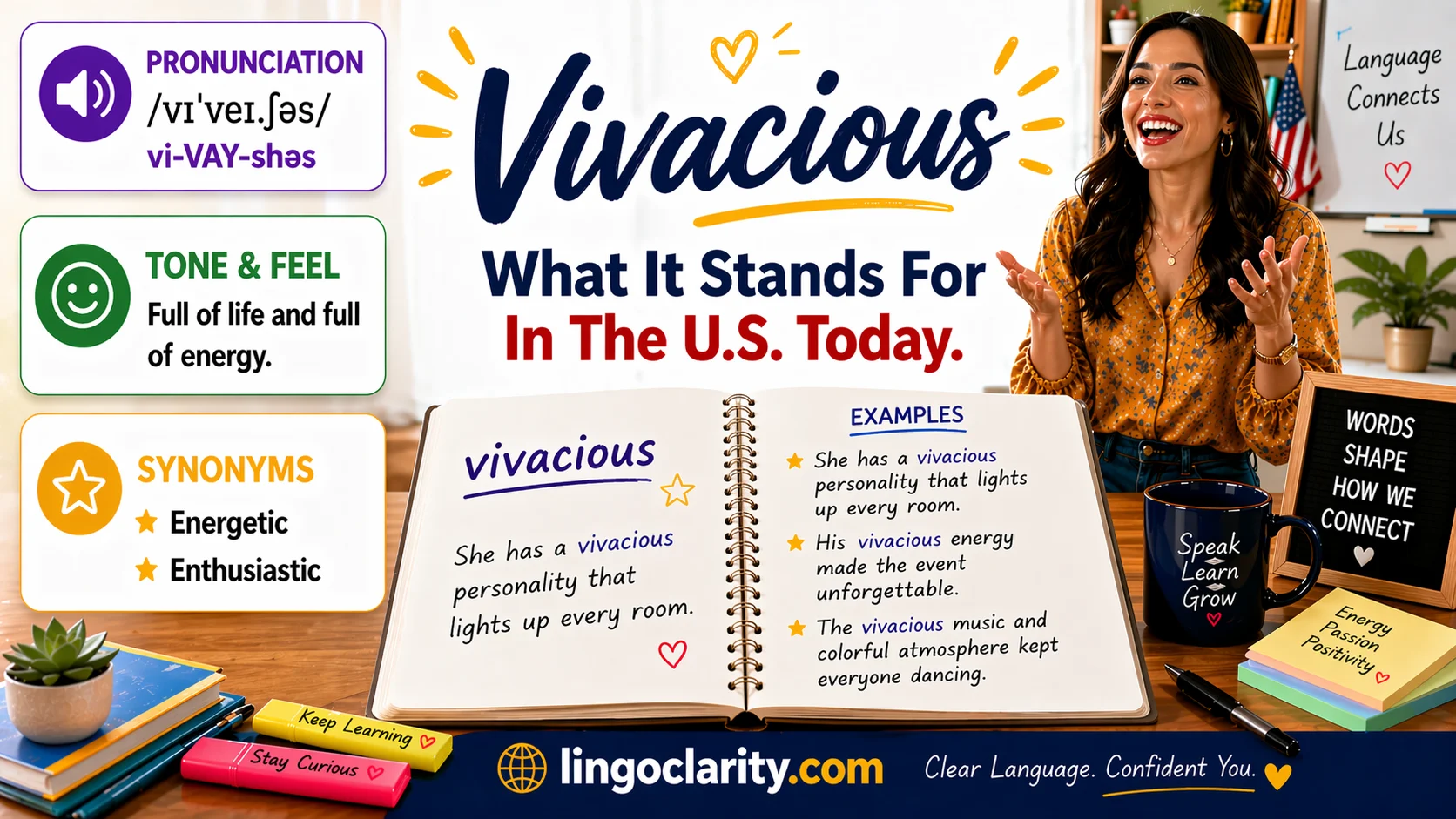
If someone is vivacious, they are lively, spirited, and attractively full of energy. In plain English, the word usually describes a person, personality, smile, voice, or style that feels bright, warm, and engaging, not just busy or loud. Major dictionaries consistently define it around ideas like lively spirit, enthusiasm, animation, and attractive energy.
Quick Answer
Vivacious means full of life, energy, and charm. It is a positive adjective, and it usually suggests lively enthusiasm with a social or appealing edge. You would most naturally use it for a person, personality, smile, conversation style, performance, or presence.
What Does Vivacious Mean?
At its core, vivacious means more than simply “active.” A person can be active and still not feel vivacious. The word usually implies animation, warmth, expressiveness, and a kind of bright social energy. Merriam-Webster defines it as lively in temper, conduct, or spirit, while Cambridge and Britannica highlight the idea of attractive liveliness. Collins adds “high spirits and animation.”
In everyday American English, the best plain-English gloss is this: vivacious means lively in a way that feels appealing, cheerful, and full of spirit. A vivacious person does not just move around a lot. They usually come across as bright, expressive, upbeat, and engaging.
Here are a few fast examples:
- She has a vivacious personality.
- His vivacious storytelling kept the room interested.
- The host gave the event a vivacious, welcoming tone.
- Her vivacious smile made her easy to remember.
Vivacious Definition In Plain English
If you want the simplest possible explanation, use this:
Vivacious = full of life in an appealing way.
That “appealing way” matters. The word often suggests a mix of energy and charm. It does not usually mean wild, chaotic, or over-the-top. It means lively in a way that feels attractive, spirited, or enjoyable to be around. That matches the way leading dictionaries frame the word and the way example banks use it in context.
How To Pronounce Vivacious
The standard American pronunciation is /vɪˈveɪʃəs/, which you can say as vih-VAY-shus. Some dictionaries also show a variant beginning closer to və or, less commonly, vī. The main stress falls on the middle syllable: VAY.
Break it into three parts:
- vi
- VAY
- shus
Common mistakes include putting the stress on the first syllable or mumbling the middle vowel. If you say vih-VAY-shus, you will sound natural.
Part Of Speech, Grammar, And Word Forms
Vivacious is an adjective, which means it describes a noun. You can place it before a noun or after a linking verb. Leading dictionaries also list the related forms vivaciously, vivaciousness, and vivacity.
Examples before a noun:
- a vivacious student
- a vivacious host
- a vivacious laugh
- a vivacious stage presence
Examples after a linking verb:
- She seems vivacious.
- The speaker was vivacious from start to finish.
Related forms:
- vivaciously — adverb
She greeted everyone vivaciously. - vivaciousness — noun
Her vivaciousness stood out immediately. - vivacity — noun
The interview had energy and vivacity.
For comparison, the normal forms are more vivacious and most vivacious.
Is Vivacious Positive, Formal, Or Slang?
Vivacious is usually positive. Cambridge labels it as approving, and Britannica, Collins, and Merriam-Webster all frame it around lively, attractive, spirited energy rather than criticism.
It is not slang. It is a standard English adjective with a polished, educated feel. In tone, it often sounds a little more refined than words like fun, bubbly, or energetic. Depending on context, it can feel neutral, flattering, literary, or slightly formal.
That means it works well in:
- profile writing
- book reviews
- character descriptions
- thoughtful compliments
- polished speech and professional writing
It is less likely to appear in very casual texting unless someone wants a slightly elevated word choice.
A Modern Usage Note That Matters
Several dictionaries note that vivacious is used especially of a woman or girl. That reflects longstanding usage evidence, not a hard rule about who the word can describe. You can absolutely describe a man, boy, child, host, teacher, or performer as vivacious. Still, the note matters because the word can sometimes carry a slightly old-fashioned or appearance-centered feel depending on context.
In modern writing, the safest and strongest use is to aim the word at energy, personality, manner, voice, smile, or presence, not just appearance.
Better:
- She has a vivacious personality.
- He brought a vivacious energy to the interview.
- The actress gave the role a vivacious spark.
Less strong:
- She is vivacious-looking.
The word usually lands better when it highlights spirit rather than looks alone.
When To Use Vivacious
Use vivacious when you want more than energetic. Choose it when the energy feels:
- warm
- expressive
- socially engaging
- bright
- charming
- lively in an appealing way
It fits especially well with people and people-related nouns, such as:
- personality
- host
- speaker
- teacher
- child
- laugh
- smile
- manner
- performance
- presence
- conversation
Examples:
- The new teacher had a vivacious way of explaining difficult ideas.
- Her vivacious laugh relaxed the whole table.
- He gave a vivacious welcome that made guests feel at home.
- The actor’s vivacious performance lifted the scene.
When Not To Use Vivacious
Do not use vivacious as a catch-all word for anything active. It usually sounds wrong when the subject has no human warmth, no expressive energy, or no social spark.
Awkward:
- a vivacious spreadsheet
- a vivacious contract
- a vivacious tax policy
Better:
- a lively presentation
- an engaging explanation
- a dynamic campaign
It can also sound off in solemn or tragic contexts. If you are describing grief, danger, disaster, or a formal report, vivacious is often too bright and personality-heavy.
It is also not the best word when you only mean fast, busy, or intense. For those ideas, words like active, energetic, busy, or dynamic may fit better.
Vivacious Vs. Lively Vs. Vibrant Vs. Bubbly
These words overlap, but they are not interchangeable. Merriam-Webster’s synonym guidance and broader thesaurus evidence show that vivacious belongs to the same family as lively, animated, and sprightly, but it usually adds a clearer sense of charm and spirited social appeal. Vocabulary.com similarly emphasizes playfulness and sparkle.
| Word | Best Use | Nuance |
|---|---|---|
| Vivacious | people, personalities, performances, smiles | lively plus charm, sparkle, and appealing spirit |
| Lively | debates, classrooms, parties, discussions | broad, flexible, less polished |
| Vibrant | colors, cities, cultures, personalities | strong energy, brightness, fullness |
| Bubbly | very cheerful, talkative people | more casual, playful, and informal |
| Animated | speech, storytelling, gestures | visibly expressive and active |
| Sprightly | older-fashioned praise, often for movement or spirit | brisk and lively, sometimes slightly quaint |
Use vivacious when lively feels too plain and bubbly feels too casual.
Common Collocations And Natural Uses
These are some of the most natural combinations in modern English:
- vivacious personality
- vivacious smile
- vivacious laugh
- vivacious host
- vivacious speaker
- vivacious manner
- vivacious presence
- vivacious performance
- vivacious energy
- vivacious style
Natural examples:
- She gave a vivacious introduction that woke up the room.
- The candidate came across as confident, sharp, and vivacious.
- Her vivacious personality made her easy to trust.
- The interview became much more interesting once the guest’s vivacious side came through.
- Even in a short scene, the actress created a vivacious presence.
Synonyms, Antonyms, And Related Words
Common synonyms include lively, spirited, animated, sprightly, energetic, vibrant, bubbly, and effervescent. Merriam-Webster and Cambridge’s thesaurus materials both place vivacious among high-energy, upbeat words, while Merriam-Webster lists antonyms like lifeless, languid, and listless.
The best synonym depends on what you mean:
- choose energetic when you mean physical or mental drive
- choose animated when you mean expressive movement or speech
- choose bubbly when you want a casual, cheerful tone
- choose vibrant when you want brightness or richness
- choose vivacious when you want charm plus lively spirit
Useful antonyms:
- languid
- listless
- lifeless
- dull
- flat
- sluggish
Origin And Word History
Vivacious comes from Latin vivax and ultimately from vivere, meaning to live. Etymonline traces the word to the 1600s, and Collins and the OED connect it to the same Latin root. Older historical senses included ideas related to strong life force or being long-lived, but modern English mainly uses vivacious to mean lively, spirited, and animated.
That origin helps explain why the word feels richer than a plain synonym. It carries the idea of being full of life, not just active.
Common Mistakes With Vivacious
Using It As A Noun
Wrong: She is a vivacious.
Right: She is vivacious.
Using It For Any Busy Thing
Wrong: The budget meeting was vivacious.
Better: The discussion was lively.
Confusing It With Vicious
These words look and sound somewhat similar at a glance, but they are completely different. Vivacious is positive and energetic. Vicious is harsh, cruel, or violent.
Making It About Looks Only
The word can imply attractiveness, but it usually works best when it highlights spirit, manner, or presence.
Less effective:
- She has a vivacious face.
Better:
- She has a vivacious manner.
- She has a vivacious personality.
Overusing It In Formal Or Serious Contexts
Because the word is bright and personality-driven, it can sound out of place in legal, technical, tragic, or highly sober contexts.
How To Use Vivacious In Real Sentences
Here are practical, natural examples in American English:
- The keynote speaker was vivacious without sounding forced.
- Her vivacious personality made the team meetings less stiff.
- He gave the role a vivacious charm that the script badly needed.
- The restaurant owner greeted guests with a vivacious warmth.
- The candidate seemed intelligent, poised, and vivacious.
- Even over video, her vivacious energy came through clearly.
- The novel’s heroine is witty, flawed, and deeply vivacious.
- His vivacious storytelling kept the children focused.
- She answered with a vivacious grin and a fast joke.
- The performance felt vivacious rather than merely loud.
Frequently Asked Questions
What does vivacious mean?
It means lively, spirited, and attractively full of life. In most contexts, it is a positive word for someone whose energy feels bright, expressive, and engaging.
Is vivacious a compliment?
Yes. In most cases, vivacious is a compliment. It usually praises someone’s energy, personality, warmth, or animated presence. Cambridge explicitly treats it as approving.
Is vivacious formal?
Not exactly formal, but it is more polished than casual words like fun or bubbly. It fits everyday writing, professional profiles, reviews, and thoughtful conversation, especially when you want a more precise word choice.
Can you describe a man as vivacious?
Yes. Although several dictionaries note that the word is often used especially of a woman or girl, it is not limited to women. In modern English, it can describe anyone whose energy feels lively and engaging.
What is the difference between lively and vivacious?
Lively is broader. It can describe anything active, energetic, or full of movement. Vivacious usually adds charm, brightness, or social sparkle. If lively is the general word, vivacious is the more vivid and flattering one.
How do you pronounce vivacious?
In American English, the standard pronunciation is /vɪˈveɪʃəs/, commonly written as vih-VAY-shus. The middle syllable gets the stress.
Is vivacious the same as bubbly?
No. Bubbly is more casual and playful. Vivacious sounds a little more polished and often suggests charm, spirit, and expressive presence rather than just cheerfulness.
What is the noun form of vivacious?
The most useful noun form is vivacity. You may also see vivaciousness, though vivacity is often the more elegant and common choice. Dictionaries also list vivaciously as the adverb form.
Final Takeaway
Vivacious is one of those words that says more than energetic and more gracefully than bubbly. It means full of life, spirit, and charm, and it works best when you want to describe someone whose energy feels bright, expressive, and appealing. Use it for personality, presence, speech, smiles, performances, and social warmth. Avoid it for lifeless objects, overly technical contexts, or situations where you only mean “busy” or “fast.”
Used well, vivacious is a precise, flattering word that makes your writing sound sharper and more human.
