
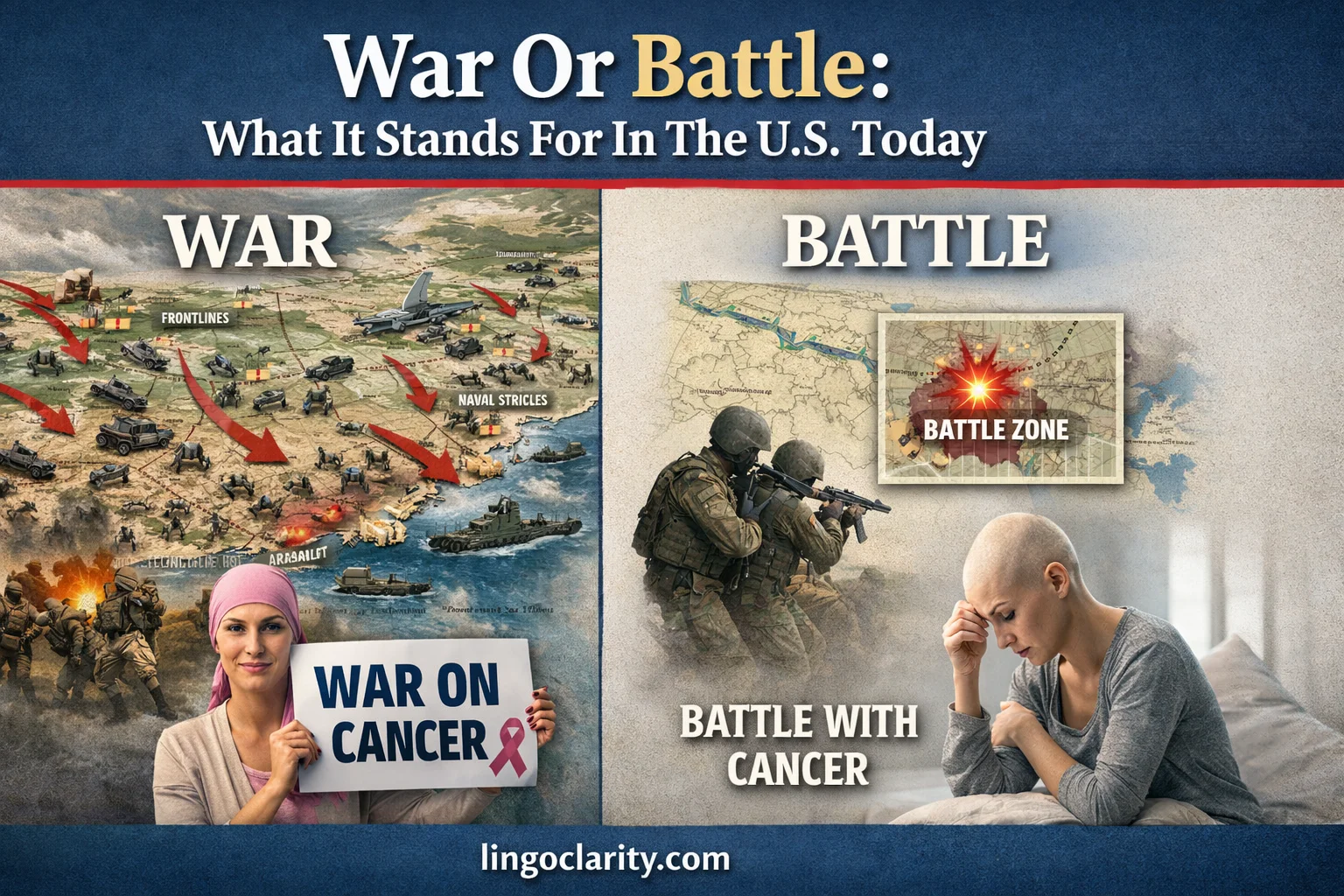
Both war and battle are correct in US English, but they are not usually interchangeable. The simplest reliable distinction is one of scale and focus. Standard dictionary and reference definitions treat war as the larger armed conflict or broader state of hostility, while battle is a more specific hostile encounter or a focused struggle. Those same sources also show that both words extend beyond military writing into figurative English, where the contrast still matters.
That difference affects much more than dictionary meaning. It changes the tone of a sentence, the size of the conflict you are describing, and what a reader imagines. In most contexts, war feels sweeping, prolonged, and organized. Battle feels narrower, more immediate, and easier to point to as one fight, one contest, or one personal struggle.
This is why strong writing depends on choosing the right one. If you call a whole conflict a battle, your sentence may sound too narrow. If you call one personal struggle a war, your sentence may sound too grand, too abstract, or simply less natural than it should. The goal is not just correctness. It is precision.
Quick Answer
Use war when you mean a large conflict, a broader state of hostility, or an organized campaign.
Use battle when you mean one specific fight, one direct contest, or one focused struggle.
A good memory line is this: a war can contain many battles, but a battle does not usually name the whole war. That summary matches the standard way major dictionaries and reference works distinguish the two terms.
If you only want the shortest practical rule, use this one:
- War = the big conflict
- Battle = the specific fight inside it, or a more focused struggle
What “War” Means
In standard English, war first refers to a state or period of armed hostile conflict between states, nations, or other organized groups. Reference works also extend the word beyond literal warfare to mean a state of hostility, a competition between opposing forces, or a broad campaign aimed at a particular end. That is why English can use war both literally and figuratively without changing its core idea of large-scale conflict.
That broader sense matters in everyday writing. When someone writes about a war on corruption, a price war, or a culture war, the point is not one isolated moment. The point is an extended struggle, usually involving multiple actions, multiple sides, and a larger frame. Even outside military language, war still suggests breadth, duration, and organized opposition.
Here are natural examples of war in modern US English:
- The war lasted for years and reshaped the region.
- The two companies entered a price war.
- The city declared war on illegal dumping.
- The groups have been at war for months.
In each sentence, war names the larger conflict, not just one episode inside it.
What “Battle” Means
Standard dictionary definitions treat battle as a hostile encounter between opposing military forces. They also extend the word to a lengthy contest, struggle, or controversy, which is why English uses phrases such as legal battle, custody battle, and battle for control. That figurative sense is well established, not casual slang.
Compared with war, battle points to something more bounded. It may still be intense and serious, but it sounds more concrete. Readers tend to picture a clash they can isolate: one fight, one showdown, one phase, one hard effort, or one personal struggle. That is exactly why battle works so well in legal, political, medical, athletic, and emotional contexts.
Here are natural examples of battle:
- The battle was over by nightfall.
- She is facing a long battle with debt.
- The candidates are in a close battle for suburban voters.
- The startup is locked in a legal battle over its name.
In each case, battle feels focused and specific, even when the situation is figurative.
The Core Difference: Scope
The clearest and most useful difference between these words is scope. War is the larger condition, campaign, or conflict. Battle is the individual clash or more limited struggle inside that larger frame. This is not just a stylistic opinion. It follows directly from standard definitions that place war at the level of extended armed conflict and battle at the level of a hostile encounter or defined struggle.
That is why sentences like these feel right:
- The nation entered the war.
- The army won the battle.
- The company is fighting a regulatory battle.
- Activists say the wider war over policy is far from over.
Notice how the meaning changes with the scale. War frames the whole situation. Battle zooms in on one contest within it.
This is also why writers often get in trouble when they swap the two without thinking. A sentence can remain understandable and still sound wrong because it frames the conflict at the wrong level.
How Figurative English Uses Them
The military roots of these words still shape their figurative use. In figurative English, war usually works when the speaker wants to emphasize a broad, strategic, organized, or long-running conflict. Battle usually works when the speaker wants to emphasize a focused, difficult, or personal struggle. That difference is fully consistent with dictionary definitions that extend war to a broader struggle and battle to a contest or controversy.
Real public usage shows the same split. National Cancer Institute materials refer to the national “war on cancer,” which frames cancer as a wide public campaign, while other NCI pages use “battle with cancer” for an individual person’s struggle. Those examples do not mean English has a rigid rule, but they clearly show the difference in frame: public campaign versus personal ordeal.
That makes the following contrast especially useful:
- war on cancer = broad social, medical, and policy campaign
- battle with cancer = one person’s struggle with illness
The same pattern often appears elsewhere:
- war on waste sounds broad and institutional
- battle with addiction sounds personal and direct
- price war sounds like an ongoing market conflict
- legal battle sounds like a defined dispute
When To Use War
Choose war when your sentence needs the idea of a large-scale conflict or extended organized opposition. It is usually the stronger choice when you are describing nations, factions, systems, institutions, or any conflict that unfolds across time and across multiple events.
Use war when you mean:
- a national or international armed conflict
- a broad state of hostility
- an organized public campaign
- a rivalry that feels sweeping or long-running
These examples show the pattern:
- The war dragged on for a decade.
- The parties are at war over the budget.
- Officials announced a war on fraud.
- The industry is stuck in a price war.
In each example, war works because the frame is big. It is not one moment. It is the larger struggle.
When To Use Battle
Choose battle when your sentence needs the idea of a specific fight, one contest, or a direct struggle that can be pictured more narrowly. It is often the better word when the subject is one event, one legal dispute, one election fight, one recovery effort, or one person’s hardship.
Use battle when you mean:
- one military engagement
- one focused political or legal contest
- one concrete effort to overcome a problem
- one person’s struggle with illness, debt, addiction, or hardship
These examples show the pattern:
- The battle began at dawn.
- She faces an uphill battle in court.
- He fought a long battle with debt.
- The two candidates are in a tight battle for first place.
In each example, battle feels specific, immediate, and bounded.
Side-By-Side Examples That Sound Natural
Here is the difference in action:
- The war lasted for years.
The battle lasted for hours. - The government launched a war on corruption.
The senator is in a battle over ethics charges. - The rival brands started a price war.
The smaller brand won the latest shelf-space battle. - The country is still at war.
The troops survived the battle. - Researchers speak of a national war on cancer.
One patient may describe a private battle with cancer.
These pairings show why the words are related but not interchangeable. War widens the lens. Battle tightens it.
Common Mistakes And Better Rewrites
One common mistake is using battle for the whole conflict.
Less accurate: The battle between the two countries lasted twenty years.
Better: The war between the two countries lasted twenty years.
Another common mistake is using war where English more naturally wants a focused personal struggle.
Less natural: She is in a war with debt.
Better: She is in a battle with debt.
A third mistake is flattening figurative meaning.
Weak: The city began a battle on illegal dumping.
Better: The city began a war on illegal dumping.
Weak: The company is in a war with its former CEO over one contract dispute.
Better: The company is in a battle with its former CEO over the contract dispute.
The fix is almost always the same: ask yourself whether you mean the whole conflict or one defined fight. If it is the whole thing, choose war. If it is one focused clash, choose battle.
Can They Be Verbs Too?
Yes. Both words can function as verbs, but they do different work.
Merriam-Webster defines war as a verb meaning to be in active or vigorous conflict or to engage in warfare. It is correct, but it usually sounds more formal, literary, or historical than everyday conversation. You are more likely to read groups warred for years than to hear it in casual speech.
Battle is also a verb, and dictionaries define it as to engage in battle, to struggle, or to fight against. That verb form fits modern everyday English much more comfortably in sentences such as She battled for custody or He battled the illness for years.
That difference helps explain why these sound natural:
- The factions warred for decades.
- She battled her way back onto the team.
- Lawmakers are battling over the proposal.
The verbs are both correct, but battle more easily fits common figurative prose.
Tone And Reader Effect
Meaning is the first issue, but tone matters too. War tends to sound heavier, broader, and more dramatic because it implies a large frame. Battle tends to sound more immediate and human because it points to a particular clash or struggle. That tonal difference follows naturally from the scope built into standard definitions.
For writers, that means word choice can subtly reshape the sentence:
- war can make a conflict sound systemic, strategic, or sweeping
- battle can make it sound concrete, urgent, and personal
Neither tone is automatically better. The better choice is the one that matches your actual meaning.
FAQs
Is war always bigger than battle?
In standard usage, yes, war normally names the larger conflict and battle names a specific clash or more focused struggle within that broader frame. That is the most dependable distinction for both literal and figurative writing.
Can battle mean a personal struggle?
Yes. Standard dictionary definitions explicitly extend battle beyond military combat to mean a contest, controversy, or hard struggle. That is why phrases like battle with debt, legal battle, and custody battle sound natural in American English.
Can war be used figuratively?
Yes. War can refer not only to literal armed conflict but also to broader hostility, opposition, or campaigns aimed at a goal. That is why figurative phrases like war on corruption or price war make sense.
Which sounds more natural for illness: war or battle?
For an individual person’s struggle, battle is often the more natural choice. For a broad public campaign, war is often the better fit. Real NCI usage shows both patterns: war on cancer for the national campaign and battle with cancer for an individual struggle.
Are war and battle interchangeable in history writing?
Usually not. In historical writing, the difference in scope matters a great deal. War refers to the broader armed conflict, while battle refers to a particular military encounter. Swapping them can make the writing inaccurate or at least imprecise.
Which word should I use in everyday writing?
Use war when you mean the bigger conflict or wider campaign. Use battle when you mean one direct fight, one dispute, or one personal struggle. If you test the scale of the sentence first, the better word usually becomes obvious.
Conclusion
Both war and battle are correct words in US English, but they are not the same. War refers to the larger conflict, broader campaign, or overall state of hostility. Battle refers to one specific fight, one direct contest, or one focused personal struggle.
That difference matters in both literal and figurative writing. A country may fight a war, but soldiers fight a battle. A government may launch a war on corruption, but a person may face a battle with illness. In each case, war sounds broader and more sweeping, while battle sounds narrower and more immediate.
The easiest way to remember the distinction is this: war is the whole conflict; battle is one fight within it. If you choose based on scale, your wording will sound clearer, more natural, and more precise.
