

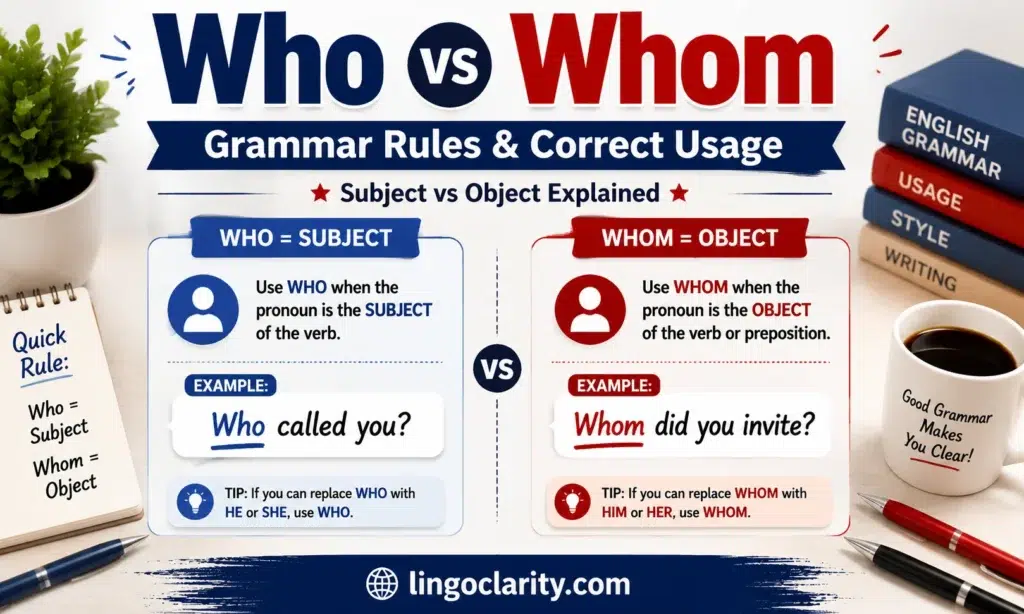
Many English learners—and even native speakers—sometimes hesitate between who and whom because both words refer to people, but they are used in different grammatical situations. The difference becomes easier to understand once you know whether the person is doing the action or receiving the action.
The simple rule is:
- Use who when the person is the subject (the one performing the action).
- Use whom when the person is the object (the one receiving the action).
For example:
✅ Who called you?
(He called you → subject)
✅ Whom did you call?
(You called him → object)
Although whom is still correct in formal writing, everyday American English often uses who in many casual situations. Understanding the traditional rule helps you write more accurately, especially in professional emails, academic writing, and formal documents.
In this guide, you will learn the clear difference between who vs. whom, an easy trick to choose the right word, common mistakes, examples, and when using “whom” actually matters.er.
Quick Answer
Use who when the pronoun is the subject of a verb (the person performing the action).
Use whom when the pronoun is the object of a verb or a preposition (the person receiving the action).
Examples:
- Who called you yesterday?
(He called you → “he” = subject, so use who.) - Whom did you invite to the meeting?
(You invited him → “him” = object, so use whom.)
A simple trick: replace the word with he/she/they or him/her/them. If he/she/they fits, use who. If him/her/them fits, use whom.
In modern American English, who is often used instead of whom in casual speech and everyday writing. However, whom is still useful in formal writing, especially after prepositions or in professional contexts.
Understanding this small grammar difference can help you write clearer emails, essays, and professional documents while sounding more natural in everyday conversations.al speech, but formal writing still follows the traditional rule.
What Is Correct: Who Or Whom?
Both who and whom are correct English pronouns, but they have different grammatical functions. The correct choice depends on whether the pronoun is acting as the subject (the person doing the action) or the object (the person receiving the action).
| Form | Best Use | Explanation |
|---|---|---|
| Who | Subject of a verb | Refers to the person performing the action |
| Whom | Object of a verb or preposition | Refers to the person receiving the action |
Examples:
- Who wrote this report?
(He wrote the report → “he” is the subject.) - Whom did you contact about the project?
(You contacted him → “him” is the object.)
A simple way to remember the difference is the he/him test:
- If he/she/they fits, use who.
- If him/her/them fits, use whom.
The difference between who and whom is not about meaning—they both refer to people. The difference is about sentence structure and grammatical role. While whom is still preferred in formal writing, who is commonly used in everyday American English.
The Core Grammar Rule
The distinction between who and whom comes from pronoun case.
In English, pronouns often change form depending on their grammatical role.
For example:
- I / me
- he / him
- she / her
The same pattern applies here:
- who functions like he/she (subject)
- whom functions like him/her (object)
This subject–object pattern explains why the two forms exist.
When Each Form Is Correct
Using Who As The Subject
Use who when the pronoun performs the action of the verb.
Examples
- Who is leading the project?
- Do you know who wrote this article?
- Who wants coffee?
- The student who asked the question stayed after class.
Using Whom As The Object
Use whom when the pronoun receives the action or follows a preposition.
Examples
- Whom did you call yesterday?
- To whom should I send the email?
- The manager whom we hired starts Monday.
- The colleague whom I recommended got the job.
The key factor is the pronoun’s role in the clause, not its position in the sentence.
When The Choice Is Incorrect Or Less Natural
Some sentences use the wrong form because the grammatical role is misunderstood.
Incorrect
- Whom is calling?
- Whom wrote this book?
Correct
- Who is calling?
- Who wrote this book?
In both examples, the pronoun is the subject, so who is correct.
However, other sentences may be grammatically correct but sound too formal for everyday conversation.
Formal
- Whom are you meeting tonight?
Natural conversation
- Who are you meeting tonight?
In everyday American English, many speakers prefer who in situations like this.
Meaning, Structure, And Tone Differences
The difference between who and whom is primarily grammatical, not semantic.
Both words refer to a person or group of people. The only difference is the pronoun’s function within the sentence.
However, tone can change slightly.
Examples
Informal style
- Who did you invite?
Formal style
- Whom did you invite?
Because modern English favors simpler constructions, who often replaces whom in casual communication.
Real-World Examples
These examples show how the two forms appear in everyday sentences.
Subject Examples (Who)
- Who organized the event?
- Who lives next door?
- The student who solved the problem explained the answer.
Object Examples (Whom)
- Whom did the company hire?
- The professor whom students admire retired this year.
- To whom it may concern.
Common Mistakes And Quick Fixes
Writers often make predictable mistakes when choosing between who and whom.
| Common Mistake | Correct Fix |
|---|---|
| Using whom as a subject | Replace with who |
| Using who after a preposition | Use whom |
| Using whom just to sound formal | Use who when natural |
Example Corrections
Incorrect: Whom is coming to dinner?
Correct: Who is coming to dinner?
Incorrect: Who did you give the letter to?
Formal: To whom did you give the letter?
The He/Him Test: A Quick Way To Decide
A simple test can help you choose the correct pronoun.
Replace the word with he or him.
- If he fits → use who
- If him fits → use whom
Example
Who/whom did you call?
You called him → whom is correct.
Final sentence:
Whom did you call?
Usage Notes In Modern American English
Modern usage has shifted slightly compared with traditional grammar rules.
Today:
- Who is common in everyday speech
- Whom appears mainly in formal writing
- Whom often appears after prepositions
Because formal phrasing can sometimes sound stiff, writers often restructure sentences.
Example
Formal:
To whom should I address the email?
More natural:
Who should I address the email to?
Both are understandable, but the second version sounds more natural in conversation.
Frequently Asked Questions
Both versions are used in modern English, but they have different levels of formality. Traditionally, “whom did you call?” is considered grammatically correct because the pronoun is the object of the verb call. You called him, not he, so whom is the correct object form.
However, “who did you call?” is extremely common in everyday American English and is widely accepted in casual conversations.
Yes. Whom is still used, especially in formal writing, academic contexts, professional communication, and expressions that include prepositions.
Examples:
To whom should I send this letter?
With whom are you working on this project?
In everyday speech, many Americans use who instead because it sounds more natural.
People use whom less often because modern English has become more flexible and conversational. Many speakers prefer the simpler word who, even in situations where traditional grammar would use whom.
For example:
Formal:
Whom did you invite to the event?
Common:
Who did you invite to the event?
Both are easily understood, but the second version is more common in everyday communication.
Yes. “Who did you send the email to?” is natural and commonly used in American English.
A more formal version is:
To whom did you send the email?
The formal version follows the traditional rule because whom is the object of the preposition to. However, ending a sentence with a preposition is normal in modern English, so the first version is acceptable in everyday writing and speech.
Use the he/him test:
If you can replace the word with he, she, or they, use who.
If you can replace it with him, her, or them, use whom.
Examples:
✅ Who wrote the article?
→ He wrote the article.
✅ Whom did you hire?
→ You hired him.
This simple trick helps you choose between who and whom in most sentences.
Conclusion
The difference between who and whom becomes much easier to understand when you focus on the role the pronoun plays in a sentence. Use who when the person is performing the action (the subject), and use whom when the person is receiving the action or follows a preposition (the object).
A quick test is to replace the word with he/she/they or him/her/them. If the subject form works, choose who. If the object form works, choose whom.
Although whom is becoming less common in everyday American conversation, it still appears in formal writing, professional communication, and expressions such as “To whom it may concern.” Understanding the traditional rule helps you write clearer, more accurate sentences while also recognizing how modern English is changing.

4 thoughts on “Who VS Whom: Grammar Rules And Correct Example, Usage In US English”
Comments are closed.