
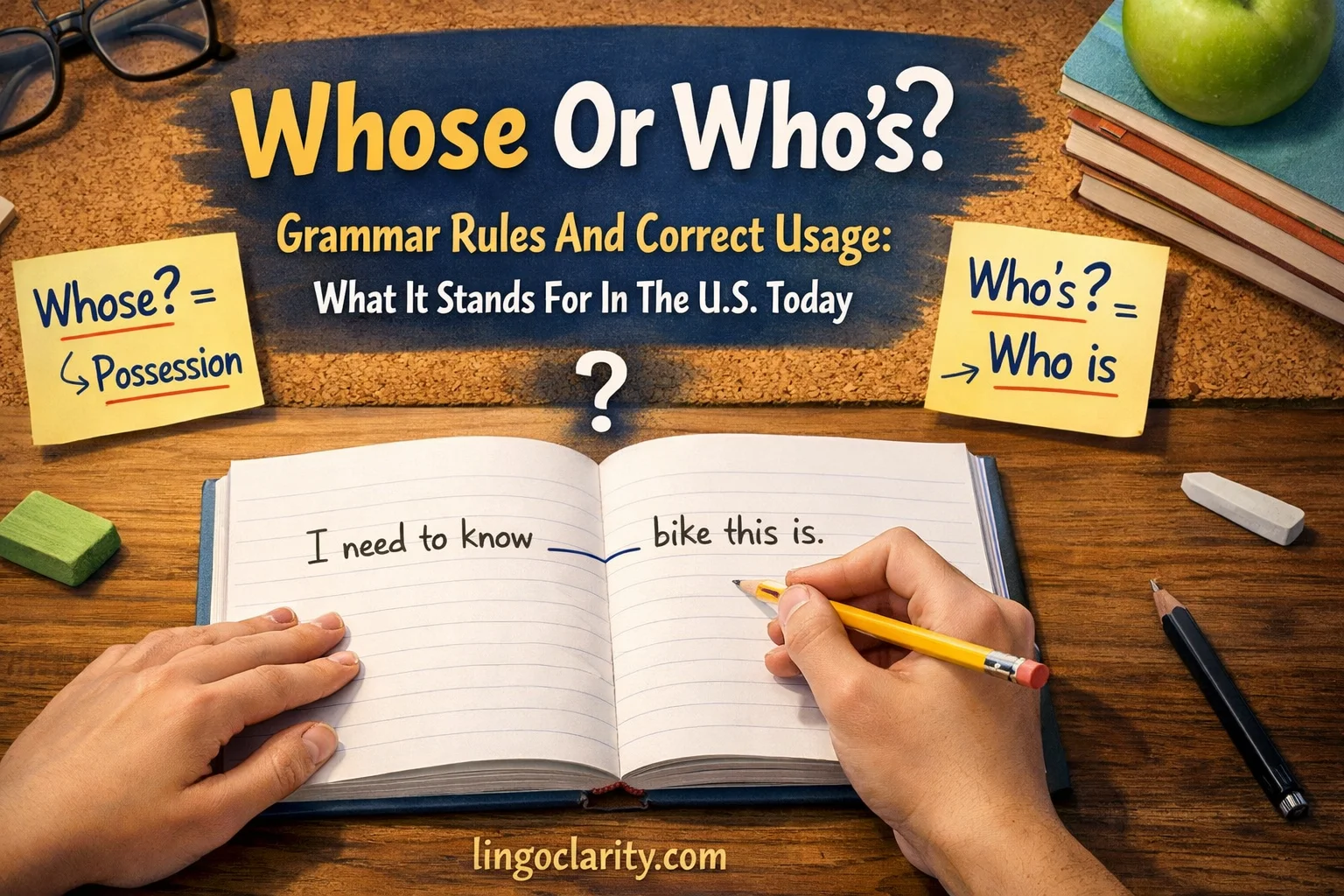
Many English learners—and even experienced writers—mix up these two similar words because they sound exactly the same. However, their grammatical roles are completely different.
One form shows possession, while the other is a contraction. As a result, choosing the wrong one can change the meaning of a sentence.
Fortunately, the rule is simple. Once you understand how each form works, choosing the correct word becomes much easier.
Quick Answer
The difference is straightforward.
- Whose shows possession or belonging.
- Who’s is a contraction of “who is” or “who has.”
| Form | Best Use | Why |
|---|---|---|
| whose | Showing ownership | Possessive form of who |
| who’s | Short for who is or who has | Contraction with apostrophe |
Examples
- Whose phone is ringing?
- Who’s calling you tonight?
Although the two words sound identical, they perform very different grammatical functions.
What Is Correct?
Both forms are correct in English. However, they serve different purposes within a sentence.
Use whose when referring to ownership or belonging.
Meanwhile, use who’s when the sentence means who is or who has.
Examples
- Whose jacket is on the chair?
- Who’s ready for the meeting?
Therefore, understanding the rule behind each form helps you choose the correct one quickly.
The Core Grammar Rule
The distinction between these words comes down to possession versus contraction.
Whose — The Possessive Form
The word whose is the possessive form of the pronoun “who.” In other words, it asks about ownership or relationship.
It works similarly to other possessive pronouns such as:
- his
- her
- their
- its
Example
Whose jacket is on the chair?
In this sentence, the speaker is asking who owns the jacket.
Who’s — The Contraction
The form who’s is a contraction that represents:
- who is
- who has
Examples
Who’s coming to the meeting?
Who’s finished the report?
If the sentence expands correctly to who is or who has, then the contraction is the correct choice.
When Each Form Is Correct
Use Whose For Possession
Use whose when talking about ownership, relationships, or association.
Examples
Whose car is parked outside?
Do you know whose backpack this is?
She met a teacher whose advice changed her career.
In each sentence, the word introduces a person or object connected by possession.
Use Who’s As A Contraction
Use who’s when the sentence clearly means who is or who has.
Examples
Who’s ready to start the presentation?
Who’s been using my laptop?
The student who’s leading the project is very organized.
Therefore, replacing the word with who is is often a quick way to confirm the correct form.
When The Words Are Incorrect
One of the most common mistakes is using the contraction to show possession.
Incorrect
Who’s bag is this?
Correct
Whose bag is this?
Another error appears when writers forget that the contraction must expand into two words.
Incorrect
Whose coming to dinner?
Correct
Who’s coming to dinner?
Because of this rule, checking whether “who is” fits the sentence can quickly reveal the correct choice.
Meaning, Structure, And Usage Differences
Although these words sound identical, they serve different grammatical roles.
Whose
- Shows possession
- Functions as a possessive determiner or pronoun
- Usually appears before a noun
Example
Whose idea was this?
Who’s
- Functions as a contraction
- Represents who is or who has
- Often appears in questions or clauses
Example
Who’s responsible for the report?
In contrast, the possessive form focuses on ownership rather than sentence action.
Real-World Examples
To understand the difference more clearly, consider these everyday examples.
Examples With Whose
Whose turn is it to present?
The author whose book inspired me is speaking tonight.
Do you know whose keys these are?
Examples With Who’s
Who’s going to drive tonight?
Who’s already finished the assignment?
I know a student who’s studying abroad next semester.
These examples show how both forms appear naturally in everyday English.
Common Mistakes And Quick Fixes
Many writers assume that apostrophes always indicate possession. However, pronouns follow a different rule.
For example, these possessive pronouns do not use apostrophes:
- his
- hers
- theirs
- its
- whose
Because of this pattern, the possessive form never includes an apostrophe.
Quick Fix
If the sentence shows ownership, choose the possessive form.
If the sentence means who is or who has, use the contraction.
Exceptions And Special Notes
There are no major grammar exceptions for these words. However, one usage detail is worth noting.
Modern English allows the possessive form to refer to things as well as people, especially in relative clauses.
Example
That’s the car whose alarm keeps going off.
Although older grammar guides discouraged this usage, it is now widely accepted.
The Quick Test
A simple trick can help you choose the correct word quickly.
Replace the word with “who is.”
If the sentence still makes sense, use who’s.
Example:
Who’s calling?
→ Who is calling? ✔
However, if the sentence does not work after the replacement, use whose.
Example:
Whose jacket is this?
→ Who is jacket? ✘
Therefore, the possessive form must be correct.
Usage Notes
In extremely formal writing, some authors avoid contractions and instead write who is in full.
However, in everyday American English, the contraction is completely standard in conversation and professional communication.
Meanwhile, the possessive form appears in both formal and informal writing because it expresses ownership.
Conclusion
The difference between these two commonly confused words comes down to one simple rule.
Although they sound the same, their grammatical roles are completely different. Therefore, the easiest way to choose correctly is to apply the “who is” test.
If the sentence works with who is, use the contraction. Otherwise, use the possessive form.
Once you remember this rule, choosing the correct word becomes simple and automatic.
FAQs
What is the difference between whose and who’s?
The possessive form shows ownership, while the contraction represents who is or who has.
Is “who’s name” correct?
No. The correct phrase is whose name because the sentence refers to ownership.
Can whose refer to things as well as people?
Yes. In modern English, the possessive form can refer to objects or animals, particularly in relative clauses.
Example:
The house whose roof collapsed was recently renovated.
How can I remember the difference easily?
Use the “who is” test. If replacing the word with who is makes sense, use the contraction. Otherwise, use the possessive form.
Is who’s formal or informal?
The contraction is common in everyday writing and conversation. However, extremely formal writing sometimes prefers who is instead.
