
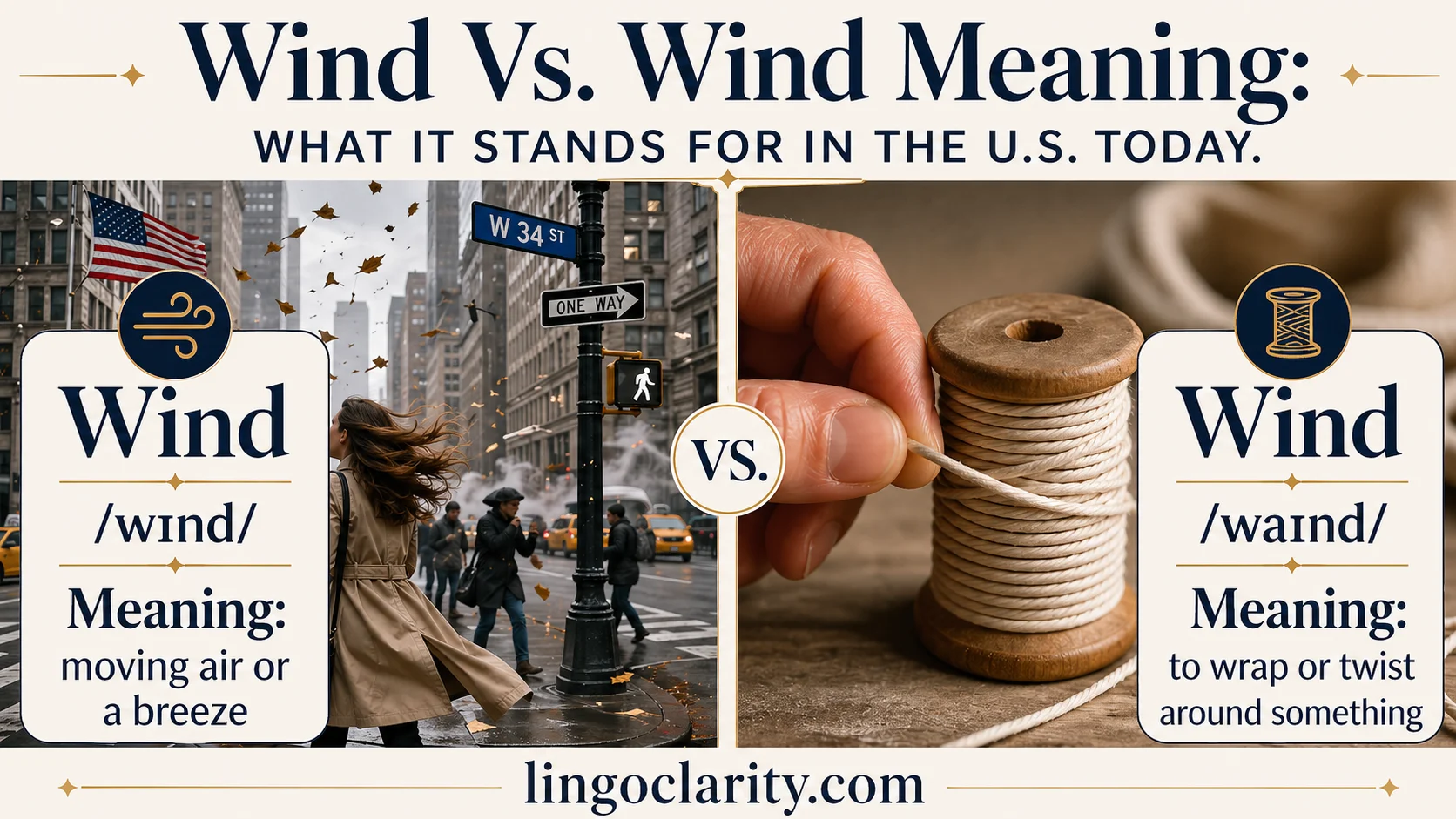
Wind and wind are spelled exactly the same, but they do not always mean the same thing. More importantly, they are not always pronounced the same way.
Use wind pronounced /wɪnd/, rhyming with pinned, when you mean moving air.
Example:
The wind knocked over the patio chairs.
However, use wind pronounced /waɪnd/, rhyming with find, when you mean to turn, twist, wrap, tighten, or move in a curved path.
Example:
Please wind the cord around the charger.
Therefore, the difference is not spelling. The difference is meaning and pronunciation. In writing, the word looks identical. In speech, however, the sentence tells you which pronunciation is correct.
Quick Answer
| Word | Pronunciation | Meaning | Example |
|---|---|---|---|
| wind | /wɪnd/, rhymes with pinned | Moving air | The wind blew all night. |
| wind | /waɪnd/, rhymes with find | Turn, twist, wrap, tighten, or curve | Wind the string around the spool. |
In simple terms, wind /wɪnd/ blows. Wind /waɪnd/ turns.
So, if the sentence is about weather, air, a breeze, a gust, or breath, use the /wɪnd/ pronunciation. If the sentence is about wrapping, coiling, tightening, turning, or curving, use the /waɪnd/ pronunciation.
Why Wind And Wind Are So Easy To Confuse
People confuse wind and wind because English sometimes uses one spelling for two different words. As a result, spelling alone cannot tell you how to say the word.
For example, look at these two sentences:
The wind was cold this morning.
Please wind the cable neatly.
The written word is identical in both sentences. However, the first sentence is about moving air, so wind is pronounced /wɪnd/. The second sentence is about wrapping a cable, so wind is pronounced /waɪnd/.
This kind of word is called a homograph because it shares the same spelling with another word. More specifically, wind and wind are also heteronyms because they are spelled the same but pronounced differently.
They are not homophones, though. Homophones sound alike. Since wind /wɪnd/ and wind /waɪnd/ sound different, they do not fit that category.
Wind Pronounced /Wɪnd/: Meaning Moving Air
Wind pronounced /wɪnd/ means air in motion. This is the word you use for weather, storms, breezes, gusts, drafts, wind speed, and wind direction.
Examples:
The wind blew leaves across the driveway.
A cold wind came through the open window.
The forecast says the winds may reach 40 miles per hour.
The wind rattled the windows all night.
Because this meaning refers to moving air, it often appears in weather reports, outdoor descriptions, and everyday conversation. You might hear it when someone talks about a windy day, a storm, a breeze off the lake, or air moving through a room.
Usually, this form of wind is a noun.
Examples:
The wind is strong today.
There was no wind during the race.
A sudden wind pushed the smoke toward the road.
However, the same air-related meaning can also appear in words and expressions connected to breath. For instance, winded means temporarily unable to breathe easily.
Example:
The long sprint left him winded.
In that sentence, winded is related to breath, not twisting or turning.
Wind Pronounced /Waɪnd/: Meaning Turn, Twist, Wrap, Or Curve
Wind pronounced /waɪnd/ usually works as a verb. It means to turn, twist, wrap, coil, tighten, or move in a curving path.
Examples:
Please wind the hose before putting it away.
The trail winds through the woods.
She forgot to wind the old clock.
He had to wind the bandage around his wrist.
Unlike the air meaning, this version often involves movement around something or along a curved route. Therefore, it commonly appears with cords, cables, thread, yarn, ribbon, watches, clocks, roads, rivers, trails, and staircases.
For example, you can wind string around a spool. Likewise, a road can wind through the mountains. In both cases, the idea is turning, wrapping, or curving.
This pronunciation also appears in several common phrasal verbs, including wind up, wind down, wind around, and wind through.
The Main Difference At A Glance
| Context | Correct Meaning | Pronunciation | Example |
|---|---|---|---|
| Weather or air | Moving air | /wɪnd/ | The wind is strong today. |
| Breeze or gust | Moving air | /wɪnd/ | A warm wind came off the lake. |
| Breath or being out of breath | Air or breath | /wɪnd/ | The fall winded him. |
| Wrapping something | Coil or wrap | /waɪnd/ | Wind the cord around the reel. |
| A road, river, or trail | Move in curves | /waɪnd/ | The road winds through the canyon. |
| A clock, toy, or watch | Tighten by turning | /waɪnd/ | Wind the clock before bed. |
| Ending gradually | Slow down or finish | /waɪnd/ | The party began to wind down. |
As you can see, context does most of the work. If air is moving, choose /wɪnd/. If something is turning, wrapping, or curving, choose /waɪnd/.
How To Choose The Right Pronunciation
To choose the right pronunciation, ask one simple question:
Is something blowing, or is something turning?
If something is blowing, pronounce wind as /wɪnd/.
Examples:
The wind knocked over the trash cans.
The wind was too strong for sailing.
A cool wind moved through the trees.
If something is turning, wrapping, or curving, pronounce wind as /waɪnd/.
Examples:
Can you wind the cord around the hook?
The river winds behind the houses.
The staircase winds up to the tower.
This shortcut works because the two meanings belong to different everyday situations. Moving air belongs to weather and breath. Turning or curving belongs to motion, shape, and handling objects.
Grammar Forms: Wind, Winds, Winding, Wound, And Winded
The grammar forms are where many mistakes happen. Therefore, it helps to separate the two meanings clearly.
Wind And Winds
When wind means moving air, the plural is winds, pronounced /wɪndz/.
Examples:
Strong winds delayed the flight.
Cold winds moved in overnight.
However, when wind means to turn, twist, wrap, or curve, winds is the third-person singular verb form, pronounced /waɪndz/.
Examples:
The path winds through the park.
She winds the clock every Sunday.
The spelling is the same, but the sound changes with the meaning.
Winding
Winding usually comes from wind /waɪnd/. It means curving, twisting, wrapping, or turning.
Examples:
A winding road led to the cabin.
He was winding the cable around the reel.
The trail was narrow and winding.
In these examples, winding uses the long i sound because it is connected to turning or curving.
Wound
The past tense of wind /waɪnd/ is wound, pronounced /waʊnd/, rhyming with found.
Examples:
She wound the scarf around her neck.
He wound the watch before leaving.
The river wound through the valley.
However, do not confuse this with wound pronounced /wuːnd/, meaning an injury.
Compare:
He wound the string around the stick.
Meaning: He wrapped the string.
The nurse cleaned the wound.
Meaning: The nurse cleaned the injury.
Although the spelling is the same, these are different words with different pronunciations.
Winded
Winded usually means temporarily out of breath. It is pronounced with the short i sound, as in wind /wɪnd/.
Examples:
The sprint left him winded.
She was winded after climbing the stairs.
The fall winded him for a few seconds.
Importantly, winded is not the normal past tense of wind meaning turn or wrap. For that meaning, use wound.
Incorrect:
She winded the ribbon around the gift.
Correct:
She wound the ribbon around the gift.
Common Phrases With Wind Pronounced /Wɪnd/
Several common expressions use wind with the moving-air pronunciation, /wɪnd/. These phrases often have figurative meanings, but they still keep the air-related sound.
Get Wind Of
To get wind of something means to hear about it, especially before it is officially announced.
Example:
Reporters got wind of the decision before the company released a statement.
Here, wind is pronounced /wɪnd/.
Second Wind
A second wind is a new burst of energy after feeling tired.
Example:
I was exhausted after the first half, but I got my second wind near the end of the game.
Again, wind is pronounced /wɪnd/.
Take The Wind Out Of Someone’s Sails
To take the wind out of someone’s sails means to reduce someone’s confidence, energy, or excitement.
Example:
The harsh criticism took the wind out of her sails.
Because the phrase comes from the image of wind powering a sail, it uses /wɪnd/.
Throw Caution To The Wind
To throw caution to the wind means to take a risk without worrying much about the consequences.
Example:
They threw caution to the wind and booked a last-minute trip.
In this expression, wind is also pronounced /wɪnd/.
Common Phrases With Wind Pronounced /Waɪnd/
Other common expressions use wind with the turning or curving pronunciation, /waɪnd/. These phrases can be literal or figurative.
Wind Up
Wind up can mean to tighten something by turning it.
Example:
Can you wind up the music box?
However, wind up can also mean to end up in a situation.
Example:
We might wind up staying home tonight.
Additionally, in informal speech, wind someone up can mean to annoy, tease, or provoke someone.
Example:
Do not wind up your little brother before bedtime.
In all three uses, wind is pronounced /waɪnd/.
Wind Down
Wind down means to relax, slow down, or gradually come to an end.
Examples:
I like to wind down with a book before bed.
The meeting began to wind down after an hour.
The past tense is wound down.
Example:
The party wound down around midnight.
Wind Around
Wind around means to wrap around something or curve around something.
Examples:
The vine will wind around the fence.
She wound the ribbon around the box.
Since the meaning involves wrapping or curving, pronounce wind as /waɪnd/.
Wind Through
Wind through means to move through a place in a curving or indirect path.
Examples:
The road winds through the hills.
The parade route wound through downtown.
Again, this meaning uses /waɪnd/.
Common Mistakes And Correct Examples
Mistakes with wind and wind usually happen in speech, reading aloud, or choosing the wrong past-tense form. Fortunately, each mistake has a simple fix.
Mistake 1: Pronouncing The Air Meaning Like /Waɪnd/
Incorrect pronunciation:
The wind is freezing today.
Said as /waɪnd/.
Correct pronunciation:
The wind is freezing today.
Said as /wɪnd/.
Because the sentence is about weather, the correct sound is /wɪnd/.
Mistake 2: Pronouncing The Turn Meaning Like /Wɪnd/
Incorrect pronunciation:
Please wind the cord around the reel.
Said as /wɪnd/.
Correct pronunciation:
Please wind the cord around the reel.
Said as /waɪnd/.
Because the sentence is about wrapping a cord, the correct sound is /waɪnd/.
Mistake 3: Using Winded Instead Of Wound
Incorrect:
She winded the scarf around her neck.
Correct:
She wound the scarf around her neck.
Since the meaning is “wrapped,” the past tense must be wound, not winded.
Mistake 4: Confusing Wound With Wound
Incorrect understanding:
He wound the rope.
Meaning: He injured the rope.
Correct understanding:
He wound the rope.
Meaning: He wrapped or coiled the rope.
Meanwhile, wound as a noun means an injury.
Example:
The doctor treated the wound.
Although these words are spelled the same, pronunciation separates them.
Mistake 5: Calling Wind And Wind Homophones
Incorrect:
Wind and wind are homophones.
Correct:
Wind and wind are homographs and heteronyms.
They are spelled the same, but they do not sound the same.
Everyday Examples Of Wind /Wɪnd/
The wind blew my hat into the street.
A strong wind pushed the door open.
The wind made the trees bend.
There was just enough wind to fly a kite.
The wind picked up before the storm.
A warm wind came off the lake.
The runner was winded after the final lap.
The cold wind made the walk uncomfortable.
In each sentence, wind is connected to air, weather, or breath. Therefore, the correct pronunciation is /wɪnd/.
Everyday Examples Of Wind /Waɪnd/
Please wind the earbuds before you put them away.
The line seemed to wind around the entire room.
The road winds past the school and into the neighborhood.
She forgot to wind the old clock.
The river winds through the valley.
He wound the bandage around his ankle.
Let’s wind down after dinner.
If you keep teasing him, you will wind him up.
In each sentence, wind involves turning, wrapping, curving, ending gradually, or provoking. Therefore, the correct pronunciation is /waɪnd/.
Synonyms That Help You Check The Meaning
Synonyms can help you decide which pronunciation fits.
For wind /wɪnd/ meaning moving air, possible synonyms include:
breeze
gust
draft
air current
gale
airflow
For example, if you can replace wind with breeze or gust, you probably need the /wɪnd/ pronunciation.
Example:
A cold wind came through the window.
A cold breeze came through the window.
For wind /waɪnd/ meaning turn, twist, wrap, or curve, possible synonyms include:
wrap
coil
twist
turn
curl
curve
meander
tighten
For example, if you can replace wind with wrap, coil, or curve, you probably need the /waɪnd/ pronunciation.
Example:
Please wind the rope around the post.
Please wrap the rope around the post.
Simple Practice Test
Choose the correct pronunciation for each sentence.
- The wind blew the papers off the table.
Answer: /wɪnd/ because it means moving air. - Wind the string around the spool.
Answer: /waɪnd/ because it means wrap. - The road winds through the canyon.
Answer: /waɪnd/ because it means curves. - A strong wind came from the west.
Answer: /wɪnd/ because it means air. - She wound the ribbon around the gift.
Answer: /waʊnd/ because wound is the past tense of wind /waɪnd/. - The climb left him winded.
Answer: /ˈwɪndɪd/ because winded relates to breath.
FAQ
What is the difference between wind and wind?
Wind pronounced /wɪnd/ means moving air. Wind pronounced /waɪnd/ means to turn, twist, wrap, tighten, or move in a curved path. The spelling is the same, but the pronunciation and meaning are different.
How do you pronounce wind when it means air?
When wind means air in motion, pronounce it /wɪnd/. It rhymes with pinned. For example: The wind is strong today.
How do you pronounce wind when it means turn or twist?
When wind means turn, twist, wrap, or curve, pronounce it /waɪnd/. It rhymes with find. For example: Please wind the cord neatly.
Is wind and wind a homograph?
Yes. Wind and wind are homographs because they are spelled the same but have different meanings. Additionally, they are heteronyms because they are pronounced differently.
Are wind and wind homophones?
No. Homophones sound the same, but wind /wɪnd/ and wind /waɪnd/ do not. Therefore, they are not homophones.
What is the past tense of wind?
The past tense of wind /waɪnd/ is wound, pronounced /waʊnd/. For example: She wound the thread around the spool.
Is winded the past tense of wind?
Usually, no. Winded means out of breath. For example: The run left him winded. However, when wind means wrap or turn, the past tense is wound.
How do you pronounce wind up?
Wind up is pronounced /waɪnd ʌp/. It can mean to tighten something by turning it, to end up in a situation, or to annoy someone.
How do you pronounce wind down?
Wind down is pronounced /waɪnd daʊn/. It means to relax, slow down, or gradually come to an end.
Conclusion
Use wind /wɪnd/ for moving air, weather, and breath.
Use wind /waɪnd/ for turning, twisting, wrapping, tightening, or curving.
Ultimately, the spelling will not help because both words are spelled the same. Instead, read the sentence for meaning. If something is blowing, say wind /wɪnd/. If something is turning, wrapping, or curving, say wind /waɪnd/.
