
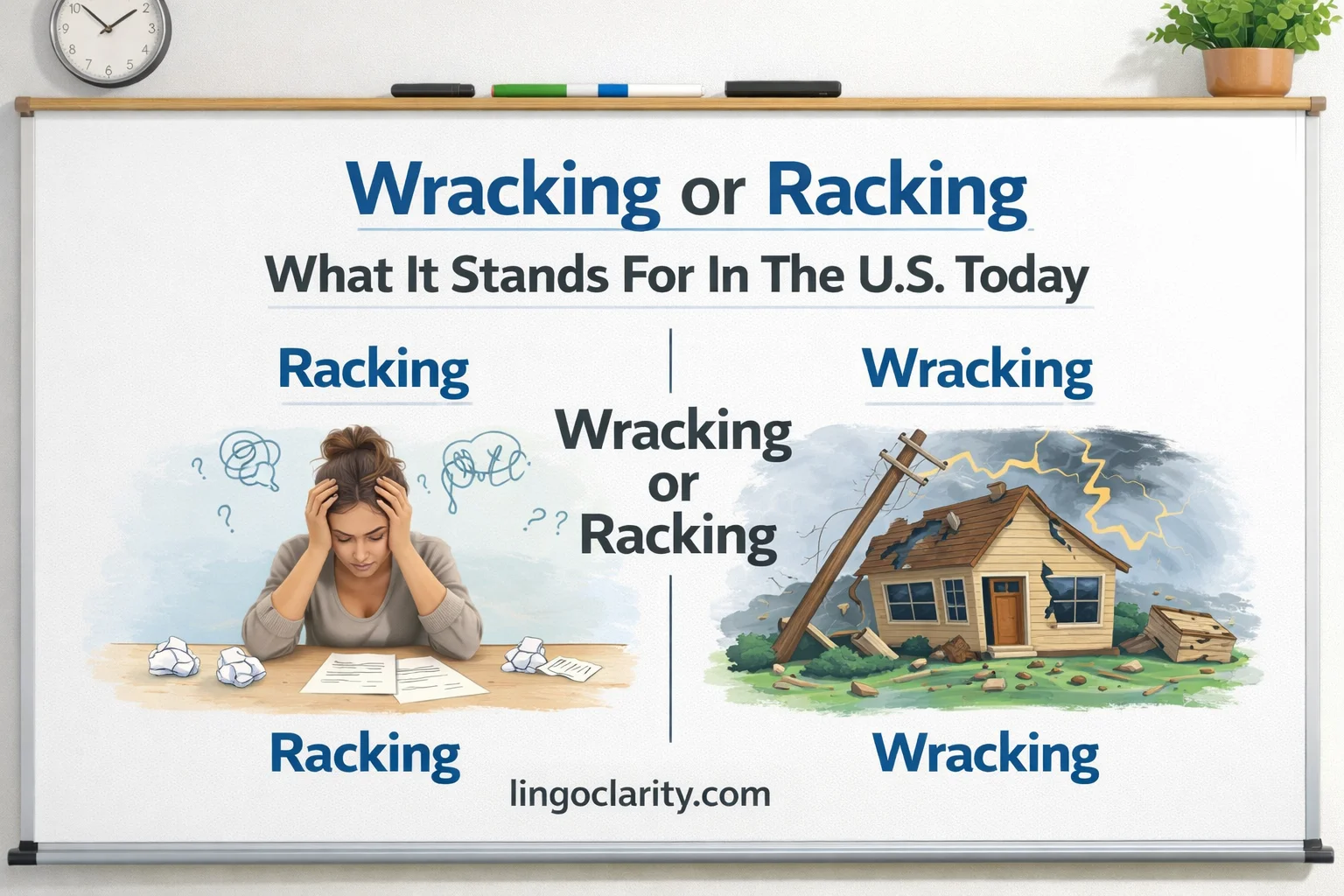
Many writers pause when they reach wracking or racking because both forms look familiar, both sound the same, and both appear in real English. That overlap makes the choice feel harder than it should be. Still, if your goal is clear, modern US English, there is a simple rule that works most of the time: use racking as your default choice. Major dictionary and usage references treat wrack as a real word, and they also note that it overlaps with rack in some common expressions. Even so, they generally present racking as the more standard or safer form in phrases like racking your brain and nerve-racking, while wrack / wracking / wracked remains more natural in ruin-, damage-, or devastation-related wording.
So, yes, both forms exist. However, they do not feel equally standard in every context. That is exactly why this pair deserves a careful, practical explanation.
Quick Answer
In modern US English, racking is usually the right choice for everyday writing. Use it when you mean mental strain, pressure, torment, or intense effort, as in racking your brain, nerve-racking, or racking up points. Use wracking more cautiously. It still appears as a recognized variant and can feel natural when the idea leans toward ruin, wrecking, or devastation.
If you want the simplest editor-safe rule, choose racking unless you have a strong reason to prefer wracking.
Simple Definition
Here is the plain-English version:
- racking usually relates to strain, torment, pressure, or intense mental effort
- wracking usually relates more closely to ruin, wrecking, or destructive force
- in some fixed or familiar expressions, the two forms overlap, which is why people keep seeing both
Because of that overlap, the issue is not whether wracking is “fake.” It is not fake. The real question is which form will look more natural and more standard to most US readers in a given sentence.
Key Differences At A Glance
| Context | Best Choice | Why |
|---|---|---|
| Thinking very hard | racking | Standard choice in racking your brain |
| Causing tension or stress | racking | Fits the well-established sense of strain or torment |
| Scoring or accumulating | racking | Correct in racking up points, racking up debt, and similar phrases |
| Damage, ruin, or devastation | wracking can fit | More closely tied to destruction-related meaning |
| Neutral US writing when unsure | racking | Safest, clearest default |
| A few familiar variants | wracking may appear | Recognized, but often less standard-looking |
Why People Confuse These Words
The confusion happens for two main reasons. First, rack and wrack are pronounced the same. Second, the words have overlapped in meaning for a long time, especially in expressions connected to suffering, strain, or destruction. Merriam-Webster notes that although the two words come from different sources, usage has blurred them enough that many dictionaries now list wrack as a variant in some familiar expressions. Dictionary.com makes the same basic point: the words often overlap in contexts involving torment or destruction.
As a result, readers run into both racking your brain and wracking your brain, both nerve-racking and nerve-wracking, and both racked with pain and wracked with pain. Once people see both versions in print, they naturally assume both must work everywhere. That is where the trouble starts.
The Real Difference Between Wracking And Racking
The clearest practical distinction is this:
racking is the better choice when the idea is strain, torment, pressure, or intense effort.
wracking makes more sense when the idea is wrecking, damage, or devastation.
That is why these sentences feel natural:
- I was racking my brain for the answer.
- The delay was nerve-racking.
- They are racking up wins this season.
By contrast, this kind of wording leans more naturally toward wrack:
- The coastline was storm-wracked after the hurricane.
- The town was wracked by poverty.
- His body was wracked with grief.
Even here, though, English does not draw a perfect line. Britannica gives examples such as wracked by poverty, while its rack entry also shows racked by disease and racked by civil war. In other words, real usage still overlaps. That is why the safest editorial advice is not “they are always completely different.” The safer advice is “racking is usually the standard default, while wracking / wracked still feels natural in some damage- or distress-heavy contexts.”
Which Form Is Safer In Modern US English
If you are writing for work, school, business, publishing, or the web, racking is usually the safer form.
That advice covers the expressions most people actually use:
- racking your brain
- nerve-racking
- racking pain
- racking up sales
- racking up debt
- racking up points
This matters because readers expect familiar phrasing. When you choose the spelling most readers already recognize as standard, your sentence moves smoothly. When you choose the less expected variant, some readers stop and question the wording instead of following your meaning.
So, in plain terms, if you are unsure, choose racking.
When Wracking Still Makes Sense
That does not mean wracking is wrong in every case. It still makes sense when you want the idea of wrecking, ruin, or violent damage to come forward more clearly. Britannica defines wrack as causing pain or damage and notes that it often appears as wracked. Merriam-Webster also points out that some writers reserve wrack for storm, wreckage, or destruction language.
So these can sound natural:
- a storm-wracked coastline
- a region wracked by conflict
- a family wracked by grief
- years of wracking damage
Even so, you should use this form intentionally. In neutral prose, many editors will still prefer another clearer choice, such as damaging, devastating, ruining, or racked by.
Real-Life Example
Imagine these three settings:
At school:
You are taking a math test and cannot remember one formula. You would naturally write, I was racking my brain during the exam.
At work:
A delayed project update is making everyone tense. You would most likely say, The silence was nerve-racking for the whole team.
In a dramatic news-style sentence:
A long civil conflict has left a region in bad condition. Here, The country was wracked by years of violence can sound strong and natural.
That contrast helps. In ordinary modern writing, racking fits effort and strain. In more dramatic damage-related phrasing, wracked / wracking may still work well.
Tone, Context, And Formality
Tone matters here more than many people realize.
racking sounds plainer, more current, and more standard in modern US prose. It is the form that usually disappears into the sentence, which is exactly what you want in most writing.
wracking, on the other hand, can sound more literary, slightly older, or more dramatic. Sometimes that tone helps. Other times it distracts. If a reader pauses to wonder whether you meant racking, your sentence loses force.
For that reason, racking is usually better in:
- academic writing
- workplace writing
- online articles
- product copy
- classroom materials
- business communication
Meanwhile, wracking works best when you truly want a sense of destruction, ruin, or dramatic suffering.
Common Phrases And The Best Choice
Some phrases cause the most confusion, so it helps to settle them one by one.
Racking Your Brain
This is the safer and more standard modern choice in US English. Dictionary.com explicitly identifies racking my brain as the more common or standard form, and Britannica lists rack your brain/brains under rack.
Wracking Your Brain
This form does appear, and Merriam-Webster acknowledges that many dictionaries list wrack as a variant in this expression. Still, it is more likely to look nonstandard to a careful US reader.
Nerve-Racking
This is the better default spelling. Dictionary.com describes nerve-racking as the more common and standard version. Britannica also lists nerve-racking under rack.
Nerve-Wracking
This version is widely seen and understood. However, it still tends to look like the less standard variant when compared with nerve-racking.
Racking Up
Always choose racking up, not wracking up. Britannica defines rack up as accumulate or achieve over time, as in points, losses, or sales.
Rack And Ruin
In modern US usage, rack and ruin is the safer fixed phrase. Britannica lists the idiom under rack, and Dictionary.com also treats rack and ruin as the standard form, even while noting historical variation.
Synonyms
Because these forms overlap, the best synonym depends on the exact sentence.
Synonyms For Racking
- straining
- tormenting
- taxing
- agonizing
- exhausting
- pressuring
Synonyms For Wracking
- wrecking
- ruining
- devastating
- damaging
- ravaging
- shattering
A useful editing trick is this: if neither racking nor wracking feels perfectly clear, replace the word with one of these simpler options. Often, that produces the strongest sentence.
Opposites
There is no single opposite that fits every use, but these are helpful contrasts.
Opposites For Racking
When racking means straining or tormenting, useful opposites include:
- soothing
- easing
- calming
- relieving
- comforting
Opposites For Wracking
When wracking means damaging or ruining, useful opposites include:
- preserving
- protecting
- restoring
- repairing
- strengthening
Sentence Usage
Here are clear examples that show how these forms work in real sentences.
Correct Use Of Racking
- I spent half the afternoon racking my brain for her last name.
- Waiting for the test results was nerve-racking.
- The patient described a racking cough that kept him awake.
- Their team is racking up wins this month.
- She was racking her brain to remember the address.
- The long delay was racking everyone’s patience.
Correct Use Of Wracking
- The fishing village was wracked by repeated storms.
- Years of conflict left the region wracked by poverty.
- He sat in silence, wracked with guilt.
- The drought kept wracking the farmland season after season.
- The nation was wracked by unrest.
- The old shoreline looked storm-wracked after winter.
Safer Rewrites When You Want Maximum Clarity
- Instead of wracking your brain, write racking your brain
- Instead of nerve-wracking, write nerve-racking
- Instead of wracking up debt, write racking up debt
- Instead of wracking damage, consider devastating damage
These rewrites reduce reader hesitation and make the sentence feel more standard right away.
Common Mistakes
Writers often make the same mistakes with this pair. Fortunately, each one is easy to fix.
Mistake 1: Treating The Words As Perfectly Interchangeable
They do overlap, but they are not equally natural in every context.
Quick fix: Use racking as your default. Save wracking for ruin- or destruction-heavy wording.
Mistake 2: Writing “Wracking Up”
This is one of the clearest errors.
Quick fix: Always write racking up points, racking up debt, racking up sales, or racking up wins.
Mistake 3: Choosing “Wracking Your Brain” In Formal Writing
This version exists, but it often looks less standard.
Quick fix: In edited US prose, prefer racking your brain.
Mistake 4: Assuming “Wracking” Sounds More Sophisticated
Sometimes writers pick wracking because it looks more dramatic or unusual. However, unusual is not always better.
Quick fix: Choose the form that serves the sentence, not the form that looks fancier.
Mistake 5: Forgetting That A Simpler Word May Be Better
In some sentences, neither form is the clearest choice.
Quick fix: Replace it with straining, agonizing, damaging, or devastating when that makes the line easier to read.
A Practical Editing Rule You Can Actually Use
When you are editing and do not want to overthink it, use this three-step rule:
- If the phrase is about thinking hard, stress, torment, or accumulating, choose racking.
- If the phrase is strongly about damage, wrecking, or ruin, wracking / wracked may fit.
- If the sentence still looks awkward, replace the word with a clearer synonym.
That rule is simple, fast, and reliable. Better yet, it matches how careful modern US writers already tend to handle the pair.
FAQs
Is “racking your brain” or “wracking your brain” better?
Racking your brain is the better default in modern US English. Wracking your brain does appear, and usage notes recognize it as a variant, but racking your brain is more likely to look standard to most readers.
Is “nerve-wracking” wrong?
Not exactly. It is widely used and widely understood. However, nerve-racking is usually treated as the more standard version in US English.
Can I use “wracked by grief” or “wracked by poverty”?
Yes. That wording is natural and well established. Britannica gives examples such as wracked by poverty, and wracked by often feels right when the sentence emphasizes suffering or damage.
Is “rack and ruin” or “wrack and ruin” better?
For modern US writing, rack and ruin is the safer choice. Some references note variation, but rack and ruin is the form most readers will expect.
Should I always avoid “wracking”?
No. You do not need to avoid it completely. You just should not use it as your default spelling. It works best when the sentence clearly points toward wrecking, damage, or ruin.
What should I do if I want the least distracting option?
Choose racking. It is the clearest all-purpose answer for most modern US writing.
Conclusion
If you want one rule that will keep your writing clean, natural, and publication-ready, use racking in most situations.
Choose racking for mental effort, strain, torment, or accumulation:
- racking your brain
- nerve-racking
- racking pain
- racking up points
Choose wracking only when you intentionally want a ruin-related or destruction-heavy sense, or when you are using an accepted variant on purpose.
That approach gives you the best of both worlds. It respects real English usage, and it also protects clarity. Most importantly, it helps your writing sound smooth to modern US readers instead of making them stop and second-guess your choice.
