
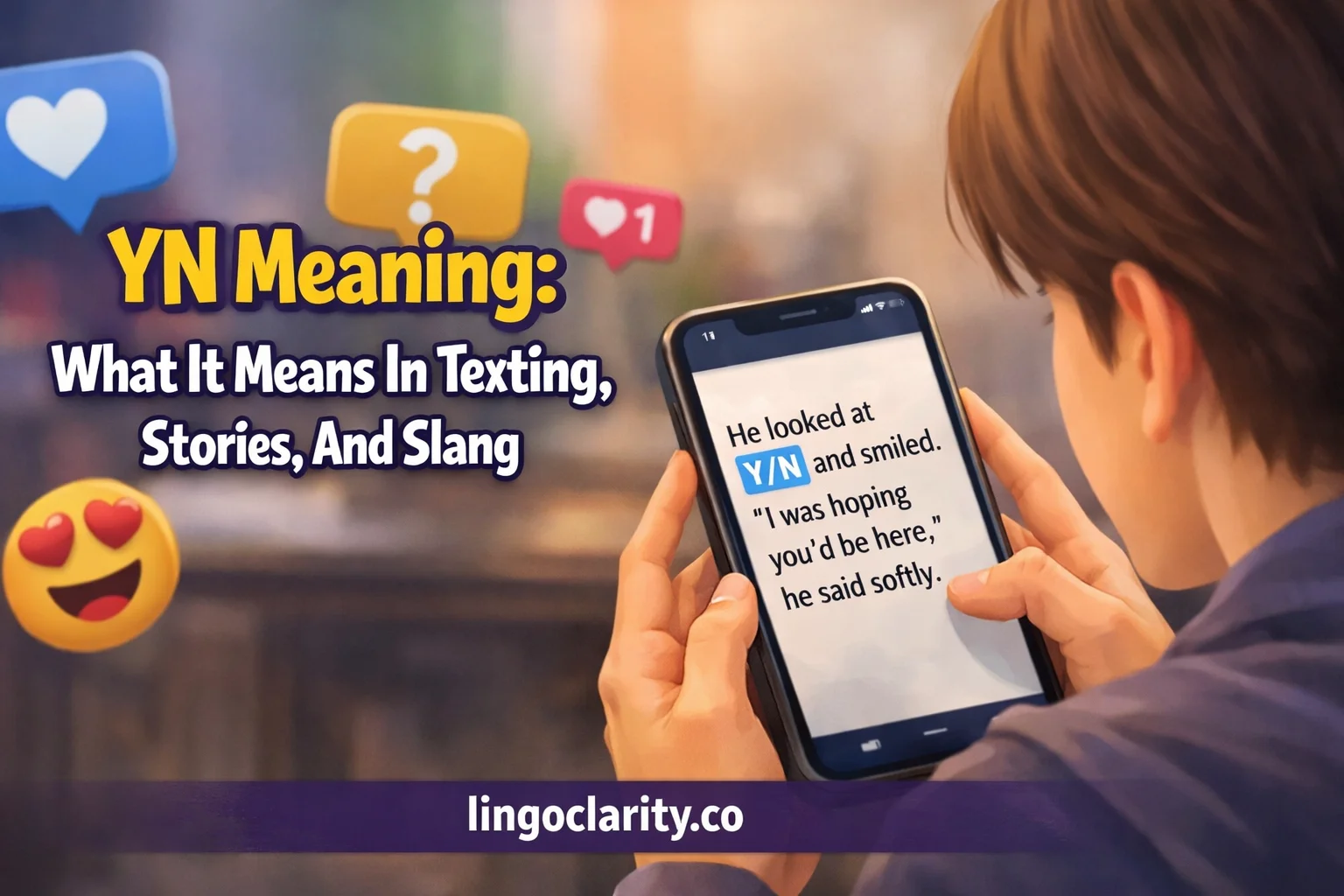
You’ll see YN (or Y/N) in texts, TikTok comments, Wattpad, Tumblr, and reader-insert stories. The key thing to know is this: YN does not have one universal meaning. It changes by context.
Most common meanings:
- In texting, YN often means “yes or no?” (a quick request for a binary answer).
- In fan fiction and reader-insert stories, Y/N means “your name” (a placeholder the reader replaces mentally).
- In some slang spaces, YN can also be used with other meanings (including a highly offensive one). If you’re unsure, read the surrounding words before responding.
Quick Answer
YN usually means one of these:
- Texting: YN = “yes or no?”
- Reader-Insert Stories: Y/N = “your name.”
- Other Slang: In some communities, YN can have additional meanings, including an offensive slang use.
What YN Means In Texting
In everyday messaging, YN is commonly used to push for a quick decision. It’s basically shorthand for: “Yes or no?”
How It Looks In Real Texts
- “Coming tonight, YN?”
- “You free at 6? YN”
- “Should I grab food for you too, YN?”
When It Sounds Natural
Use YN only when the answer can truly be yes or no. If the question needs explanation, YN feels lazy or confusing.
Common Mistake
Wrong: “Can you explain the project? YN”
Better: “Can you explain the project?”
What Y/N Means In Fan Fiction And Reader-Insert Stories
In fan fiction and reader-insert content, Y/N is a placeholder for the reader. It means “your name.”
Writers use it so the reader can imagine themselves in the story.
Examples
- “Y/N walked into the room quietly.”
- “He looked at Y/N and smiled.”
- “Everyone waited for Y/N to answer.”
How To Read It Easily
When you see Y/N, replace it with a name in your head:
- “Y/N sat by the window.” → “Aisha sat by the window.”
Many readers don’t literally insert their real name every time—they just mentally treat it as a blank “reader” slot.
How To Tell Which Meaning Is Intended
Use this quick context check:
If It’s A Text Or DM
- Ends a question?
- Looks like a prompt for a fast reply?
It likely means “yes or no.”
If It’s A Story Or Scenario
- Appears inside narration?
- Looks like a name slot?
It likely means “your name.”
If It’s A TikTok Or Slang Comment
- Mentions “YNs,” “a YN,” or uses it like a label for people?
It may be a slang/community meaning—read carefully and consider the tone.
Other Meanings You Might See
Because YN is short, different communities reuse it.
YN As “Why Not”
Some slang dictionaries list YN as “why not.” This use exists, but it’s less consistent than “yes or no” and “your name,” so context matters even more.
Example:
- “We can try it. YN?” (meaning: “Why not?”)
YN As An Offensive Slang Label
In some online slang, YN is also used as an initialism for a phrase containing a racial slur. That usage is offensive, can stereotype people, and is not appropriate for general writing. If you see it used that way, it’s best not to repeat it—especially in professional or public contexts.
When You Should Avoid Using YN
Even when your meaning is harmless, YN is still informal and can read as unclear.
Avoid it in:
- work emails
- customer support
- school assignments
- formal posts where tone matters
- any situation where clarity or professionalism is important
Instead of: “Can you attend tomorrow, YN?”
Write: “Can you attend tomorrow? Please reply yes or no.”
Cleaner Alternatives That Say The Same Thing
When YN Means “Yes Or No”
- “Yes or no?”
- “Quick yes/no?”
- “Can you confirm?”
- “Are you in?”
When Y/N Means “Your Name” In Stories
If you’re writing, consider using:
- a neutral placeholder name
- “the reader”
- a character nickname
- a customizable input style (some writers use tools/extensions, but that’s optional)
Common Mistakes And Quick Fixes
Mistake: Assuming YN Always Means One Thing
Fix: Check whether it’s a chat question (yes/no) or a story placeholder (your name).
Mistake: Using YN For Questions That Need Explanation
Fix: Only use it for true yes/no questions.
Mistake: Using YN In Professional Writing
Fix: Spell it out for clarity.
Mistake: Missing The Slash In Stories
Fix: In reader-insert writing, Y/N is the standard format most readers recognize.
Examples Of YN In Real Context
Text Message Examples
- “Pick you up at 7, YN?”
- “Still coming? YN”
- “Want coffee? YN”
Story Examples
- “Y/N turned the page slowly.”
- “The gift was meant for Y/N.”
- “No one expected Y/N to say that.”
Comparison Table
| Context | Best Meaning | Why It Fits |
|---|---|---|
| Casual text message | Yes or no | It asks for a binary reply |
| Reader-insert story | Your name | It’s a placeholder for the reader |
| Work email | Avoid | Too informal; can confuse readers |
| Slang-heavy comments | Depends | Some uses vary by community |
FAQs
What does YN mean in texting?
Most commonly, YN means “yes or no?” It’s a quick way to ask for a simple confirmation.
What does Y/N mean in fan fiction?
In reader-insert stories, Y/N means “your name.” It’s a placeholder the reader replaces mentally.
Do people actually insert their real name for Y/N?
Some do, but many readers simply read it as “the reader” or treat it as a blank placeholder rather than inserting their real name every time.
Is YN the same as “why not”?
Sometimes. Some slang references list YN as “why not,” but it’s not as consistent as “yes or no” in texting or “your name” in stories.
Should you use YN in professional messages?
No. It’s informal and can look unclear. Spell it out instead.
Can YN have an offensive meaning?
Yes. In some slang contexts, YN can be used as an initialism tied to a racial slur. That usage is offensive and best avoided.
Conclusion
YN is a short abbreviation with multiple meanings. In texting, it most often means “yes or no?” In reader-insert stories, Y/N means “your name.” In other slang spaces, it can carry additional meanings, including an offensive one—so context matters.
If you want the safest rule: Texting question = yes/no. Story placeholder = your name. And when clarity matters, spell it out.
