
If you are searching carino meaning, you are probably staring at a text, a DM, a caption, or a comment and wondering if someone just called you cute or just called you their darling. Both are possible, and one tiny letter decides which.
Here is the key. Carino” can be two different things: a missing-ñ spelling of the Spanish word cariño, which means affection, love, or “dear,” or a real Italian word, carino (for a male) and carina (for a female), which means cute, nice, pretty, or kind. Same six letters, two very different vibes.
This guide explains both meanings in plain English, shows you exactly when each word fits, how to say each one out loud, and gives copy-ready examples you can send without sounding awkward. Start with the quick answer below, then check the side-by-side table so you never mix them up again.
Quick Answer
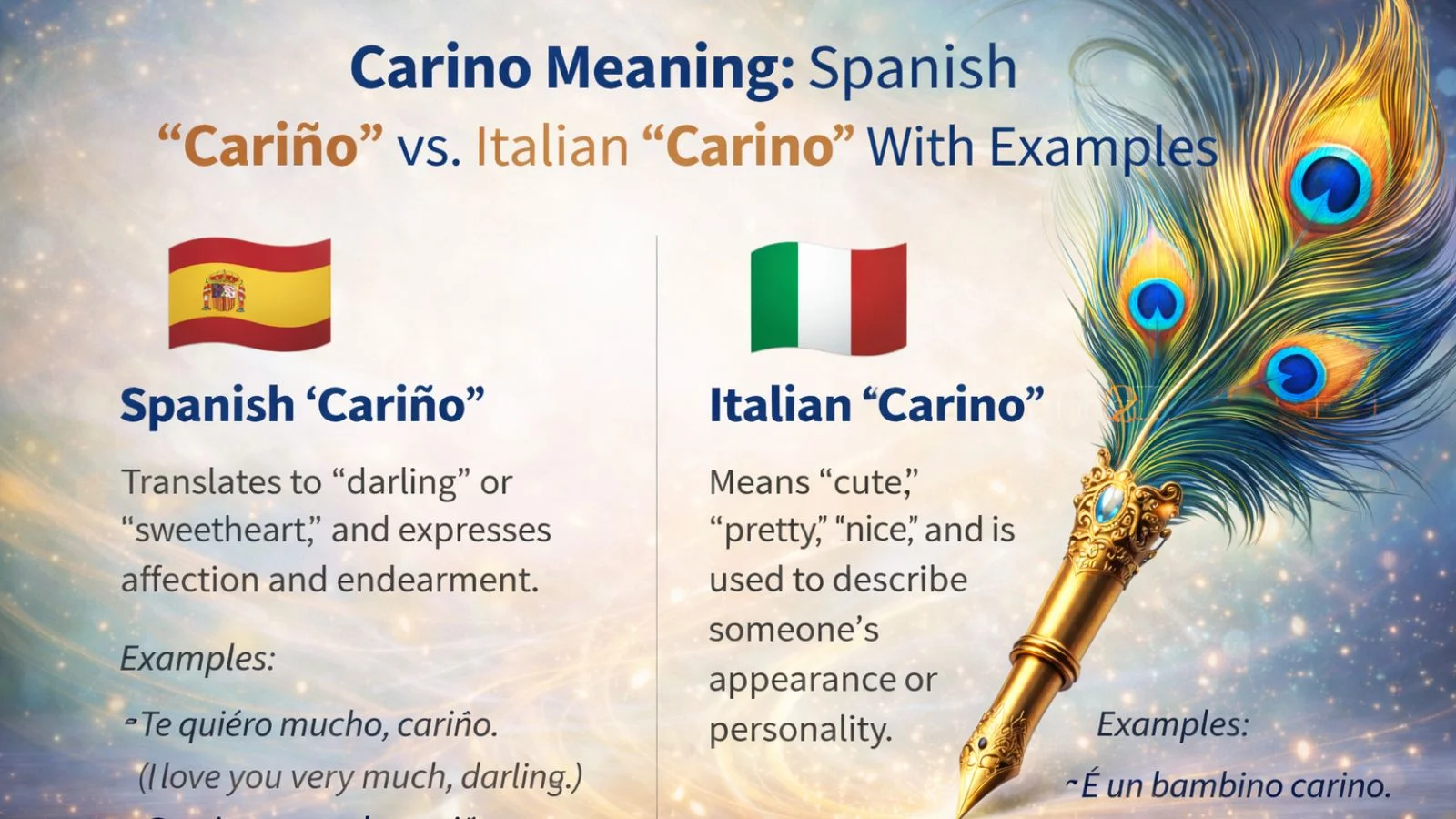
Carino meaning depends on which language the sender used. In Spanish, the correct word is cariño (kah-REE-nyoh), a noun meaning affection or love and a term of endearment like “honey,” “sweetie,” or “dear.” In Italian, carino (kah-REE-noh) is an adjective meaning cute, pretty, nice, or kind, and it changes to carina for a female, carini for males or a mixed group, and carine for females. Spelled without the ñ, “carino” is not a standard Spanish word at all.
Carino vs Cariño at a Glance
| Italian carino | Spanish cariño | |
|---|---|---|
| Word type | Adjective | Noun / term of endearment |
| Means | Cute, pretty, nice, kind | Affection, love, “dear,” “honey” |
| Says it about | A person, outfit, place, or gesture | A person you feel warmth for |
| Tone | Light, friendly, casual | Warm, intimate, family or romantic |
| Example | “Che carino!” (How cute!) | “Gracias, cariño.” (Thanks, dear.) |
| Spelling trap | No ñ, ever | Needs the ñ |
Key Takeaways (TL;DR)
- Spanish: write cariño (ñ matters).
- Italian: write carino/carina (“cute/nice/kind”).
- Tone is intimate: best for close relationships; risky with strangers, coworkers, or in power-imbalance situations.
- If you’re unsure, use a neutral alternative (name, “hi,” “thanks,” etc.).
Carino vs. Cariño: Why the Spelling Matters
In Spanish, ñ is a separate letter, not just an “n with a mark.” That’s why cariño is the standard spelling for the Spanish word meaning affection.
Why people type “carino” anyway: English keyboards and quick texting make ñ harder to type, so people often drop it. In casual contexts, Spanish readers may still interpret “carino” as cariño, but in school, formal writing, and language-learning settings it can look incorrect.
Rule of thumb
- Writing Spanish? Use cariño.
- Writing Italian? Use carino/carina.
- Not sure which language the conversation is in? Use no nickname.
Meaning of Cariño in Spanish (noun + nickname)
1) As a noun: “affection / fondness”
Spanish cariño commonly means affection—warm, positive feeling toward someone (or even a place, object, or memory).
A less common dictionary sense is nostalgia/longing.
Examples (affection / fondness)
- Le tengo mucho cariño a mi abuela. (I’m very fond of my grandma.)
- Eso fue un gesto de cariño. (That was a gesture of affection.)
- Lo recuerdo con cariño. (I remember him with affection.)
2) As a nickname: “dear / honey / sweetheart”
Spanish speakers also use cariño to address someone warmly—similar to “dear” or “honey,” depending on relationship and tone.
Examples (nickname)
- Buenas noches, cariño.
- ¿Estás bien, cariño?
- Ven acá, cariño.
Mini-translation tip: Don’t auto-translate cariño as “love” every time. Often “affection/fondness” is more accurate.
Meaning of Carino in Italian (adjective)
In Italian, carino is an adjective meaning cute / nice / pleasant / kind, and it can also be used ironically (“Well aren’t you being nice…”).
Italian adjectives change with gender and number:
- carino (masc. singular)
- carina (fem. singular)
- carini (masc. plural)
- carine (fem. plural)
Examples (Italian)
- Il tuo cane è carino. (Your dog is cute.)
- Che storia carina! (What a nice story!)
- È stato un gesto carino. (That was kind.)
Common confusion: Italian carino ≠ Spanish cariño. They look similar but don’t function the same way (adjective vs noun/nickname).
Real-World Patterns You’ll See (fast recognition)
Spanish patterns
- Nickname: Hola, cariño.
- “With affection”: con cariño
- “To be fond of”: tener cariño a/por…
Italian patterns
- It’s cute/nice: È carino/carina.
- You’re cute/nice: Sei carino/carina.
- A kind gesture: un gesto carino
Carino/Cariño in Texting & Social Media (tone matters)
In messages, cariño usually signals warmth and closeness—but it can also read as flirty or overly intimate if the relationship is new.
Tone boosters
- Cariño + ❤️ → very affectionate/romantic
- Cariño… → can sound serious, disappointed, or annoyed
- Oye, cariño → often introduces a request or correction
Text-style examples
- Cariño, ya llegué.
- Buenos días, cariño ☀️
- Cariño, ¿me ayudas con esto?
- No te enojes, es con cariño.
When It Fits (and When It’s Risky)
Usually a good fit
- Partners
- Parent ↔ child
- Very close friends (depending on region/style)
Risky fit (use caution)
- Strangers (can feel intrusive)
- Customer/service situations (can sound patronizing)
- Workplace DMs, especially across rank/power
Safer rule: If you wouldn’t say “honey” in English there, don’t use cariño there either.
When NOT to Use It (safer alternatives)
Skip cariño in:
- Job emails, client messages
- First-time chats with someone new
- Serious conflict messages
- Formal school communication
Safer options
- Use the person’s name
- Use neutral greetings: “Hi/Hello,” “Thanks,” “Good morning”
- In Spanish, a neutral sign-off like Saludos can be safer than Con cariño for professional contexts.
Common Phrases (Spanish)
- con cariño = “with affection” (often a sign-off)
- te tengo cariño = “I’m fond of you” (care/attachment, not always romantic)
- mi cariño = “my dear” (stronger, more personal)
- de cariño = “as a nickname / affectionately”
Examples
- Con cariño, Ana.
- Te tengo cariño, pero necesito espacio.
Alternatives (choose by warmth level)
Spanish alternatives
- Neutral / safer: aprecio (appreciation), afecto (affection), estimado/a (formal “dear”)
- Warm / intimate: amor, mi amor, corazón, cielo (relationship-dependent)
Italian alternatives
- “Dear” (letters): caro/cara
- “Dearest” (letters): carissimo/carissima
- Use carino when you mean “cute/nice/kind,” not “dear.”
Quick Comparison Table (Context → Best Choice)
| Context | Best Choice | Why |
|---|---|---|
| Spanish text to partner | cariño | Warm and common for close relationships |
| Spanish text to close friend | name or cariño (if truly close) | Avoids unwanted intimacy |
| Spanish message to new date | their name | Safer; doesn’t rush closeness |
| Spanish card to family | Con cariño, + name | Classic affectionate sign-off |
| Work email in Spanish | Estimado/a or neutral greeting | Professional tone |
| Italian conversation | carino/carina | Correct Italian meaning (“cute/nice/kind”) |
Common Mistakes (and quick fixes)
- Mistake: Writing carino in Spanish homework
Fix: Use cariño (ñ). - Mistake: Translating cariño as “love” every time
Fix: Often better: “affection/fondness.” - Mistake: Using cariño at work to sound friendly
Fix: Use the person’s name + a polite close. - Mistake: Spanish grammar error: Me gusta tú cariño
Fix: Me gusta tu cariño (no accent on tu as “your”).
Mini Quiz (fast)
- Spanish cariño usually means: ____
- Italian carino usually means: ____
- In a work email, the safer Spanish choice is: ____
- The letter that changes the Spanish word is: ____
Answer key
- affection/fondness; also “dear” as a nickname
- cute/nice/kind
- estimado/a or neutral greeting
- ñ
FAQs
What does cariño mean in English?
Most often: affection or fondness. As a nickname, it can be “dear,” “honey,” or “sweetheart.”
Is cariño romantic?
It can be romantic, but it’s also used for family affection and friendly warmth. Context matters.
What does “te tengo cariño” mean?
Usually: “I’m fond of you”—care and attachment, not automatically “I’m in love.”
How do you pronounce cariño?
Approx: kah-REE-nyoh (ñ sounds like “ny” in “canyon”).
How do I type ñ?
- Windows (numeric keypad): Alt + 0241 for ñ (and Alt + 0209 for Ñ).
- Mac: press and hold n to pick ñ, or use Option-based accents.
- iPhone/iPad/Android: press and hold n, then choose ñ.
Conclusion
Carino meaning depends on the language you’re actually using. In Spanish, the correct word is cariño (with ñ) meaning affection or “dear.”
In Italian, carino/carina means cute/nice/kind.
When you’re unsure—or the setting is professional—choose a neutral word and keep it simple.

1 thought on “Carino Meaning: 2 Real Meanings Most People Get Wrong”
Comments are closed.