
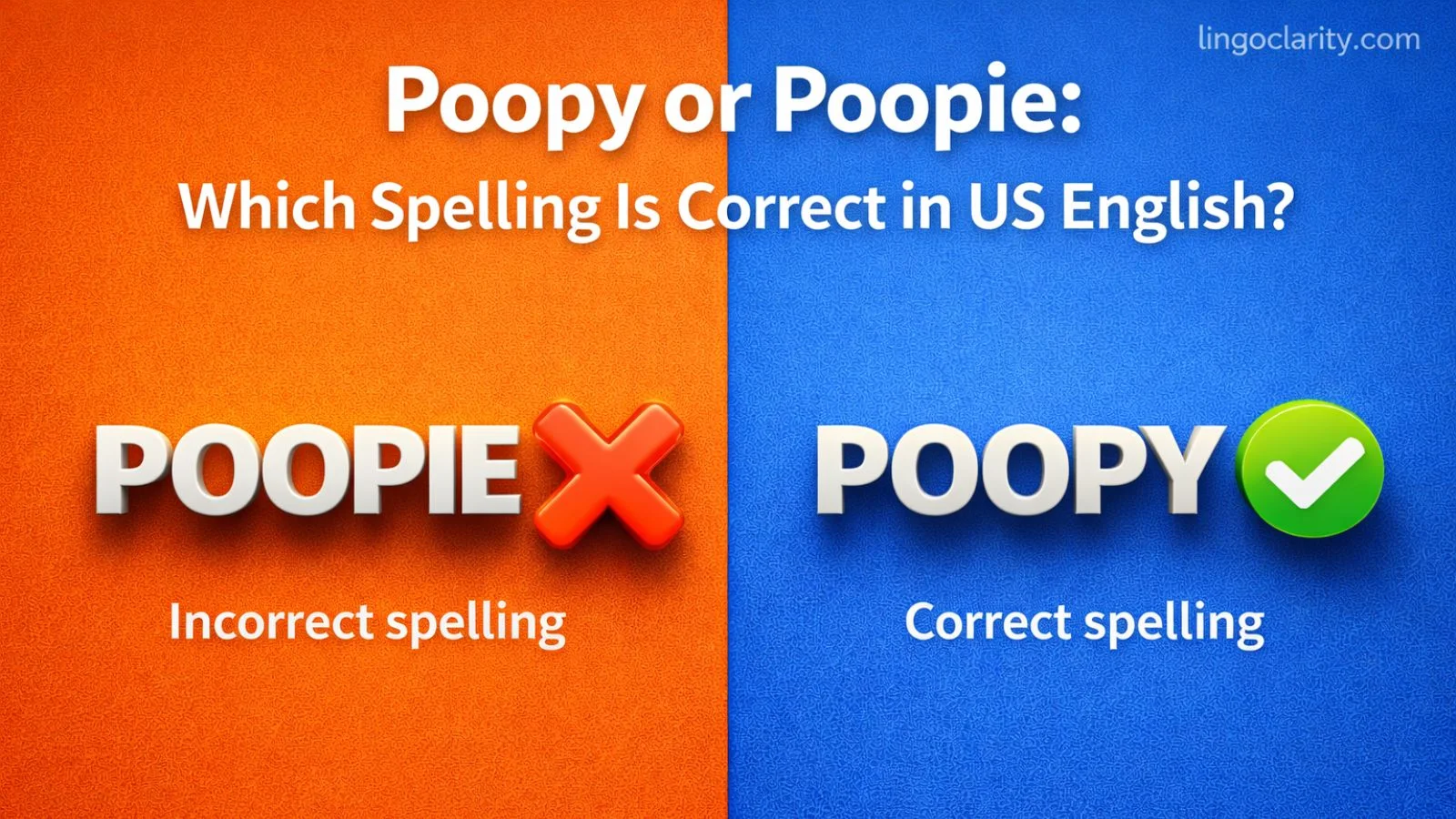
Quick answer: Poopy is the correct spelling in American English. It’s the form listed in Merriam-Webster, and it works as both an adjective and a casual noun. Poopie is a nonstandard variant — not an error in a text to a toddler, but the wrong choice anywhere a dictionary might be consulted.
Most people land on this question mid-sentence, thumb hovering over the keyboard, writing a daycare note or a group text. So here’s the practical version: type poopy and move on. The longer answer is more interesting, because the split between poopy and poopie isn’t random — it follows a pattern that governs dozens of English words you already use, and once you see the pattern you’ll never have to look up this kind of spelling again.
Poopy or Poopie at a Glance
| Poopy | Poopie | |
|---|---|---|
| Status | Standard American spelling | Nonstandard variant |
| In Merriam-Webster | Yes (adjective) | No entry |
| Parts of speech | Adjective; informal noun | Same senses, different spelling |
| Forms | poopier, poopiest | none recognized |
| Pronunciation | POO-pee /ˈpü-pē/ | POO-pee — identical |
| Best used for | Any casual writing or speech | Deliberate baby talk, nicknames, pet names |
| Safe default? | Yes | No |
What Does “Poopy” Actually Mean?
Poopy is an informal adjective with two senses, both of which Merriam-Webster records. The first is literal: soiled with feces, as in a poopy diaper. The second is figurative and much broader — bad, unpleasant, no good. A poopy day has nothing to do with a bathroom. It’s the same softening move that turns crappy into an all-purpose complaint.
It also functions as a noun in family speech, especially among small children and the adults talking to them: I made a poopy. Dictionaries tend to log the adjective and leave the noun to the household, but the noun is real and extremely common.
Both spellings sound exactly the same. That’s worth saying plainly, because it explains why the confusion exists at all — nothing in your ear tells you which one to write. The comparative forms follow the adjective smoothly: poopier, poopiest. You don’t say more poopy.
Where Does “Poopy” Come From?
The root word is older than most people guess. According to the Online Etymology Dictionary, poop in the excrement sense shows up around 1744 as a children’s euphemism, probably imitative in origin — a sound word, essentially. The verb sense, meaning to defecate, is dated to 1903.
Poopy itself is much more recent. Merriam-Webster gives a first known use of 1967, which places it squarely in the postwar boom of nursery vocabulary. The Oxford English Dictionary carries an entry for the adjective as well. Poopie, by contrast, has never been picked up as a headword by a major dictionary. It circulates in handwriting, in brand names, in text messages, and in the spelling habits of people who learned the word by ear.
Why Does English Spell It -y and Not -ie?
This is the part competing pages skip, and it’s the part that actually helps you.
English builds affectionate and diminutive words with an ending pronounced /ee/, and that ending has two spellings. As a rule of thumb:
- -y is the default for everyday nouns and adjectives built off a consonant: doggy, tummy, mommy, sleepy, crispy, messy, potty.
- -ie shows up in personal names and nicknames (Katie, Charlie, Robbie), in words where a bare -y would look wrong or sit awkwardly after another vowel (cookie, movie, brownie, auntie), and in deliberately cute coinages.
Poop ends in a consonant and behaves like a common noun, so the regular pattern delivers poopy — exactly as it delivers doggy rather than doggie as the primary form.
One wrinkle explains why poopie feels natural to so many writers. You’ll notice that -ie is the livelier suffix in newer coinages: selfie, hoodie, foodie, bestie, blankie. Because -ie now carries that fresher, cuddlier charge, people reach for it when they want extra softness. That instinct isn’t stupid. It’s just not standard.
How Do You Use “Poopy” in a Sentence?
Five contexts, five registers:
- Text message: “Heads up — she had a poopy diaper about ten minutes before you got here.”
- Speech to a toddler: “Do you need to go poopy, or can you wait until we’re home?”
- Casual figurative use: “I had a poopy day and I’m going to bed early.”
- Fiction or dialogue: “Don’t be such a poopy-pants about it,” she said, which is exactly how a seven-year-old argues.
- Professional childcare log — what to write instead: “Soiled diaper changed at 2:15 p.m.” The spoken version at pickup can stay poopy; the written record shouldn’t.
That last pair is the useful distinction. Neither spelling belongs in a medical chart, an incident report, or a message to a client. Neither AP nor Chicago has an entry for the word, which is its own quiet signal: this isn’t vocabulary that turns up in edited prose. [link to AP Stylebook]
Is “Poopie” Ever Correct? Common Mistakes and Fixes
Poopie isn’t a misspelling in the way recieve is a misspelling. It’s a variant with a narrow job — signaling baby talk, or naming something on purpose (a pet, a plush toy, a joke account). Outside that job, it reads as a slip.
Here are the errors that actually cost you:
- Writing poopie in anything public. Fix: poopy. If a word game, spell-checker, or dictionary-based tool is involved, only poopy is recognized.
- “More poopy.” Fix: poopier. It’s a one-syllable-plus-y adjective, so it inflects.
- Typing poppy. Fix: proofread. Poppy is a flower and a perfectly good word, which means spell-check will never flag it for you.
- Hyphenating poopy diaper. Fix: leave it open. The compound insult poopy-pants is usually hyphenated; the ordinary adjective-plus-noun phrase isn’t.
- Using either spelling in formal writing. Fix: swap the word, not the spelling.
What Can You Say Instead of “Poopy”?
The substitutes aren’t interchangeable — each carries a different level of formality:
- Poop / poo — the plain nouns. Poo skews younger and more British; poop is the American default.
- Doo-doo, number two — nursery euphemisms, roughly equal in register to poopy.
- Soiled, dirty — neutral adjectives. A soiled diaper is what you write down.
- Stool — clinical. Use it with a pediatrician, not a preschooler.
- Crappy — covers only the figurative sense of poopy, and it’s blunter.
- Messy, stinky — sidestep the subject while still describing it.
Poopy or Poopie: Frequently Asked Questions
Is “poopie” a real word?
It’s a real spelling variant, but not a recognized dictionary word. Merriam-Webster lists poopy and has no entry for poopie. Use poopie only when you want an obviously babyish tone, or in a name.
Is “poopy” in the dictionary?
Yes. Merriam-Webster enters poopy as an informal adjective meaning soiled with feces, and also unpleasant or no good. The Oxford English Dictionary carries an entry as well.
Is it a poopy diaper or a poopie diaper?
Poopy diaper, two words, no hyphen. That’s the standard form in American English and the one to use in any note a teacher, sitter, or relative will read.
Is “poopy” a bad word?
No. It’s childish rather than vulgar, which is exactly why parents use it. It’s fine in casual speech and texts, and out of place in professional writing.
What’s the plural of “poopy”?
The adjective has no plural. When poopy is used as a children’s noun, people say poopies in speech, but there’s no dictionary-backed plural to point to.
The Rule Worth Keeping
Write poopy by default and save poopie for the moments when sounding like a two-year-old is the actual goal. And if you keep the wider pattern — -y for ordinary words, -ie for names and cute coinages — you’ve just solved doggy, potty, blankie, and a dozen other spellings you haven’t looked up yet.

1 thought on “Poopy or Poopie: Which Spelling Is Correct in US English”
Comments are closed.