
You might see seeks in a school essay, a news headline, or a work email. It often shows up in formal lines like, “The company seeks new talent.” You may also see it on grammar tests where you must match the verb to the subject.
This small word matters because it shows who is doing the action. Seeks is the present form used with he, she, it, or one singular subject. Many learners write seek by mistake in these spots, which sounds incorrect in standard English.
This guide explains seeks meaning in simple terms. You’ll learn when to use seeks vs seek, how does/doesn’t changes the verb form, what seeks to means, and how to write natural sentences. You’ll also get common mistakes, clear alternatives, and a quick quiz.
Quick Answer
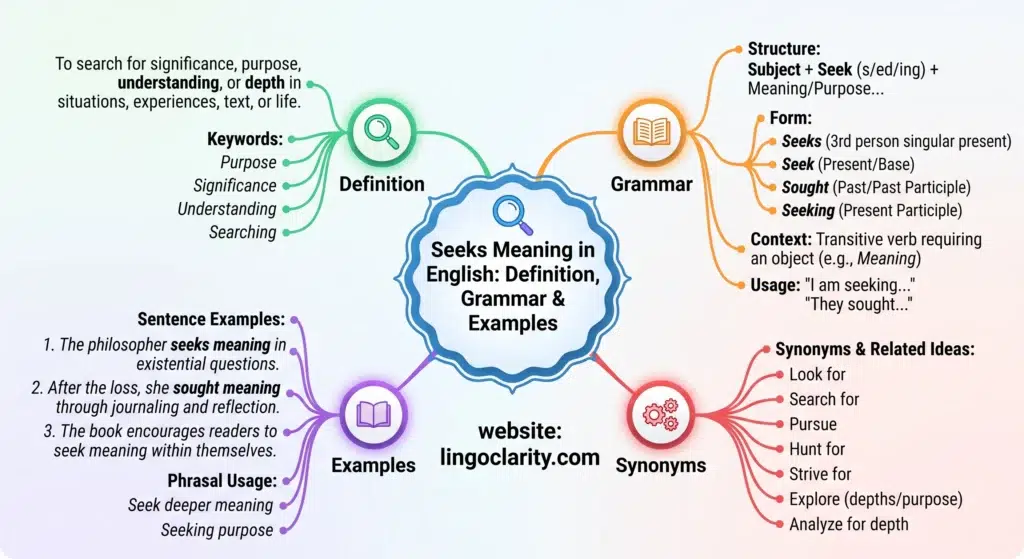
Seeks means “looks for” or “tries to get/achieve.” It is the third-person singular present tense of seek (used with he, she, it, or one singular subject).
Seeks Meaning in Everyday English
Seeks is a form of seek. It means someone tries to find, get, or achieve something.
People often use seeks for goals and abstract things like help, answers, justice, or change. It can also be used for physical things, but it sounds more formal than “looks for.”
Examples:
• “She seeks help after the accident.”
• “He seeks a better job.”
• “The team seeks answers.”
• “The policy seeks fairness.”
❌ Mistake: Using seeks with a plural subject.
✅ Fix: Use seek with they/we: “They seek answers.”
Seeks vs Seek: Why One Has -S
English adds -s in the present simple for he, she, it (third-person singular). That’s why we write seeks, not seek, with one singular subject.
Examples:
• “He seeks solutions.”
• “She seeks advice.”
• “It seeks a safe path.”
• “The company seeks investors.”
❌ Mistake: “He seek help.”
✅ Fix: “He seeks help.”
How Seeks Works in a Sentence
The most common pattern is:
Subject + seeks + object
The object can be a thing, a person, or a goal.
• “She seeks clarity.”
• “He seeks support.”
• “The group seeks change.”
Does/Doesn’t rule (important)
In negatives and questions, English uses does. When you use does, the main verb drops the -s.
• Statement: “She seeks attention.”
• Negative: “She does not seek attention.”
• Question: “Does she seek attention?”
• Short answer: “Yes, she does.”
❌ Mistake: “Does she seeks…?”
✅ Fix: “Does she seek…?”
Verb Forms: Seek, Seeks, Sought, Seeking
Here are the forms learners see most often:
| Form | Example | What it is |
|---|---|---|
| seek | “I seek help.” | base form |
| seeks | “He seeks help.” | present (he/she/it) |
| sought | “She sought help.” | past tense |
| seeking | “They are seeking help.” | -ing form |
❌ Mistake: “seeked” (past tense).
✅ Fix: Past tense is sought.
What “Seeks To” Means
Seeks to” is common in formal writing. Usually, it means “tries to” or “aims to” do something. You’ll see it often in news, business, and school writing, where it sounds serious and goal-focused.
Examples:
• “The bill seeks to reduce costs.”
• “The program seeks to help families.”
• “He seeks to improve his writing.”
• “The school seeks to support new students.”
❌ Mistake: “seeks for to”
✅ Fix: Use seeks to + verb, or seeks + noun.
Common Things People Seek
These phrases are very common in US English:
• seeks help
• seeks advice
• seeks approval
• seeks employment
• seeks justice
• seeks answers
• seeks funding
• seeks treatment
• seeks peace
• seeks attention
Examples:
• “He seeks advice before signing.”
• “The group seeks justice.”
• “The startup seeks funding.”
• “She seeks treatment right away.”
Tone note: In casual talk, “looks for” often sounds warmer.
Seeks in Modern Sentences (Copy-Ready)
These sentences sound natural in school, work, and everyday life:
• “Our neighbor seeks quiet after work.”
• “The coach seeks a better plan.”
• “She seeks a refund after the error.”
• “He seeks permission before filming.”
• “The company seeks new clients.”
• “The city seeks feedback from residents.”
❌ Mistake: Overusing seeks in casual messages.
✅ Fix: Mix in “looks for,” “wants,” or “is trying to.”
Tone and Formality: Is Seeks Too Formal?
Seeks often sounds formal or official. It’s common in headlines, policies, and statements.
If your message is friendly, “seeks” can feel stiff. A simpler verb may sound more natural.
Formal:
• “The organization seeks volunteers.”
Casual:
• “The organization is looking for volunteers.”
Tip: If you worry the tone sounds cold, use “looking for” or “trying to.”
When Not to Use Seeks
Avoid seeks when the subject is not singular.
Don’t use seeks with: I, you, we, they
Use seek instead.
• Wrong: “They seeks help.” → Right: “They seek help.”
• Wrong: “I seeks advice.” → Right: “I seek advice.”
Also watch does questions:
• Wrong: “Does she seeks…?” → Right: “Does she seek…?”
Common Confusions: Seek vs Search vs Look For
Seek and search overlap, but they don’t feel the same.
• seek = often goal-focused, slightly formal
• search = often more active/detailed (search a room, search the web)
• look for = everyday and friendly
Examples:
• “Police search the car.”
• “She seeks answers.”
• “I’m looking for my keys.”
Typing confusion:
❌ Mistake: “seeks” vs “sees”
✅ Fix: Read the sentence once before sending.
Alternatives and Synonyms for Seeks
Pick the replacement that matches your meaning and tone:
• looks for — friendly, everyday
• searches for — more active or detailed
• tries to find — very clear
• aims to — formal, goal-focused
• tries to — simple and common
• pursues — long-term effort
• requests — asks formally
• asks for — plain and direct
• goes after — informal, energetic
• hunts for — casual, playful tone
Best Choice by Context
| Context | Best Choice | Why |
|---|---|---|
| Casual text | looks for | Warm and natural |
| News headline | seeks | Standard formal tone |
| Business statement | seeks to | Clear goal + formal |
| School essay | seeks | Academic and precise |
| Customer email | is looking for | Polite and friendly |
| Legal/policy tone | seeks | Common official phrasing |
Mini Quiz
• Which is correct: “He seek” or “He seeks”?
• Fill in: “Does she ___ help?”
• Past tense: “Yesterday, she ___ advice.”
• Choose the best casual option: seeks / looks for
• Pick the right form: They seek / They seeks
Answer key:
• He seeks
• seek
• sought
• looks for
• They seek
FAQs
What does “seeks” mean?
“Seeks” means “looks for” or “tries to get/achieve.” It’s used with one person or one thing in the present tense.
When do you use “seeks” instead of “seek”?
Use “seeks” with he, she, it, or one singular subject. Use “seek” with I, you, we, they.
What does “seeks to” mean?
“Seeks to” usually means “tries to” or “aims to.” It’s common in formal writing.
What is the past tense of “seek”?
The past tense is sought. “Seeked” is not standard.
How do you use “seeks” in a sentence?
Use it in the present simple with a singular subject: “She seeks advice before deciding.”
What’s the difference between “seek” and “search”?
Both mean “look for,” but “search” often suggests a more careful, detailed look.
What are synonyms for “seeks”?
Common options include “looks for,” “searches for,” “pursues,” and “aims to,” depending on tone.
Conclusion
Seeks is the correct present-tense form of seek for he, she, it, or any single subject. It means “looks for” or “tries to get/achieve,” and it often appears in more formal writing like headlines, policies, and school essays. If you’re unsure, use this quick check: Does/doesn’t + seek (no -s), but he/she/it + seeks. With that rule, your sentences will sound natural and correct in US English.
