
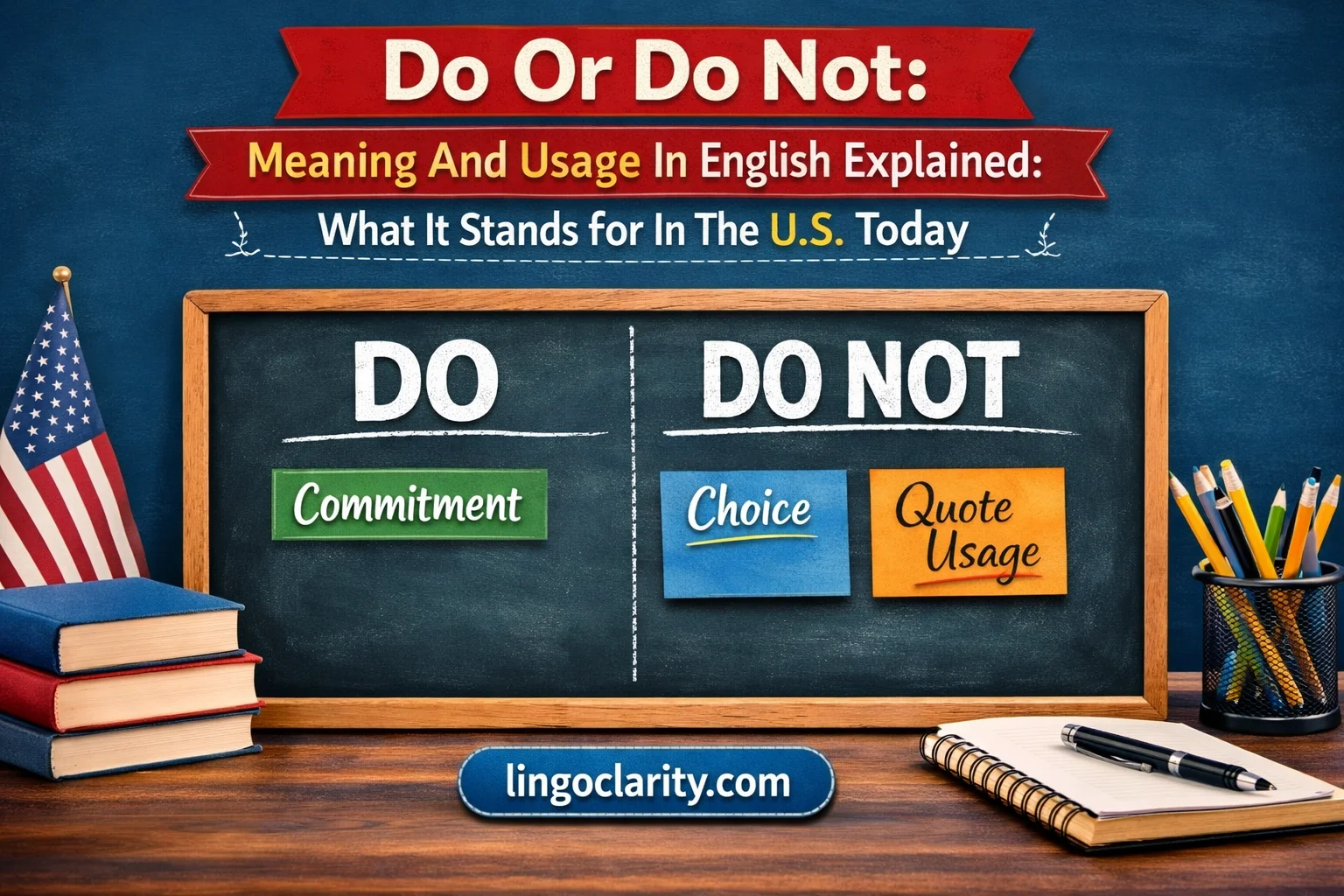
You’ve seen it on gym walls, LinkedIn posts, motivational posters, and classroom whiteboards. Four short words that somehow carry more weight than a full paragraph of advice.
But here’s the part most people miss: the line is almost always quoted wrong — and the misquote changes the meaning.
This guide breaks down what do or do not actually means, where it came from, why it sounds strange in modern English, and when using it makes you sound sharp instead of forced.
Quick Answer
Do or do not means commit fully to an action or honestly choose not to do it. It rejects half-effort and hesitation, framing action as a binary decision rather than a scale of effort. The phrase comes from Yoda in The Empire Strikes Back (1980) and is now used broadly to express resolve and accountability.
TL;DR
- Do or do not means act with full commitment, or step back honestly.
- It comes from Yoda in Star Wars: The Empire Strikes Back (1980).
- Most people misquote it — the original has three separate sentences, not one.
- It is not slang and not informal.
- It sounds dramatic, quoted, or literary — not conversational.
- It emphasizes mindset and resolve, not perfection or success.
- Perfectly understandable in English, but uncommon in everyday practical writing.
Where the Phrase Comes From
The phrase entered popular English through Star Wars: The Empire Strikes Back, released in 1980. Yoda says it to Luke Skywalker on Dagobah, after Luke says he’ll try to lift his X-wing from the swamp.
Yoda’s response, in full: “Do. Or do not. There is no try.”
That punctuation matters, and it’s where nearly everyone gets it wrong.
The Misquote Most People Repeat
| What people write | What was actually said |
|---|---|
| “Do or do not, there is no try.” | “Do. Or do not. There is no try.” |
| “Do or do not. There is no try.” | “Do. Or do not. There is no try.” |
| “There is no try, only do.” | Not a real quote at all |
Three sentences, not one. Each full stop forces a pause, which turns the line into three separate verdicts instead of a single flowing sentence. The rhythm is the argument — commitment, refusal, and the rejection of the middle ground each get their own beat.
What “Do or Do Not” Actually Means
At its core, the phrase makes a claim about intention, not outcome.
It says that “trying” is not a real third option. You either commit to an action with full intent, or you don’t commit. What people call trying is often a hedge — a way to attempt something while pre-building an excuse for failure.
Three things the phrase does not mean:
- It doesn’t mean you must succeed. Committing fully and still failing is doing, not trying.
- It doesn’t mean effort is worthless. It means half-hearted effort with a built-in exit is worthless.
- It doesn’t mean never quit. Choosing “do not” is presented as a legitimate, honest option.
That last point is the one most motivational posts erase. The phrase gives you two valid choices. Refusing is one of them.
The Grammar: Why It Sounds Unusual
There’s a real linguistic reason the phrase feels stiff, and it’s worth understanding if you write or teach English.
1. It’s two imperative clauses joined by “or.”
“Do” is an imperative. “Do not” is a negative imperative. Joining them with or creates a forced binary — a choice with no third branch.
2. The main verb is missing (ellipsis).
The full form would be: “Do [it], or do not [do it].” Both objects are deleted because context supplies them. English allows this, but it’s compressed, so the result sounds clipped and formal.
3. “Do” is working as a pro-verb.
Here, do stands in for whatever action was just mentioned — the way it stands in for a noun. This is why the phrase works in almost any context without naming the task.
4. No contraction.
Everyday English would say “don’t.” Using the uncontracted “do not” adds stress, formality, and finality. Compare:
- “Do it or don’t.” → casual, conversational
- “Do or do not.” → formal, declarative, weighty
That single choice is most of what makes the line sound like a pronouncement rather than a suggestion.
How to Use “Do or Do Not” in Real English
It works well in:
- Motivational writing and speeches — “This team has one rule: do or do not.”
- Captions and headlines — short, punchy, instantly recognizable.
- Direct coaching or feedback — when someone keeps hedging.
- Personal accountability notes — journals, goal lists, habit trackers.
- Deliberate Star Wars references — where the recognition is the point.
Natural example sentences
- “Stop saying you’ll try to make it. Do or do not.”
- “He treats every commitment as do or do not — there’s no maybe with him.”
- “The coach’s philosophy was simple: do or do not, but don’t waste the season pretending.”
- “I’ve adopted a do-or-do-not rule about side projects this year.”
Note the last one: when used as a modifier before a noun, it takes hyphens — a do-or-do-not approach, a do-or-do-not mindset.
Where it falls flat
- Business emails — sounds theatrical and slightly aggressive.
- Academic writing — too informal in register, despite sounding formal.
- Casual conversation — most listeners will hear the Star Wars reference before they hear your point.
- Sensitive situations — telling someone struggling to “do or do not” reads as dismissive.
- Anywhere effort genuinely deserves credit — learning, recovery, therapy, early skill-building.
“Do or Do Not” vs. “Dos and Don’ts”
These two get confused constantly, and they’re not related.
| Phrase | Meaning | Function |
|---|---|---|
| Do or do not | Commit or don’t — a binary choice about one action | Motivational imperative |
| Dos and don’ts | A list of recommended and discouraged behaviors | Practical guidance list |
| Do’s and don’ts | Same as above, alternative spelling | Practical guidance list |
“Dos and don’ts” is a plural noun phrase about rules. “Do or do not” is a command about commitment. They only look similar.
Similar Phrases and Alternatives
If the Star Wars association is too strong for your context, these carry similar weight:
| Alternative | Best for | Tone |
|---|---|---|
| “All in or all out” | Team and business settings | Direct, modern |
| “Commit or walk away” | Coaching, negotiations | Plain, professional |
| “Go big or go home” | Casual, energetic | Informal, dated |
| “Either way, decide” | Neutral professional writing | Calm, practical |
| “Half-measures don’t count” | Explanatory writing | Explanatory |
Common Mistakes to Avoid
- Punctuating it as one sentence. If you’re quoting Yoda, use three: Do. Or do not. There is no try.
- Writing “There is no try, only do.” This isn’t the quote. It’s a paraphrase that circulates widely.
- Using it to shame someone. The phrase works as self-direction; it lands badly as criticism.
- Forgetting the hyphens as a modifier. A do-or-do-not mindset, not a do or do not mindset.
- Contracting it. “Do or don’t” is fine English but loses the entire effect.
Frequently Asked Questions
What does “do or do not” mean in simple terms?
It means commit fully to something or don’t do it at all. There’s no acceptable middle option where you half-attempt it.
Is “do or do not” grammatically correct?
Yes. It’s two imperative clauses joined by or, with the object removed through ellipsis. It’s compressed but fully grammatical.
Who said “Do or do not, there is no try”?
Yoda, in Star Wars: The Empire Strikes Back (1980), speaking to Luke Skywalker on Dagobah. The original punctuation is “Do. Or do not. There is no try.”
Is “do or do not” slang?
No. It’s a formal-sounding imperative. Its informality comes from being a pop-culture quote, not from the words themselves.
Can I use “do or do not” in formal writing?
Rarely. It works in speeches and motivational writing, but in academic or professional documents it reads as a quotation rather than your own voice.
What’s the difference between “do or do not” and “just do it”?
“Just do it” pushes you toward action. “Do or do not” allows refusal as a valid choice — it’s about honesty regarding intent, not about always acting.
Does “do or do not” mean you can’t fail?
No. You can commit fully and still fail. The phrase targets half-hearted intention, not unsuccessful outcomes.
Final Takeaway
Do or do not isn’t really about productivity. It’s about honesty with yourself.
The phrase asks you to stop hiding behind “I’ll try” — a word that lets you claim credit for intending something while protecting you from failing at it. Commit, or admit you’re not going to. Both are respectable. The hedge in between isn’t.
Use it when you want weight. Skip it when you want warmth.
