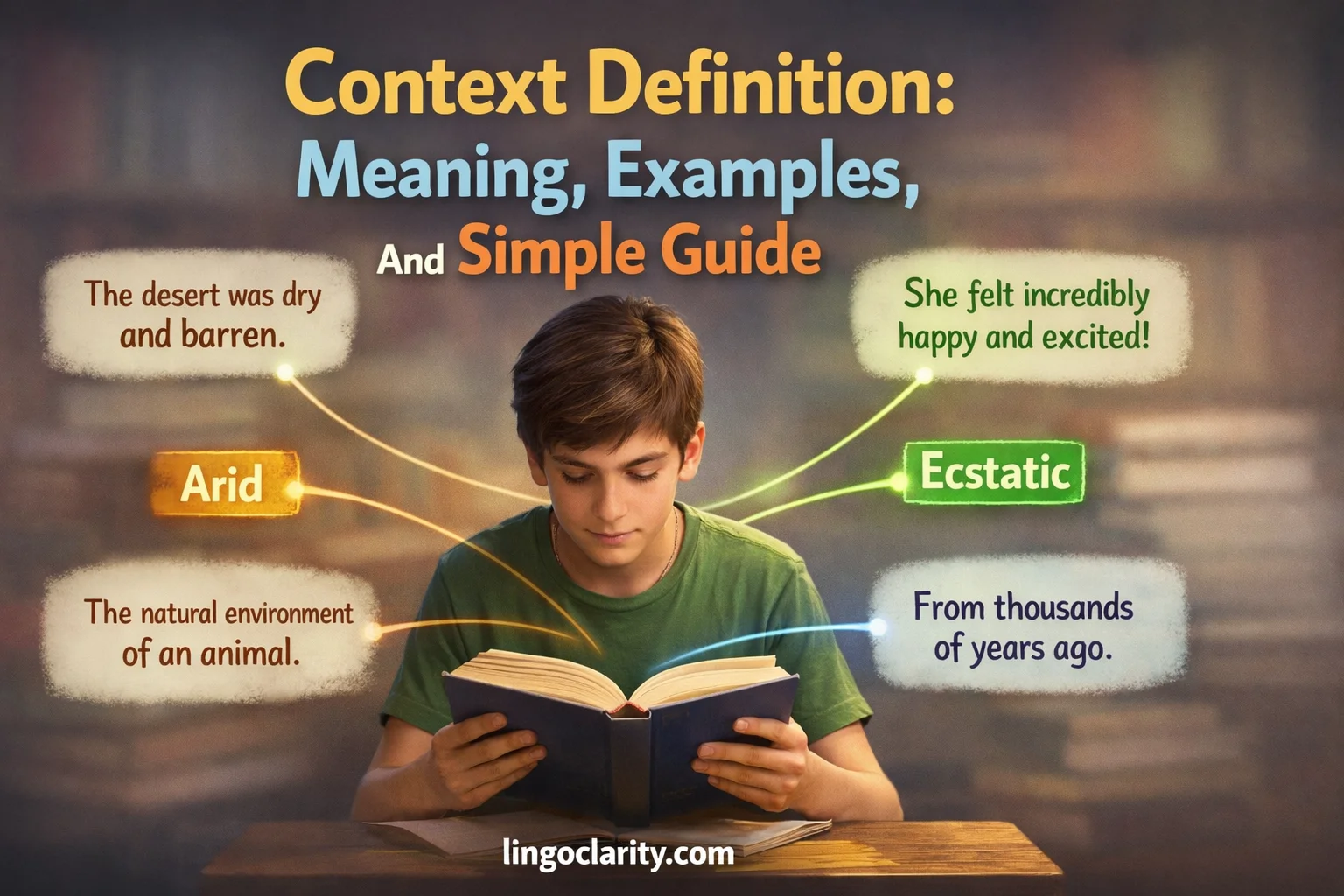
Context is the surrounding information — the words, the situation, the culture, the history, and the relationship between people — that tells you which meaning is intended. There are five main types of context: linguistic, situational, cultural, historical, and social.
Now the fun part. Read this sentence:
“She is cold.”
Is she shivering? Could she be acting unfriendly? Or is a nurse reporting a low temperature? The words never change. What changes is everything around them — and that is context doing its job.
Quick facts
| Pronunciation | KAHN-tekst /ˈkɑːn.tekst/ |
| Part of speech | Noun |
| Plural | contexts |
| Related forms | contextual (adjective), contextualize (verb) |
| Word origin | Latin contexere — con- (“together”) + texere (“to weave”) |
That origin is worth pausing on, because it explains the whole idea in one word. Contexere means “to weave together.” The same Latin root texere gives us text, textile, and texture. A piece of writing is literally a woven thing, and context is the weave around each thread. Pull one word out of that weave and it frays — which is exactly what happens when someone is quoted “out of context.”
What Is Context? A Simple Definition
The context definition is the information surrounding a word, phrase, or message that reveals its intended meaning.
Context can include:
- The words and sentences before and after
- The situation where the communication happens
- The relationship between the people involved
- Cultural expectations and shared knowledge
- Historical background
- The purpose behind the message
A dictionary tells you what a word can mean. Context tells you what it does mean, right here, in this sentence, said by this person.
Take the word bank:
“The bank closed at 5 p.m.”
Here, bank is a financial institution.
“They sat on the river bank.”
Here, bank is the sloping ground beside water.
Merriam-Webster lists both senses of bank, along with several more. It cannot tell you which one a writer meant. Only the surrounding words can do that, and that is the difference between a definition and a meaning.
Definition vs. meaning, in one line: a definition is fixed and lives in the dictionary; a meaning is produced in the moment, by a word plus its context.
The 5 Types of Context
Linguists usually sort context into five kinds. You use all five every day without naming them.
1. Linguistic Context
Linguistic context is the language immediately around a word — the sentence it sits in, and the sentences on either side. It is the narrowest type and often the fastest to spot.
“The pitcher was empty, so I filled it with lemonade.”
Pitcher here is a jug, not a baseball player. The words empty, filled, and lemonade settle it before you even finish reading.
“The pitcher threw a fastball past the batter.”
Same word, different neighbors, different meaning.
Linguistic context is what lets a fluent reader move through a page without stopping at every word that has more than one sense — which is most words in English.
2. Situational Context
Situational context is the physical circumstance: where you are, when it is, and what is happening around you.
“It’s getting late.”
At 11 p.m., with guests still lingering, a host who says it means please go home. Said by a friend as you both hurry toward a train platform, it means we need to move. Spoken quietly by someone waiting on news, it may mean I’m worried.
The sentence is four words long and carries none of that. The room supplies it.
3. Cultural Context
Cultural context is the shared knowledge, customs, and expectations of a group. It explains why a phrase lands perfectly for one audience and confuses another.
“That’s a home run.”
To a US audience, this obviously means a complete success. To someone from a country where baseball is rarely played, the sentence is a puzzle with no clue attached.
Politeness works the same way. In some cultures, a direct “no” is normal and efficient. In others, “that would be difficult” is the no, and hearing it as a maybe is a genuine mistake — not a language problem, a cultural context problem.
4. Historical Context
Historical context is the time period and the events surrounding a message. It matters most when you read something written in another era.
Words shift. Nice once meant foolish or ignorant. Awful once meant full of awe — a compliment. A reader who applies a 2026 meaning to a 1726 sentence will get it backwards.
Historical context also explains urgency and tone. A public notice about rationing reads as strange advice today and as ordinary practicality in 1943. Nothing about the words changed; the world around them did.
5. Social Context
Social context is the relationship between the people communicating, and the level of formality that relationship calls for.
“Send it over when you get a chance.”
From a close colleague, this is relaxed and genuinely flexible. From your manager on the morning of a deadline, it is a polite instruction with a clock attached.
Social context is why the same request gets written three different ways — a text to a sibling, an email to a client, a note to a professor — and why using the wrong one feels immediately off, even when every word is technically correct.
How Context Changes Meaning
Context does four jobs at once, and it does them so quickly that most people never notice.
It selects the right meaning. The word light can mean brightness, a lamp, not heavy, or not serious. You never consciously choose among those four. The sentence chooses for you.
It carries tone. “Great.” can be delight or flat sarcasm. In speech, the voice decides. In writing, the surrounding sentences have to do that work — which is why tone is so easy to misread in a text message and so much harder to misread in person.
It fills in what was left out. “Same time tomorrow?” makes complete sense between two people with a standing appointment and none at all to a stranger reading over your shoulder. Shared context lets people say less.
It prevents ambiguity. Many English sentences have more than one possible reading, and context quietly discards the wrong ones. When it fails to, you get a genuinely ambiguous sentence — one that stays unclear no matter how carefully you read it.
This is also why “taken out of context” is such a serious complaint. A quoted sentence keeps all of its words and loses the thing that made those words mean what they meant.
Context Clues in Reading
Context clues are hints inside a passage that let a reader work out an unfamiliar word without stopping to look it up. Teaching readers to notice them is one of the most widely used vocabulary strategies in US classrooms — Reading Rockets covers the approach in detail for teachers and parents.
There are four common kinds.
| Type of clue | What it does | Example |
|---|---|---|
| Definition clue | The meaning is stated directly in the sentence | “The arid desert, a place with almost no rainfall, stretched for miles.” |
| Example clue | Examples show the category the word belongs to | “She packed several provisions: bread, dried fruit, and canned soup.” |
| Synonym clue | A nearby word means roughly the same thing | “He was elated — thrilled, really — by the news.” |
| Antonym clue | A contrast word signals the opposite meaning | “The path was treacherous, not the safe, easy walk we expected.” |
How to use a context clue in three steps
- Read past the word, not just up to it. The clue often sits after the unfamiliar word, not before it.
- Look for signal words. Or, that is, such as, and for example introduce definitions and examples. But, unlike, however, and instead introduce contrasts.
- Test your guess. Replace the word with your guess and reread the sentence. If it still makes sense, you are almost certainly right.
One honest caution: context clues are a strong first tool, not a guarantee. Some sentences simply do not contain enough information, and the right move then is a dictionary, not a better guess.
Context in Everyday Life
At school
A student reads “The colonists were incensed by the new tax.” Incensed is unfamiliar, but new tax and what came before it point clearly toward anger. That is linguistic and historical context working together, and it is what allows students to read above their vocabulary level.
At work
“Let’s circle back on this.” In a meeting where a decision is being delayed, it means not now. In a meeting where the discussion has drifted, it means we will return to this. Same phrase, opposite implications about whether anything will happen.
In text messages
Digital messages strip out tone of voice, facial expression, and timing all at once, so readers lean hard on the little context that remains — punctuation, emoji, timing, and shared history. A period at the end of a one-word reply reads as neutral to one person and cold to another.
Abbreviations depend on context even more heavily. PMO means one thing in a work email about project management and something completely different in a group chat. Nothing but context separates them.
While reading fiction
A character says “Fine.” after an argument. Every reader knows things are not fine. The word carries the opposite of its dictionary meaning, and the preceding scene is the only reason that works.
Context vs. Background vs. Setting vs. Situation
These four words overlap enough that writers often use them interchangeably. They are not quite the same.
| Term | What it refers to | Focus |
|---|---|---|
| Context | All surrounding information that explains meaning | Why something means what it means |
| Background | Earlier information and history | What came before |
| Setting | The place and physical environment | Where it happens |
| Situation | The current circumstances | What is happening now |
Background, setting, and situation are all parts of context. Context is the widest of the four — it includes them, plus language, culture, and relationship.
A quick test: if you can point at it, it is probably setting or situation. If it explains a meaning, it is context.
This is also the kind of distinction that shows up between near-synonyms all over English, where two words share a definition but differ in tone and use — solitude and loneliness being one of the clearest examples.
Common Mistakes With Context
Quoting out of context. Lifting a sentence away from what surrounded it. This is the most consequential mistake on the list, because the words stay accurate while the meaning does not.
Ignoring tone. Reading a sarcastic or gentle line as literal. Very common in email and text, where tone has to be inferred from almost nothing.
Fixing on one word. Getting stuck on an unfamiliar word instead of reading the full sentence. The answer is usually two words later.
Assuming shared culture. Writing an idiom, a sports metaphor, or a local reference for an audience that does not have it. If your reader might be new to US English, “ballpark figure” is a risk and “rough estimate” is not.
Leaving out context when you write. Readers cannot see what is in your head. A message that makes perfect sense to you can be genuinely unreadable to someone who was not in the room.
How to avoid all five: read past the word, consider who is speaking and why, watch the tone as closely as the words, and when you write, name the thing you assumed everyone already knew.
Frequently Asked Questions
What is the simple definition of context?
Context is the surrounding information that explains what a word, sentence, or message actually means. It includes the nearby words, the situation, the culture, the history, and the relationship between the people involved. A dictionary gives a word’s possible meanings; context tells you which one is intended this time.
What are the 5 types of context?
The five main types are linguistic (the surrounding words), situational (the circumstances), cultural (shared customs and knowledge), historical (the time period), and social (the relationship and level of formality). Most real communication uses several at once — a text message to a friend relies on linguistic, situational, and social context together.
What are context clues?
Context clues are hints in a passage that help a reader work out an unfamiliar word. The four common kinds are definition clues, example clues, synonym clues, and antonym clues. In “The arid desert had almost no rainfall,” the phrase “no rainfall” is a definition clue telling you that arid means dry.
Can context change the meaning of a word?
Yes, and it does constantly. Light can mean brightness, a lamp, not heavy, or not serious, and only context decides which. Context can even reverse a meaning: a character who says “Fine.” after an argument means the opposite of the dictionary definition, and every reader understands that.
What does it mean to take something out of context?
It means quoting words accurately while removing the surrounding information that gave them their meaning. Because the words themselves are unchanged, the quote looks fair. The distortion comes entirely from what was left out — which is why it is such an effective and such a serious misrepresentation.
Why do writers need to provide context?
Because readers cannot see what the writer already knows. Without enough context, a reader has to guess at who, when, and why — and guesses go wrong. Good writers add the details, definitions, and background that a newcomer needs, and they judge how much to add by who is reading.
What is the difference between context and background?
Background is one part of context: the earlier events and history leading up to something. Context is broader and includes background plus the situation, the language used, the culture, and the relationship between the people. All background is context; not all context is background.
Quick Quiz: Test Your Understanding
1. In “The pitcher was empty, so I filled it with water,” which type of context tells you that pitcher means a jug? A. Cultural B. Linguistic C. Historical D. Social
2. Your manager says “Send it over when you get a chance” on the morning of a deadline. Which type of context makes this an instruction rather than a casual request? A. Social B. Linguistic C. Historical D. Situational
3. “The path was treacherous, not the safe, easy walk we expected.” What kind of context clue is safe, easy? A. Definition clue B. Example clue C. Synonym clue D. Antonym clue
4. The word context comes from Latin contexere, which means:
A. Speaking clearly
B. Weaving together
C. Standing beside
D. Explaining
5. Which of these is the widest term? A. Setting B. Background C. Context D. Situation
Answers: 1 — B. 2 — A. 3 — D. 4 — B. 5 — C.
Final Thoughts
The five types of context — linguistic, situational, cultural, historical, and social — are not academic categories to memorize. They are the five things you are already checking, automatically, every time you read a message and decide what someone meant by it.
The Latin was right. Context is a weaving. Words are threads, and a thread on its own tells you very little about the cloth.
Noticing which type of context you are relying on is what turns that automatic process into a skill. It makes you a sharper reader, because you know where to look when a sentence resists you. It makes you a clearer writer, because you can see what your reader is missing. And it makes you harder to mislead, because you recognize a quote that has had its weave cut away.
