
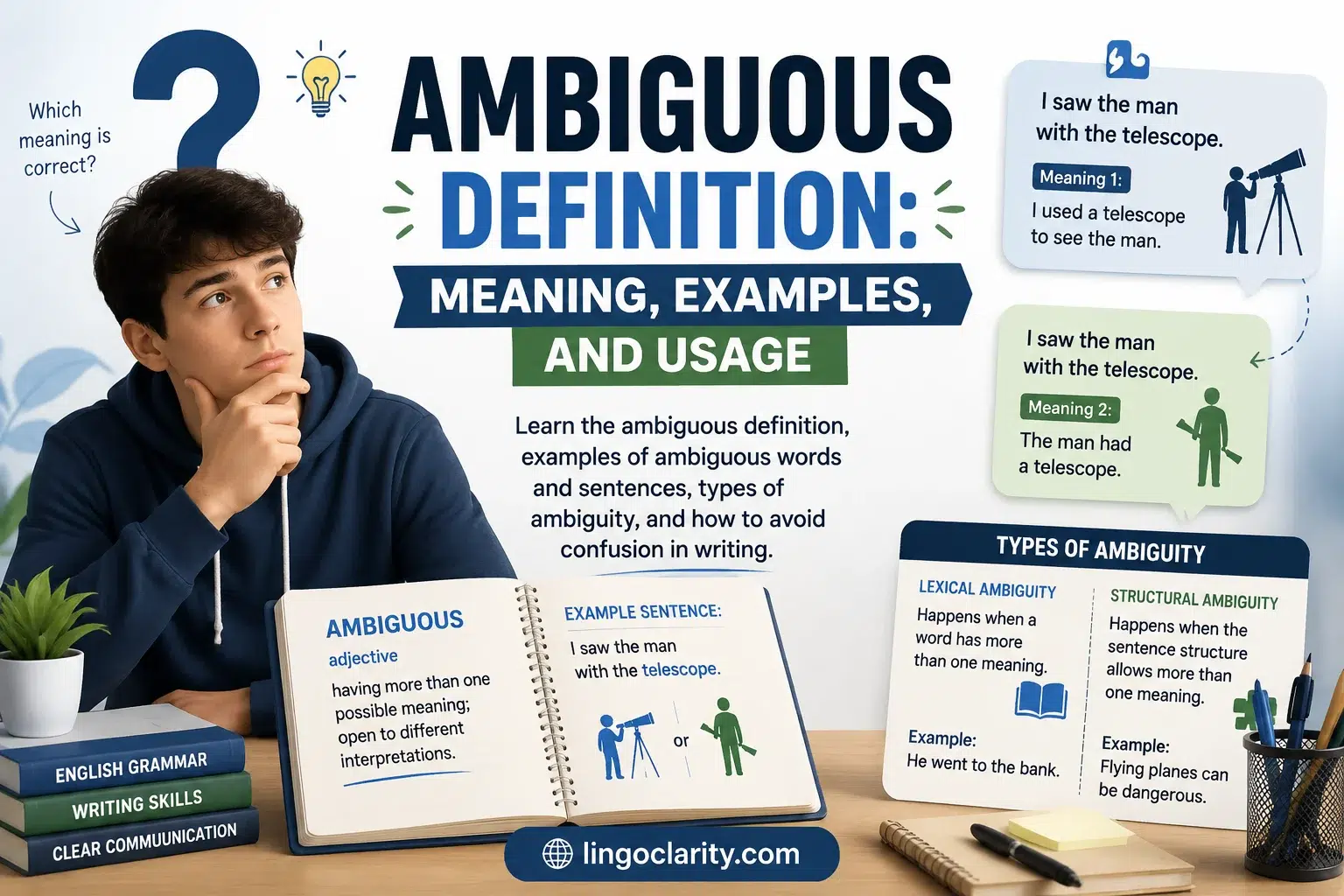
The word ambiguous describes something that is unclear because it can have more than one possible meaning or interpretation. An ambiguous word, phrase, or sentence may confuse readers because different people can understand it in different ways depending on the context.
Ambiguity is common in everyday conversations, writing, advertisements, and professional communication. For example, the sentence “I saw the man with the telescope” is ambiguous because it is unclear whether the speaker used a telescope or the man had one. The surrounding context helps determine the intended meaning.
Understanding the ambiguous definition helps writers choose clearer words and helps readers recognize when a message may have multiple interpretations. In this guide, you will learn the meaning of ambiguous, its pronunciation, examples, types of ambiguity, common uses, and how to avoid ambiguity in writing.
Quick Answer
Ambiguous means unclear because something has two or more possible meanings or interpretations. An ambiguous word, phrase, or sentence can be understood in different ways depending on context.
Example:
“I saw the man with the telescope.”
This sentence could mean:
- I used a telescope to see the man.
- The man had a telescope.
Because both meanings are possible, the sentence is ambiguous.
Ambiguous Meaning At A Glance
| Word | Ambiguous |
|---|---|
| Part of speech | Adjective |
| Pronunciation | am-BIG-yoo-us |
| Meaning | Having more than one possible meaning |
| Simple meaning | Not completely clear |
| Opposite | Clear, definite, obvious |
What Does Ambiguous Mean?
The word ambiguous describes something that can have more than one meaning. It is used when a word, statement, action, or situation is open to different interpretations.
For example:
“She went to the bank.”
The word bank is ambiguous because it can mean:
- A place where people keep money
- The side of a river
The correct meaning depends on the surrounding information.
Ambiguous Definition In Simple English
In simple terms, ambiguous means:
“Something that is not clear because people can understand it in different ways.”
An ambiguous statement does not always mean the speaker made a mistake. Sometimes writers intentionally use ambiguity for humor, mystery, or creativity.
How To Pronounce Ambiguous
The pronunciation of ambiguous is:
am-BIG-yoo-us
Phonetic spelling:
/æmˈbɪɡ.ju.əs/
The stress falls on the second syllable: BIG.
Examples Of Ambiguous Words
Some English words naturally have multiple meanings.
| Word | Meaning 1 | Meaning 2 |
|---|---|---|
| Bank | Financial institution | River edge |
| Bat | Flying animal | Sports equipment |
| Light | Not heavy | Brightness |
| Match | Competition | Something used to make fire |
Example:
“He picked up the bat.”
Without context, we do not know whether he picked up a baseball bat or saw a flying animal.
Examples Of Ambiguous Sentences
1. I Saw Her Duck
Possible meanings:
- I saw her lower her head.
- I saw her pet duck.
2. The Chicken Is Ready To Eat
Possible meanings:
- The cooked chicken is ready for people to eat.
- The chicken is hungry and ready to eat food.
3. Visiting Relatives Can Be Annoying
Possible meanings:
- Going to visit relatives can be annoying.
- Relatives who visit can be annoying.
Types Of Ambiguity
Lexical Ambiguity
Lexical ambiguity happens when one word has multiple meanings.
Example:
“He went to the bank.”
The word “bank” creates ambiguity.
Structural Ambiguity
Structural ambiguity happens when the arrangement of words creates multiple meanings.
Example:
“Flying planes can be dangerous.”
Meaning 1:
- Operating airplanes can be dangerous.
Meaning 2:
- Airplanes that are flying can be dangerous.
Ambiguous Vs Vague
These words are related but different.
| Ambiguous | Vague |
|---|---|
| Has multiple possible meanings | Lacks specific details |
| Two or more interpretations exist | Meaning is unclear because information is missing |
Example:
Ambiguous:
“I saw the person with the camera.”
Who had the camera?
Vague:
“I saw something.”
What did you see?
Is Ambiguous Always Bad?
No. Ambiguity can sometimes be useful.
Writers use ambiguity in:
- Poetry
- Movies
- Literature
- Advertising
- Humor
For example, a mystery movie may have an ambiguous ending to encourage viewers to create their own interpretation.
However, ambiguity can create problems in:
- Contracts
- Instructions
- Workplace communication
- Academic writing
Clear writing is usually preferred in professional situations.
How To Avoid Ambiguous Writing
Writers can make sentences clearer by:
- Adding enough context
- Choosing specific words
- Avoiding unclear pronouns
- Placing modifiers correctly
- Revising confusing sentences
Example:
Ambiguous:
“She told her friend that she was late.”
Who was late?
Clear:
“She told her friend, Maria, that Maria was late.”
Synonyms For Ambiguous
Common synonyms include:
- Unclear
- Confusing
- Vague
- Uncertain
- Doubtful
- Open-ended
- Indefinite
Antonyms For Ambiguous
Opposite words include:
- Clear
- Definite
- Certain
- Specific
- Obvious
- Precise
Common Uses Of Ambiguous
In Everyday Speech
“His answer was ambiguous.”
Meaning:
His answer was unclear and could have several meanings.
In Business
“The instructions were ambiguous.”
Meaning:
Employees could interpret the instructions differently.
In Law
“An ambiguous contract clause.”
Meaning:
The wording allows different legal interpretations.
FAQs
Ambiguous means unclear because something can have more than one possible meaning.
It depends on the situation. Ambiguity can be creative in art but problematic in instructions or professional writing.
“I saw the man with the telescope” is ambiguous because it is unclear who had the telescope.
The opposite of ambiguous is clear, definite, or specific.
Writers avoid ambiguity when they need readers to understand one exact meaning.
Yes. Authors and advertisers sometimes use ambiguity to create curiosity or multiple interpretations.
Conclusion
The ambiguous definition refers to something that has more than one possible meaning. Ambiguous words and sentences are common in English because many words have multiple meanings and sentence structures can create different interpretations.
Understanding ambiguity helps readers interpret language correctly and helps writers communicate more clearly. When accuracy matters, using specific words and enough context can prevent confusion.

1 thought on “Ambiguous Definition Explained: Meaning, Examples, And Types”
Comments are closed.