
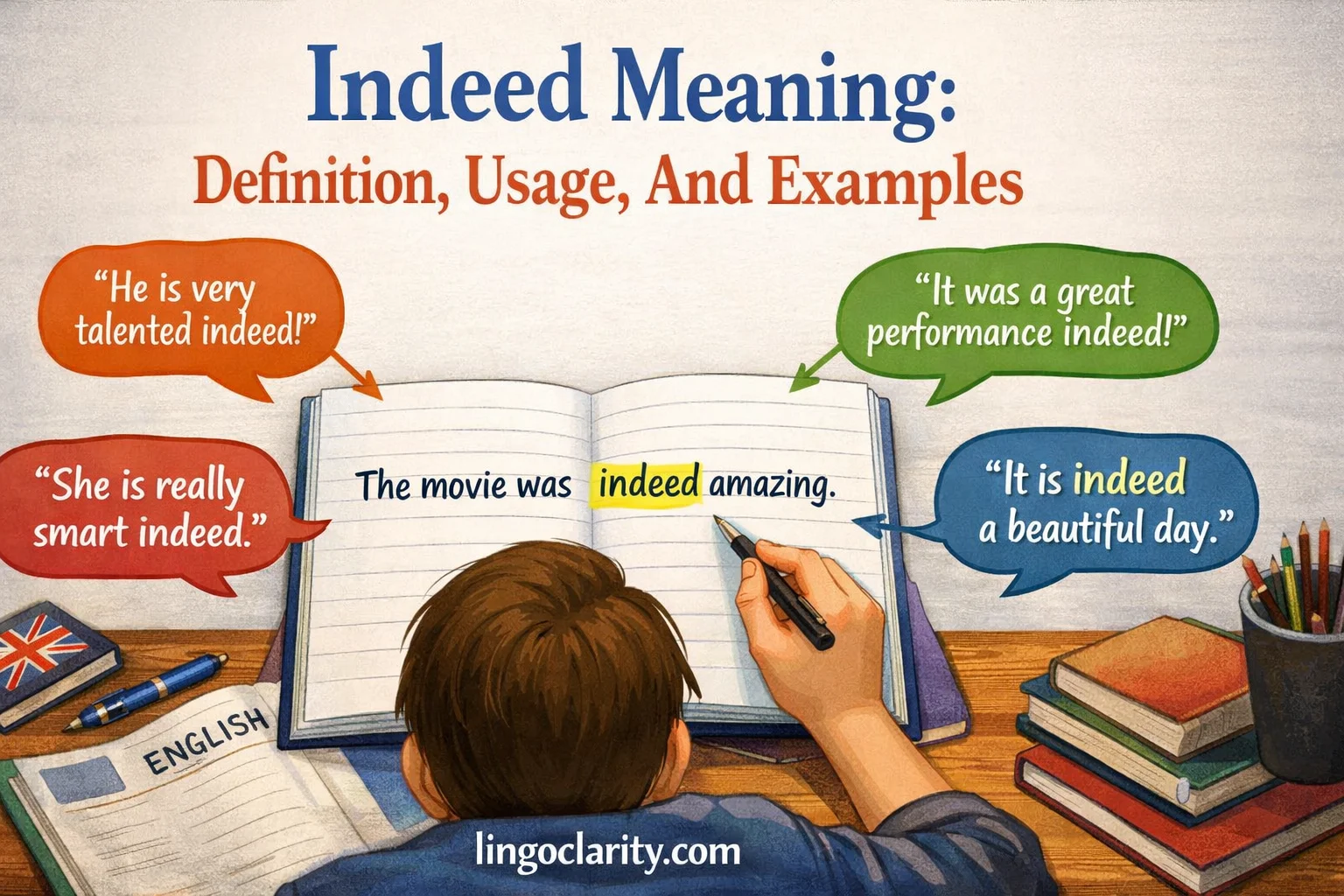
English contains many short words that play an important role in adding clarity, emphasis, and tone to sentences. One of these useful words is indeed. Although it is small and easy to overlook, it helps speakers confirm information, strengthen statements, and show agreement.
People frequently use indeed in conversations, interviews, academic writing, and formal discussions. Because it can appear in several positions within a sentence, English learners sometimes find it confusing to understand exactly how it works.
However, once you understand its purpose, the word becomes simple and powerful. It allows speakers and writers to reinforce a statement or confirm something that has already been said.
This guide explains the indeed meaning, how the word functions in English grammar, how to pronounce it correctly, and how to use it naturally in everyday sentences.
Quick Answer
Indeed is an adverb used to confirm, emphasize, or strengthen a statement. It often means “truly,” “certainly,” or “in fact.”
Example:
The movie was long, but it was indeed interesting.
In this sentence, indeed reinforces the idea that the movie was genuinely interesting.
TL;DR
• Indeed confirms or emphasizes a statement.
• It functions as an adverb in English grammar.
• The word can appear at the beginning, middle, or end of a sentence.
• It often means “truly,” “certainly,” or “in fact.”
• It is common in formal speech and writing, though it also appears in everyday conversation.
What Does Indeed Mean
The word indeed strengthens or confirms a statement that someone has already made. It signals that something is true, accurate, or worthy of emphasis.
Speakers often use it to show strong agreement or to reinforce a point.
Examples:
• The weather is cold today. It is indeed freezing.
• She is talented. She is indeed one of the best singers in the group.
• The task looked difficult, but it was indeed manageable.
In each example, the word emphasizes that the statement is true or noteworthy.
Definition In Plain English
In simple terms, indeed means:
• truly
• certainly
• in fact
• without doubt
It shows that something is unquestionably true or that the speaker strongly agrees with a statement.
Example:
The exam was difficult. It was indeed challenging.
Here, the second sentence confirms and reinforces the first statement.
Pronunciation Of Indeed
The pronunciation of indeed is straightforward.
Pronunciation:
in-DEED
The stress falls on the second syllable, which is common in many English adverbs.
Example pronunciation:
in-DEED
A common mistake among learners is placing the stress on the first syllable. Native speakers normally emphasize the second syllable, giving the word its natural rhythm.
Part Of Speech
The word indeed functions as an adverb.
Adverbs modify verbs, adjectives, or entire statements. In this case, indeed strengthens or confirms an idea rather than describing an action.
Examples:
• The results were indeed surprising.
• She did indeed finish the project on time.
• The discovery was indeed remarkable.
In these sentences, indeed reinforces the truth or significance of the statement.
How Indeed Is Used In Sentences
One reason indeed is flexible is that it can appear in different positions within a sentence.
After A Statement
Sometimes indeed appears in a second sentence to confirm the first idea.
Example:
The restaurant is popular. It is indeed very busy.
This structure emphasizes that the second statement proves the first.
In The Middle Of A Sentence
The word often appears before an adjective or noun phrase to add emphasis.
Example:
She is indeed a skilled designer.
Here, indeed strengthens the description of the person.
At The Beginning Of A Response
It can also introduce agreement in conversation.
Example:
Person A: That was a great presentation.
Person B: Indeed, it was excellent.
In this case, the word signals clear agreement.
Common Contexts Where People Use Indeed
People commonly use indeed in several everyday situations.
Confirmation
The speaker confirms that something is correct or accurate.
Example:
Yes, that is indeed correct.
Emphasis
The word strengthens an important point.
Example:
This is indeed an important decision.
Formal Writing Or Speech
The word frequently appears in formal language, academic writing, or professional discussions.
Example:
The research results were indeed significant.
In casual conversation, people sometimes replace indeed with words like really or actually.
Synonyms And Similar Words
Several English words express ideas similar to indeed, although their tone and formality may vary.
| Word | Meaning | Example |
|---|---|---|
| certainly | strong agreement | She is certainly qualified. |
| truly | emphasizing truth | This is truly impressive. |
| really | casual emphasis | That movie was really good. |
| in fact | confirming information | In fact, the plan worked. |
While these words are similar, indeed often sounds slightly more formal and emphatic.
Origin Of The Word Indeed
The word indeed developed from the older English phrase “in deed.”
Historically, the phrase meant “in reality” or “in truth.” Over time, the two words merged into the single form indeed.
Although the spelling changed, the meaning stayed largely the same. Today, the word continues to emphasize truth or confirm a statement in modern English.
Common Mistakes With Indeed
English learners sometimes misuse the word in ways that sound unnatural.
Overusing The Word
Using indeed too frequently can make writing sound overly formal.
Incorrect:
Indeed I went to the store, and indeed I bought milk.
Better:
I went to the store and bought milk.
Using It Without Emphasis
Because indeed is meant to strengthen an idea, it should highlight something meaningful.
Less natural:
I indeed ate lunch.
Better:
The meal was indeed delicious.
Here, the word adds emphasis to the description.
Mini Quiz
Test your understanding of the word indeed.
- What does indeed usually express?
A. Doubt
B. Confirmation
C. Question - Which part of speech is indeed?
A. Adverb
B. Verb
C. Noun - Which sentence uses indeed correctly?
A. Indeed she runs every day.
B. She indeed runs every day.
C. Both A and B
Answer Key
- B — Confirmation
- A — Adverb
- C — Both A and B
FAQs
What does indeed mean in English?
Indeed means truly, certainly, or in fact. It confirms or strengthens a statement and shows that something is definitely true.
How do you use indeed in a sentence?
You can place indeed before or after the main idea in a sentence.
Example:
She is indeed a talented artist.
Is indeed formal or informal?
The word often sounds slightly formal, especially in writing or professional speech. However, people still use it naturally in everyday conversation.
Can indeed start a sentence?
Yes, indeed can appear at the beginning of a sentence to confirm or emphasize an idea.
Example:
Indeed, the results surprised everyone.
What part of speech is indeed?
Indeed is an adverb. It strengthens or confirms the meaning of a statement.
What is another word for indeed?
Common alternatives include certainly, truly, really, and in fact, although the tone may vary depending on the situation.
Conclusion
The word indeed is a small but powerful part of English vocabulary. As an adverb, it confirms statements and adds emphasis when something is clearly true.
Understanding how to use indeed helps you recognize stronger expressions in conversations, articles, and academic writing. Once you become familiar with its meaning and placement, you can use it confidently to reinforce ideas and communicate more clearly in English.
