
Many writers pause when they see thru and through side by side. They sound the same, and both can appear in real-world American English. But they do not carry the same weight in standard writing.
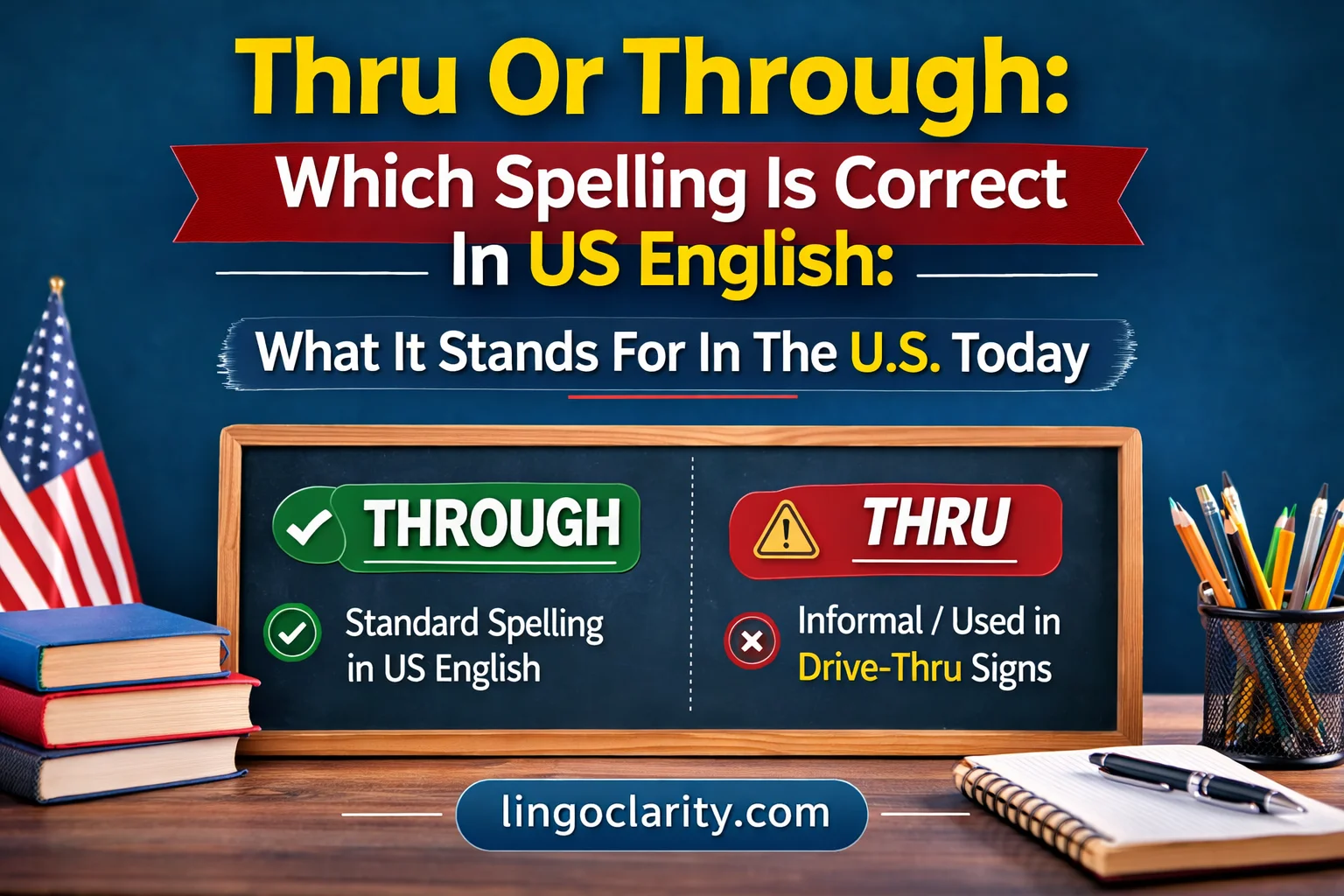
In modern US English, through is the standard spelling for essays, emails, reports, articles, and professional communication. Thru is a recognized variant, but dictionaries and usage sources treat it as less common, informal, or especially common in signs, ads, and fixed expressions.
Quick Answer
Use through in almost all normal US writing.
Use thru only in limited cases, such as:
- set phrases like drive-thru
- signage such as No Thru Traffic
- brand names or labels
- very casual, space-saving writing
Is Thru Or Through Correct?
Both spellings exist, but they are not equal in standard usage.
Through is the correct standard spelling in US English. Merriam-Webster defines thru as a “less common spelling of through,” and Cambridge labels it as another spelling used in signs and advertisements.
That means the safest choice for almost every reader and editor is through.
Are Thru And Through The Same Word?
Yes. They are two spellings of the same word, with the same core meanings and the same pronunciation. The difference is not meaning. The difference is context, formality, and convention.
You can use through to mean:
- from one side to the other
- from beginning to end
- by means of something
- during an entire period
Thru can stand in for those same meanings, but it is usually avoided in polished prose.
Key Differences At A Glance
| Context | Best Choice | Why |
|---|---|---|
| School essay | through | Standard spelling |
| Work email | through | More professional |
| Website article | through | Preferred by editors and readers |
| Text message | through or thru | thru may appear casually |
| Road sign | thru | Common in compressed sign wording |
| Restaurant lane name | drive-thru or drive-through | Depends on style, branding, or house preference |
Why People Confuse Them
The confusion is easy to understand because both spellings are pronounced the same way. Since thru matches the sound so neatly, many people assume it is simply the modern American spelling.
That impression gets stronger because thru appears in places people see every day, including signs, lane markers, and business branding. Cambridge specifically notes its use in signs and advertisements, which helps explain why it feels familiar even though it is not the standard spelling for regular prose.
Which Spelling Should You Use In US English?
Choose through for nearly all writing:
- emails
- articles
- blog posts
- school assignments
- résumés
- reports
- business communication
Choose thru only when there is a specific reason to keep it:
- it is part of a fixed label
- it appears in official signage
- it belongs to a business name
- you are intentionally writing in a highly casual or compressed style
For most writers, this rule works well: if you have to decide, choose through.
Is This A US Vs UK Difference?
Not really.
This is not a case like color/colour, where one spelling is standard in American English and the other in British English. The bigger distinction is standard vs informal, not US vs UK. Merriam-Webster and Cambridge both describe thru as a variant or sign-based spelling rather than the normal American standard.
So even in the United States, through remains the default spelling.
When Thru Is Acceptable
There are a few situations where thru looks natural rather than mistaken.
Signs And Public Wording
Shortened spellings often appear on signs because they save space and are easy to scan quickly. That is one reason forms like No Thru Traffic became so familiar in public settings. Cambridge explicitly notes sign use as a normal environment for thru.
Drive-Thru As A Fixed Form
This is the best-known exception. AP style uses drive-thru, while Merriam-Webster lists drive-through as the main form and drive-thru as a less common variant. That means both forms exist in published American English, but drive-thru often survives as a special fixed label rather than proof that thru should be used everywhere.
Branding And Casual Writing
A brand may choose thru because it looks shorter, friendlier, or more commercial. In casual texts or ads, writers may also prefer it for speed. Merriam-Webster says current use occurs chiefly in informal writing and some technical journals.
When Thru Looks Wrong
In polished writing, thru often looks too casual. Even when readers understand it, it can feel like ad copy, texting shorthand, or signage rather than careful prose.
These examples usually need through:
- Please read the contract through before signing.
- We drove through the tunnel at noon.
- She worked through lunch to finish the draft.
Using thru in those sentences would usually make the writing look less polished.
Common Mistakes To Fix
Mistake 1: Treating Thru As The Normal Everyday Spelling
It is not the standard default. Replace thru with through unless there is a clear reason to keep the shorter form.
Mistake 2: Saying The Words Have Different Meanings
They do not. They are spelling variants of the same word. The difference is usage level, not dictionary meaning.
Mistake 3: Assuming Drive-Thru Makes Thru Standard Everywhere
It does not. Drive-thru is a special case. Merriam-Webster still gives drive-through as the main headword and marks drive-thru as less common.
Examples In Natural US English
These examples show the usual pattern clearly.
Standard prose
- Please read the report through before the meeting.
- We walked through the park after dinner.
- She stayed calm through the interview.
- The team worked through the weekend.
Fixed or sign-style wording
- The pharmacy’s drive-thru closes at 10 p.m.
- The sign said No Thru Traffic after 3 p.m.
Parts Of Speech And Usage Notes
Preposition
This is the most common role.
- We drove through the tunnel.
- Light came through the window.
Adverb
- Are you almost through?
- He read the memo all the way through.
Adjective
- It was a through train with no change required.
What About Thru?
Thru is usually not discussed as a separate grammatical item. It is simply a variant spelling standing in for through, most often in reduced or informal contexts.
A Brief Word History
Thru is not a brand-new internet invention. Merriam-Webster notes that it has a long history as an occasional spelling variant and that spelling reformers helped increase its popularity in the late nineteenth and early twentieth centuries. Even so, through remained the standard form and still does today.
That historical point matters because it explains why thru looks familiar without making it the preferred spelling for formal writing.
Phrases Where You May See Each Form
Common With Through
- through and through
- go through
- see through
- read through
- through Friday
- through the night
Common With Thru
- drive-thru
- No Thru Traffic
- sign or ad wording that saves space
Conclusion
The best answer is simple: through is the correct standard spelling in US English.
Thru is a real variant, but it is mostly limited to informal use, public signs, advertising language, and fixed forms such as drive-thru. So if you want the safest, clearest, and most professional choice, use through.
FAQs
Is thru ever correct in US English?
Yes. It can be correct in signs, branding, and fixed terms such as drive-thru, but it is not the preferred spelling for normal formal writing.
Should I use thru in an essay or work email?
No. Use through in essays, business writing, reports, and professional communication.
Do thru and through mean different things?
No. They mean the same thing. The difference is spelling convention and level of formality.
Is drive-thru more correct than drive-through?
Not universally. AP style accepts drive-thru, while Merriam-Webster lists drive-through as the main form and drive-thru as a less common variant. House style and branding often decide which one appears.
Why do road signs use thru?
Usually because shorter wording is easier to fit and scan quickly. Usage sources specifically note that thru appears in signs and advertisements.
