
Fourth or forth freezes writers mid-sentence, and spell-check will never warn you, because both spellings are real English words. They sound identical in American speech, so your ear is no help at all.
Quick Answer: Which Spelling Is Correct?
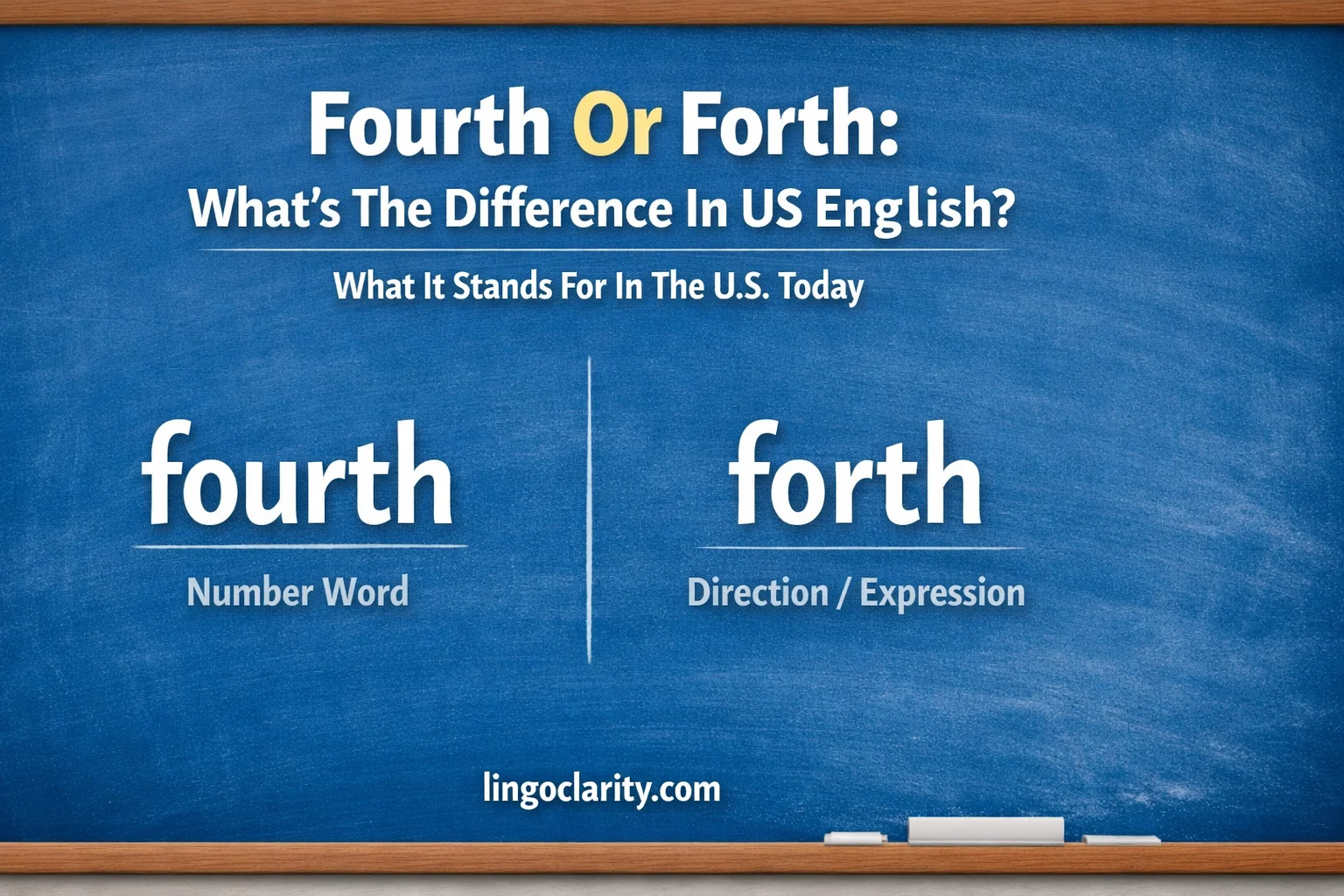
Use fourth when the number 4 is involved: a position in a sequence, a calendar date, or one of four equal parts.
Use forth when the meaning is forward, outward, or into view, and inside set expressions such as and so forth, back and forth, set forth, and bring forth.
The five-second test: drop 4th into the sentence. If it reads naturally, the ordinal spelling is correct. If forward reads naturally instead, the directional spelling wins.
Fourth or Forth At A Glance
| Context | Correct Word | Why It Works |
|---|---|---|
| Position in a sequence | fourth | Ordinal form of 4 |
| A calendar date | fourth | Dates use ordinal numbers |
| One of four equal parts | fourth | It names a quarter |
| Movement ahead or outward | forth | It means forward or onward |
| Something coming into view | forth | It signals emergence |
| Fixed idioms | forth | Standard in every set phrase |
What Fourth Means
This is the ordinal form of the number four, and it tells your reader where something sits in an order.
You reach for it in four everyday situations:
- Rank or position: She finished in fourth place at the state meet.
- Dates: The permit expires on the fourth of November.
- Chapters and sections: He read the final chapter before the fourth.
- Fractions: About one-fourth of the staff called in sick.
In modern US English, this ordinal is completely tone-neutral. It belongs in text messages, school assignments, business reports, journalism, and formal prose without raising a single eyebrow. Nobody notices it, which is exactly what you want from a functional word doing a functional job.
What Forth Means
The shorter spelling means forward, onward, outward, or into view. Today it survives mostly inside established expressions rather than as a standalone everyday adverb.
Watch how it behaves:
- The speaker stepped forth to answer questions.
- The maple put forth new leaves in April.
- The report sets forth the company’s hiring goals.
- We covered pricing, deadlines, staffing, and so forth.
This is standard, correct English. Outside its familiar phrases, though, it carries a formal or literary flavor, so a casual blog post rarely needs it on its own.
The One-Letter Rule (Your Memory Trick)
Here is the entire distinction in a single line:
Fourth contains four. The directional word does not.
If the sentence connects to the number 4 in any way, whether counting, ranking, dating, or dividing, keep the u. If the sentence is about direction, emergence, or a memorized phrase, drop it.
Two swap tests confirm the choice in seconds:
- Swap in 4th. “She came in 4th place” reads fine, so the ordinal is right.
- Swap in forward. “Go forward and do your best” reads fine, so the directional adverb is right.
I have taught this pair to copywriters for years, and the swap test is the only trick that survives a deadline. Rules get forgotten under pressure. A two-second substitution does not, because it uses your ear instead of your memory.
Real-Life Examples Writers Actually Face
I have edited this error in nearly every kind of document, and it clusters in predictable places.
In work email. A project manager writes, “Please see the attached plan, which sets forth our Q4 targets.” That sentence lays something out for view, so the directional version is right. One line later, “our fourth quarter results” is pure numbering. Same email, both spellings, both correct.
In event invitations. Party invites are where this slip goes public. “Join us for the Fourth of July” is a date, every single time, and a misspelled invitation gets screenshotted and passed around long before anyone tells you.
In school papers. Students writing about Shakespeare or scripture often reach for older phrasing, such as “the prophet came forth from the crowd.” That is one of the rare cases where the directional adverb genuinely earns its place outside an idiom.
In sports write-ups. Rankings dominate the copy: down, quarter, seed, and overall standings all attach to the ordinal, which is why sports desks see this pair more than anyone.
In recipes and budgets. “Reserve one-fourth of the batter” and “one quarter of the monthly budget” both describe a portion, so the number word stands in each.
Dates: Where The Mistake Goes Public
Dates deserve their own warning, because holiday posts, headlines, and invitations travel further than anything else you write.
Correct: July Fourth, the fourth of November, her birthday is on the 4th
Incorrect: July Forth, the forth of November
Calendar dates are read as ordinal numbers, first, second, third, 4th, so the ordinal spelling is the only option. Writing July 4th in numerals is also perfectly acceptable in headlines, social captions, and casual copy, and it sidesteps the trap entirely. When a client is nervous about the error, numerals are the safest route on a banner or an invitation.
Common Mistakes And Quick Fixes
| Mistake Type | Wrong | Right | Why |
|---|---|---|---|
| Rank | She finished in forth place | She finished in fourth place | Ranking needs the number word |
| Date | The parade is on July Forth | The parade is on July Fourth | Dates use ordinal numbers |
| Idiom | Deadlines, staffing, and so fourth | Deadlines, staffing, and so forth | The expression is fixed |
| Movement | Go fourth and do your best | Go forth and do your best | The sentence means forward |
Two of those four account for the overwhelming majority of published errors: the holiday date and the and so idiom. If you only ever check two phrases in your own writing, check those.
Grammar Roles: How Each Word Behaves
| Word | Part Of Speech | Typical Use | Example |
|---|---|---|---|
| fourth | Adjective or noun | Modifies a noun, or names a rank | the final chapter; a close fourth |
| forth | Adverb | Describes direction or emergence | step forth, come forth |
The ordinal also works as a fractional noun (one-fourth of the total) and as a musical interval in written harmony. The directional word functions almost exclusively as an adverb in current US English. Noun use is rare, and it never stands alone as a verb, though it anchors well-known verb phrases such as bring forth.
Word History In Brie
The ordinal grew straight out of four and has served as the standard ordinal form for centuries, which is why the u never left it. Its relatives are obvious once you look: four, fourteen, forty, and quarter all circle the same number, and only forty dropped the u along the way, which is its own famous spelling trap.
The directional word descends from Old English forð, meaning forward or onward, and it belongs to the same family as further, furthermore, and forward. It was once a common everyday adverb, used the way we now use out or ahead. As English simplified, forward absorbed the ordinary jobs and the older form retreated into fixed expressions and elevated prose, which is exactly where you still find it today.
That history explains the modern split neatly: one word does math, the other does motion. They were never related, and they only collided because English pronunciation flattened the difference between them.
A 30-Second Proofreading Routine
Because no spell-checker will catch this, build a habit instead. Here is the routine I use on client copy before it ships.
- Search your draft for both spellings using find, one at a time. Most documents contain fewer than ten hits, so this takes seconds.
- Read each hit in isolation, not in the flow of the sentence. Flow is what hid the error in the first place.
- Apply the swap test to each one: does 4th fit, or does forward fit?
- Check dates twice. Holiday copy, invitations, and headlines carry the highest cost because they get shared and screenshotted.
- Check every idiom. If the phrase ends in and so, or begins with back and, the directional spelling is the only correct option.
That five-step pass costs half a minute and removes the single most embarrassing typo in the pair. On anything that will be printed, run it twice, because print has no edit button.
One more safeguard is worth building in. If a phrase is going on a banner, a T-shirt, a wedding program, or a paid ad, have a second person read it cold, with no context and no explanation from you. A fresh reader who has not been staring at the copy for an hour catches wrong-word errors that your own eye now skips automatically. Professional proofreaders call this the cold-read pass, and it is the cheapest insurance in publishing.
Quick Self-Test
Choose the right spelling for each blank, then check yourself below.
- The store is on the ___ floor.
- He stepped ___ to accept the award.
- We discussed budget, hiring, and so ___.
- Only one-___ of the tickets sold.
- Her birthday falls on the ___ of June.
Answers: 1. fourth, 2. forth, 3. forth, 4. fourth, 5. fourth
Five out of five means you are done second-guessing this pair. Miss one, and it will almost certainly be the date. Dates are where nearly everyone slips, which is why they get their own section above.
Cheat Sheet
| If Your Sentence Is About… | Use |
|---|---|
| Counting or ranking | the ordinal with u |
| A calendar date | the ordinal with u |
| A quarter of something | the ordinal with u |
| Moving ahead or outward | the shorter spelling |
| Coming into view | the shorter spelling |
| A memorized idiom | the shorter spelling |
FAQs
Is fourth or forth correct for dates?
Always the ordinal. Write July Fourth, the fourth of June, or simply July 4th. A date is an ordinal number, and the directional word has no numerical meaning whatsoever.
Is “and so fourth” ever correct?
No. The expression is and so forth, meaning “and other things like that.” The misspelled version is one of the most common typos in professional email, and readers do notice it.
What is the main difference between these two words?
One is a number word covering rank, order, dates, and fractions. The other is a direction word meaning forward, outward, or into view, and it lives mostly inside set phrases.
Is “go fourth” ever correct?
Only in an unusual sentence that literally involves the number 4, such as a game where teams go first, second, third, then fourth. When you mean “head out and try,” the expression is go forth.
What about “back and forth”?
That idiom takes the directional spelling, because it describes motion in two directions and no number is involved: the negotiation went back and forth for weeks.
How do I remember the difference quickly?
Look for the number hiding inside the longer spelling. If four belongs in your meaning, keep the u. If forward fits the slot instead, drop it.
Do British and American English treat them differently?
No. The rule is identical in US, UK, Canadian, and Australian English. This is a meaning distinction, not a regional spelling preference like color and colour.
Which spelling is more common today?
The ordinal, by a wide margin, because numbers, dates, and rankings appear constantly in everyday writing. The directional word shows up far less often and almost always inside one of its familiar phrases.
Conclusion
Fourth or forth comes down to one question: is your sentence doing math, or is it doing motion? Numbers, ranks, dates, and quarters take the longer spelling, because four is literally sitting inside it. Forward movement, emergence, and memorized idioms take the shorter one, and they always have.
Run the swap test whenever you hesitate. Drop 4th into the sentence, and if it reads naturally, the ordinal is correct. Drop in forward, and if that reads naturally, use the directional word instead. Two seconds of checking protects you from the one typo spell-check will never catch, and from mailing out an invitation to a July Forth barbecue.
