
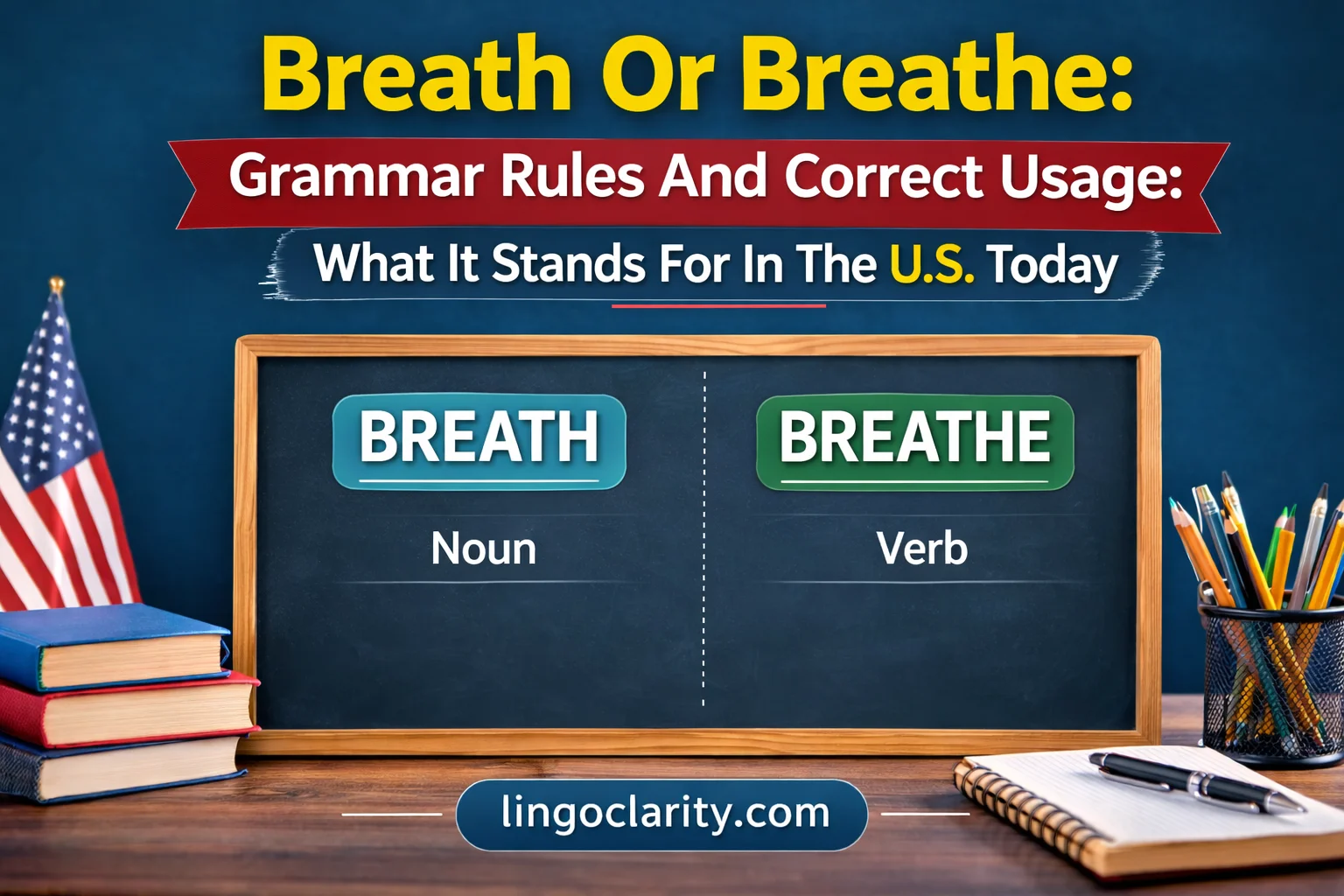
Many writers mix up breath and breathe because the words look similar and are closely related in meaning. However, they do not do the same job in a sentence. In standard US English, breath is a noun, while breathe is a verb.
That difference matters in everyday writing. You take a breath, but you breathe slowly. Once you focus on whether the sentence needs a thing or an action, the choice becomes much easier.
This guide explains the grammar rule behind breath and breathe, shows when each form is correct, highlights common mistakes, and gives clear examples you can follow with confidence.
Quick Answer
Breath is a noun. Breathe is a verb.
Use breath when you are naming the air itself, a single intake of air, or a pause for air. Use breathe when you mean the action of taking air in and out.
For example:
- Take a deep breath is correct.
- Please breathe slowly is correct.
- Take a deep breathe is incorrect.
That is the core difference in standard US English: breath names something, while breathe shows an action.
Breath Or Breathe: Which Is Correct?
Both words are correct, but they are correct in different sentence patterns.
Choose breath when the sentence needs a noun:
- She took a deep breath.
- He was out of breath.
Choose breathe when the sentence needs a verb:
- Try to breathe slowly.
- I could barely breathe after the run.
So the real question is not which word is “better.” The real question is what job the word is doing in the sentence.
The Core Grammar Rule
The difference between breath and breathe is a part-of-speech difference.
- Breath = noun
- Breathe = verb
A noun names a thing, state, or unit. A verb shows an action or process.
That means:
- breath refers to air from the lungs, one act of breathing, or a pause for air
- breathe means to inhale and exhale
This is why the words are related in meaning but cannot usually replace each other.
How To Remember The Difference
A simple memory tip can help.
Breathe has an extra e, and that extra letter appears in the action word.
Breath is shorter, and it names the thing itself.
Another quick test is to look at the word around it.
You usually need breath after words such as:
- a
- the
- deep
- short
- my
- your
- his
- her
You usually need breathe after words such as:
- to
- can
- could
- should
- must
- please
When To Use Breath
Use breath when the word is acting as a noun.
Common Meanings Of Breath
Breath can mean:
- the air you take in and let out
- one full intake of air
- a short pause for recovery
- a physical state, as in out of breath
Examples Of Breath In Sentences
- She took a deep breath before speaking.
- After climbing the stairs, I was out of breath.
- Hold your breath for five seconds.
- He stopped for a breath and then continued.
- She finally caught her breath after the sprint.
Common Phrases With Breath
Some of the most common noun patterns are:
- take a breath
- take a deep breath
- hold your breath
- catch your breath
- out of breath
- under your breath
- bad breath
When To Use Breathe
Use breathe when the word is acting as a verb.
Common Meanings Of Breathe
Breathe means:
- to take air into the lungs and let it out
- to inhale and exhale with ease or difficulty
- to give life or energy to something in a figurative sense
Examples Of Breathe In Sentences
- Try to breathe slowly.
- I could hardly breathe in the smoke.
- He stopped to breathe after the run.
- It is easier to breathe outside.
- The new manager helped breathe life into the project.
Common Phrases With Breathe
Some standard verb patterns include:
- breathe slowly
- breathe deeply
- breathe in
- breathe out
- breathe through your nose
- breathe more easily
- breathe life into
Breath Vs. Breathe In Side-By-Side Examples
Looking at both words together makes the difference easier to see.
- Take a deep breath.
- Try to breathe deeply.
- He was out of breath.
- He could barely breathe.
- She caught her breath.
- She stopped to breathe.
In each pair, breath names something, while breathe describes the action.
Common Mistakes To Avoid
Because the two words look and sound so similar, writers often swap them by mistake.
Using Breathe When You Need Breath
These are incorrect:
- Take a deep breathe.
- I need to catch my breathe.
- She held her breathe.
These are correct:
- Take a deep breath.
- I need to catch my breath.
- She held her breath.
Using Breath When You Need Breathe
These are incorrect:
- I cannot breath.
- Please breath slowly.
- He needs to breath through his nose.
These are correct:
- I cannot breathe.
- Please breathe slowly.
- He needs to breathe through his nose.
In formal and everyday written English, these are not style preferences. They are grammar errors.
Why Writers Confuse Breath And Breathe
The confusion is easy to understand for two reasons.
First, the words are closely related in meaning. Both refer to respiration, air, and the body.
Second, they are very similar in spelling. The only visual difference is the final e, but that small letter changes the grammatical role of the word.
In speech, the distinction may also feel subtle to learners and fast speakers. In writing, however, the difference matters.
A Quick Test You Can Use
Ask yourself one question:
Does the sentence need a thing or an action?
- If it needs a thing, use breath.
- If it needs an action, use breathe.
Try these examples:
- I need to ___ slowly. → breathe
- Take a deep ___. → breath
- She lost her ___ after the run. → breath
- Try to ___ through your nose. → breathe
This test works in most cases.
Grammar Rule Details
The rule is straightforward:
Use breath as a noun and breathe as a verb.
That is the entire grammatical distinction.
Correct Usage Patterns
Use breath when naming:
- air from the lungs
- one intake of air
- a pause for recovery
- a condition related to breathing
Use breathe when showing:
- the action of inhaling and exhaling
- the act of breathing easily or with difficulty
- figurative action, as in breathe life into
Are There Any Exceptions?
There are no major exceptions to the rule.
The only small nuance is that breath can be countable or uncountable depending on meaning.
- Take two deep breaths.
- Bad breath can be embarrassing.
Even so, it remains a noun in both cases. The main rule never changes: breath is the noun, and breathe is the verb.
Real-World Examples In US English
Here are natural, modern examples that show how each form works in context:
- The nurse told me to take a deep breath.
- After the sprint, he needed a minute to catch his breath.
- I opened the window so we could breathe more easily.
- During yoga class, we paused to breathe in and out slowly.
- She stood still, took one steady breath, and began speaking.
- With all that dust in the room, it was hard to breathe.
These examples reflect the standard way the two words are used in clear written English.
Usage Notes
Many people think this is only a spelling issue, but that explanation is incomplete. The real issue is grammatical.
Yes, breath and breathe are spelled differently. More importantly, though, they do different jobs in a sentence. That is why checking the sentence structure is more reliable than just memorizing the spelling.
It also helps to learn the words in common phrases rather than in isolation. Once you recognize patterns like take a breath and need to breathe, the correct form becomes much easier to choose.
Frequently Asked Questions
Use breath. The correct phrase is take a deep breath because the sentence needs a noun.
Use breathe. After can’t, the sentence needs a verb, so I can’t breathe is correct.
Yes. Breath is a noun. It can refer to air from the lungs, one act of breathing, or a pause for air.
Yes. Breathe is a verb. It means to take air in and let it out.
People confuse them because the words are closely related in meaning and very similar in spelling. The easiest fix is to check whether the sentence needs a noun or a verb.
No, not in standard written English. They are related words, but they perform different grammatical functions.
Remember that breathe has an extra e, and it is the action word. Breath is the noun.
Conclusion
The difference between breath and breathe is simple once you focus on grammar instead of spelling alone.
Use breath for the noun.
Use breathe for the verb.
If the sentence names air, a single intake, or a pause, choose breath. If it shows the action of inhaling and exhaling, choose breathe.
When in doubt, ask yourself whether the sentence needs a thing or an action. That quick check will usually give you the right answer.
