
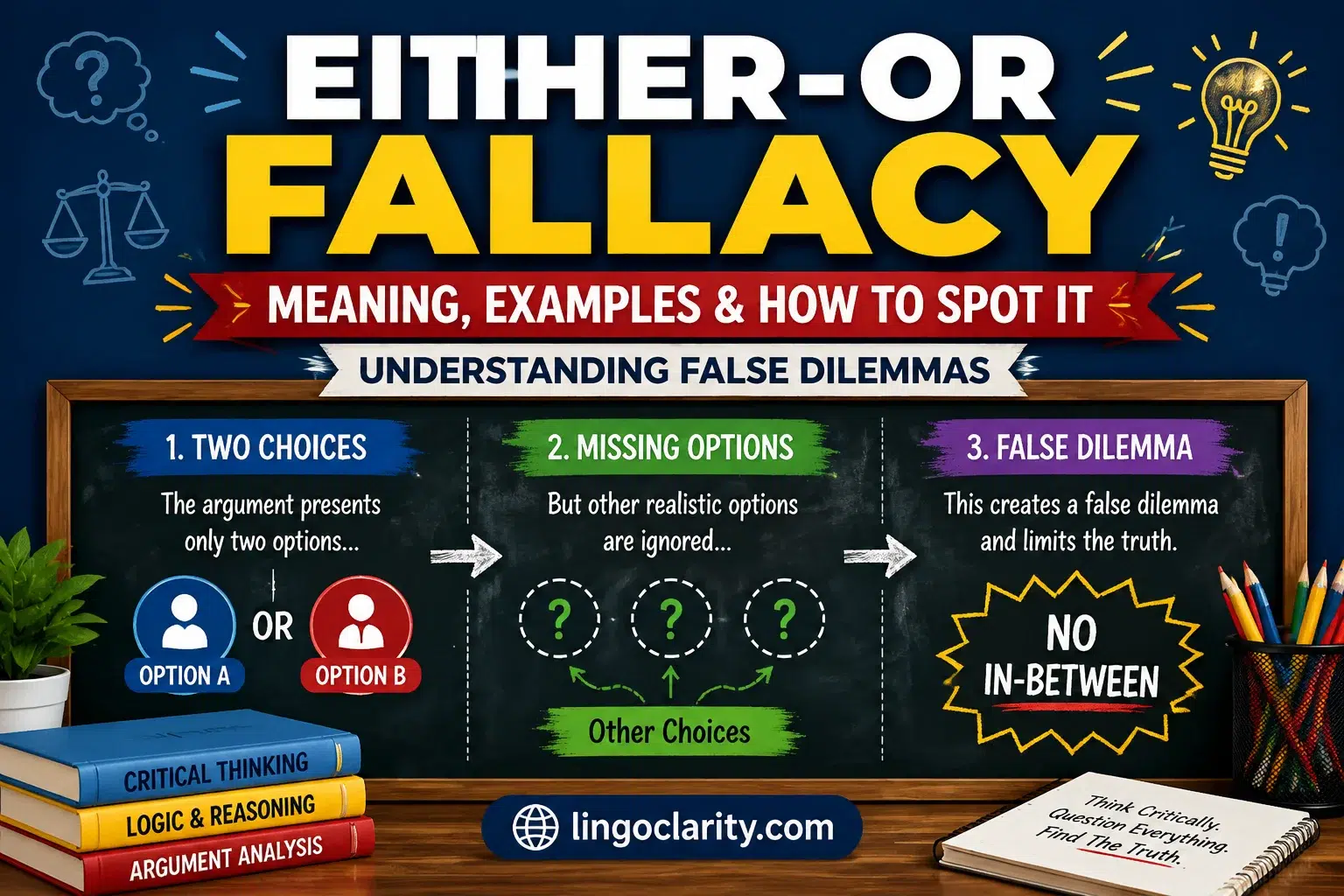
An either-or fallacy happens when someone reduces a complicated issue to just two choices, even though other realistic options exist. Logicians and writing guides usually call this the same error as a false dilemma or false dichotomy: an argument that treats two options as the only possibilities when the real world offers more.
The fallacy isn’t about grammar. Saying “either you finish the report or you don’t” is completely normal English. The problem starts when a speaker uses that either-or structure to hide the fact that a third, fourth, or fifth option exists — and then uses the artificial two-choice setup to pressure you toward one side.
This guide breaks down how the fallacy works, where it shows up, when either-or statements are actually valid, and how to catch it in other people’s arguments (and your own).
Quick Answer
The either-or fallacy is a logical mistake where someone presents only two choices even though more realistic options exist. Also called a false dilemma or false dichotomy, it creates a misleading “either this or that” situation by ignoring middle positions and alternative solutions.
TL;DR
- Either-or fallacy forces a choice between two options when more exist.
- It is also known as false dilemma and false dichotomy.
- The problem is not the phrase “either…or”; the problem is misleading reasoning.
- It commonly appears in politics, advertising, debates, and everyday conversations.
- A real either-or statement is valid only when the options are complete and exclusive.
What Is the Either-Or Fallacy
The either-or fallacy is an informal logical fallacy: a flaw in the content of an argument rather than its structure. It occurs when someone presents two options as the complete, exhaustive set of possibilities, then draws a conclusion based on that artificial limit.
Britannica describes it as presenting only two options while ignoring other genuine possibilities. Scribbr and most university critical-thinking guides use “false dilemma,” “false dichotomy,” and “either-or fallacy” interchangeably, since all three describe the same underlying mistake: mutually exclusive framing where the options aren’t actually the only ones, or aren’t actually mutually exclusive.
A simple way to state it: the fallacy forces a choice between two options while quietly deleting every option in between.
Example: “You either support this policy, or you don’t care about the community.” That’s a false dilemma because someone can support the goal of the policy while still thinking it needs changes — a middle position the statement pretends doesn’t exist.
How The Either-Or Fallacy Works
The either-or fallacy works through two moves, often combined:
- Limiting the options. The arguer presents two choices as if they’re the only ones available, when a third, fourth, or blended option is realistic.
- Forcing exclusivity. The arguer treats the two options as mutually exclusive — you can only pick one — even when someone could reasonably hold both, or neither.
The Logical Structure Behind It
Formally, this fallacy confuses contraries (statements that can’t both be true, but could both be false) with contradictories (statements where exactly one must be true). A true either-or statement relies on contradictories — “the number is even or it is odd” leaves no third option. A false dilemma dresses up contraries to look like contradictories, hiding the fact that both options could be false or that a middle ground exists.
You’ll see a few named variations of this pattern:
- Bifurcation — the basic version: cutting a multi-option issue down to exactly two.
- Disjunctive syllogism (misused) — “It’s A or B; it’s not A; therefore it’s B” — valid in form, but false in practice if A and B were never the only options.
- Constructive and destructive dilemmas — two-pronged arguments built so that whichever branch you pick, you land on the same (usually undesirable) conclusion, even though a third branch was available all along.
Why This Fallacy Is So Persuasive
Either-or framing works because it removes the mental effort of weighing multiple options. Once an audience accepts that there are only two paths, one option can be made to look responsible, moral, or safe, while the other looks reckless or foolish — regardless of what a more complete set of choices would show.
This connects to zero-sum thinking: the assumption that one side’s gain must be another side’s loss. It also overlaps with black-and-white thinking, a broader tendency to see situations in extremes. The difference is that black-and-white thinking describes a general mental habit, while the either-or fallacy refers specifically to a flawed argument built on a forced two-way choice.
Some speakers create false dilemmas by accident, because oversimplifying a messy issue feels natural. Others use it deliberately, as a persuasion tactic, because a forced choice pushes an audience toward a predetermined answer faster than an honest, multi-option discussion would.
Either-Or Fallacy, False Dilemma, And False Dichotomy: What’s The Difference
In practice, these terms overlap almost completely, and most sources use them as synonyms. Where writers do draw a line, it’s a technical one: a false dilemma usually refers to the flawed argument itself, while a false dichotomy more precisely refers to the underlying belief that only two categories exist. Either-or fallacy is the more conversational label for the same error, and it’s the phrase most people search for and use in everyday speech, classrooms, and debate.
You don’t need to pick one term and stick to it. If you’re analyzing an argument, “false dilemma” is the more academic phrasing; if you’re describing the pattern in plain language, “either-or fallacy” works just as well.
Real-World Examples Of The Either-Or Fallacy
In Politics
“If you are not with us, you are against us” is a classic either-or fallacy — it erases every position between full agreement and total opposition. Pandemic-era arguments that framed lockdowns as a choice “between the loss of our way of life and the loss of life” did the same thing: real policy debates involved dozens of intermediate options (partial reopening, targeted restrictions, phased timelines), not just two.
In Advertising
Ads often imply that buying a product is the only alternative to disaster. A moving-company commercial that shows chaos and destruction as the only alternative to hiring that specific company is a false dilemma — plenty of other moving companies and methods exist.
In The Workplace
“Either we cut the budget in half, or the whole department shuts down” ignores options like phased cuts, revenue increases, or restructuring. This version is especially common in high-pressure meetings, where a forced choice can shut down real problem-solving.
In Everyday Arguments
“Either this app is perfect, or it’s useless” is a false dilemma because usefulness exists on a spectrum. A better, non-fallacious version: “It has real limitations, but it’s still useful for most people’s day-to-day needs.” Notice how the fix doesn’t abandon criticism — it just restores the middle ground the original statement deleted.
A Famous Historical Example
One well-known instance of this pattern is the argument sometimes summarized as “liar, lunatic, or lord,” used in religious apologetics to argue that a historical figure must fall into one of three categories. Critics have long pointed out that this is a false trilemma (a three-option version of the same fallacy): it ignores other plausible categories, such as “legend,” “misunderstood,” or “partially accurate historical account.” The example is useful precisely because it shows the fallacy doesn’t only come in two-option form — any argument that artificially caps the realistic options, whether at two or three, has the same structural flaw.
When Either-Or Statements Are Not A Fallacy
Not every two-option statement is a false dilemma. Some situations genuinely have only two outcomes:
- “The light is either on or off.” (No third electrical state in normal use.)
- “A person is either 18 or older, or they are not,” in a context that defines a legal age threshold.
- “Would you like salad or fries with that?” in a restaurant with only two side options on the menu.
- “The test result is either positive or negative,” where the test itself has no third outcome.
The test is simple: are these really the only two options, and are they genuinely mutually exclusive? If yes, the either-or statement is accurate, not fallacious. The fallacy only appears when a speaker manufactures a false sense of only-two-options where reality actually offers more.
Either-Or Fallacy vs. Related Fallacies And Thinking Patterns
Black-And-White Thinking
This is the broader cognitive pattern of seeing people, situations, or ideas as entirely good or entirely bad, with no in-between. The either-or fallacy is what happens when that pattern shows up inside a specific argument.
The Continuum Fallacy (Fallacy Of The Beard)
This is essentially the mirror-image error: insisting that because there’s no sharp line between two ends of a spectrum, no real distinction exists at all (“one grain of sand isn’t a heap, so heaps don’t exist”). Where the either-or fallacy wrongly erases the middle of a spectrum, the continuum fallacy wrongly erases the ends.
Morton’s Fork
A specific rhetorical trap where both of the two offered options lead to the same conclusion, no matter which one is chosen (“if you’re rich, you can afford the tax; if you’re poor, you clearly don’t need the money you’re keeping”). It’s a specialized use of either-or framing designed so that escape is impossible.
Slippery Slope
Often confused with false dilemma, but different: a slippery slope argument claims one small step will inevitably trigger an extreme chain of consequences. A false dilemma limits the options available right now. The two can appear together, but they’re distinct errors.
Pairing With Other Fallacies
Either-or framing frequently shows up alongside a straw man (misrepresenting the opposing option to make it look worse) or a sunk cost argument (“we’ve already spent so much, our only options are to finish or waste it all”). Spotting one of these fallacies is a good reason to check an argument for the others.
How To Spot An Either-Or Fallacy
Ask these questions whenever an argument presents exactly two choices:
- Are these genuinely the only two options, or are others being left out?
- Could someone reasonably choose both, or neither?
- Is there a middle position, a phased approach, or a blended solution?
- Does the framing make one option sound obviously worse, using emotional language rather than evidence?
- Would the argument still work if a third option were added back in?
If a “yes” to question 1 or 2 is hard to defend, you’re likely looking at a false dilemma.
How To Respond When Someone Uses This Fallacy On You
Push back on the framing, not the person. Useful lines include:
- “What options are we leaving out here?”
- “Is there a version of this where we do a bit of both?”
- “Are those two outcomes actually guaranteed, or is that worst-case thinking?”
- “Can you walk me through why a third option isn’t possible?”
Logicians sometimes call this “escaping between the horns of the dilemma” — instead of picking one of the two forced options, you challenge the premise that only two options exist.
How To Avoid Committing This Fallacy In Your Own Writing
- Before finalizing an argument, list every option you can think of, then check whether you’ve quietly dropped any of them from your final draft.
- Replace absolute words like always, never, everyone, and no one with qualified language like often, rarely, or most people — absolutes are what usually smuggle a false dilemma into a sentence.
- If you’re using either-or phrasing for genuine clarity (a real two-option scenario), briefly say why those are the only two options — that transparency is what separates a valid distinction from a rhetorical trap.
- Read your argument as if you were the person being asked to choose. If your honest reaction is “wait, isn’t there another way,” revise the framing.
| Situation | How to Read It | Why |
|---|---|---|
| A light is on or off | Valid statement | Only two normal states exist |
| A political issue has two sides only | Question it | Complex issues usually have more options |
| An advertisement shows only two choices | Likely fallacy | It may ignore alternatives |
Test Your Understanding
- “You either love math, or you’re lazy.” — False dilemma. Disliking math has nothing to do with effort or laziness; those are unrelated traits being falsely linked.
- “The door is either locked or unlocked.” — Not a fallacy. A standard door lock genuinely has only two states.
- “Either we change this deadline, or the project fails.” — Likely a false dilemma, unless every other option (more staff, reduced scope, overtime) has genuinely been ruled out.
- “You are either a success or a failure.” — False dilemma. Most outcomes fall somewhere between total success and total failure.
Frequently Asked Questions
What does either-or fallacy mean?
It means presenting only two choices as if they’re the only real possibilities, when other realistic options exist. It’s most often called a false dilemma or false dichotomy.
Is either-or fallacy the same as false dilemma?
Yes, in everyday use. Technically, “false dilemma” refers to the flawed argument, while “false dichotomy” refers to the underlying belief that only two categories exist — but nearly every source treats them as interchangeable.
What is a simple example of the either-or fallacy?
“You either agree with me completely, or you’re against progress.” This ignores every position between full agreement and total rejection.
Is either-or fallacy a grammar term?
No. It’s a term from logic and argumentation, not grammar. The either…or sentence structure itself is completely normal English; the fallacy only exists when that structure hides real alternatives.
Can either-or statements ever be correct?
Yes. When a situation genuinely has only two outcomes — a light switch, a binary test result, a menu with two sides — an either-or statement is accurate rather than fallacious.
Is either-or fallacy the same as black-and-white thinking?
They’re related but not identical. Black-and-white thinking is a general habit of seeing things in extremes. The either-or fallacy is what that habit looks like inside one specific argument.
Where does this fallacy show up most often?
Politics, advertising, workplace negotiations, and everyday arguments are the most common places, because forcing a two-way choice is an effective (if dishonest) way to pressure someone toward a predetermined answer.
The Bottom Line
The either-or fallacy shrinks a complicated issue down to two options and hopes nobody notices what got left out. The fix is always the same question: what else is possible here? Once you get in the habit of asking it, forced two-way choices become much easier to spot — in political speeches, in ads, in workplace arguments, and in your own writing. That one question can make your reading, reasoning, and argument analysis much stronger.
