
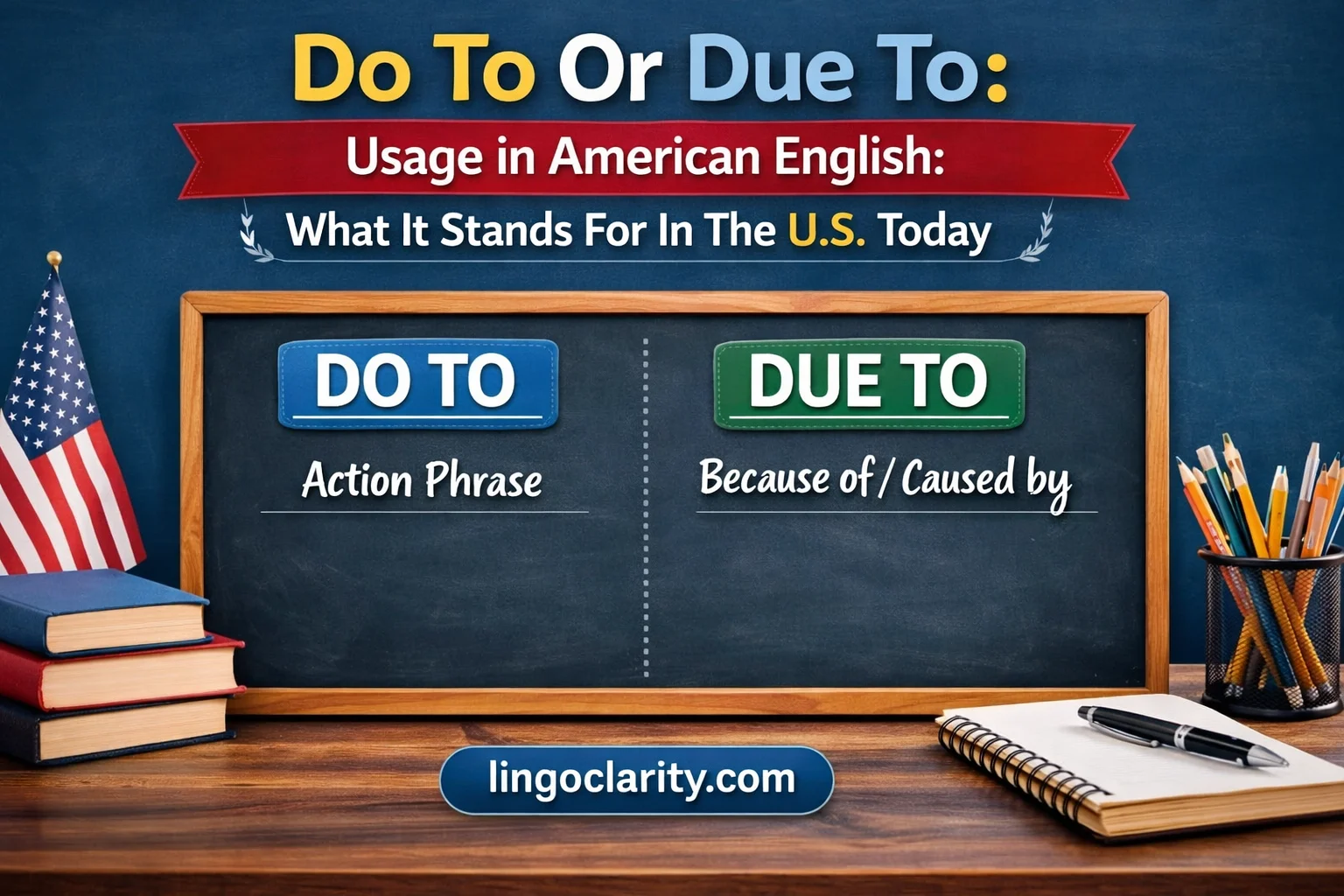
Do to or due to? Many writers hesitate over these two forms because they often sound alike in everyday speech. Even so, do to and due to do not mean the same thing, and they cannot be swapped freely. One points to a cause, the other to an action, and mixing them up is one of the most common slips in US English writing.
In most sentences, the correct choice is due to when you mean because of or caused by. By contrast, do to usually appears only when do is the verb and to begins the next part of the sentence.
Compare these:
- The game was delayed due to rain.
- What did you do to my laptop?
One gives a reason. The other describes an action. That is the core difference.
Quick Answer
Use due to when you are giving a reason. It works exactly like because of. Use do to only when you literally mean performing an action to someone or something — it is the verb do plus the preposition to.
Giving a reason (due to):
- The store closed early due to ice.
- My flight was delayed due to fog over Chicago.
- Rent went up this year due to higher property taxes.
- The meeting was moved to Friday due to a scheduling conflict.
Performing an action (do to):
- What did you do to the screen?
- Look what the puppy did to my running shoes.
- Don’t do to others what you wouldn’t want done to you.
The mistake people actually make:
Right: Due to the storm, school was canceled.
Wrong: Do to the storm, school was canceled.
Why People Confuse Them
The biggest reason is sound. In everyday American English, do and due are often pronounced the same or nearly the same. That means the mistake usually starts as a spelling problem.
The confusion gets stronger because English has many perfectly normal sentences with do followed by to:
- What can we do to help?
- What did you do to the chair?
Because those are common, some writers start treating the action pattern as if it could also express cause. It cannot.
Another reason is older advice about due to. Some traditional style guides tried to limit it more strictly, but in modern edited English it is widely accepted as a standard way to express cause.
Key Differences At A Glance
| Context | Best Choice | Why |
|---|---|---|
| Giving a reason | due to | It means because of or caused by. |
| Describing an action toward something | do to | Do is the verb, and to starts the next phrase. |
| Delay, cancellation, or explanation | due to | This is the standard cause expression. |
| Asking what happened to something | do to | The sentence is about an action, not a reason. |
In plain terms:
- due to = reason, cause, explanation
- do to = action pattern
- the first is standard for cause
- the second is usually wrong when the writer means because of
Meaning And Usage Difference
What The Cause Phrase Means
When you use due to, you are pointing to a cause, source, or explanation.
Examples:
- The flight was canceled due to fog.
- Sales fell due to a supply problem.
- The road closed due to flooding.
In each case, the phrase answers why something happened.
What The Action Form Means
The other form is not a single fixed expression with its own meaning. It is simply the verb do plus to.
Examples:
- What did you do to the chair?
- What can we do to improve service?
- What did the heat do to the paint?
Here, the sentence answers what action happened.
The Easiest Test
Replace the phrase with because of.
If the sentence still works, choose the cause phrase.
- The event was canceled because of weather.
- The event was canceled due to weather.
But this does not work:
- What did you because of the chair?
That is why the action form belongs there instead.
Tone, Context, And Formality
In modern US English, due to works in both formal and everyday writing. You will see it in notices, journalism, business messages, and school writing.
Still, because of can feel more direct in casual prose.
Compare:
- The picnic was canceled due to rain.
- The picnic was canceled because of rain.
Both are correct. The second often sounds slightly more conversational.
The action form is different. It is not a style choice at all. It only works when the sentence is clearly about doing something to a person, object, or situation.
Natural:
- What did the storm do to the fence?
Wrong:
- The fence fell do to high winds.
Which One Should You Use?
Choose due to when your sentence answers why.
Choose do to when your sentence answers what action someone performed.
Use the cause phrase:
- The meeting was moved due to a power outage.
- Her absence was due to illness.
- The delay happened due to a wiring problem.
Use the action form:
- What did you do to the printer?
- What can we do to help?
- What did the medicine do to him?
When One Choice Sounds Wrong
The action form sounds wrong when you are trying to express cause.
Wrong:
- We stayed home do to the storm.
Right:
- We stayed home due to the storm.
The cause phrase sounds wrong when the sentence needs an action verb.
Wrong:
- What due to you break the handle?
Right:
- What did you do to break the handle?
This is why the two forms should never be treated as spelling variants of the same expression.
Common Mistakes And Quick Fixes
Using The Action Form To Show Cause
Wrong:
- The event was canceled do to weather.
Right:
- The event was canceled due to weather.
Correcting A Sentence That Was Already Right
Wrong correction:
- What did you due to the car?
Right:
- What did you do to the car?
If do is the real verb, keep it.
Using A Wordy Construction
Wordy:
- The meeting moved due to the fact that the speaker was sick.
Better:
- The meeting moved because the speaker was sick.
Also good:
- The meeting moved due to the speaker’s illness.
Treating The Two As Interchangeable
They are not interchangeable. One introduces cause. The other shows an action.
Everyday Examples
Examples Showing Cause
- School was closed due to snow.
- The package arrived late due to a sorting error.
- Our seats changed due to a maintenance issue.
- The game ended early due to lightning.
Examples Showing Action
- What did you do to your phone?
- What can we do to make checkout faster?
- What did the dog do to the couch?
- What did they do to fix the leak?
A Note About Related Patterns
Part of the confusion comes from the fact that due appears in more than one standard structure.
Compare these:
- Her delay was due to traffic.
- The train is due to arrive at 6:15.
The first one expresses cause. The second means expected or scheduled. They look similar, but they are not functioning the same way.
That does not change the main rule here. When you mean because of, use the cause phrase. When you mean performing an action, use the verb pattern.
Conclusion
For most writers, the choice is simple.
Use due to when you mean because of.
Use do to only when you are talking about doing something to someone or something.
One form explains a reason. The other describes an action. Once you ask whether your sentence answers why or what happened, the correct choice becomes much easier.
FAQs
Is do to ever correct?
Yes. It is correct when do is the verb and to starts the next part of the sentence, as in What did you do to the file?
Is due to grammatically correct in modern English?
Yes. It is standard in modern English when it means because of or caused by.
Should I use due to or because of?
Both are correct in many sentences. Because of often sounds more conversational, while due to can sound slightly more formal.
Why do people write do to instead of due to?
Usually because the two forms sound alike in speech, so the mistake begins as a spelling mix-up.
Is due to the fact that wrong?
Not always, but it is often wordy. In many cases, because, since, or a shorter revision will sound better.
What is the easiest way to choose the right form?
Try replacing it with because of. If that works, use due to. If the sentence is about an action, use do to.
