
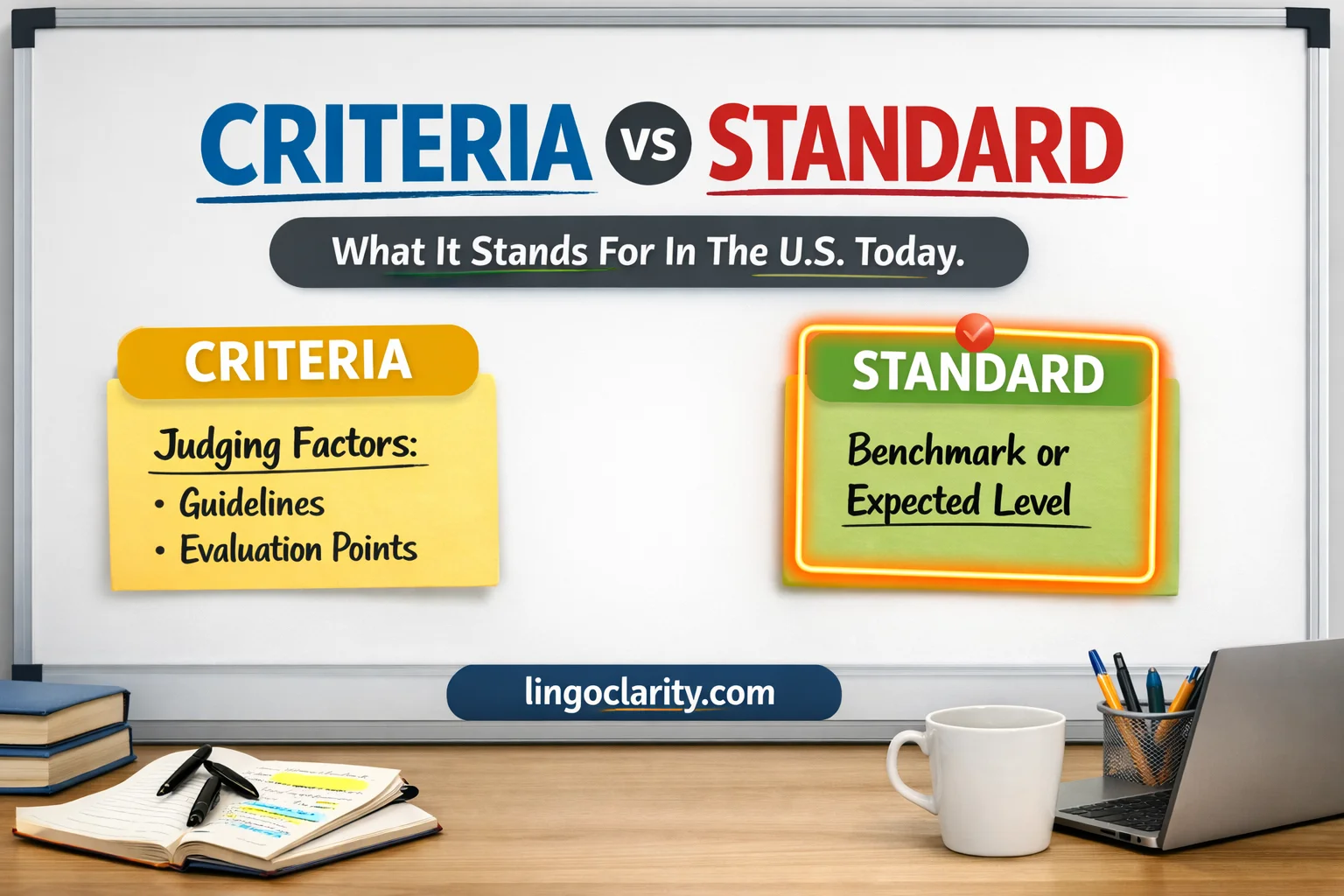
Criteria are the things you check. A standard is the level you check them against. That one sentence settles most of the sentences where writers stall between these two words.
I’ve spent years editing hiring policies, grading rubrics, and compliance documents, and this pair causes more silent errors than almost any other in professional writing — silent because both words are real, both sound formal, and a wrong choice never trips spellcheck. It just makes a sentence slightly wrong in a way readers feel but can’t name.
TL;DR
- Criteria = the factors, conditions, or points used to judge something. Plural. Singular is criterion.
- Standard = the benchmark, norm, rule, or acceptable level something is measured against. Works as a noun and an adjective.
- Fast test: Can you count them and list them? Use criteria. Is it one level something must reach? Use standard.
Quick Answer: Criteria vs Standard
Use criteria for the specific points, conditions, or factors used to judge something. Use standard for an accepted level, benchmark, norm, or rule.
A hiring example makes it concrete. A company’s criteria might be experience, writing ability, and reliability — three separate things reviewers look at. Its standard is that every finalist must have at least five years of relevant experience — one bar every candidate has to clear.
Criteria are the columns. The standard is the line drawn across them.
Criteria vs Standard at a Glance
| What You Are Doing | Best Choice | Why |
|---|---|---|
| Listing the factors used to judge or select | Criteria | Names the separate points under review |
| Naming an accepted level of quality | Standard | Names the benchmark to be reached |
| Writing a policy or compliance rule | Standard | Usually an established, official norm |
| Explaining how a winner is chosen | Criteria | A set of judging factors |
| Describing what counts as acceptable | Standard | Points to a required level |
| Modifying another noun | Standard | Standard procedure, standard format — criteria procedure is not English |
| Referring to one single factor | Criterion | The singular form |
| Referring to many required levels | Standards | Meets industry standards, health standards |
What Criteria Actually Means
A criterion is a means of judging. The word came into English from Greek kritērion, “a means of judging,” which is why the plural kept its Greek shape instead of taking an -s.
In practice, criteria are the countable, listable dimensions of an evaluation. If you can put bullet points next to them, they’re criteria.
- A scholarship committee’s criteria: financial need, academic record, community service.
- A vendor selection’s criteria: cost, reliability, delivery time, support quality.
- A grant review’s criteria: originality, feasibility, budget realism, team capacity.
Each is a list of separate things being looked at — not a level anything has to reach.
The Grammar: Criterion, Criteria, and the Word That Isn’t
Criteria is plural. Criterion is singular. Careful writing holds the line:
- ✅ The hiring criteria are clear.
- ✅ One criterion is leadership experience.
- ❌ The main criteria is experience.
- ❌ We added a new criteria.
Two points most guides skip. Criterions exists — Merriam-Webster records it as an occasional English-style plural — but it reads as an error to most editors. Criterias is not a word in any register; it stacks a plural on a plural, exactly like datas.
There’s one honest complication. Merriam-Webster notes that criteria is “frequently used as a singular as well as a plural, much like data and agenda.” That drift is documented — but documented isn’t accepted. In job postings, academic writing, and anything a copy editor touches, singular criteria still reads as a mistake. My rule for clients: write criterion when you mean one, and let the language sort out its own future.
I once reviewed a university admissions page where every instance read “the main criteria is.” A prospective student emailed to point it out, and the page was rewritten within a week — not because the meaning was unclear, but because a page about academic standards that misuses an academic word loses the room.
What Standard Actually Means
Standard traveled a stranger road. It began as a military flag — the banner an army rallied around, which is why we still say standard-bearer. The sense of “a fixed measure everyone agrees to” grew out of that: the thing you gather around becomes the thing you’re measured by.
As a noun, a standard is a benchmark, norm, rule, or accepted level: the work meets the standard; the product failed to reach the required standard. The plural is even more common: the restaurant meets the city’s health standards; the parts comply with industry standards; she accused the policy of applying a double standard.
And unlike criteria, standard works as an adjective: the standard form, our standard procedure, the standard format. This is the cleanest dividing line between the two words. “Use the criteria template” is not a sentence English produces.
How Criteria and Standards Work Together
Here’s where most articles stop — and where the real confusion lives. In the fields that use both words heavily, criteria and standards aren’t rivals. They’re two axes of the same grid.
In a grading rubric. The criteria are the rows: clarity, evidence, organization, mechanics. The standards are the columns: excellent, proficient, developing, needs work. Assessment designers at Monash and other universities teach exactly this split. You don’t choose between them — without both, you have half a rubric.
In an ISO audit. Under ISO 19011, the audit criteria are the policies, procedures, and requirements used as the reference point. One of those references is typically a published standard — ISO 9001, say. So the standard is one of the criteria. Both words are correct; neither substitutes.
In healthcare quality assurance. The criterion is the measurable element (“time from admission to first assessment”); the standard is the quantified level (“within 30 minutes, 95% of the time”).
In software. Acceptance criteria are the conditions a user story must satisfy before it ships. Coding standards are the conventions the team writes all its code against. Say “acceptance standards” or “coding criteria” in review and you’ll get a puzzled look.
The pattern: criteria are the dimensions; standards are the levels on those dimensions.
Why People Mix Them Up
Three reasons, and the first isn’t the writer’s fault.
- The dictionary invites it. Merriam-Webster defines criterion as “a standard on which a judgment or decision may be based” — one word defined using the other.
- They share every context. Hiring, admissions, grading, auditing, compliance, quality control, procurement.
- The plural throws people. Because criteria feels like a mass noun, writers say “our criteria is,” and once the number is wrong the sentence sounds off — so they swap in standard to fix a problem that was never about word choice.
The Ten-Second Test
Run three questions in order. The first “yes” gives you your word.
- Am I modifying a noun? (standard procedure, standard rate) → standard, as an adjective. Stop.
- Can I list and count them? (cost, timing, safety) → criteria. Only one? → criterion.
- Am I naming one level something must reach or comply with? → standard — or standards if several official ones apply.
Two yeses means you’re in rubric territory and need both words in different slots.
Criteria vs Standard in Real Situations
Hiring: “The selection criteria include cost, reliability, and delivery time.” / “Every candidate must meet our standard of five years’ experience.” A practical note from editing job postings: these aren’t interchangeable legally either. Criteria implies a weighted assessment where strength on one factor offsets another. Standard implies a threshold — clear it or you’re out. Hiring managers use them loosely; candidates and employment lawyers read them precisely.
Education: “The essay criteria include clarity, evidence, and organization.” / “One criterion for the honors track is a completed Algebra II course.” / “The school’s writing standard is higher this year.”
Audits and compliance: “The audit criteria include the quality manual, ISO 9001, and the customer contract.” / “The facility failed to meet the applicable safety standards.”
Healthcare: “The review criteria cover documentation, timeliness, and follow-up.” / “Care fell below the accepted standard of care” — a fixed legal and medical phrase.
Law and insurance: “The claim didn’t meet the eligibility criteria.” / “The prosecution must satisfy the standard of proof.”
Standard of proof, standard of living, and standard of care are locked phrases. None accepts criteria.
Common Mistakes and Quick Fixes
| ❌ Wrong | ✅ Right | The Problem |
|---|---|---|
| The main criteria is experience. | The main criterion is experience. | Plural treated as singular |
| The report meets our criteria of quality. | The report meets our standard of quality. | You mean a required level |
| The scholarship standard include service and grades. | The scholarship criteria include service and grades. | Wrong word and broken agreement |
| Use the criteria format. | Use the standard format. | Criteria has no adjective form |
| We updated the criterias. | We updated the criteria. | Plural stacked on a plural |
| He breached the criteria of care. | He breached the standard of care. | Fixed phrase |
Related Words People Confuse With Both
| Word | What It Means | Use It When |
|---|---|---|
| Benchmark | A reference point, often numeric | Comparing against a known figure or competitor |
| Requirement | Something mandatory | Missing it disqualifies outright |
| Guideline | Recommended, not binding | Advisory rather than enforceable |
| Specification | Exact technical detail | Describing a physical or technical build |
| Metric | The unit of measurement | Naming how you measure |
| Threshold | The minimum crossing point | Emphasizing a pass/fail line |
| Rubric | The full grid of criteria and levels | Referring to the scoring instrument |
| Norm | Typical or expected behavior | Describing what’s usual, not required |
Fixed Phrases With Each Word
| Criteria | Standard / Standards |
|---|---|
| selection criteria | standard of care |
| eligibility criteria | standard of proof |
| admission criteria | standard of living |
| evaluation criteria | standard practice |
| acceptance criteria | standard procedure |
| inclusion criteria | industry standards |
| audit criteria | health and safety standards |
| judging criteria | double standard |
Frequently Asked Questions
Is criteria singular or plural?
Plural. The singular is criterion. Match the verb: “the criteria are clear.”
Can criteria be used as a singular?
Merriam-Webster records that usage, the way data and agenda drifted. But it’s still treated as an error in edited writing. Use criterion when you mean one.
Is criterias a word?
No — it’s a plural on a plural, like datas. Criterions appears occasionally but reads as a mistake.
Can criteria and standard ever mean the same thing?
They overlap without being interchangeable. In ISO auditing a published standard can serve as one of the audit criteria. But in ordinary usage, criteria are the factors under review and a standard is the level expected.
Which fits hiring or admissions better?
Both, in different slots. A policy that names its criteria but never states its standard is the most common gap I find when editing hiring documents.
Can standard be used as an adjective?
Yes — standard procedure, standard format, standard rate. Criteria has no adjective form at all.
What’s the difference between criteria and requirements?
A requirement is mandatory; miss it and you’re out. Criteria are dimensions under evaluation, where weakness on one can be offset by strength on another.
Easiest way to remember?
Criteria are the checklist items. A standard is the target.
Conclusion
The criteria vs standard question clears up the moment you separate the factors from the level. Criteria are the things you check — countable, listable, plural, with criterion as the singular. A standard is the level you check them against, and it doubles as an adjective in phrases like standard procedure, a job criteria can never do.
