
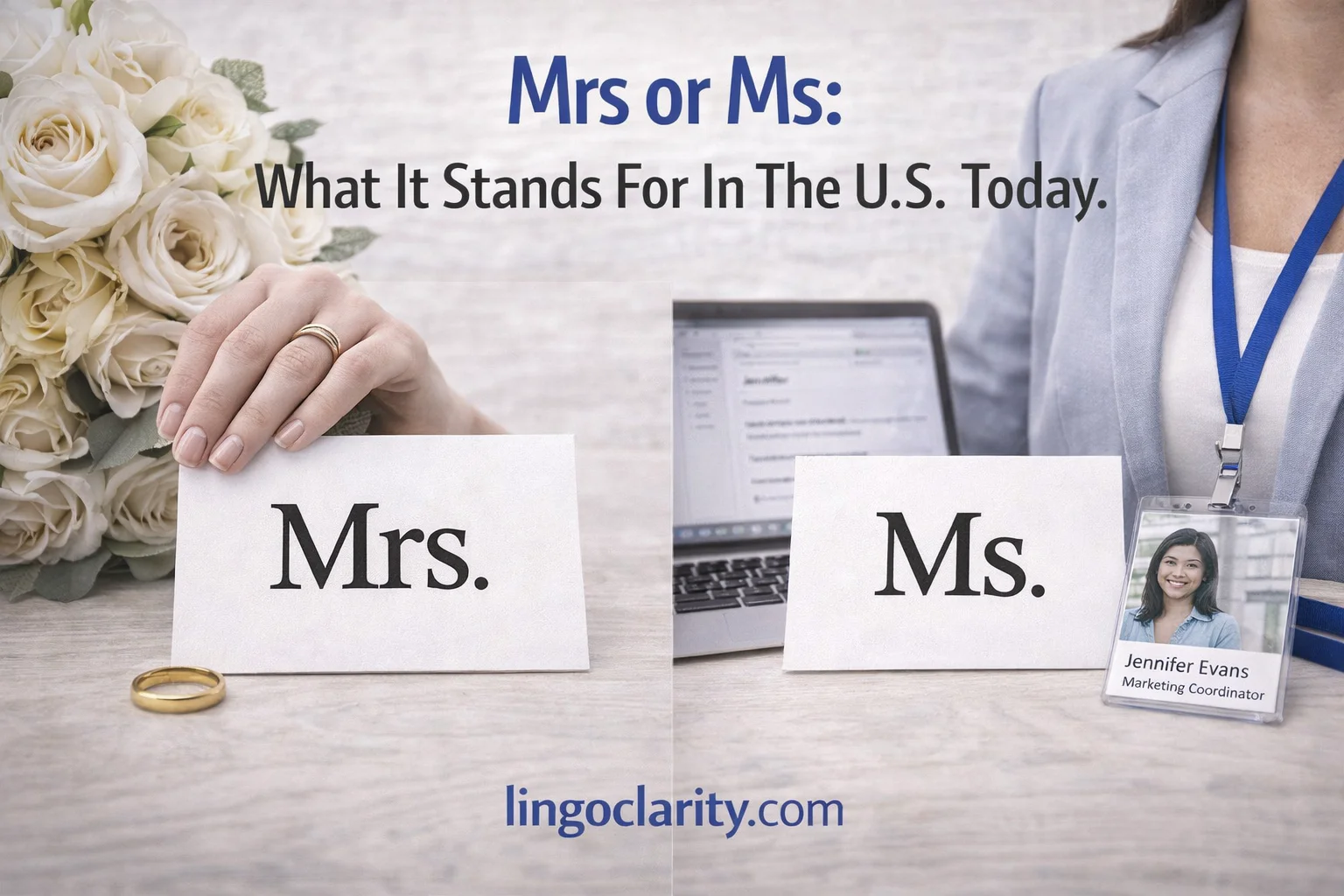
Many writers stop when they have to choose between Mrs. and Ms. because both titles come before a woman’s name, both sound polite, and both appear in formal writing. That overlap makes the choice feel harder than it really is.
In modern US English, the core difference is straightforward. Mrs. is traditionally used for a married woman, while Ms. is used for a woman without stating whether she is married. Dictionaries and grammar sources still present that basic distinction clearly, and that is the best place to start.
What makes the topic more practical than purely grammatical is personal preference. A married woman may prefer Mrs. or Ms., and once you know her preference, that preference should guide your choice. In business and general professional writing, Ms. is often the safer neutral option when you do not know what the person prefers.
So the real question is not only “Which one is correct?” It is also “Which one is respectful, natural, and appropriate in this situation?” That is the question this guide answers.
Quick Answer
Use Mrs. when you know a woman uses that married title.
Use Ms. when her marital status is unknown, irrelevant, or not something you should assume. In modern US writing, Ms. is usually the safest default when you do not know the person’s preference. Dictionaries define Ms. as a title used to avoid saying whether a woman is married, while Mrs. is tied to married status.
In American style, these titles are usually written with periods: Mrs. and Ms. Chicago style explicitly uses a period after Ms., and American dictionaries commonly present both forms with periods.
Key Difference At A Glance
| Situation | Better Choice | Why |
|---|---|---|
| You know she prefers a married title | Mrs. | It matches her stated preference |
| You do not know her preference | Ms. | It avoids guessing about marital status |
| Business email to an adult woman | Ms. | It is the safer neutral default |
| Formal school or office record with confirmed preference | Mrs. | It respects the title she uses |
| She is married but signs her name with Ms. | Ms. | Preference matters more than assumption |
| She has a professional title such as Dr. | Neither | Use the professional title instead |
This chart reflects the most useful real-world rule: use the title the person uses for herself when you know it; use Ms. when you do not know. That approach fits current dictionary definitions and standard guidance on formal address.
What Mrs. Means
Mrs. is the traditional courtesy title used before the surname of a married woman. Merriam-Webster defines it as a conventional title before a married woman’s surname, and Cambridge gives the same basic meaning.
Examples:
- Mrs. Carter
- Mrs. Elena Carter
- Dear Mrs. Carter
In practice, Mrs. often carries a slightly more traditional tone than Ms. It can feel personal, family-centered, or socially established, especially in invitations, school communication, neighborhood contexts, and formal social introductions.
That does not make Mrs. old-fashioned in a negative sense. It simply means the title openly signals marriage in a way that Ms. does not. For women who prefer it, Mrs. is perfectly standard, polite, and correct.
What Ms. Means
Ms. is a title for a woman that does not state whether she is married. Cambridge defines it as a title used before a woman’s family name or full name to avoid saying if she is married or not. Merriam-Webster similarly explains that Ms. is used instead of Miss or Mrs. when marital status is unknown or unimportant.
Examples:
- Ms. Patel
- Ms. Dana Patel
- Dear Ms. Patel
This is why Ms. works so well in modern workplaces, schools, directories, and customer communication. It keeps the focus on the person rather than on her marital status.
One detail matters here: Ms. is not only for unmarried women. A woman may be married and still prefer Ms. Cambridge’s examples directly note that a married woman may prefer the title Ms.
That is the point many writers miss. Mrs. refers to a married title. Ms. is a neutral title for an adult woman and may also be the preferred title of a married woman.
Why People Confuse Mrs. And Ms.
People confuse these titles because they belong to the same system of polite address. These titles appear before names and fit naturally in formal writing. You will see them in letters, emails, school records, office forms, and everyday introductions. That overlap is one reason people mix them up.
The confusion also comes from older etiquette habits. Some people were taught a simple rule that Mrs. = married and Miss = unmarried, then later encountered Ms. in business writing and assumed it must mean something narrow or special. But current dictionary and grammar guidance shows that Ms. functions as the neutral adult title.
Pronunciation adds another layer. Ms. is pronounced miz. Mrs. is usually pronounced MISS-iz or MIS-iz. Standard dictionaries and pronunciation guides reflect that difference, though fast speech can blur them.
Once you separate the meanings, the choice becomes much easier:
- Mrs. = married title
- Ms. = neutral title
Which One Should You Use In Modern US English?
For most modern US writing, the most practical rule is this:
If you know the person prefers Mrs., use Mrs. If you do not know, use Ms.
That rule works because it combines correctness with respect. It also matches how current dictionaries define Ms. as the form used when marital status is unknown or irrelevant.
This is especially useful in:
- business emails
- cover letters
- customer service messages
- school communication
- office directories
- professional introductions
In all of those settings, guessing marital status adds no value. A neutral title is usually the better choice.
Examples:
- Dear Ms. Nguyen,
- Thank you for your time, Ms. Brooks.
- Please contact Ms. Rivera with any questions.
If the woman signs her own message as Mrs. Walker, then switch to Mrs. Walker. If she signs as Ms. Walker, use Ms. Walker. The simplest professional rule is to mirror the title the person uses.
How To Use Mrs. And Ms. In Letters And Emails
When writing a formal salutation, standard English usage pairs these titles with a surname, not with a first name alone. Cambridge Grammar notes that formal situations usually use a title plus surname, and Purdue OWL also shows titles used with last names or full names in salutations.
Natural examples:
- Dear Mrs. Johnson,
- Dear Ms. Johnson,
- Hello, Ms. Flores,
Less natural examples:
- Dear Mrs. Emily,
- Hello, Ms. Jennifer,
The second set sounds off because formal titles usually do not pair with a first name by itself.
A few practical rules help:
Use The Person’s Own Preference When You Know It
If an email signature says Ms. Laura Kim, use Ms. Kim in your reply.
If a parent introduces herself as Mrs. Alvarez, use Mrs. Alvarez.
Use Ms. When You Are Unsure
If you are contacting an adult woman for the first time and do not know her preference, Ms. is usually the safest choice. That choice avoids making a personal assumption and aligns with the neutral function of Ms. in current usage.
Use A Professional Title Instead When One Applies
Merriam-Webster’s definition of Mrs. notes that a title of rank, honorific, or professional title may replace it. In other words, if someone is Dr. Evans, Judge Morales, or Professor Reed, those titles usually take priority over Mrs. or Ms.
Examples:
- Dear Dr. Shah,
- Professor Lewis will speak at noon.
- Thank you, Judge Ramirez.
Tone, Formality, And Social Meaning
Many writers ask whether Mrs. is more formal than Ms. In most cases, that is not the best way to frame the difference.
Both titles are formal enough for polite written English. The more useful contrast is this:
- Mrs. feels more traditional and explicitly marital.
- Ms. feels more neutral and less focused on private status.
That is why Ms. often feels smoother in business, academic, and administrative contexts. It keeps the interaction professional and avoids unnecessary assumptions. That is also why many forms, directories, and workplace messages favor Ms. when no preference is known. This is an inference drawn from the way current sources define and exemplify Ms. as the title that avoids stating marital status.
By contrast, Mrs. may be the better fit in settings where the person clearly uses it and wants that identity reflected.
When One Choice Sounds Wrong
A title can be grammatically possible and still sound wrong in context.
Mrs. can sound wrong when:
- you do not know the woman’s preference
- you are writing in a professional setting
- you are guessing based on a ring, family role, or age
- the person actually uses Ms.
Ms. can sound wrong when:
- the woman clearly uses Mrs.
- she has already identified herself with that title
- you ignore her stated preference
A different title can also make both forms wrong. If the person is professionally addressed as Dr. Green, then Ms. Green or Mrs. Green is usually not the best choice. Merriam-Webster’s usage note supports replacing social titles with honorific or professional titles where required.
Common Mistakes And Quick Fixes
Mistake 1: Thinking Ms. Means Unmarried
This is one of the most common errors. Ms. does not mean unmarried. It means the title does not state whether the woman is married. A married woman may still prefer Ms.
Quick fix: Use Ms. as the neutral adult title.
Mistake 2: Assuming Every Married Woman Wants Mrs.
Some married women prefer Mrs. Some prefer Ms. Marriage alone does not tell you which title a person wants.
Quick fix: Follow the person’s signature, profile, form, or introduction when available.
Mistake 3: Pairing The Title With Only A First Name
In formal writing, Mrs. Taylor and Ms. Taylor sound standard. Mrs. Emma and Ms. Emma usually do not. Cambridge Grammar specifically points writers toward title + surname in formal situations.
Quick fix: Use the surname after the title.
Mistake 4: Forgetting American Punctuation
In US English, the usual style is Mrs. and Ms. with periods. Chicago explicitly uses the period after Ms.
Quick fix: In US-focused writing, include the periods unless your house style says otherwise.
Real-World Examples
These examples show how the choice works in daily writing.
Example 1: Business Email
You are emailing a hiring manager named Carla Benson, but you do not know her preference.
Best choice: Dear Ms. Benson,
Example 2: School Communication
A student’s parent signs a note as Mrs. Ramirez.
Best choice: Thank you, Mrs. Ramirez.
Example 3: Client Communication
A client’s email signature reads Ms. Aisha Khan.
Best choice: Dear Ms. Khan,
Example 4: Married Woman With Neutral Preference
Your colleague is married but always signs her messages as Ms. Chen.
Best choice: Ms. Chen
Example 5: Professional Title Available
A married physician is listed on the clinic website as Dr. Monica Perez.
Best choice: Dr. Perez, not Mrs. Perez or Ms. Perez
Pronunciation And Punctuation
Pronunciation helps many learners remember the difference:
- Ms. is usually pronounced miz
- Mrs. is usually pronounced MISS-iz or MIS-iz
Punctuation matters too. In American English, the standard written forms are Mrs. and Ms. with periods. Chicago style explicitly supports the period in Ms., and major US dictionaries present the title that way as well.
That means these are the safest US forms to publish:
- Mrs. Hall
- Ms. Hall
Mrs. Vs. Ms. In One Simple Rule
If you want one rule you can remember easily, use this:
Use Mrs. when you know she wants Mrs. Use Ms. when you do not know.
That rule is accurate, practical, and respectful. It matches modern dictionary definitions, standard formal address patterns, and the realities of professional communication.
Frequently Asked Questions
Should I use Ms. if I do not know her preference?
Yes. In modern US English, Ms. is usually the safest choice when you do not know a woman’s preferred title because it does not state whether she is married.
Can a married woman use Ms.?
Yes. A married woman can still prefer Ms., and Cambridge gives examples showing that marriage does not prevent a woman from using that title.
Is Mrs. more formal than Ms.?
Not necessarily. Both are formal titles. The bigger difference is that Mrs. highlights married status, while Ms. stays neutral.
Should I write Ms or Ms. in American English?
In American English, Ms. with a period is the standard published form. Chicago style explicitly uses the period.
Should I use Mrs. or Ms. with a first name?
Usually no in formal writing. Standard formal address is title + surname, such as Mrs. Lopez or Ms. Lopez.
What if the person is Dr. or Professor?
Use the professional title instead. Standard reference guidance treats professional or honorific titles as taking priority over Mrs. or Ms. when they apply.
Conclusion
The difference between Mrs. and Ms. is simple once you strip away the confusion.
Mrs. is the traditional title for a married woman. Ms. is the neutral title that does not reveal or emphasize marital status. Current dictionary and grammar sources continue to support that distinction clearly.
In real writing, the best choice comes down to two things: accuracy and respect. If you know the person prefers Mrs., use Mrs. If you do not know, Ms. is usually the safer and more professional default.
That is why Ms. appears so often in modern US emails, letters, forms, and workplace writing. It is polite, neutral, and practical. And when a person’s own preference is known, that preference should always come first.
