
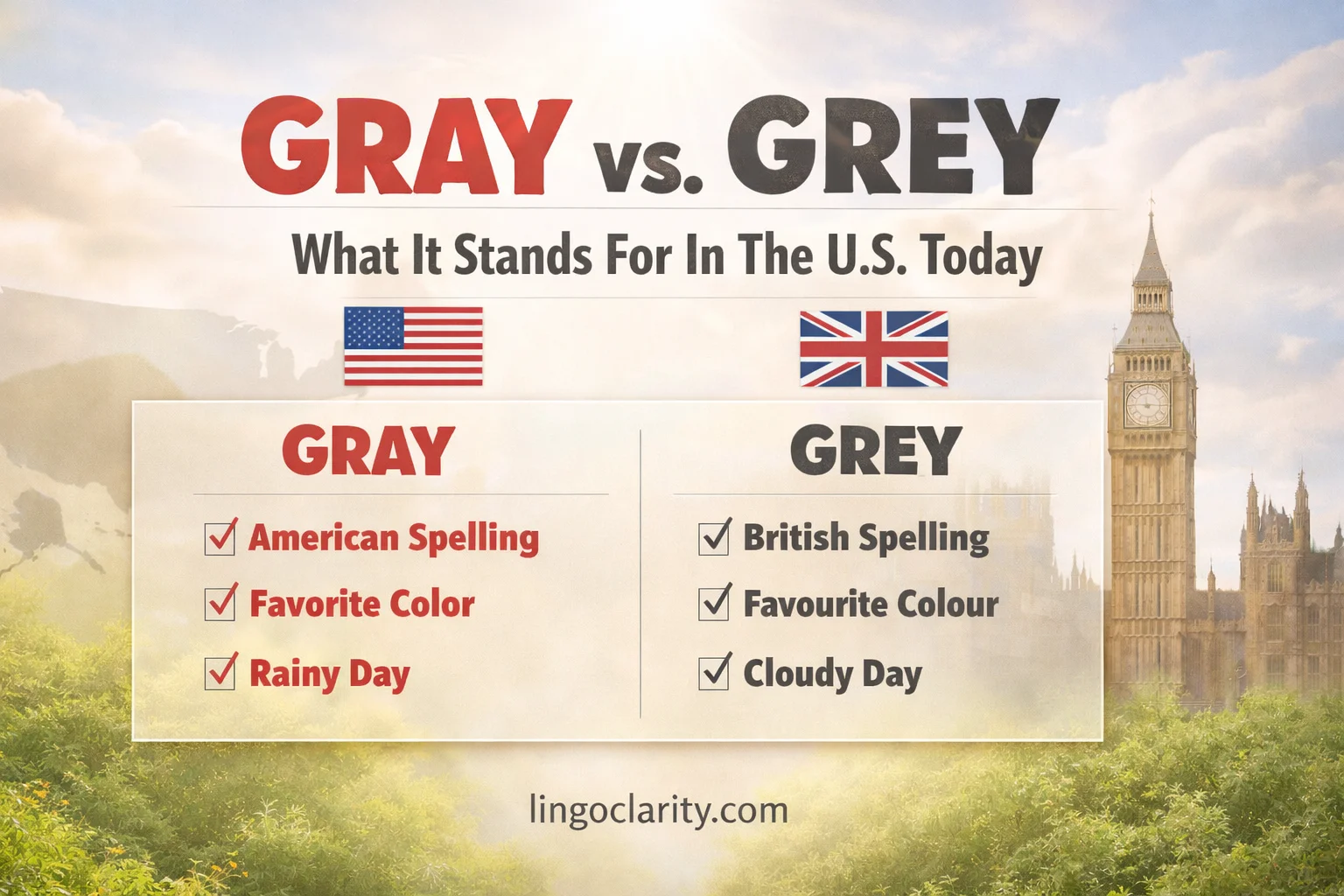
Gray vs. grey is mostly a matter of regional spelling, not a difference in meaning. If you write for an American audience, gray is usually the right choice. Both forms refer to the same color between black and white and are pronounced the same way, but gray is standard in US English, while grey is more common in British English, Canadian English, and many other non-US varieties.
For US readers, gray is the safest default. For UK readers, grey will usually look more natural. If you are using a brand name, title, or other fixed term, keep the official spelling exactly as it appears.
Quick Answer
Use gray for US readers. Use grey for UK readers and other audiences that follow British spelling. Keep grey in fixed names such as Earl Grey, Greyhound, and Grey’s Anatomy.
Use gray for:
- US websites
- US school or workplace writing
- US marketing copy
- US editorial content
- US product descriptions
Use grey for:
- UK audiences
- British publications
- Non-US copy that follows British spelling
- Official names that already use grey
Keep the official spelling in names such as Earl Grey, Greyhound, and Grey’s Anatomy. Use gray for the SI radiation unit gray (Gy).
Gray Vs. Grey: The Real Difference
There is no hidden meaning split between gray and grey.
They do not describe different shades. One is not more formal, more elegant, or more correct in every situation. They are variant spellings of the same word. Major references all treat the difference as regional rather than semantic. Merriam-Webster says gray is more frequent in American English, while grey is more common in Canada, the UK, and elsewhere. Grammarly makes the same point, and ProWritingAid says the spellings are simply American versus British preference.
That is why these examples are all normal, depending on audience:
- US English: gray sky, gray hair, gray area
- UK English: grey sky, grey hair, grey area
The meaning stays the same. What changes is what your readers expect to see. Cambridge and Collins also separate the forms this way, treating gray as the US spelling and grey as the standard non-US form.
Which Spelling Should You Use In The USA?
For modern US English, choose gray unless you have a specific reason not to.
That is the strongest editorial default for American readers. It looks standard in US articles, product pages, emails, ad copy, and academic writing. If a sentence is written for Americans and no fixed name is involved, gray will almost always look cleaner and more expected than grey.
Examples that fit normal US usage:
- The app uses a dark gray menu bar.
- Her dog’s muzzle is turning gray.
- The contract leaves a gray area around refunds.
- Tomorrow’s forecast is cold, wet, and gray.
In each case, grey would still be understandable, but to many US readers it would look imported, inconsistent, or slightly off-style. That matters more in polished publishing than in casual chat.
When Grey Is Still Correct In US Writing
Even in American English, grey is still correct when it belongs to an official name, title, or brand.
That means you should not “correct” these examples to gray:
- Earl Grey tea
- Greyhound
- Grey’s Anatomy
Those spellings are fixed because they are part of official names. Twinings uses Earl Grey, Greyhound uses Greyhound, and ABC uses Grey’s Anatomy. A good editor preserves the official form instead of forcing US spelling onto a title or brand.
You should also preserve grey in direct quotations, imported product names, or brand materials that intentionally use non-US spelling. In other words, use US spelling for your own prose, but do not rewrite someone else’s official wording.
Which Spelling Should You Use In The UK?
For UK readers, use grey.
That is the standard British spelling, and it is the form British-oriented dictionaries and usage references present as normal. Oxford has separate entries for gray and grey, with gray treated in American English and grey presented as the standard British form. Cambridge and Collins reflect the same split.
Examples that fit normal UK usage:
- She bought a grey coat for winter.
- The sky stayed grey all afternoon.
- There is a legal grey area here.
- He is starting to go grey at the temples.
If you publish for both the UK and the USA, the best move is not to mix spellings on the same page. Localize the content by market.
What About Canada And Other English-Speaking Markets?
Canada often leans toward grey, not gray.
Merriam-Webster explicitly notes that grey is more common in Canada, the UK, and elsewhere. That means Canadian-facing copy may look more natural with grey, even though Canadians will understand both forms.
For international brands, the practical rule is simple:
- US audience: gray
- UK audience: grey
- Canada and many other non-US markets: usually grey
- Global mixed audience: follow one house style per document and stay consistent
Does Gray Mean A Different Shade Than Grey?
No. In standard usage, gray and grey do not mark different shades.
People often assume there must be a hidden distinction because both spellings appear in books, articles, packaging, and product descriptions. But major usage references do not treat them as separate colors. They are alternate spellings of the same basic word.
A paint brand, fashion label, or design system might use the words differently for naming purposes, but that is a branding choice, not a rule of English. As a language question, the difference is regional spelling, not color science.
Why Writers Get Tripped Up
This pair confuses people for a simple reason: both spellings are common enough to look familiar.
Unlike a true error pair, such as two words with different meanings, gray and grey both look legitimate. That makes writers suspect there must be a deeper usage rule. Then proper names complicate the picture even more. A US writer may spend the day editing gray buttons in interface copy and then watch Grey’s Anatomy at night. Both spellings are correct in those contexts.
That is why the best rule is not “pick the prettier one.” It is “match the audience, then preserve fixed names.”
Common Phrases And How They Usually Appear
Regional spelling often carries into common compounds and phrases.
In US English, you will usually see:
- gray area
- gray hair
- gray market
- gray matter
- graying
In UK English, you will usually see:
- grey area
- grey hair
- grey market
- grey matter
- greying
Merriam-Webster notes that the regional pattern extends into specialized terms and scientific designations, while Cambridge and Collins list forms such as grey area and related compounds under grey. Collins also records graying as a spelling variant linked to the same base word.
Gray As A Scientific Term
One place where the spelling is not optional is radiation measurement.
The gray is the SI unit of absorbed ionizing radiation dose, abbreviated Gy. NRC defines one gray as the SI equivalent of 100 rads, or 1 joule per kilogram, and NIST uses the same spelling in its own radiation-calibration material. Collins also lists gray separately as the SI unit.
So if you are writing about radiation dose, gray is not just the American spelling of a color word. It is the official unit name.
How Editors Make The Choice
A good editor does not treat this as a philosophical question. It is a style decision.
Use this order of priority:
- Audience: Are you writing for the USA or the UK?
- House Style: Does the publication or client follow US or British spelling?
- Fixed Names: Does the phrase belong to a brand, title, or quotation?
- Technical Usage: Are you referring to the SI unit gray (Gy)?
If you answer those four questions, the correct spelling becomes obvious almost every time. That is also what the best competitor pages gesture toward, but most do not turn it into such a clean workflow.
Examples That Show The Rule In Action
Here is what correct US usage looks like:
- The landing page uses light gray cards and a dark header.
- His beard is going gray earlier than he expected.
- The policy leaves a gray area around cancellations.
- Rain will keep the morning gray until noon.
Here is what correct UK usage looks like:
- She wore a grey jumper and black boots.
- The sea looked cold and grey by late afternoon.
- The proposal sits in a legal grey area.
- He is greying at the temples.
Here are cases where the fixed spelling overrides audience:
- I ordered an Earl Grey before the meeting.
- She took a Greyhound to Chicago.
- They started rewatching Grey’s Anatomy last weekend.
Common Mistakes To Avoid
Do not assume gray and grey refer to different shades. They usually do not.
Do not mix both spellings in one US article unless there is a real reason, such as a brand name or quotation. Mixed spelling makes copy look sloppy.
Do not “Americanize” official names. Earl Grey, Greyhound, and Grey’s Anatomy should stay exactly as they are.
Do not forget the science exception. The SI unit is gray, not grey.
FAQ
Is grey ever correct in US English?
Yes. Grey is correct in US English when it appears in a fixed name, title, quotation, or imported style choice. It is also understandable in general prose, but for standard US copy, gray is the better default.
Is gray or grey used in Canada?
Both appear, but grey is more common in Canada according to Merriam-Webster. For Canadian-facing content, grey will usually feel more natural.
Do gray and grey describe different shades?
No. In normal English usage, they are spelling variants of the same color word, not separate shade labels.
What about graying and greying?
The same regional rule applies. In US English, graying is the expected spelling. In UK English, greying is more natural. Collins records graying as a variant spelling tied to the same word family.
Which spelling is better for SEO in the United States?
For a page aimed at US readers, gray should usually be your primary spelling because it matches standard American usage. You can still include grey naturally in a comparison section, FAQ, or discussion of UK spelling, but the main US-facing copy should center on gray. That recommendation follows the regional usage pattern described by Merriam-Webster, Grammarly, and ProWritingAid.
Final Verdict
If your audience is in the United States, use gray.
If your audience is in the UK, use grey.
If you are dealing with a fixed name, keep the official spelling.
And if you are talking about the radiation unit, the correct form is always gray (Gy).
That is the cleanest modern rule, the best editorial rule, and the safest SEO rule for US English today.
