
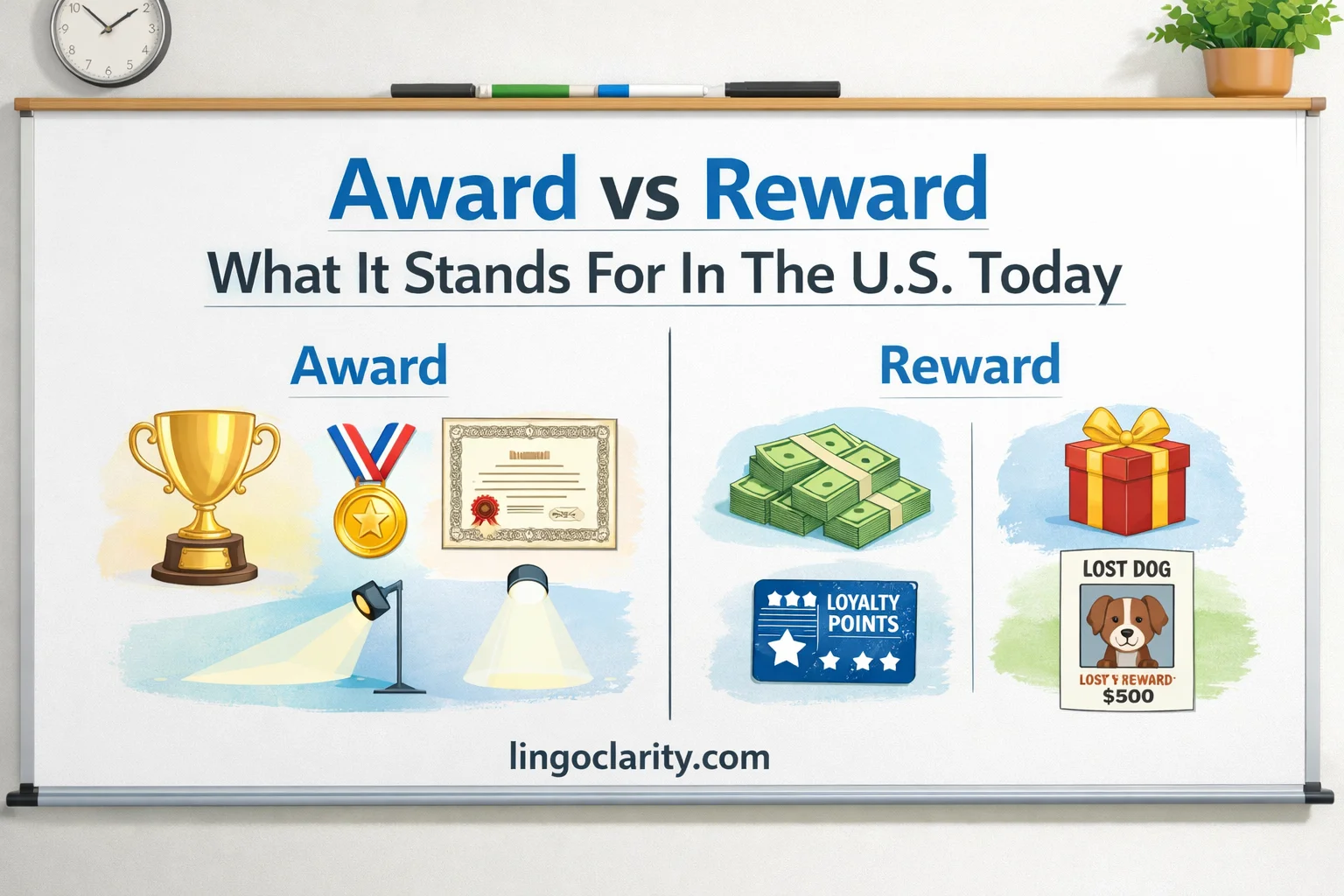
Award vs reward both mean giving something to someone, but the reason is different. An award is given after a judge, panel, or organization decides you deserve it, usually for excellence or achievement. A reward is given back in return for something you did, such as good work, help, honesty, or loyalty. Awards are judged. Rewards are earned.
Quick Answer
These seven rules cover almost every sentence you will ever write:
Money follows the same logic. Courts award damages. Stores give rewards points. Never the reverse.
A judge decides an award. Panels, committees, courts, and voting bodies grant awards.
An action earns a reward. Effort, honesty, help, or loyalty comes back to you as a reward.
Rewards can be promised first. You can post a reward for a lost dog. You cannot post an award for one.
Awards are decided last. Judging happens, then the award is announced.
Verb patterns differ. You award someone a thing. You reward someone for something or with something.
Only reward has an adjective. “Rewarding” is a word. “Awarding” as an adjective is not. The award form is award-winning, hyphenated before a noun.
Why People Confuse These Words
People confuse award and reward because both words often appear in positive situations. In other words, both can involve praise, value, or success.
For instance, an employee might receive an award at a company event. At the same time, that same employee might also receive a cash reward or bonus. Because both things happen in the same general setting, many writers assume the words mean the same thing.
Even so, the focus changes.
An award usually highlights recognition, official choice, or formal granting. A reward, meanwhile, highlights return, benefit, payoff, or thanks for something done.
That difference may seem small at first. Still, it matters a lot in clear writing.
Key Differences At A Glance
| Context | Best Choice | Why |
|---|---|---|
| A trophy given after judging | Award | It is a formal recognition of achievement. |
| Money offered for finding a lost dog | Reward | It is something given in return for help. |
| A judge gives damages | Award | It is an official legal decision. |
| A teacher gives extra recess for good behavior | Reward | It is given in return for behavior. |
| Credit card points or store perks | Reward | It refers to benefits or incentives. |
| A school gives a scholarship | Award | It is a formal grant or honor. |
Therefore, when you are unsure, ask one simple question: Is this mainly official recognition, or is it something given in return?
If it is official, use award. If it is given in return, use reward.
Meaning And Usage Difference
The clearest rule is this:
- Award = official recognition, formal decision, or authorized granting
- Reward = return, benefit, payment, incentive, or thanks for action
That is the main difference. However, the surrounding context also matters.
Award usually appears in schools, contests, ceremonies, government decisions, business agreements, and legal settings. As a result, it often sounds more formal and more public.
Reward, by contrast, works in a wider range of situations. For example, it appears in parenting, teaching, workplaces, loyalty programs, public notices, and everyday life. Because of that, it can sound practical, personal, or motivational.
Here is the easiest way to separate them:
- If someone is officially chosen, recognized, or granted something, use award
- If someone gets something back for effort, help, behavior, or success, use reward
So, these sentences sound natural:
- She received an award for best documentary.
- The foundation awarded him a grant.
- The police offered a reward for information.
- The coach rewarded the team with a day off.
Tone, Context, And Formality
Tone matters here too. In general, award sounds more official. Because of that, it fits schools, ceremonies, government decisions, contracts, grants, and legal rulings.
Reward, on the other hand, is more flexible. It can sound formal in some cases, such as a police reward for information. However, it can also sound casual in everyday speech, such as rewarding yourself with dessert after a long week.
In other words, award often feels public and recognized by others. Reward, by contrast, often feels practical, personal, or result-based.
For example:
- A gold medal is an award.
- Airline miles are rewards.
- A scholarship is usually an award.
- A bonus lunch can be a reward.
Therefore, context should guide your choice.
Which One Should You Use?
Use award when:
- someone is officially recognized
- a prize or honor is formally given
- a school, court, jury, or committee makes a decision
- you are talking about scholarships, grants, contracts, or damages
Use reward when:
- something is given in return for effort or behavior
- money is offered for information or help
- you mean a benefit, payoff, or incentive
- you are talking about points, perks, bonuses, or loyalty systems
A helpful test is this:
Is the focus on official recognition? Use award.
Is the focus on return, benefit, or motivation? Use reward.
That simple test solves most cases quickly.
Verb Patterns You Should Know
Writers often understand the meanings but still make mistakes with sentence structure. Therefore, it helps to learn the most natural verb patterns.
Common Patterns With Award
Use:
- award someone something
- award something to someone
Examples:
- The foundation awarded Maya a scholarship.
- The foundation awarded the scholarship to Maya.
- The city awarded the contract to a local builder.
- The court awarded damages to the family.
Common Patterns With Reward
Use:
- reward someone for something
- reward someone with something
Examples:
- The manager rewarded the staff for meeting the goal.
- The manager rewarded the staff with gift cards.
- The school rewarded students for regular attendance.
- She rewarded herself with a quiet weekend.
So, while both words can be verbs, they follow different grammar patterns in natural use.
When One Choice Sounds Wrong
Some situations make the difference very clear.
You usually say:
- She won an award for best actress.
- The police offered a reward for information.
- The judge awarded damages.
- The store gives reward points.
- The university awarded him a fellowship.
By contrast, these versions sound wrong or unnatural:
- She won a reward for best actress.
- The police announced an award for information.
- The judge rewarded damages.
- The store gives award points.
Therefore, if the sentence sounds tied to ceremony, law, or official selection, award is safer. If the sentence sounds tied to return, incentive, or helpful action, reward is safer.
Real-Life Examples
Real examples make this difference much easier to remember. So, let’s look at common situations.
At School
The principal gave Elena an award for perfect attendance.
Meanwhile, the teacher rewarded the whole class with extra reading time after a strong week.
In the first sentence, the focus is formal recognition. In the second, the focus is something given in return for good behavior.
At Work
The company awarded her the leadership prize during the annual meeting.
Later, the boss rewarded the sales team with a bonus lunch.
Again, the first example is official and public. The second is practical and result-based.
In Public Notices
The family offered a reward for the safe return of their missing dog.
Eventually, a neighbor received the reward after sharing useful information.
Here, reward is correct because the money is offered in return for help.
In Law And Business
The court awarded damages to the homeowners.
Similarly, the city awarded the contract to the lowest qualified bidder.
In both cases, the word is formal, official, and decision-based.
In Daily Life
Finishing the project early felt like its own reward.
Afterward, he rewarded himself with a nice dinner.
These examples use reward because the idea is personal benefit or payoff.
Simple Definition
If you want the shortest possible rule, remember this:
Award means an official honor or formal grant.
Reward means something given back for effort, help, behavior, or results.
That rule is simple, but it works in most real sentences.
Synonyms
Synonyms can help you feel the difference more clearly. However, they are not perfect substitutes in every context.
Synonyms Of Award
Depending on the sentence, close options include:
- prize
- honor
- distinction
- recognition
- grant
For example, a teaching award may also be called an honor or distinction. Likewise, a scholarship award may function like a grant.
Synonyms Of Reward
Depending on the sentence, close options include:
- bonus
- benefit
- payoff
- compensation
- recompense
For example, a cash reward may also be called compensation. In the same way, loyalty rewards can be described as benefits or perks.
Opposites Or Near-Opposites Of Reward
Depending on context, opposites may include:
- punishment
- penalty
- fine
- discipline
For example, instead of rewarding good behavior, a school might punish bad behavior.
Sentence Usage
Here are clean, natural examples that show how both words work in real US English.
Correct Use Of Award
The university gave her an award for academic excellence.
The actor won an award for best supporting role.
The board awarded a grant to the new program.
After the hearing, the judge awarded damages.
The city awarded the contract to a local company.
Correct Use Of Reward
The police offered a reward for information about the robbery.
Her parents rewarded her with a new laptop after graduation.
The travel card gives users reward points on every purchase.
The coach rewarded the team for staying focused.
In the end, the hard work was its own reward.
Common Mistakes
These two words cause the same problems again and again. Fortunately, the fixes are simple.
Using Reward For A Formal Prize
Incorrect: She received a reward for best journalist.
Correct: She received an award for best journalist.
If the context is judged, ceremonial, or official, use award.
Using Award For Information Money
Incorrect: The family offered an award for information.
Correct: The family offered a reward for information.
If something is offered in return for help, use reward.
Mixing Up Legal Usage
Incorrect: The court rewarded damages.
Correct: The court awarded damages.
Legal English strongly prefers award damages.
Confusing Incentives With Honors
Incorrect: The store gives award points to shoppers.
Correct: The store gives reward points to shoppers.
Points, perks, and bonuses usually belong on the reward side.
A Quick Memory Trick
Here is an easy way to remember the pair:
Award = official
Reward = return
So, judges award. Schools award. Committees award.
Meanwhile, parents reward. Managers reward. Stores offer rewards.
Because that pattern is so strong, it can guide you even when you feel unsure.
Conclusion
If you want the safest rule, remember this:
Choose award for official recognition or formal granting.
Choose reward for something given in return for effort, help, behavior, or results.
That one distinction will solve most mistakes.
A student may win an award. A teacher may give a reward. A court may award damages. A store may offer rewards. Once you connect the word to the situation, your sentence becomes clearer, more natural, and more accurate.
FAQs
Is award more formal than reward?
Yes, in most cases it is. Award usually sounds more official because it often involves judgment, recognition, or an authorized decision. Reward, by contrast, usually sounds more practical, personal, or incentive-based.
Can both award and reward be nouns and verbs?
Yes, both words can work as nouns and verbs. However, their meanings still differ. Award usually points to formal recognition, while reward usually points to return or benefit.
Is a scholarship an award or a reward?
A scholarship is usually an award because it is formally granted by a school, foundation, or organization.
Why do police offer a reward, not an award?
Police offer a reward because the money is given in return for information or help. Therefore, the focus is not formal recognition. Instead, it is return for useful action.
Can reward describe a feeling, not just money?
Yes, it can. For example, finishing a difficult project can feel rewarding, and the final result can be described as its own reward.
Can someone be awarded and rewarded in the same situation?
Yes. For example, an employee might receive an award at a company event for excellence. In addition, that same employee might be rewarded with a bonus. In that case, the award is formal recognition, while the reward is the benefit given in return.
What is the main difference between award and reward?
An award is granted after a formal decision by a judge, panel, court, or organization, usually for achievement or merit. A reward is given in return for something a person did, such as effort, honesty, or loyalty. In short, awards are judged and rewards are earned. Both can be money, objects, or recognition, so the reason behind the giving is what decides the word.
