
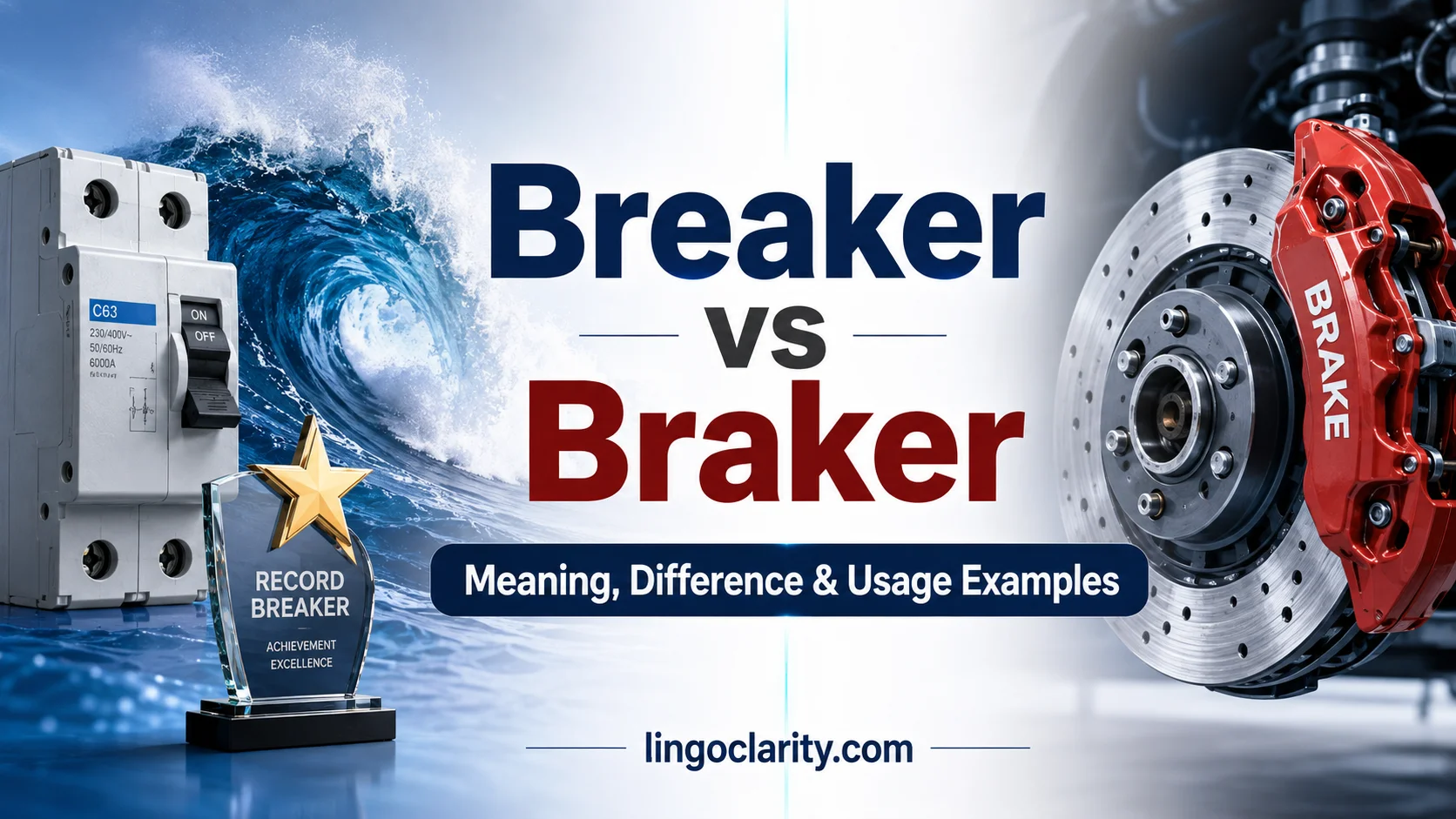
English contains many words that look and sound similar but have different meanings and uses. Breaker vs braker is one such pair that often causes confusion because both words are pronounced almost the same.
The word breaker is a common English noun with many everyday meanings. It can refer to something that breaks, a person who breaks something, an electrical safety device, or a wave that crashes into foam. Common examples include circuit breaker, record breaker, rule breaker, and deal breaker.
The word braker is much less common. It is a rare specialized noun used in limited technical contexts. Because it is uncommon, many people mistake it for a spelling error, but it can have a specific meaning depending on the context.
This guide explains the difference between breaker and braker, their meanings, examples, and when each word should be used.
Quick Answer: Breaker vs Braker
Breaker and braker are both words, but they are used differently.
- Breaker = a common word for someone or something that breaks, interrupts, or stops something.
- Braker = a rare technical term related to a person who works with a brake-related machine or process.
In everyday English, breaker is the word you will use almost all the time.
Examples:
✅ The circuit breaker stopped the electrical problem.
✅ She became a record breaker.
⚠️ The braker worked with specialized equipment.
Breaker Definition
Breaker is a noun formed from the verb break. It describes a person, object, machine, or force that breaks, separates, interrupts, or stops something.
What Does Breaker Mean?
The word is widely used in everyday English and appears in many common expressions.
Breaker Meaning as Someone or Something That Breaks
A breaker can describe a person or thing that causes something to break.
Examples:
- The machine is a powerful rock breaker.
- He became a world record breaker.
- A rule breaker may face consequences.
In these examples, breaker means something or someone connected with the action of breaking.
Circuit Breaker Meaning
One of the most familiar uses of breaker is in electricity.
A circuit breaker is a safety device that automatically stops the flow of electricity when a problem occurs, such as an overload or short circuit.
Examples:
- The circuit breaker turned off the power.
- The electrician replaced the damaged breaker.
Wave Breaker Meaning
A breaker can also describe a wave that breaks into foam, especially near the shore.
Examples:
- Surfers waited beyond the breakers.
- The sound of ocean breakers filled the beach.
Common Expressions With Breaker
The word breaker appears in many familiar phrases:
Deal Breaker
Something that makes an agreement or relationship impossible.
Example:
- Lack of trust was a deal breaker.
Record Breaker
Someone who achieves a new record.
Example:
- The athlete became a record breaker.
Rule Breaker
Someone who does not follow rules.
Example:
- A rule breaker may receive a penalty.
Icebreaker
Something that helps people start a conversation.
Example:
- The game was a good icebreaker.
What Does Braker Mean?
Braker Definition
Braker is a rare noun with a specialized meaning. It is not commonly used in normal conversation, articles, or everyday writing.
The word may refer to a worker involved with a specific brake-related machine or industrial process.
Example:
- The braker operated specialized production equipment.
Because this word is uncommon, many readers may not recognize it immediately.
Where Is Braker Used?
Unlike breaker, braker does not appear frequently in general English.
You are unlikely to see it in:
- Daily conversations
- School writing
- News articles
- Business communication
- General websites
It may appear only in specific technical or historical contexts.
Breaker vs Braker: Key Differences
| Feature | Breaker | Braker |
|---|---|---|
| Word type | Common noun | Rare noun |
| Origin | From “break” | Related to “brake” |
| Everyday use | Very common | Very uncommon |
| Main meaning | Something or someone that breaks | Specialized brake-related worker |
| Examples | Circuit breaker, record breaker | Technical equipment worker |
Why Do People Confuse Breaker and Braker?
Break and Brake Sound the Same
The main reason for confusion is that break and brake are homophones. They sound similar but have different meanings.
Break
Meaning:
- To damage
- To separate
- To interrupt
Examples:
- Be careful not to break the glass.
- The connection broke suddenly.
Brake
Meaning:
- A device used to slow or stop movement
Examples:
- Press the brake pedal.
- The car brake needs repair.
Because breaker comes from break, while braker appears connected to brake, people sometimes mix the spellings.
Breaker vs Braker Examples
✅ The circuit breaker needs replacement.
✅ She is a record breaker.
✅ The ocean breakers were very strong.
✅ The contract included a deal breaker.
Examples of Braker
⚠️ The braker worked with specialized machinery.
This usage is rare and normally appears only in specific technical situations.
Which Word Should You Use?
For most writing situations, choose breaker.
Use breaker when talking about:
- Electrical systems
- Waves
- Rules
- Records
- Agreements
- Machines
Use braker only when the context specifically requires the rare technical meaning.
For general readers, students, and writers:
Breaker is the natural and expected choice.
Common Mistakes With Breaker and Braker
Mistake 1: Using Braker for Electricity
Incorrect:
- The power braker stopped working.
Correct:
- The power breaker stopped working.
Mistake 2: Writing Deal Braker
Incorrect:
- The price was a deal braker.
Correct:
- The price was a deal breaker.
Mistake 3: Confusing Break and Brake
Incorrect:
- The car break failed.
Correct:
- The car brake failed.
Frequently Asked Questions
Yes,Both words can exist in English, but they have different meanings. Breaker is common, while braker is rare and specialized.
Yes. Breaker is used widely in everyday English, while braker appears only in limited technical contexts.
The correct term is circuit breaker.
Yes. Record breaker is the standard expression.
They are confused because break and brake sound alike, even though they have different meanings.
Usually no. Unless you are discussing a specific technical meaning, breaker is the appropriate choice.
Conclusion
The difference between breaker vs braker is not about one spelling being completely wrong. Both words can appear in English, but they serve different purposes.
Breaker is the common word used for electrical devices, waves, people who break records or rules, and many everyday expressions.
Braker is a rare specialized term that appears only in limited contexts.
When writing for general readers, remember:
Breaker is common. Braker is specialized.
Understanding the difference helps you choose the right word with confidence.
