
TL;DR
Quick test: if you can swap in whenever, write anytime. If you cannot, write any time.
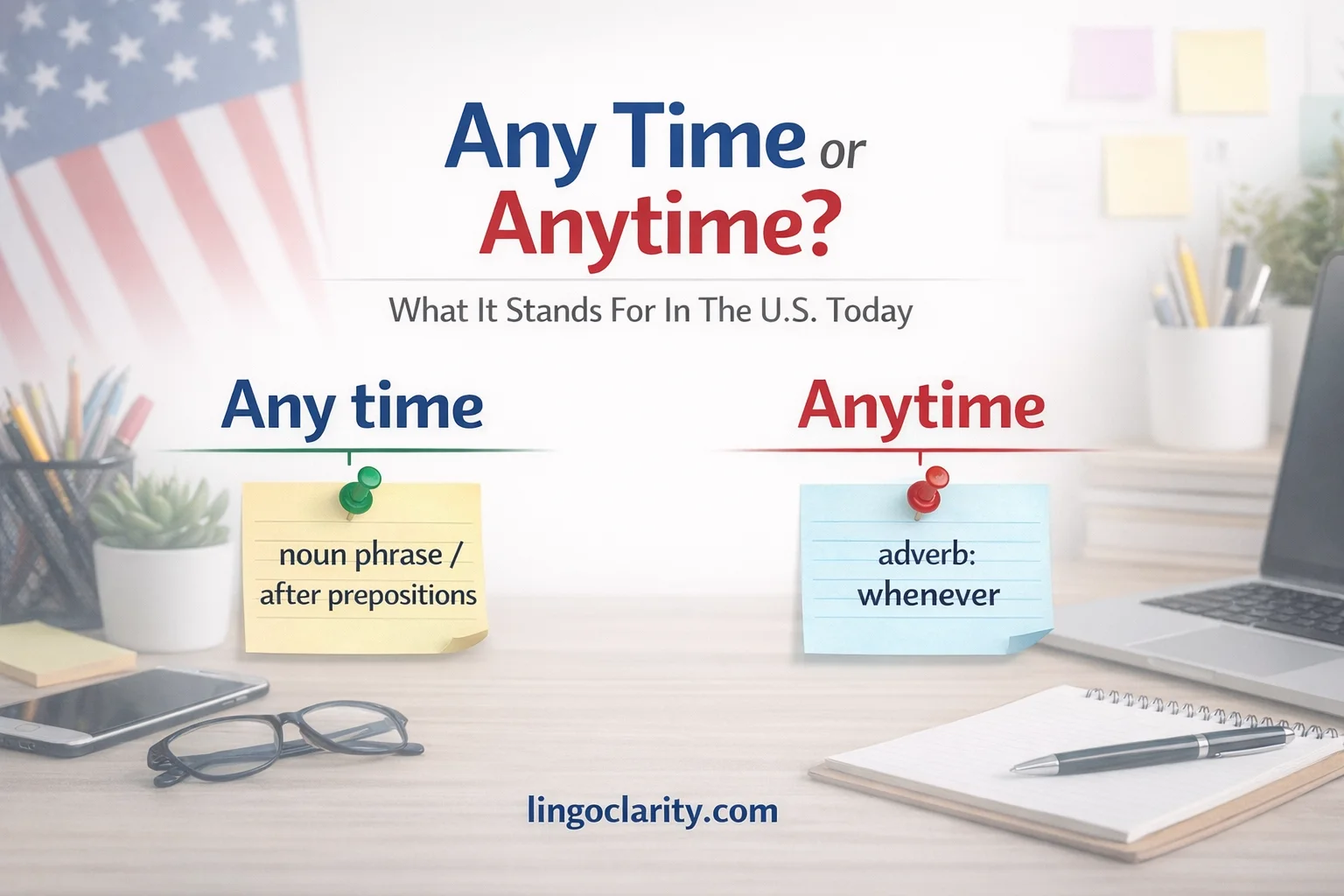
Anytime is a standard one-word adverb meaning whenever or at any time.
Any time is a two-word noun phrase, and it is required after a preposition such as at, for, or before.
Both are correct English. Neither is a spelling error.
Quick Answer
Use anytime when it means whenever:
- Call me anytime.
- Anytime you need help, text me.
- We are not moving anytime soon.
Use any time when time is a noun phrase:
- You can call at any time.
- Do you have any time this afternoon?
- Any time after lunch works for me.
The 5-Second Test
Step 1. Try swapping the word for whenever. If the sentence still makes sense, write anytime.
Step 2. Look at the word directly before it. If it is at, for, in, before, or after, write any time as two words.
Step 3. Ask whether you could put much or some in front of it. If yes (“do you have any time“), time is a noun, so keep the space.
Any Time vs. Anytime At A Glance
| Context | Best Choice | Why |
|---|---|---|
| Meaning “whenever” | anytime | Standard adverb |
| After a preposition (at, for, before) | any time | Noun phrase object |
| Talking about available time | any time | time stays a noun |
| “Soon” expressions (not anytime soon) | anytime | Common adverb use |
| Careful, formal, edited writing | any time | Accepted across more structures |
Common Mistakes To Avoid
- “Call me at anytime.” The preposition at needs the noun. Write at any time.
- “Do you have anytime later?” Time is a noun here. Write any time.
- Assuming one form is a typo. Both are listed in Merriam-Webster, Cambridge, and Collins.
- Splitting it in “not anytime soon.” That is a fixed adverbial phrase and stays one word.
Simple Definition
Anytime is usually a one-word adverb that means at any time, whenever, or no matter when. Dictionaries show this clearly in examples such as “Call me anytime” and “The bus should be here anytime now.”
Any time is the two-word form used when time still acts as a noun. In that structure, any modifies time, just as it would in phrases like any day or any place. Usage guides especially point out this pattern after prepositions and in sentences about an amount, choice, or stretch of time.
Why People Mix Them Up
This pair causes trouble for two main reasons. First, the forms sound the same in speech. Second, the open form can sometimes appear in sentences that feel adverb-like, which makes the line look blurrier than it is. Merriam-Webster explains that anytime is the true closed-form adverb, but any time can also appear in adverbial use in some contexts. That overlap is why writers often feel both look possible.
Still, overlap does not mean full interchangeability. Once a preposition appears, or once time clearly names a thing you have, need, or choose, the two-word form becomes the better grammatical fit. GrammarBook explains the same distinction by labeling anytime an adverb and any time a noun phrase.
When To Use Anytime
Use anytime when the sentence means whenever, at any time, or no matter when. This is the cleanest and most natural use of the one-word form. Standard dictionary examples include sentences like You can call me anytime, The bus should be here anytime now, and Things will not improve anytime soon.
Here are common patterns where anytime works well:
• Call me anytime.
• Anytime you want to talk, I’m here.
• We are not expecting prices to fall anytime soon.
• The package should arrive anytime now.
In all of those examples, you could roughly replace anytime with whenever or at any time, and the sentence would still make sense. That is a strong sign that the one-word adverb is the right choice.
When To Use Any Time
Use any time when time is functioning as a noun rather than as a simple adverb. This happens often in everyday writing, especially when you are talking about available time, a chosen time, or time inside a prepositional phrase. Merriam-Webster specifically notes that the noun-phrase use is easiest to spot after a preposition.
Use any time in sentences like these:
• Do you have any time to review this?
• Any time after 2:00 p.m. works for me.
• You may cancel at any time.
• We did not have any time to waste.
In each example, time is still a thing being named. You can ask for it, have it, lose it, choose it, or place it after a preposition. That is why the open form fits better. GrammarBook and Merriam-Webster both describe any time this way.
Why “At Any Time” Is The Safe Edited Choice
One of the easiest editing wins in this topic is this: after a preposition, write any time, not anytime. Merriam-Webster explains that when any time follows a preposition, it functions as the object of that prepositional phrase. That is why standard edited examples use at any time, for any time, and similar structures with two words. Collins also lists at any time as a standard phrase.
So in polished US writing, these are the safer forms:
• at any time
• for any time
• before any time that works
• after any time slot opens
That is also why at anytime looks off in careful writing. The issue is not that anytime is wrong by itself. The issue is that the sentence structure calls for the noun-phrase form instead.
Real-Life Example
Imagine you are setting up a meeting with a client.
If you write, Call me anytime tomorrow, you mean whenever tomorrow works for you. The focus is open, flexible timing.
If you write, Any time after 1:00 p.m. works for me, you are naming a range of possible time slots. Here, time is still a noun.
If you write, You may reach me at any time during business hours, the preposition at points you to the two-word form.
This is the easiest way to hear the difference in real life: anytime feels like whenever, while any time feels like a time, some time, or an amount of time. That distinction matches the way major usage guides explain the pair.
Which Form Sounds More Natural In US English?
In modern US English, anytime is fully standard when it works as an adverb. It is not slang, and it is not a spelling error. Merriam-Webster, Cambridge, Collins, and Britannica all list it directly as an adverb.
That said, any time still feels broader on the page because it handles more grammar jobs. It can act as a noun phrase, and Merriam-Webster also notes that it sometimes appears in adverbial use. That is why editors often choose any time when they want the most conservative or safest written option.
So the smart US-English advice is not “always use one word” or “always use two.” The smart advice is this:
• Use anytime confidently when it clearly means whenever.
• Use any time when grammar points to a noun phrase.
• Use any time when you want the safest fallback in polished copy.
Synonyms
There is no single perfect synonym that fits every sentence, but these are the closest natural substitutes.
For anytime:
• whenever
• at any moment
• at any point
• no matter when
For any time in noun-phrase use:
• any amount of time
• whatever time works
• any point in time
• any open time slot
The best replacement depends on the sentence. For example, Call me anytime can become Call me whenever, but Do you have any time today? works better as Do you have any free time today?
Opposites
Opposites are less exact here because these forms do not name a single fixed concept. Still, these contrasts are useful in context:
For anytime:
• never
• not at all
• at no point
For any time:
• no time
• a specific time
• a fixed time
• no free time
Examples:
• We can meet anytime ↔ We can only meet at a specific time.
• Do you have any time today? ↔ I have no time today.
Sentence Usage
Here are more polished examples you can model in your own writing.
Using anytime:
• You can stop by anytime this weekend.
• Anytime I visit New York, I try a new pizza place.
• We do not expect rates to fall anytime soon.
• The driver should be here anytime now.
Using any time:
• I do not have any time for a long call this morning.
• Any time after dinner is fine with me.
• You may update your settings at any time.
• We cannot afford to lose any time on this project.
Notice the pattern. The one-word form keeps the sentence light and adverbial. The two-word form keeps time visible as a noun.
Common Mistakes
The most common mistake is using anytime where the sentence really needs a noun phrase.
Wrong: Do you have anytime this afternoon?
Better: Do you have any time this afternoon?
Wrong: You can cancel at anytime.
Better: You can cancel at any time.
Wrong: We did not have anytime to spare.
Better: We did not have any time to spare.
Another mistake is assuming that anytime is always too casual or always wrong. That is not true. Standard dictionaries list it as a correct adverb in ordinary English. The real question is not “Does the one-word form look informal?” The real question is “Is this word acting like whenever, or is time still a noun here?”
A Simple Editing Test
When you are unsure, try one of these quick tests.
Test 1: Replace It With “Whenever”
If whenever fits naturally, anytime is often the better choice.
• Call me anytime → Call me whenever
• Anytime you need help, ask → Whenever you need help, ask
Test 2: Check For A Preposition
If the phrase follows at, for, before, after, or another preposition, any time is usually the right form.
• at any time
• for any time at all
• before any time is booked
Test 3: Ask Whether “Time” Is A Thing
If the sentence is talking about available time, chosen time, or a stretch of time, use any time.
• Do you have any time later?
• Any time after 5:00 works.
These tests line up with the dictionary and usage guidance behind the distinction.
What About The Reply “Anytime”?
You will often see Anytime! as a friendly reply to Thanks! That form is widely understood, and Britannica notes that anytime is sometimes used informally in exactly that way.
Still, in polished or carefully edited writing, Any time is the safer reply.
Example:
“Thanks for your help.”
“Any time.”
That two-word version looks slightly more careful on the page, which makes it a smart choice for business copy, educational content, and professional communication.
Conclusion
Both forms are correct, but they are not identical.
Use anytime when you mean whenever or at any time in a clear adverb sense. Use any time when time is still a noun, especially after a preposition or when you mean available time, a selected time, or a stretch of time. That is the cleanest rule, and it matches current dictionary and usage guidance.
If you remember just one line, remember this: anytime is the smooth one-word adverb, but at any time is always the safer two-word form in careful writing. That single habit will help you get this pair right almost every time.
Frequently Asked Questions
Is anytime one word in American English?
Yes. In American English, anytime is a standard one-word adverb meaning at any time or whenever. Major dictionaries list it that way.
Is any time also correct?
Yes. Any time is correct when time functions as a noun phrase, and it can also appear in some adverbial uses. That is why many editors treat it as the safer fallback when they are unsure.
Should I write at anytime or at any time?
Write at any time. After the preposition at, the two-word noun-phrase form is the better edited choice.
Which form is better in formal writing?
In formal writing, choose the form that matches the grammar. Use anytime for a true adverb meaning whenever, but use any time when time is a noun or when you want the most conservative edited choice.
Is “Anytime!” wrong as a reply to “Thanks”?
No, it is not wrong. It is understood and common. But Britannica labels that reply informal, so Any time is the safer choice in polished copy.
How can I remember the difference quickly?
Use this shortcut: if whenever fits, anytime probably works. If time feels like a thing you can have, choose, or place after a preposition, use any time.

1 thought on “Any Time or Anytime? Simple Rules Writers Get Wrong”
Comments are closed.