
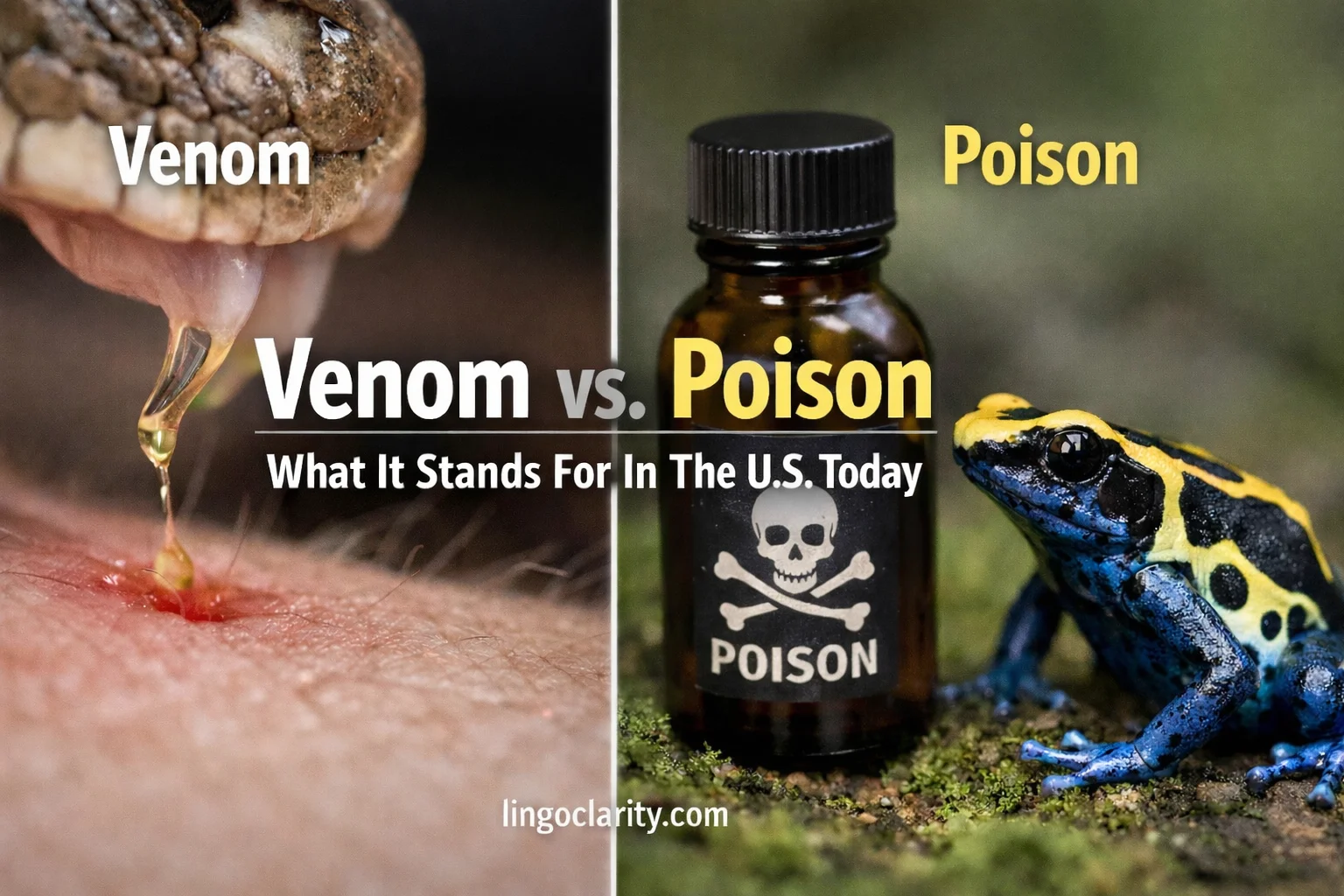
People mix up venom and poison all the time, and the confusion is understandable. Both words refer to harmful toxins. Both show up in science, news, and everyday speech. And both are often used around dangerous animals, especially snakes. But they are not interchangeable if you want accurate, high-authority writing.
Here is the simplest rule: venom is delivered by an animal through a specialized apparatus such as fangs, stingers, or spines; poison is the broader term for a harmful substance that injures when it is swallowed, inhaled, absorbed, or otherwise taken into the body. In formal biology, venom is often treated as a specialized kind of poison, which is why some dictionaries and reference works describe venom as a narrower subset rather than a separate category altogether.
That distinction matters because the wrong word can make polished writing sound loose, casual, or flat-out inaccurate. A rattlesnake has venom. Rat bait is poison. A poison dart frog is poisonous, not venomous, because its toxins are associated with its skin secretions rather than being injected through a bite or sting.
Quick Answer
Use venom when an animal actively injects a toxin into another organism, usually by biting, stinging, or piercing. Use poison for the broader category of harmful substances, especially when the substance causes harm through swallowing, inhalation, absorption, or contact. In other words, all venom can be understood as poison in the broad biochemical sense, but not all poison is venom.
A few fast examples make the distinction easy:
- A rattlesnake delivers venom through its fangs.
- A bee injects venom with its sting.
- A bottle of rat killer contains poison.
- A poison dart frog is poisonous because of toxic skin secretions.
If you remember one sentence, make it this: Venom is injected; poison is broader.
What Is The Real Difference Between Venom And Poison?
The clearest difference is not simply “animal versus chemical.” It is delivery.
Venom is a toxic substance produced by certain animals and introduced into prey or an enemy through a specialized delivery system, most commonly biting or stinging. That is the core idea behind the modern scientific and dictionary definitions.
Poison, by contrast, is the wider term. Britannica defines poison broadly as a natural or synthetic substance that damages living tissue and harms the body whether it is ingested, inhaled, absorbed, or injected through the skin. That broader definition is important because it explains why venom can be treated scientifically as one type of poison while still requiring its own more exact word in ordinary usage.
So in a usage article, the best editorial guidance is this:
- Choose venom when the toxin is delivered through a biological weapon such as fangs, a stinger, or a spine.
- Choose poison when the substance is harmful in a broader way or when the route is not active injection.
That is why “snake venom” sounds precise, while “snake poison” sounds imprecise unless you are speaking very casually or referring to poison in the broadest biochemical sense. Britannica notes that the common phrase “poisonous snake” is usually not technically correct for most dangerous snakes; venomous snake is the accurate term.
Why People Mix Them Up
The mix-up happens for three good reasons.
First, both words are linked to danger, toxins, and injury. In ordinary conversation, most people care more about “harmful” than about the exact mechanism of harm. That makes the two terms feel close even when they are not identical.
Second, casual speech often favors the more familiar word. Poison appears in warning labels, crime stories, medicine cabinets, and figurative phrases. Because it is the everyday default, people reach for it even when venom would be the sharper choice. Merriam-Webster also shows that poison has noun, verb, and adjective roles, which helps explain why it feels flexible in general writing.
Third, there is a genuine scientific overlap. Some authoritative definitions of venom explicitly say that it is, broadly, “a substance that is poisonous.” That overlap can blur the line for readers unless a writer explains that venom is the specialized, injected form.
Venom Vs. Poison In Plain English
For everyday writing, think in terms of real-world action.
If an animal has to do something to you with a built-in delivery mechanism, that points to venom. A snake bites. A scorpion stings. A bee stings. The toxin is delivered actively, not merely encountered.
If the harmful substance can hurt because you eat it, inhale it, absorb it, or touch it in the wrong way, that points to poison. Rat poison in a garage, toxic fumes in a room, or a dangerous household cleaner if swallowed all fit this broader category. Britannica’s poison definition is wide enough to cover many kinds of exposure, which is exactly why poison is the better general-use word.
This is also where the famous poison dart frog example helps. Poison frogs are known for extremely poisonous skin secretions. Britannica notes that these secretions can be dangerous if absorbed through mucous membranes or passed into the body through a cut. That makes them poisonous, not venomous.
Examples That Make The Difference Obvious
Here are practical examples that show how the word choice works in real sentences.
Correct:
- The doctor monitored the patient for signs of venom after the snakebite.
- The bee’s venom caused swelling around the sting.
- Keep the poison locked away from children.
- The fumes acted like a poison in the enclosed room.
- The poison dart frog is poisonous, not venomous.
Less precise or wrong:
- The rattlesnake released poison through its fangs.
- The child touched the frog’s venom.
Better:
- The rattlesnake injected venom through its fangs.
- The child was exposed to the frog’s poison.
A useful editing test is this: Can the organism inject it? If yes, use venom. If not, or if you are discussing a general toxic substance, use poison.
When Writers Choose The Wrong Word
The most common mistake is treating venom and poison as perfect substitutes. They are not.
Another mistake is assuming poison only applies to substances that are swallowed. That is too narrow. Authoritative reference works define poison broadly enough to include inhalation, absorption, and other harmful routes of exposure. So toxic fumes, contaminated water, and certain skin or mucous-membrane exposures can all fall under poison.
A third mistake is writing poisonous snake in copy that aims to sound exact. Casual readers may not object, but careful readers will notice. Britannica explicitly points out that most dangerous snakes are more accurately described as venomous, not poisonous.
A fourth mistake is overusing venom because it sounds dramatic. Strong writing is not about picking the more vivid word every time. It is about picking the right word. In a pet-safety article, “poisoning” will often be correct. In wildlife reporting about bites and stings, “envenomation” or “venom” may be the right technical fit. The best choice depends on the mechanism.
Can Something Be Both Venomous And Poisonous?
Yes, in some cases an animal can be both. That does not weaken the distinction; it actually proves it.
The reason is simple: venomous and poisonous describe two different ways toxins can cause harm. An organism may have an injected toxin and also contain toxins that are dangerous when eaten or absorbed. Scientific communicators often use this point to show that the categories are about delivery, not about how “dangerous” the animal is.
For most editing situations, though, you do not need edge cases. You only need the main rule. If the context is a snakebite, sting, or injected animal toxin, venom is the likely winner. If the context is a dangerous substance in the broad sense, poison is the safer choice.
Grammar And Usage: Which Forms Sound Natural?
In modern English, poison is extremely flexible. Merriam-Webster records it as a noun, a verb, and an adjective. That means all of these are standard:
- The cabinet contains a dangerous poison.
- Someone poisoned the water.
- It is a poison plant.
Venom is primarily a noun in ordinary writing, though dictionaries do record a verb form. Even so, that verb is much less common in mainstream prose than poison. In clean, modern copy, writers usually say poisoned or use the more technical envenom rather than forcing venom into a verb role.
That matters for style. Compare these:
- Natural: The spider’s venom caused immediate pain.
- Natural: The criminal poisoned the drink.
- Marked and uncommon in everyday prose: The criminal venomed the drink.
If you want fluent, publishable English, poison is the normal verb. Venom is usually the noun.
Figurative Uses Of Venom And Poison
The literal difference is scientific, but the figurative difference is stylistic.
Venom often suggests sharp malice, spite, or personal hostility. Merriam-Webster explicitly includes that figurative sense. So when a writer says, “Her reply was full of venom,” the image is of concentrated hostility aimed at someone.
Poison often suggests corruption, contamination, or slow damage spreading through a person, relationship, or system. Merriam-Webster includes figurative senses such as something destructive or harmful, and the verb sense extends naturally to ideas like poisoning trust, air, or public debate.
That is why these feel different:
- His comments were full of venom.
- Rumors poisoned the team culture.
The first is sharp and personal. The second is broader and more corrosive.
How To Remember The Difference
Use this memory trick:
If it bites or stings you, think venom. If you bite it, breathe it, drink it, or absorb it, think poison.
It is not a perfect scientific law for every edge case, but it is an excellent writing rule. It aligns with the delivery-based distinction emphasized by science communicators and reference works, and it keeps your wording crisp in almost every practical sentence.
Another simple version is this:
- Venom = injected
- Poison = broadly harmful
That one line will solve most usage problems immediately.
Conclusion
So which word should you use: venom or poison?
Use venom when an animal actively injects a toxin through fangs, a sting, or another specialized structure. Use poison when you mean the broader category of harmful substances or when the toxin is swallowed, inhaled, absorbed, or otherwise taken in without that active delivery system. In scientific terms, venom can be viewed as a specialized kind of poison; in strong everyday writing, venom is the narrower, more exact term and poison is the broader, more flexible one.
That is the distinction good editors make. And once you see it, the choice becomes easy.
FAQs
Is a snake poisonous or venomous?
Most dangerous snakes are venomous, not poisonous, because they deliver toxins by biting and injecting venom through their fangs. Britannica specifically notes that the common phrase “poisonous snake” is usually not technically correct in this context.
Are poison dart frogs venomous?
No. Poison dart frogs are known for poisonous skin secretions, which is why they are called poisonous rather than venomous. Their toxins are associated with skin secretions and can be dangerous through exposure rather than injection.
Can venom be called poison?
In a broad biochemical sense, yes. Some reference works define venom broadly as a poisonous substance, and Britannica classifies venoms as a kind of parenteral poison. But in precise word choice, venom is the better term when the toxin is injected by an animal.
Is poison only something you swallow?
No. Poison is broader than that. Britannica defines poison as harmful whether it is ingested, inhaled, absorbed, or injected through the skin, and Merriam-Webster also treats it as a broad harmful substance.
Can venom be used as a verb?
Dictionaries do record a verb form of venom, but it is far less common in everyday prose than poison. In most publishable general-audience writing, poison is the natural verb choice, while venom works best as a noun.
What is the easiest way to remember venom vs. poison?
Remember this: venom is injected; poison is broader. If the organism delivers the toxin through a bite, sting, or similar apparatus, use venom. If the harm comes through swallowing, inhalation, absorption, or general toxic exposure, use poison.
