
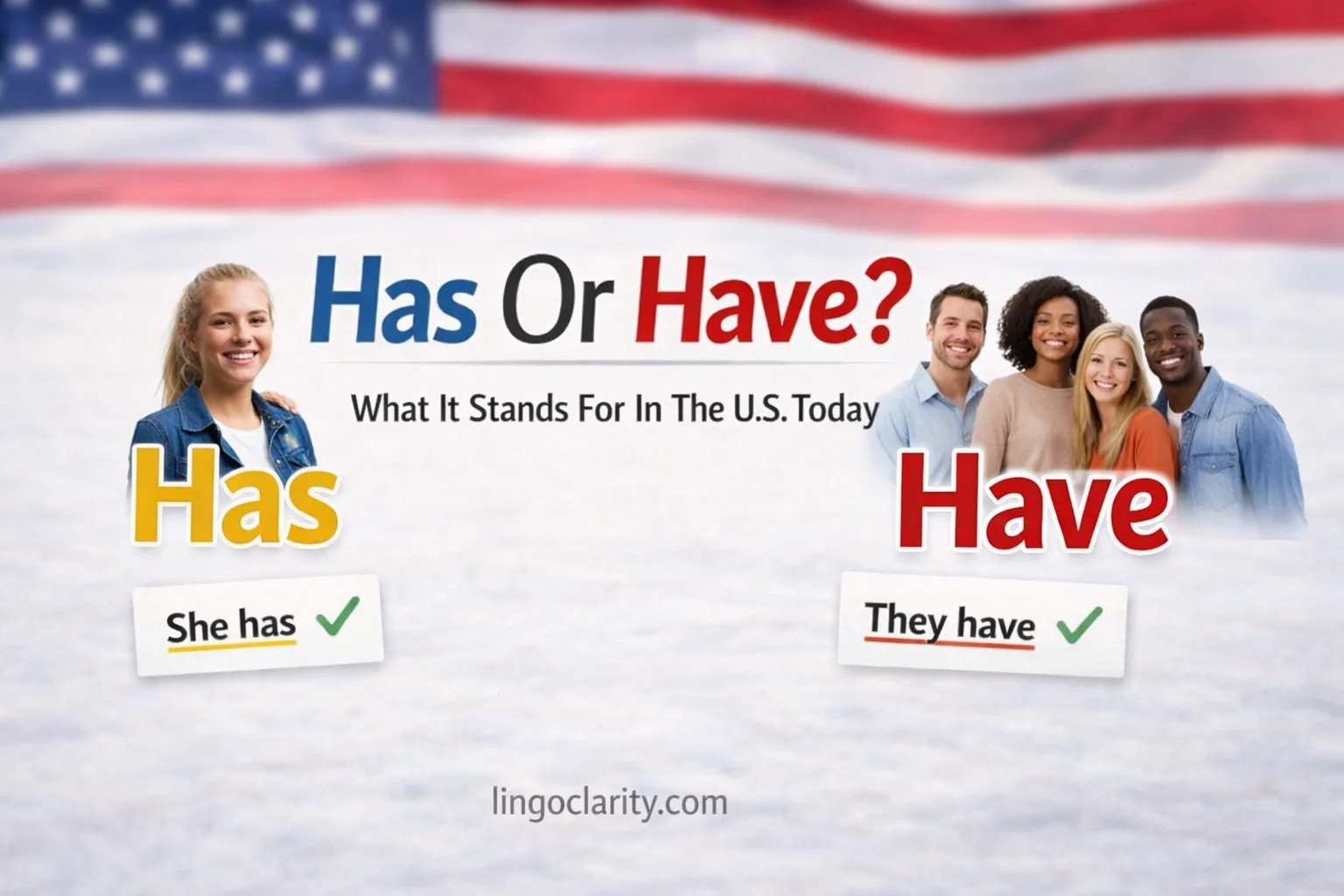
Use has with third-person singular subjects — he, she, it, and any single person or thing. Use have with I, you, we, they, and every plural subject. The same split works in the present perfect: she has finished, they have finished. One exception matters most: after do, does, did, or any modal like can or will, you always switch back to have — Does she have a minute?, never does she has.
A real-life example
Picture yourself at the DMV counter. The clerk scans your folder and says, “Your application has two documents missing, and you have thirty days to send them in.”
Both words land in one sentence, and the rule explains each: application is a single thing, so it takes has. You always takes have, no matter how many people you’re talking to. That’s the whole rule in one breath — and if you can hear the difference in that sentence, you already know which word to use in your own writing. in the present tense.
What Is The Difference Between Has And Have?
The difference between has and have is mainly grammatical. In other words, they usually do not change the core meaning of a sentence. Instead, they change form to match the subject correctly.
Both words are forms of the verb have. As a main verb, have can show possession, connection, features, duties, or experience. For example, it can show ownership in a sentence like She has a car. Similarly, it can show a feature in a sentence like The apartment has a balcony.
Both forms can also work as helping verbs. For instance, we say He has finished the report and They have finished the report. In both cases, the main idea is similar, but the subject changes, so the helping verb changes too.
Therefore, the real question is not “Which word means something different?” Rather, the real question is “Which word agrees with the subject?”
Simple Definition
Has and have are present-tense forms of the verb have.
- Has is used with he, she, it, and most singular nouns.
- Have is used with I, you, we, they, and plural nouns.
Put simply, has goes with third-person singular subjects, while have goes with the other present-tense subjects. Once you remember that, most choices become much easier.
The Core Grammar Rule
This is a subject-verb agreement rule. In English, the form of a verb often changes depending on the subject. Because of that, has is the present-tense form used with third-person singular subjects.
Use has when the subject is:
- he
- she
- it
- one person
- one thing
- one singular noun
Use have when the subject is:
- I
- you
- we
- they
- plural nouns
Therefore, these sentences are correct:
- She has a meeting at noon.
- They have a meeting at noon.
- My brother has a bike.
- My brothers have bikes.
Likewise, the same agreement rule works whether have is the main verb or a helping verb:
- He has a cold.
- He has taken the medicine.
- We have your number.
- We have called twice.
In short, the tense pattern may expand, but the agreement rule stays the same.
A Quick Comparison Table
| Subject | Correct Form | Example |
|---|---|---|
| I | have | I have your keys. |
| You | have | You have a strong point. |
| He | has | He has a dentist appointment. |
| She | has | She has a new idea. |
| It | has | It has a broken handle. |
| We | have | We have enough chairs. |
| They | have | They have the final draft. |
| Singular noun | has | The teacher has a question. |
| Plural noun | have | The teachers have a question. |
As you can see, the subject decides the verb form. That is why finding the real subject is the most important step.
When To Use Has
Use has with singular third-person subjects. For example, use it with he, she, it, one name, and most singular nouns.
With He, She, And It
- He has a sore throat.
- She has your notebook.
- It has a small crack.
Here, each subject is singular and third person. Therefore, has is the correct choice.
With A Single Person Or Thing
- Daniel has a piano lesson tonight.
- The dog has a red collar.
- The store has shorter hours on Sunday.
Again, each subject names one person or one thing. As a result, has fits naturally.
With Singular Indefinite Pronouns
Words like everyone, everybody, someone, anyone, nobody, and each are grammatically singular. Because of that, they take has in standard English.
- Everyone has a seat.
- Each student has a password.
- Someone has my charger.
- Nobody has the answer yet.
Although these words may refer to many people in a general sense, they are still singular in grammar. So, the singular verb form is correct.
With Collective Nouns In American English
In American English, collective nouns are usually treated as singular when the group acts as one unit. Therefore, has is often the safer choice in US writing.
- The team has a new coach.
- The class has a field trip tomorrow.
- The family has a long tradition of Sunday dinners.
Of course, context still matters. However, in standard US English, singular agreement is usually preferred for these nouns.
When To Use Have
Use have with I, you, we, they, and plural nouns. In most everyday sentences, that pattern is very steady and easy to apply.
With I And You
- I have your umbrella.
- You have great timing.
Importantly, English uses have with you whether you refers to one person or several people. So, we say you have, not you has.
With We And They
- We have enough money for lunch.
- They have the correct address.
In these cases, the subjects are not third-person singular. Therefore, have is the correct present-tense form.
With Plural Nouns
- The students have a quiz today.
- My neighbors have a new puppy.
- The cars have tinted windows.
Because these nouns are plural, they take have rather than has.
With Compound Subjects Joined By And
When two subjects are joined by and, the result is usually plural. For that reason, you normally use have.
- Maya and Chris have the same math teacher.
- The manager and the assistant have different schedules.
- My parents have the remote.
In other words, two separate subjects usually create a plural subject together.
Has And Have In The Present Perfect
The same agreement rule continues in the present perfect. That means the subject still decides whether you use has or have.
Use:
- has + past participle with third-person singular subjects
- have + past participle with other subjects
For example:
- She has finished her shift.
- He has already eaten.
- The company has opened a new office.
- I have finished my homework.
- We have seen that movie.
- They have already left.
So, the tense changes, but the agreement rule does not. Likewise, the same subject patterns still control the helper verb. As a result, if you know the simple present rule, you already know most of the present perfect rule too.
Sentence Usage
These sentence patterns can help you build correct sentences faster. In practice, many writers improve quickly once they memorize a few clear models.
Has With Singular Subjects
- The app has a new update.
- My friend has a part-time job.
- The restaurant has outdoor seating.
- Olivia has a violin lesson on Friday.
- The office has a break room.
Have With Other Subjects
- I have your number.
- You have a strong argument.
- We have plenty of snacks.
- They have enough evidence.
- The neighbors have two cats.
Present Perfect Sentence Usage
- She has written the email.
- He has taken the keys.
- It has stopped raining.
- I have called twice.
- We have made a decision.
- They have booked the tickets.
Overall, these patterns show that the choice becomes very predictable once the subject is clear.
Meaning, Structure, And Emphasis
Most of the time, has and have do not change the basic meaning. Instead, they change the grammar so the verb matches the subject.
Compare these two sentences:
- Ava has a question.
- The interns have a question.
The idea is nearly the same. However, the subject changes, so the verb changes too.
Sometimes the real problem is sentence structure. For example, a writer may focus on the noun closest to the verb instead of the true subject.
- One of the students has the answer.
Here, students is plural, but it is not the subject. The real subject, instead, is one, which is singular. Therefore, has is correct.
This is why longer sentences often create agreement mistakes. In longer phrases, nearby nouns can distract the writer from the real head word.
.
Common Mistakes
Writers often understand the rule but still make mistakes when the sentence gets longer. For that reason, it helps to study the most common error patterns directly.
Mistake 1: Matching The Verb To The Nearest Noun
Wrong:
- One of the players have a sprained ankle.
Right:
- One of the players has a sprained ankle.
Here, the subject is one, not players. Therefore, the singular verb form is correct.
Mistake 2: Treating Singular Indefinite Pronouns As Plural
Wrong:
- Everyone have a seat.
Right:
- Everyone has a seat.
Although everyone refers to many people, it is grammatically singular. So, has is the correct form.
Mistake 3: Using Has After Does Or Doesn’t
Wrong:
- Does she has a passport?
- She doesn’t has much free time.
Right:
- Does she have a passport?
- She doesn’t have much free time.
After do, does, did, don’t, and doesn’t, English uses the base form have. That is why has is wrong in these structures.
Mistake 4: Mixing Up Singular They
Wrong:
- If a student calls, they has a question.
Right:
- If a student calls, they have a question.
Even when they refers to one person, standard usage still takes have. Therefore, singular they does not change this rule.
Mistake 5: Misreading Compound Subjects
Wrong:
- Maya and Chris has the same class.
Right:
- Maya and Chris have the same class.
Because two subjects are joined by and, the subject is usually plural. As a result, have is the correct choice.
A Fast Test You Can Use
If you feel stuck, try a quick pronoun test. In many cases, this is the fastest way to fix the sentence.
- If the subject becomes he / she / it, use has.
- If the subject becomes I / you / we / they, use have.
Examples:
- The manager → she → has
- The managers → they → have
- Each student → he or she → has
- The students → they → have
As a practical strategy, this test works well during editing because it forces you to identify the real subject first.
Why This Rule Matters
At first, this may look like a small grammar point. However, choosing the wrong form can make your writing sound rushed or unpolished. Subject-verb agreement errors stand out in school assignments, business emails, reports, resumes, and website content.
Clear grammar builds trust. Moreover, correct verb agreement makes sentences easier to read. As a result, your writing sounds more natural, more polished, and more professional.
In everyday use, this rule matters in:
- school assignments
- emails
- resumes and cover letters
- business writing
- website content
- captions and social posts
- English-learning practice
So, even though the difference is small, the effect on clarity is real.
Final Verdict
The choice between has and have is simple once you identify the real subject. In general, use has with he, she, it, and most singular nouns. By contrast, use have with I, you, we, they, and plural nouns.
Also, remember that the same rule applies in the present perfect: she has finished, but they have finished. Finally, after does or doesn’t, always use the base form have.
Overall, the best habit is this: match the verb to the real subject, not to the nearest word. If you do that, you will avoid most has/have mistakes right away.
Frequently Asked Questions
Is it “he has” or “he have”?
Use he has. Because he is third-person singular, it takes has.
Why do we say “you have” and not “you has”?
English uses have with you whether you means one person or more than one person. So, you have is always the standard form.
Is it “everyone has” or “everyone have”?
Use everyone has in standard written English. Even though everyone refers to many people, it is grammatically singular.
Do names take “has” or “have”?
A single name usually takes has. By contrast, two names joined by and usually take have.
- Emma has a question.
- Emma and Noah have a question.
Is it “has been” or “have been”?
Both are correct. However, the subject decides which one you need.
- She has been busy.
- They have been busy.
Is “does she has” ever correct?
No. After does, use the base form have. Therefore, the correct pattern is Does she have … ?
What About Singular They?
Use have, not has.
- Someone left their bag, and they have not come back yet.
Even here, they still takes have in standard usage.
