
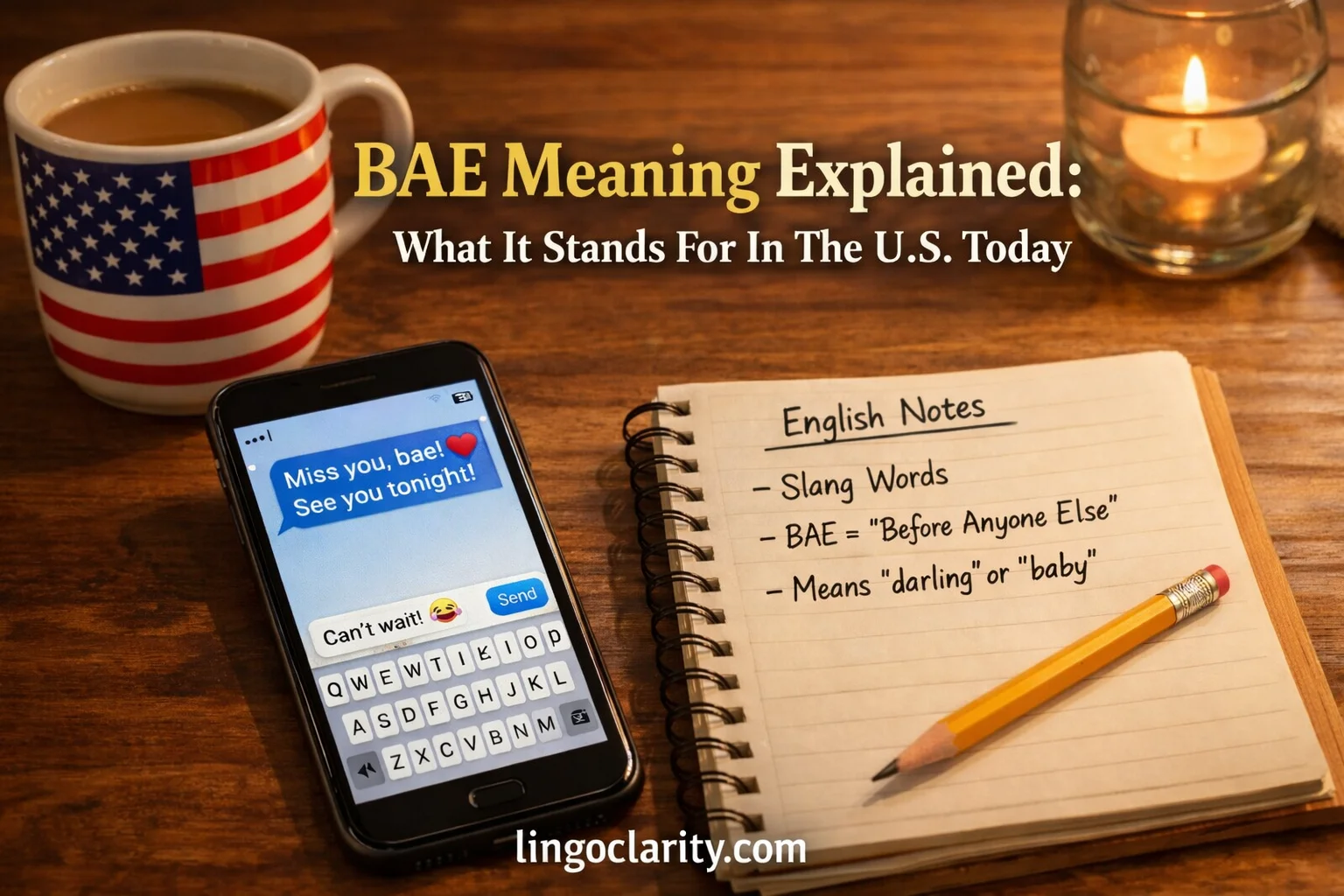
You may see bae in texts, captions, song lyrics, comments, and pop culture posts. It also appears in casual conversation, social media, and some English-learning materials. The word looks simple, but its meaning is not always obvious.
That matters because bae is highly informal. Depending on the speaker and situation, it can sound affectionate, playful, joking, ironic, or slightly dated. It can also confuse learners because people do not use it in exactly the same way every time.
In this guide, you will learn what bae means, where it likely came from, how people use it, when it sounds natural, and when it does not. You will also see practical examples, common mistakes, close alternatives, and a short quiz to test your understanding.
Quick Answer
Bae is an affectionate nickname for a romantic partner — a boyfriend, girlfriend, or spouse. It began as a shortened form of babe or baby, and the popular “Before Anyone Else” explanation came later as a backronym, not the true origin. Today bae is also used loosely for a best friend, a favorite celebrity, or even a favorite food, usually with a joking tone.
At a glance
Avoid with: coworkers, clients, strangers, or anyone you’ve just met
Literal origin: shortened form of babe / baby
Popular backronym: “Before Anyone Else” (folk etymology, not the real source)
Peak popularity: 2013–2015; now reads as slightly dated or ironic
Safe to use with: a partner, a close friend, a light-hearted caption
What Bae Means
At its core, bae is a sweet, casual word for someone special. In most cases, it refers to a romantic partner. It can also describe someone or something a person loves in a playful way.
You can think of it as a modern pet name that overlaps with words like babe, baby, and sometimes boo. The exact feeling depends on who says it, how they say it, and who they are talking about.
Common meanings include:
- a boyfriend or girlfriend
- a husband, wife, or partner
- a crush
- a close friend, in some social groups
- a pet, used jokingly
- a favorite thing, used playfully
Examples:
- “I’m meeting my bae after work.”
- “Bae made dinner tonight.”
- “Good morning, bae.”
- “My dog is my bae, honestly.”
- “Coffee is bae today.”
In most cases, bae sounds cute and relaxed. In others, it can sound ironic or slightly old-fashioned because the slang became especially popular in the 2010s.
How Bae Works In A Sentence
Bae usually works as a noun. It can name a person, or it can be used directly when speaking to someone.
The patterns are simple and common in casual English.
Common patterns:
- my/your + bae
- Hey, bae as direct address
- X is bae for playful praise
Examples:
- “My bae loves tacos.”
- “Your bae is here.”
- “Hey, bae, how was your day?”
- “This playlist is bae.”
- “She posted a photo with her bae.”
One structure usually sounds awkward:
- “The bae is coming.”
A more natural version is:
- “My bae is coming.”
Another common mistake is using bae for someone when the relationship or setting does not fit.
Less natural:
- “I called my boss bae.”
Better:
- “I called my boss by their name.”
Does Bae Mean “Before Anyone Else”?
Some people say bae means before anyone else. That explanation is catchy, easy to remember, and still repeated online.
However, it is safer not to treat that as the one true origin. In real usage, many language references and style guides describe bae as more likely connected to a shortened form of babe or baby.
The clearest way to explain it is this:
- Before anyone else is a popular backronym.
- It spread because it sounds memorable and romantic.
- Many language references favor the shortened-babe explanation instead.
- In everyday English, the actual use of the word matters more than the slogan behind it.
For beginners, the safest explanation is simple: bae usually means a loved one, and many people use it much like babe.
Incorrect claim:
- “BAE always stands for before anyone else.”
Better explanation:
- “Some people say that, but in real use, bae is a flexible slang pet name.”
Where Bae Came From
The full history of bae is not perfectly neat, which is normal for slang. Informal words often spread through speech, music, social groups, and online culture before anyone records their exact path clearly.
The safest summary is this: bae is widely treated as a clipped form of babe or baby. It became especially visible through casual American English, music, and internet culture.
A few practical points help explain its rise:
- it is strongly tied to informal American English
- many people associate its spread with Black American speech and culture
- it became much more visible online during the 2010s
- today, most English speakers recognize it, even if they do not use it themselves
Because slang history is often messy, it is best to avoid overly confident claims about a single exact origin unless strong evidence supports them.
How To Use Bae In Real Life
Use bae in relaxed, familiar situations. Bae works best when the relationship already feels warm and informal. It sounds most natural in texts, captions, jokes, and light conversation. However, it is usually a poor choice for serious, professional, or formal writing.
Good real-life uses:
- texting your partner: “Miss you, bae.”
- a caption: “Date night with bae.”
- a joke: “Pizza is bae.”
- a playful chat: “Bae, send me that photo.”
- a soft compliment: “You look so good, bae.”
Natural examples:
- “Bae picked the movie tonight.”
- “Just got home with bae.”
- “Bae surprised me with coffee.”
- “You’re my bae, always.”
- “That hoodie is bae.”
With a partner, it usually sounds affectionate. For an object or idea, it usually sounds playful or humorous.
When Bae Sounds Natural
Some slang depends more on mood than grammar, and bae is one of those words. It sounds best when the setting is casual and the relationship is already clear.
It often feels natural in these situations:
- between partners who already use pet names
- in short text messages
- in social media captions
- in playful jokes with friends
- in light conversation rather than serious discussion
- when both people like cute or informal language
Examples that sound natural:
- “Bae, I’m outside.”
- “Lunch with bae.”
- “Bae got me flowers.”
- “That little cat is my bae.”
- “Summer Fridays are bae.”
Some people also use bae with a wink or half-joking tone because the word can feel a bit nostalgic now.
When Not To Use Bae
This is where many learners make mistakes. A word can be common online and still be wrong for the moment.
Avoid bae when the situation requires distance, clarity, or respect. In those cases, a person’s name or a more neutral term is usually better.
Do not use bae:
- in work emails
- in school essays
- with a teacher, manager, or client
- with a stranger
- very early in dating, if the other person may dislike pet names
- during a serious disagreement
- when the tone needs to be plain and respectful
Examples to avoid:
- “Dear Bae, please review the report.”
- “My professor is my bae.”
- “Excuse me, bae, where is the bus stop?”
- “I need to discuss our lease, bae.”
- “Hello bae” to someone you just met
A common problem is using bae just because it sounds trendy. A better rule is to use it only when the relationship and tone clearly support it.
Bae Vs. Babe, Baby, Boo, And Other Close Terms
These words belong to the same general family, but they do not feel exactly the same. The best choice depends on tone, age, closeness, and setting.
Here are some close alternatives:
- babe — a very common pet name for a partner; more standard than bae
- baby — warmer and often more intimate
- boo — casual and affectionate, often romantic
- partner — neutral, adult, and useful in many settings
- spouse — clear and more formal
- crush — someone you like, not necessarily your partner
- sweetheart — gentle and warm, sometimes old-fashioned
- honey — affectionate and common in speech
- love — warm, but strongly shaped by region and habit
- bestie — close friend, not romantic by default
- main squeeze — playful and old-school
- significant other — formal, clear, and less personal
A quick tone guide:
- bae = playful, casual, modern, or ironic
- babe = familiar, romantic, and widely accepted
- baby = more intimate
- boo = affectionate and relaxed
- partner = the safest general adult choice
A common mistake is assuming all pet names mean the same thing. They do not. Always match the word to the relationship and the situation.
Common Mistakes And Confusions
Many problems with bae come from spelling, tone, and context. Because the word is short, small differences matter.
Bae Vs. Bay
Bae is a pet name. Bay is a body of water.
Wrong:
- “We sat by the bae.”
Right:
- “We sat by the bay.”
Bae Vs. BAE
Lowercase bae is the slang word. Uppercase BAE may refer to a company name, initials, or another abbreviation, depending on the context.
Wrong:
- “BAE is coming over,” when you mean your partner
Better:
- “Bae is coming over.”
Romantic Vs. Playful Use
“My bae” often sounds romantic.
“Pizza is bae” is clearly playful.
If you do not notice the difference, you may misread the speaker’s tone.
Sweet Vs. Annoying Tone
Some people love the word. Others think it sounds forced, outdated, or overly cute. That means tone matters as much as meaning.
Using It Too Early
Pet names can feel pushy if the relationship is new. In early dating, using someone’s name is often safer.
Best Choice By Context
Some situations welcome a cute pet name. Others need a clearer and more neutral word.
| Context | Best Choice | Why |
|---|---|---|
| Texting your partner | bae or babe | Warm, casual, and natural |
| Instagram caption | bae | Short and playful |
| Talking about your spouse at work | partner or spouse | Clear and respectful |
| Early dating | their name | Safer and less pushy |
| Joking about food or music | bae | Light and funny |
| Talking about a friend | bestie or their name | Less likely to sound romantic |
A simple rule helps here: if you are unsure, use the person’s name. It is almost always the safer choice.
Mini Quiz
Try these before checking the answers.
- In most cases, bae refers to:
a) a teacher
b) a loved one
c) a stranger - Which sentence sounds most natural?
a) “Please review the contract, bae.”
b) “Bae is picking me up.”
c) “The bae is late.” - True or false: bae is a formal word.
- Which word is easiest to confuse with bae in spelling?
a) book
b) bay
c) bin - Which choice is usually best in a work meeting?
a) bae
b) boo
c) partner
Answers:
- b) a loved one
- b) “Bae is picking me up.”
- False
- b) bay
- c) partner
FAQs
What does bae mean in texting?
In texting, bae usually means a romantic partner or someone special. It can also be used jokingly for a pet, food, or a favorite thing. The tone is usually casual, warm, and informal.
Does bae mean “before anyone else”?
Many people repeat that explanation, and you will still see it online. However, it is not the safest full definition. In everyday English, bae works more like a pet name than a strict acronym.
How do you pronounce bae?
Bae is usually pronounced /beɪ/. It rhymes with day, say, and play.
Can you call a friend bae?
Sometimes, yes. In some friend groups, people use it playfully. Still, many listeners will hear it as romantic first, so context matters.
What’s the difference between bae and babe?
They are close in meaning, but the tone is slightly different. Babe feels more standard and widely accepted, while bae feels more slang-based, playful, and sometimes a little dated.
Is bae still used?
Yes. People still recognize and use it. However, for many speakers, it feels less fresh than it once did and may sound playful, nostalgic, or ironic rather than brand-new.
Conclusion
Bae comes down to one simple idea: it is a casual word for someone special.
Use it when the tone is warm, relaxed, and familiar. Avoid it in formal, professional, or unclear situations. When in doubt, use the person’s name or choose a more neutral term like partner.
That way, your meaning stays clear, natural, and appropriate every time.
