
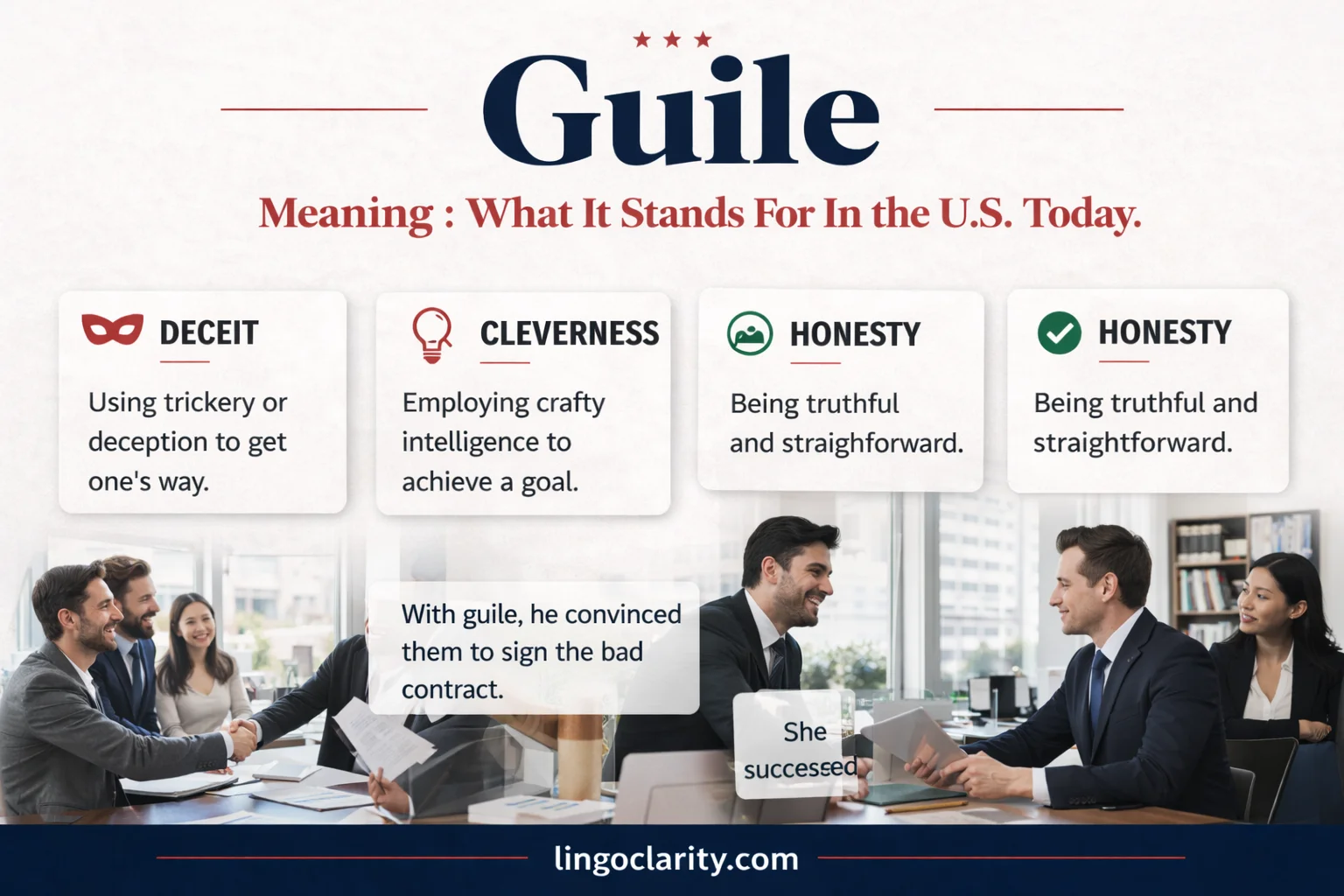
Guile means clever, usually deceptive trickery. It refers to the kind of intelligence someone uses to outsmart, manipulate, or mislead rather than act openly and honestly. In modern English, guile is mainly a formal noun, usually treated as noncount, and it often carries a negative tone, though some sports and commentary uses make it sound closer to tactical craft than outright dishonesty.
What Guile Means In Plain English
At its core, guile means sly cleverness used to gain an advantage. The word almost always suggests that the person is not being fully straightforward. They may be hiding their real plan, shaping someone else’s perception, or winning through manipulation rather than force or openness. Cambridge defines it as clever but sometimes dishonest behavior used to deceive, while Merriam-Webster centers it on deceitful cunning and duplicity.
That is why guile is stronger than a word like skill and narrower than a word like intelligence. A smart doctor, engineer, or student is not showing guile just because they are capable. Guile enters the picture when cleverness becomes sly, strategic, or morally questionable.
Is Guile Positive Or Negative?
Most of the time, guile sounds negative or morally mixed. Britannica defines it as the use of clever and usually dishonest methods to achieve something, and Oxford calls it clever but dishonest behavior used to trick people.
Still, context matters. In politics, negotiation, crime, or fiction, the word often clearly suggests manipulation. In sports writing and some commentary, though, guile can sound softer. A veteran player may win with timing, movement, patience, and tactical intelligence rather than speed or strength. Recent example usage from Merriam-Webster and Dictionary.com shows that modern writers still use guile that way.
So the best rule is this: guile usually implies hidden craft, and whether that sounds dirty or admirable depends on the setting.
How To Pronounce Guile
Guile is pronounced /gaɪl/ and usually sounds like “gyle,” rhyming with “mile.” Cambridge, Oxford, and Dictionary.com all give that pronunciation, and Merriam-Webster shows essentially the same sound with a possible light extra schwa in some pronunciations.
If you want a simple pronunciation guide, use this:
Guile = gyle = rhymes with mile
That is the easiest and most natural American-English way to remember it.
Part Of Speech, Grammar, And Word Forms
Guile is primarily a noun. Oxford marks it as uncountable, Cambridge labels it [U], and Britannica marks it [noncount]. That means English speakers usually say:
- with guile
- without guile
- full of guile
- lacking in guile
- a bit of guile
They do not usually say many guiles or several guiles in normal modern usage.
Related forms include:
- guileless: honest, innocent, or free from deceit
- guileful: full of guile, but now relatively rare outside literary or dictionary contexts
- guilefully and guilefulness: standard derivatives, but far less common in everyday speech and writing
If you want the most natural modern choice, guileless is much more useful than guileful.
When To Use Guile
Use guile when you want to emphasize that someone succeeds through crafty, indirect, or deceptive intelligence. It fits especially well in these contexts:
Fiction and storytelling. Villains, con artists, schemers, and political operators often act with guile because the word captures both intelligence and moral shadow.
Politics and negotiation. When someone wins by maneuvering, masking intentions, or controlling perception, guile often fits better than a simpler word like strategy.
Scams and manipulation. This is one of the most natural contexts for the word because deception is central to the meaning.
Sports and competition. Here the word can describe veteran craft, subtle movement, or mental sharpness, especially when a player wins without relying on raw power or speed.
Natural examples include:
- The investor was impressed by the pitch, but it was built on guile.
- She handled the hostile interview with calm and political guile.
- The striker no longer had his old pace, but he still scored with guile.
- The novel’s villain hides his guile behind perfect manners.
When Not To Use Guile
Do not use guile as a general synonym for intelligence, wisdom, or skill. The word usually needs some hint of slyness, manipulation, or hidden intention.
For example, these are weak or inaccurate uses:
- She solved the equation with guile.
- The nurse treated the patient with guile.
- He built the bridge with guile.
Those sentences sound wrong because the work described is intelligent or skillful, not deceptive.
Also be careful with tone. Guile is a fairly formal word. In everyday conversation, many speakers would choose cunning, deceit, trickery, sneakiness, or manipulation instead, depending on the exact meaning. Cambridge explicitly labels the word as formal, and Oxford does the same.
Guile Vs. Cunning Vs. Deceit Vs. Trickery
These words overlap, but they are not identical.
Guile combines cleverness with hidden intent. It usually suggests someone is using intelligence in a sly or deceptive way.
Cunning is broader. It can be negative, but it can also sound admiring. A cunning plan may be sneaky, but it can also just be clever.
Deceit focuses more on dishonesty itself. It points to lying, misleading, or false appearance, with less emphasis on tactical intelligence.
Trickery is more everyday and concrete. It feels less formal than guile and often describes direct cheating or sneaky moves.
That is why these examples feel different:
- Guile: The lobbyist relied on guile to shape the vote.
- Cunning: It was a cunning way to avoid a bigger loss.
- Deceit: The deal collapsed when the deceit was exposed.
- Trickery: The magician’s trickery fooled the audience.
Merriam-Webster and Cambridge group guile with words like cunning, deception, and deceit, but in real writing guile is often the most elegant choice when the cleverness is hidden and the tone is slightly literary or formal.
Common Phrases With Guile
A few phrases show up again and again in English:
Lacking in guile. This means someone is honest, innocent, or not inclined to manipulate others. Cambridge and Oxford both use this pattern directly.
Without guile. This means openly, sincerely, or without deceit. It is very close in meaning to guileless.
Use guile. This emphasizes deliberate strategic manipulation.
Political guile. A common phrase for crafty maneuvering in leadership or power struggles.
With guile. A concise way to say “using sly intelligence.”
Here are natural examples:
- He was ambitious, but not without guile.
- Her answer was direct and completely without guile.
- The campaign survived through political guile more than public trust.
- The veteran midfielder created space with patience and guile.
Example Sentences In Real-Life Contexts
Seeing the word in different settings helps more than memorizing a definition.
In Everyday Or News Contexts
- The fraud scheme depended on guile, not force.
- She saw through his charm and recognized the guile underneath it.
- The negotiator used guile to make the other side reveal too much.
In Fiction Or Literary Writing
- The queen in the novel wins more battles with guile than with armies.
- His smile looked warm, but it concealed years of practiced guile.
- The thief survived by nerve, speed, and a dangerous amount of guile.
In Sports Or Competition
- The forward had lost a step, but he still created chances with guile.
- The veteran pitcher beat younger hitters with guile and command.
- Their team lacked flair, yet it played with enough guile to steal the match.
These examples reflect the real range of the word: mostly negative, sometimes admiring, always more strategic than straightforward.
Guileless, Guileful, And Other Related Words
The most useful related word is guileless. Cambridge defines guileless as honest and not able to deceive, while Merriam-Webster gives innocent or naive as the core sense.
That makes guileless the natural opposite of guile in many contexts:
- a guileless child
- a guileless smile
- a guileless reply
By contrast, guileful does exist, but it is much less common in ordinary modern English. Etymonline notes that it now appears mainly in poems and dictionaries, which is why most writers simply use full of guile instead.
Other related words you may see near guile include wile, duplicity, artifice, craftiness, and deviousness. They overlap, but each carries a slightly different shade of tone or register.
A Short Note On Origin
English has used guile since the Middle English period. Etymonline traces it through Old French to a Germanic source associated with deceit, trickery, or ruse, and Merriam-Webster likewise traces it through Anglo-French and Middle English. That history fits the modern meaning closely: the idea of sly, deceptive craft has been present in the word for centuries.
Common Mistakes To Avoid
One common mistake is treating guile as if it means any kind of intelligence. It does not. The word nearly always adds a layer of slyness, manipulation, or hidden motive.
Another mistake is forcing a positive meaning in contexts where the word sounds too morally loaded. If you simply mean “smart strategy,” a word like skill, tactics, or cunning may fit better.
A third mistake is using the word too casually. Guile is standard English, not slang, but it leans formal. In relaxed speech, it may sound slightly literary.
A fourth mistake is overusing guileful. It is real, but it is not the most natural modern choice.
Finally, learners sometimes confuse guile with guilt or assume it is pluralizable like a normal count noun. In standard modern usage, guile is usually singular in form and noncount.
Frequently Asked Questions
What does guile mean in simple terms?
It means clever trickery or sly, deceptive cleverness. A person using guile is not just smart; they are using that smartness in a hidden, strategic, or manipulative way.
Is guile always negative?
Usually, yes, or at least morally shaded. Most major dictionaries tie it to deception or dishonest methods. But in sports and some commentary, it can sound more like veteran craft or tactical subtlety.
Is guile a noun or an adjective?
Guile is mainly a noun. The related adjectives are guileless and guileful, though guileless is much more common in modern use.
How do you pronounce guile?
It is usually pronounced like “gyle,” rhyming with mile.
What does “without guile” mean?
It means honest, sincere, and free from deceit. It is close in meaning to guileless.
What is the difference between guile and cunning?
Guile usually points more strongly to hidden trickery or manipulation. Cunning is broader and can sometimes sound admiring rather than dishonest.
Can guile ever be used in a positive way?
Not fully positive in most contexts, but it can be used approvingly in sports or competition when the idea is tactical intelligence rather than outright deception.
Is guile a common everyday word?
It is a standard English word, but it is more formal and literary than everyday words like trickery, deceit, or sneakiness.
The Bottom Line
If you want the clearest modern definition, use this: guile means clever, usually deceptive trickery used to gain an advantage. It is a formal noun, usually noncount, most often negative, and best used when someone wins through hidden craft rather than open honesty. When the situation is softer, especially in sports, it can suggest shrewd tactical intelligence instead of outright dishonesty.
