
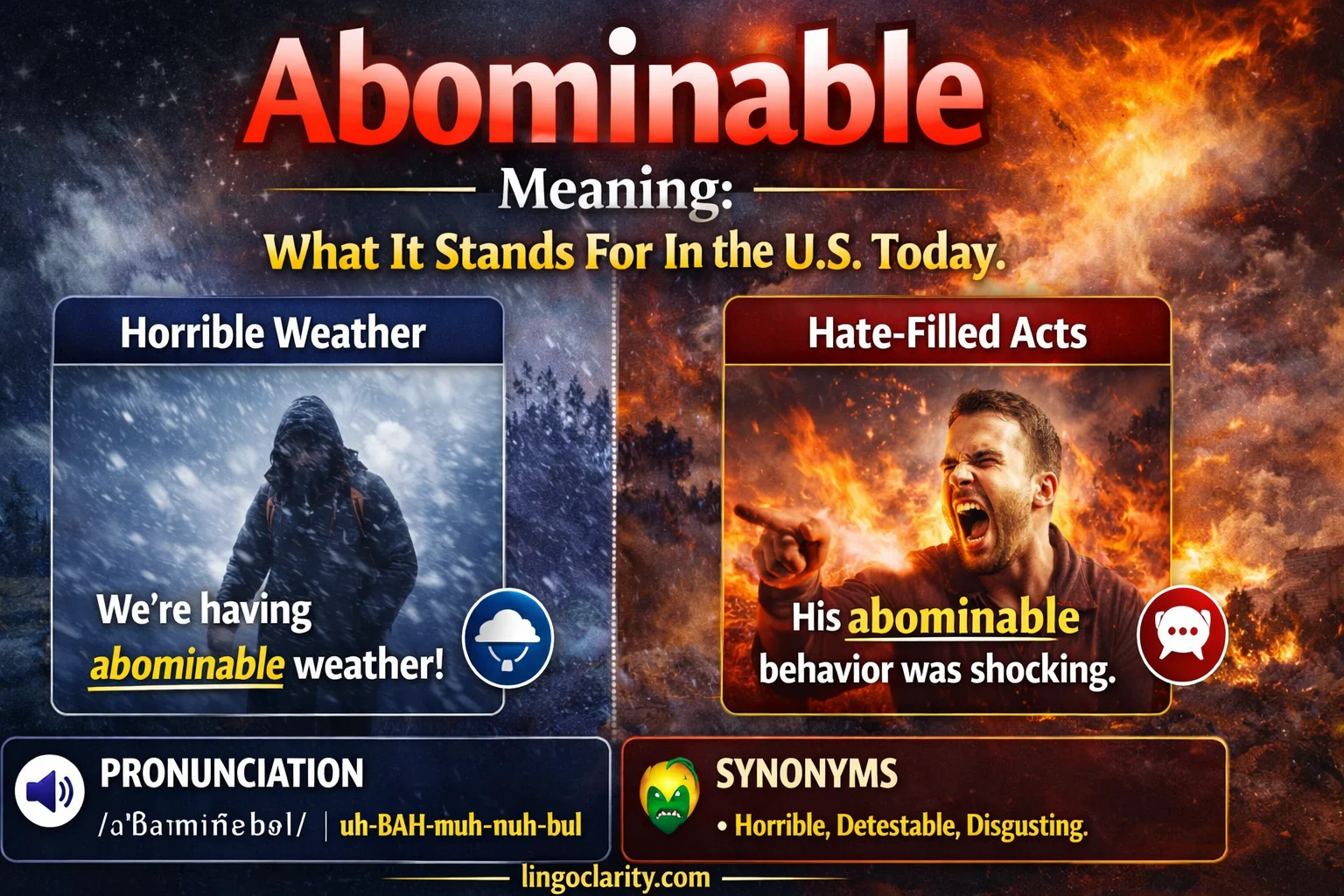
If you want the plain-English answer first, abominable means extremely bad, deeply unpleasant, or morally disgusting. Major dictionaries consistently show two main ideas: something can be abominable because it inspires disgust or hatred, or because it is simply very bad or unpleasant.
That makes abominable a powerful word, but not a casual one. It is stronger than bad, usually heavier than terrible, and often carries a tone of real disgust, condemnation, or dramatic emphasis. Merriam-Webster and Britannica label it as formal, while Collins also shows a common everyday-type sense in phrases like abominable weather or abominable workmanship.
What Abominable Means
At its core, abominable is an adjective for something that feels strongly unacceptable.
In modern English, it usually works in two ways:
- It can describe something morally offensive or hateful, such as an abominable crime or abominable treatment.
- It can describe something that is extremely bad, unpleasant, or inferior, such as abominable weather, abominable coffee, or abominable workmanship.
That distinction matters. When you call a violent act abominable, you are expressing moral horror. When you call the coffee abominable, you are using a strong, often slightly dramatic way to say it was awful.
How To Pronounce Abominable
In American English, a clear pronunciation guide is:
uh-BAH-muh-nuh-buhl
A common US IPA version is /əˈbɑː.mə.nə.bəl/, though dictionaries style phonetics a little differently. What stays consistent is the stress: the strongest beat falls on the second syllable.
You do not need to over-pronounce every middle sound. In normal speech, those unstressed syllables often soften. What matters most is getting the rhythm right: uh-BAH-muh-nuh-buhl.
Part Of Speech And Word Family
Abominable is an adjective. It usually appears before a noun or after a linking verb.
Examples:
- an abominable lie
- abominable conditions
- The service was abominable.
Its close family includes:
- abominably — adverb
- abomination — noun
- abominate — verb or root form in the word family
A common learner mistake is using the adjective where the adverb should go.
- Incorrect: He behaved abominable.
- Correct: He behaved abominably.
How Strong Is Abominable?
This is not a mild adjective. In most contexts, abominable signals serious disapproval.
Oxford defines it as “extremely unpleasant and causing horror,” while Merriam-Webster highlights disgust or hatred, and Cambridge focuses on something very bad or unpleasant. Put together, that tells you the word belongs near the top end of the negative scale.
That is why this sentence sounds natural:
- The report described the abuse as abominable.
And this one sounds exaggerated:
- My fries were a little cold, so lunch was abominable.
The second sentence is not wrong in a literal sense, but it is overblown unless the speaker is being humorous or dramatic.
When Abominable Sounds Natural
The word works best in a few recurring contexts.
Moral Wrongdoing
This is one of its strongest and most natural uses. It fits cruelty, abuse, corruption, violence, and other actions that deserve real condemnation.
Examples:
- The judge called the attack an abominable act.
- The article exposed abominable treatment of vulnerable workers.
- Many readers were shocked by the company’s abominable conduct.
This use lines up closely with dictionary senses tied to disgust, hatred, or loathsomeness.
Living Conditions Or Environments
Abominable also fits conditions that are filthy, unsafe, degrading, or inhumane.
Examples:
- Families were living in abominable conditions.
- The shelter’s bathrooms were in an abominable state.
- Investigators documented abominable sanitation problems.
This is one of the most common real-world patterns across dictionary examples.
Quality, Service, Or Craftsmanship
Here the word means something like shockingly bad or far below acceptable standards.
Examples:
- The motel food was abominable.
- Their customer service was abominable from start to finish.
- The report criticized the contractor’s abominable workmanship.
Collins and other references support this broader “very bad, unpleasant, or inferior” sense.
Weather
This is a classic use, and one many readers recognize immediately.
Examples:
- We had abominable weather all weekend.
- The roads were dangerous because the weather was abominable.
- Spring arrived late, and the first week was abominable.
Multiple major dictionaries use weather as a standard example, which tells you this phrasing is established and natural.
When A Simpler Word Works Better
A good writer does not use abominable every time something goes wrong.
For small annoyances, simpler words usually sound more natural:
- bad for neutral criticism
- awful for casual emphasis
- terrible for broad everyday negativity
- disgusting when you mean physical or emotional revulsion
- vile or detestable when you want stronger moral judgment
A practical rule: use abominable when the situation feels seriously offensive, shockingly bad, or strongly revolting. If the problem is merely inconvenient, the word is probably too strong.
Abominable Vs Similar Words
These words overlap, but they do not feel exactly the same.
- Terrible is broader and more common. You can use it for everything from a bad day to a serious tragedy.
- Disgusting centers more on revulsion, whether moral or physical.
- Vile often sounds harsher and more morally charged.
- Detestable leans into hatred or deep moral dislike.
- Dreadful can be strong, but often sounds slightly softer or more old-fashioned in American speech.
If you are choosing carefully, abominable sits in a useful middle ground: it is forceful and educated-sounding, but still widely understandable.
Common Collocations
One of the easiest ways to sound natural with a vocabulary word is to learn the phrases it commonly appears in.
Useful combinations include:
- abominable behavior
- abominable crime
- abominable conditions
- abominable treatment
- abominable weather
- abominable taste
- abominable workmanship
- abominable coffee or service
These patterns matter because they show how the word behaves in real English. If you keep using it with nouns like conditions, treatment, behavior, and weather, your phrasing will sound much more natural.
Example Sentences In Modern American English
Here are some clean, natural examples:
- The investigation uncovered abominable living conditions in the dormitory.
- Her treatment of the new employee was abominable.
- We expected a modest hotel, but the room was abominable.
- The airline’s customer support was abominable after the cancellation.
- The town endured abominable weather for most of January.
- His table manners were abominable, though everyone pretended not to notice.
- The smell coming from the basement was absolutely abominable.
- Critics described the policy as abominable and deeply unfair.
Notice the pattern: the word works best when the speaker wants to express more than simple dissatisfaction. It signals disgust, shock, or emphatic disapproval.
Common Mistakes To Avoid
Using It For Minor Problems
This is the biggest mistake. If your coffee order was slightly wrong, abominable will usually sound theatrical.
Missing The Tone
The word is standard English, not slang or profanity. But it often sounds more elevated, literary, or formal than words like bad or awful. Merriam-Webster and Britannica both mark it as formal, and Oxford places it at an advanced learner level.
Confusing The Forms
Remember:
- abominable = adjective
- abominably = adverb
- abomination = noun
Using It Without A Clear Reason
Strong words need clear justification. If the thing you are describing is only mildly annoying, readers may feel the language is inflated.
Origin And History
The history of abominable helps explain why the word still feels so strong.
Merriam-Webster traces it through Middle English, Anglo-French, and Late Latin, and notes that it descends from Latin abominari, a verb connected to rejecting something as an ill omen or detesting it. Collins also traces the word to Latin abōminābilis and abōminārī. Merriam-Webster dates its first known English use to the 14th century.
That history matches the word’s modern feel. Even today, abominable sounds heavier than ordinary criticism. It does not just say something is poor. It suggests that something is so bad it deserves rejection, disgust, or moral contempt.
FAQ
What does abominable mean?
It means something is extremely bad, deeply unpleasant, or morally disgusting. Depending on context, it can express either strong disapproval or intense dislike.
How do you pronounce abominable?
A simple American pronunciation guide is uh-BAH-muh-nuh-buhl. The stress falls on the second syllable.
Is abominable a bad word?
It is a strongly negative word, but it is not profanity. It is a standard dictionary word used to express serious dislike, disgust, or condemnation.
Is abominable formal or informal?
It often sounds more formal or elevated than everyday words like bad, awful, or terrible. At the same time, one common sense is used in ordinary phrases such as abominable weather.
Can abominable describe weather?
Yes. That is one of the most established and natural uses of the word. Major dictionaries explicitly use abominable weather as an example.
What is another word for abominable?
Good alternatives include detestable, disgusting, terrible, horrible, vile, and dreadful. The best synonym depends on whether you want moral condemnation, sensory disgust, or broad negative emphasis.
What is the difference between abominable and terrible?
Terrible is broader and more common in everyday speech. Abominable is stronger, weightier, and more likely to suggest disgust, moral offense, or dramatic emphasis.
How do you use abominable in a sentence?
Use it before a noun or after a linking verb. For example: They were kept in abominable conditions or The meal was abominable. That structure matches standard dictionary usage.
Final Takeaway
Abominable is a strong adjective for things that are not just bad, but seriously offensive, hateful, disgusting, or shockingly unpleasant. It works especially well for cruel behavior, filthy conditions, terrible weather, and standards so poor they feel almost outrageous.
Use it with care. That is what gives it force. When the situation truly deserves strong condemnation, abominable is precise, vivid, and memorable. When the problem is minor, a simpler word will usually sound smarter.
