
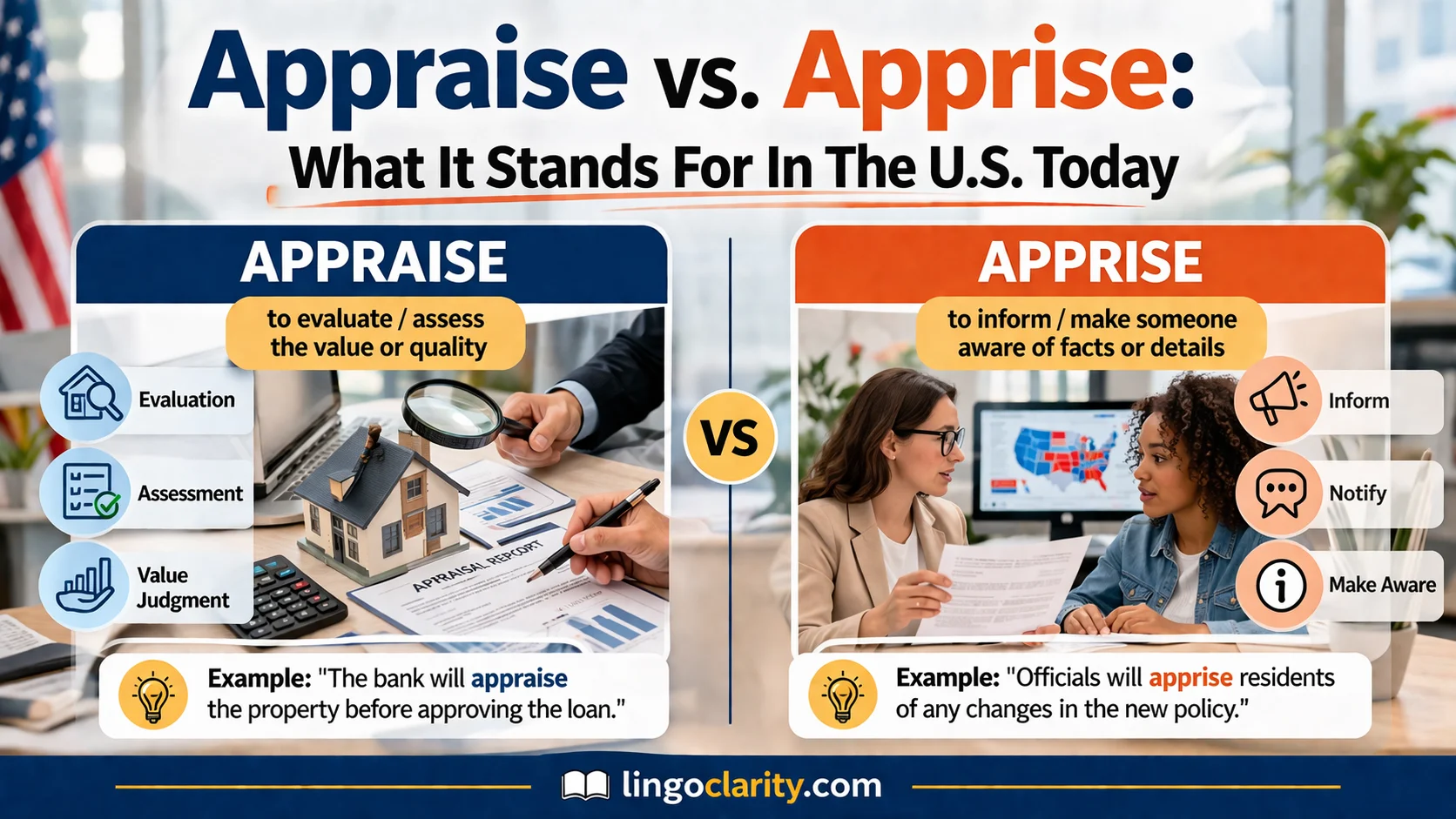
Appraise and apprise are easy to mix up because they look and sound similar, but they do not mean the same thing. Appraise means to evaluate, assess, or estimate value, while apprise means to inform or make someone aware. If you confuse them, your sentence can shift from talking about judgment to talking about communication. The simplest way to remember the difference is this: you appraise things, and you apprise people. Below, you’ll learn what each word means, how to use it correctly, and how to avoid common mistakes like “keep me appraised” when you really mean “keep me apprised.”
Quick Answer
Appraise means to evaluate, assess, or estimate value or quality. Apprise means to inform someone or make them aware of something. That is the difference in one line, and it is the same distinction you will find across major dictionary and usage sources. Oxford also marks apprise as formal, which matters when you are deciding whether it fits the tone of your sentence.
Use appraise when the action is judgment:
- The bank will appraise the house.
- The committee will appraise the proposal.
Use apprise when the action is informing:
- Please apprise me of any changes.
- The attorney apprised the client of the new deadline.
If you remember one rule, make it this:
You appraise things. You apprise people.
Why These Words Get Confused
The confusion is easy to understand. The words look almost identical, sound close in fast speech, and both tend to appear in formal writing. Merriam-Webster notes that both words have been in common use for centuries and both have French roots, which helps explain why they feel like a matched pair even though their meanings differ.
Their pronunciations are close but not the same:
- Appraise: /əˈpreɪz/
- Apprise: /əˈpraɪz/
That small vowel change matters. It helps signal that these are different words doing different jobs.
What Appraise Means
Appraise means to assess, evaluate, or form a judgment about something. In many contexts, it means estimating monetary worth, such as the value of a house, painting, ring, or antique. But that is not its only meaning. Oxford’s entry shows that appraise can also mean to examine something and form an opinion about it, and in British English it can refer to making a formal judgment about a person’s work. Grammarly likewise notes that it often appears in fields such as real estate, art, and high-value goods.
That is why all of these are correct:
- The lender hired an expert to appraise the property.
- The museum asked a specialist to appraise the painting.
- She stepped back to appraise the quality of her work.
- Managers may appraise staff during a formal review.
So while appraise is often associated with price, its broader idea is careful evaluation.
What Apprise Means
Apprise means to tell, inform, notify, or make someone aware. Oxford gives the standard grammar pattern clearly: apprise somebody of something. It also marks the verb as formal, which is an important usage note because many writers reach for it in sentences where a simpler verb might sound more natural.
Examples:
- Please apprise the board of any material changes.
- We were fully apprised of the situation.
- The embassy apprised citizens of the risks involved.
This word is common in official, legal, academic, business, and administrative writing. It is correct standard English, but it is usually more formal than tell, inform, notify, brief, or update.
The Most Useful Grammar Rule
The easiest way to choose between these words is to look at the object in the sentence.
With appraise, the object is usually the thing being judged:
- appraise the property
- appraise the damage
- appraise the plan
With apprise, the object is usually the person being informed, often followed by of:
- apprise the client of the delay
- apprise the committee of the decision
- keep me apprised of any updates
That rule resolves most confusion quickly. If the sentence points to what is being evaluated, choose appraise. If it points to who is being informed, choose apprise.
Tone, Formality, And When A Simpler Verb Is Better
One reason writers hesitate over apprise is that it can sound stiff. That instinct is not wrong. Oxford explicitly labels apprise as formal, and Grammarly describes it as typical of official or formal communication.
That means this sentence sounds natural in a formal context:
- Please apprise the board of any new developments.
But in everyday US English, many writers would choose:
- Please let me know about any changes.
- Please update the team.
- Please inform me if anything changes.
So the choice is not only about meaning. It is also about register. Apprise is correct, but it is not always the best stylistic fit. If you want plain, modern, conversational prose, a simpler verb may read better.
Appraised Vs. Apprised
This is one of the most common search variants, and it causes real mistakes in professional writing.
- Appraised = evaluated or given a value
- Apprised = informed or made aware
Correct:
- The house was appraised at $520,000.
- We were apprised of the policy change.
- Keep me apprised of the situation.
Usually wrong:
- Keep me appraised of the situation.
That sentence is almost always a mistake. If you mean “keep me informed,” the correct word is apprised, not appraised. Several current usage pages surface this exact confusion because it is one of the most frequent real-world errors.
Common Mistakes And Quick Fixes
Using Appraise When You Mean Inform
Wrong: Please appraise me of any changes.
Right: Please apprise me of any changes.
Quick fix: If tell, inform, or update would fit, you want apprise, not appraise.
Thinking Appraise Is Only About Money
Wrong idea: Appraise only refers to price.
Better rule: Appraise can mean assessing value, quality, merit, workmanship, or performance depending on context. Oxford’s definitions explicitly support that broader use.
Writing Keep Me Appraised
Wrong: Keep me appraised.
Right: Keep me apprised.
Quick fix: If the idea is “keep me informed,” always check whether you meant apprised.
Forgetting The Standard Pattern With Apprise
Less natural: Please apprise the delay to the client.
Natural: Please apprise the client of the delay.
Quick fix: Think apprise someone of something.
Using Apprise In Casual Copy Where It Sounds Too Formal
Correct but stiff: Please apprise me of any changes.
Smoother in plain English: Please let me know if anything changes.
Quick fix: In everyday writing, choose the simpler verb unless you want a formal tone.
Examples In Natural US English
Real Estate And Insurance
- The lender required an expert to appraise the home before approving the mortgage.
- The adjuster came out to appraise the storm damage.
Work And Performance
- The panel will appraise the proposal before the next vote.
- Her manager will appraise her performance during the annual review.
Business And Legal Communication
- Please apprise the team of any schedule changes.
- Counsel will apprise both parties of the revised filing date.
Everyday Rewrites
- Formal: We were apprised of the situation.
- Plain: We were informed of the situation.
- Formal: Please apprise me of the outcome.
- Plain: Please let me know the outcome.
A Better Memory Trick
Some articles rely on loose sound associations, but the most reliable memory trick is grammatical.
Think:
- Appraise = assess the thing
- Apprise = advise or inform the person
Or even shorter:
- Appraise → object under evaluation
- Apprise → person receiving information
That memory aid is stronger than trying to remember sound alone because it works inside real sentences.
Word History Without The Filler
If you care about why these words look so similar, Merriam-Webster and Oxford offer a useful answer: they have different historical roots but ended up close in form, which makes confusion almost inevitable. Merriam-Webster notes that appraise comes from Anglo-French preiser, while apprise comes from Old French aprendre. Oxford traces appraise through an earlier form associated with setting a price and apprise through a French form tied to learning or informing.
Merriam-Webster also notes the odd side case of apprize, which has been used historically as a synonym or spelling variant. That is interesting, but it is not something most modern writers need. For normal usage today, keep the distinction simple: appraise for evaluation, apprise for informing.
Bottom Line
Use appraise when the job is judgment, assessment, or valuation.
Use apprise when the job is informing, notifying, or making someone aware.
If you want the fastest possible test, use this sentence:
You appraise the thing. You apprise the person.
Frequently Asked Questions
Is it keep me apprised or keep me appraised?
The correct phrase is keep me apprised when you mean keep me informed. Keep me appraised is usually wrong unless you literally mean ongoing evaluation. Current usage pages routinely flag this as one of the most common mistakes with the pair.
Is it appraise me or apprise me?
If you mean inform me, the correct phrase is apprise me. Appraise me means evaluate me, which is a different idea.
Can appraise mean more than estimate price?
Yes. Appraise can mean evaluating value, quality, workmanship, merit, or performance, not just assigning a dollar amount. Oxford’s entry makes that broader range clear.
Is apprise too formal for everyday writing?
Often, yes. Apprise is correct, but Oxford labels it formal, so in casual US English, tell, inform, update, or let me know may sound more natural.
What is the easiest way to remember the difference?
Remember the object pattern: appraise the thing; apprise the person of the thing. That is the quickest and most reliable way to choose correctly.
Are both words standard English?
Yes. Both are correct standard English verbs. They are not interchangeable, but neither is wrong on its own. The mistake happens only when the wrong one is used for the sentence’s meaning.
