
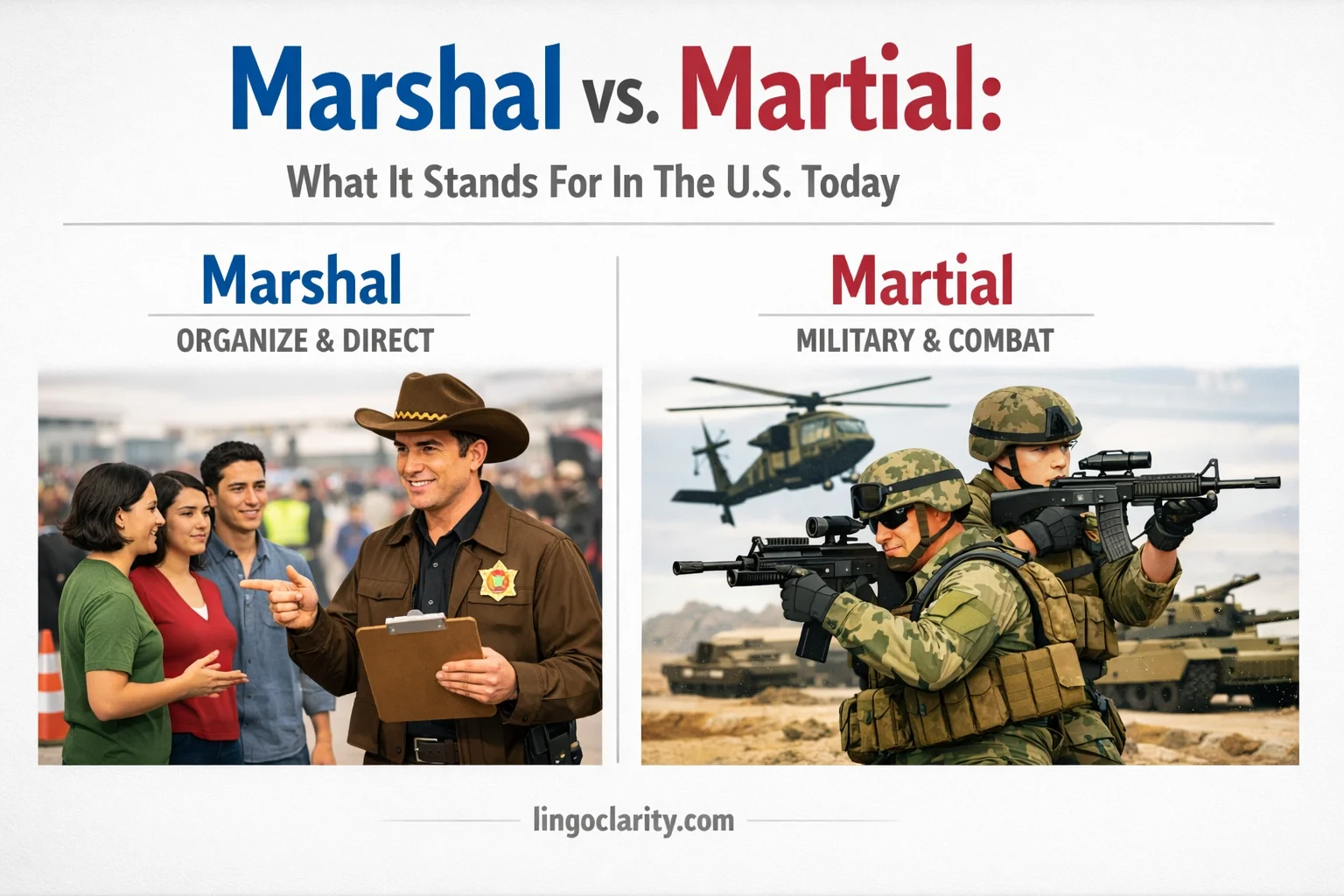
If you need the quick rule, here it is: use marshal for an official role or the act of organizing, and use martial for anything related to war, the military, or combat. That is why marshal the evidence is correct, but martial law is also correct.
These two words sound the same in standard American English, which is exactly why they cause so much trouble in writing. On the page, though, they do completely different jobs. Once you learn the pattern, the choice is usually obvious.
Quick Answer
Use marshal when you mean:
- an official, officer, or person directing an event
- the act of arranging, gathering, or organizing something
Use martial when you mean:
- military rule
- war, soldiers, or combat
- combat-related traditions or training
So these are correct:
- The attorney marshaled the evidence.
- The fire marshal inspected the building.
- The government declared martial law.
- She has studied martial arts for years.
And these are wrong:
- martial the evidence
- marshal law
- marshal arts
Merriam-Webster, Cambridge, and Grammarly all draw the same basic line: marshal works as a noun and verb, while martial is an adjective tied to war or military life.
Marshal vs. Martial At A Glance
The simplest way to separate the two is to ask what the word is doing in the sentence.
If it is naming a person or describing an organizing action, use marshal.
If it is describing something military, warlike, or combat-related, use martial.
That gives you a fast test:
- Can you replace it with organize, gather, or direct? Choose marshal.
- Can you replace it with military, warlike, or combat-related? Choose martial.
This rule lines up with standard dictionary usage and with how the words appear in common phrases such as marshal support, U.S. Marshal, martial law, and martial arts.
When To Use Marshal
Marshal has two main jobs in modern US English.
First, it is a noun. A marshal can be an officer, official, or designated person in charge of a ceremony or event. Merriam-Webster includes meanings such as a parade marshal, a law officer, and a fire marshal. The U.S. Marshals Service describes itself as the enforcement arm of the federal courts, which shows how established the title is in American public life.
Second, marshal is also a verb. As a verb, it means to gather, arrange, or deploy something in an orderly and effective way. You can marshal evidence, marshal support, marshal resources, or marshal your thoughts. Cambridge and Merriam-Webster both define it in terms of bringing people or things together in order to achieve a purpose.
Here are natural US-English examples:
- The campaign marshaled support before the vote.
- The lawyer marshaled the evidence before trial.
- She paused to marshal her thoughts before answering.
- A fire marshal inspected the exit routes.
- The parade marshal led the procession.
In other words, marshal is about direction, arrangement, and official responsibility.
When To Use Martial
Martial is mainly an adjective. It describes something related to war, soldiers, military life, or combat. Merriam-Webster defines it as “of, relating to, or suited for war or a warrior” and also as relating to an army or military life. Cambridge gives essentially the same meaning.
That is why you see it in phrases like:
- martial law
- martial arts
- martial discipline
- martial music
- martial bearing
Here are a few natural examples:
- The nation’s constitution limits when martial law can be imposed.
- He has practiced martial arts since childhood.
- The general had a stiff, almost martial presence.
- The novel describes a deeply martial culture.
The key point is that martial does not usually name a person or an organizing action. It describes a military or combat-related quality.
Why People Mix Them Up
This confusion is completely understandable for two reasons.
First, marshal and martial are pronounced alike in standard American English. Merriam-Webster and Grammarly both give essentially the same pronunciation for the two words.
Second, they both appear in serious contexts involving authority, order, law, conflict, or formal institutions. A marshal may be a law officer. Martial may appear in a phrase like martial law. Those contexts feel related, even though the words themselves are not interchangeable.
That is why the part of speech matters so much. Marshal usually acts as a noun or verb. Martial usually acts as an adjective.
The Phrase People Get Wrong Most: Martial Law
If you write marshal law or Marshall law, you are almost certainly making a mistake. The correct phrase is martial law. Cambridge defines martial law as control by the army instead of ordinary civilian leadership, and Cornell’s Legal Information Institute explains it as a situation in which military authority temporarily replaces civil authority.
So this is correct:
- The government declared martial law during the emergency.
And these are wrong:
- The government declared marshal law.
- The government declared Marshall law.
This mistake is so common that multiple competing pages focus almost entirely on it. That tells you how often people search the phrase incorrectly.
Court-Martial Is Another Fixed Phrase
Another place writers slip is court-martial. A court-martial is a military legal proceeding used to try offenses under military law. Cornell’s Wex entry defines it that way and distinguishes among general, special, and summary courts-martial.
That means:
- court-martial = correct
- court-marshal = wrong in this legal sense
This matters because some writers overapply the logic of marshal being an officer and assume court-marshal should exist. It does not. The legal term is court-martial.
Common Mistakes And How To Fix Them
Here are the errors readers make most often:
Wrong: The lawyer martialed the evidence.
Right: The lawyer marshaled the evidence.
Wrong: The state declared marshal law.
Right: The state declared martial law.
Wrong: She teaches marshal arts.
Right: She teaches martial arts.
Wrong: The martial guided runners to the start line.
Right: The marshal guided runners to the start line.
Wrong: A court-marshal reviewed the charges.
Right: A court-martial reviewed the charges.
A good editing check is to swap in a simpler word.
If organize fits, use marshal.
If military fits, use martial.
That one test solves most cases immediately.
What About Marshall With Two Ls?
This is where many searchers get tripped up.
Marshall is usually a proper noun: a surname, place name, or title inside a name, as in Thurgood Marshall, the Marshall Islands, or the Marshall Plan. Merriam-Webster’s explainer and other usage pages note that Marshall also appears as a variant spelling in limited contexts, but in ordinary edited American writing, it is usually treated as a name rather than the standard form of the common noun or verb marshal.
So:
- U.S. Marshal = correct
- fire marshal = correct
- Marshall law = wrong
- Marshal Marshall = possible, but only if the person’s name is Marshall
If your spell-check is nudging you toward Marshall, slow down and look at the sentence. Are you naming a person or place? Then Marshall may be right. Are you talking about an officer or the act of organizing? Then you almost certainly want marshal.
US English Notes On Verb Forms
You may see both marshaled and marshalled, as well as marshaling and marshalling. Merriam-Webster lists both sets of verb forms as accepted variants. For a US-English article, it is usually best to stay consistent and use marshaled and marshaling throughout unless a house style requires otherwise.
That means these are fine in US English:
- She marshaled her notes before the interview.
- The team is marshaling resources for the launch.
Consistency matters more than showing every possible variant.
Word Origins That Help The Meaning Stick
The history of the words actually makes the distinction easier to remember.
Martial comes from Latin martialis, meaning “of Mars,” the Roman god of war. That is why its modern meaning still points so directly to war, soldiers, combat, and military life.
Marshal, by contrast, came into English through French from older Germanic roots and originally referred to a servant in charge of horses before the word developed into a title for an official and, later, a verb meaning to arrange or direct.
That history matches the modern meanings surprisingly well:
- martial = war
- marshal = management, order, command, office
A Memory Trick That Actually Helps
Most memory tricks are forgettable, but this one works because it matches real usage.
Use marshal when the sentence is about managing or mobilizing.
Use martial when the sentence is about the military.
Both marshal and manage start with that practical, organizational feel.
Both martial and military point to force, soldiers, or combat.
It is not perfect, but it is fast, and it holds up under real writing conditions.
FAQ
Is it marshal law or martial law?
It is martial law. The phrase refers to military authority replacing normal civilian authority during an emergency. Marshal law is a common misspelling, not the standard term.
Can marshal be a verb?
Yes. Marshal is commonly used as a verb meaning to gather, arrange, direct, or organize people, ideas, evidence, or resources. Standard examples include marshal support, marshal arguments, and marshal your thoughts.
Is martial ever a noun?
In normal modern usage, martial is mainly an adjective, not a common noun. Most writers encounter it in phrases such as martial law, martial arts, and court-martial.
What is the difference between marshal and Marshall?
Marshal is the common noun and verb used for an officer, official, or organizing action. Marshall is usually a proper noun, such as a person’s name or place name. That is why U.S. Marshal is correct, but Thurgood Marshall is also correct.
Is court-martial related to martial or marshal?
It is related to martial. The fixed legal term is court-martial, meaning a military court or military legal proceeding. Court-marshal is not the standard legal form.
Final Takeaway
If you remember only one rule, make it this:
Use marshal for a person in charge or the act of organizing.
Use Martial (disambiguation) for anything military, war-related, or combat-related.
That gives you the right answer in nearly every real sentence:
- marshal the evidence
- marshal support
- fire marshal
- U.S. Marshal
- martial law
- martial arts
- court-martial
They may sound the same, but they do different jobs. Once you see that split, the mistake becomes much harder to make.
