
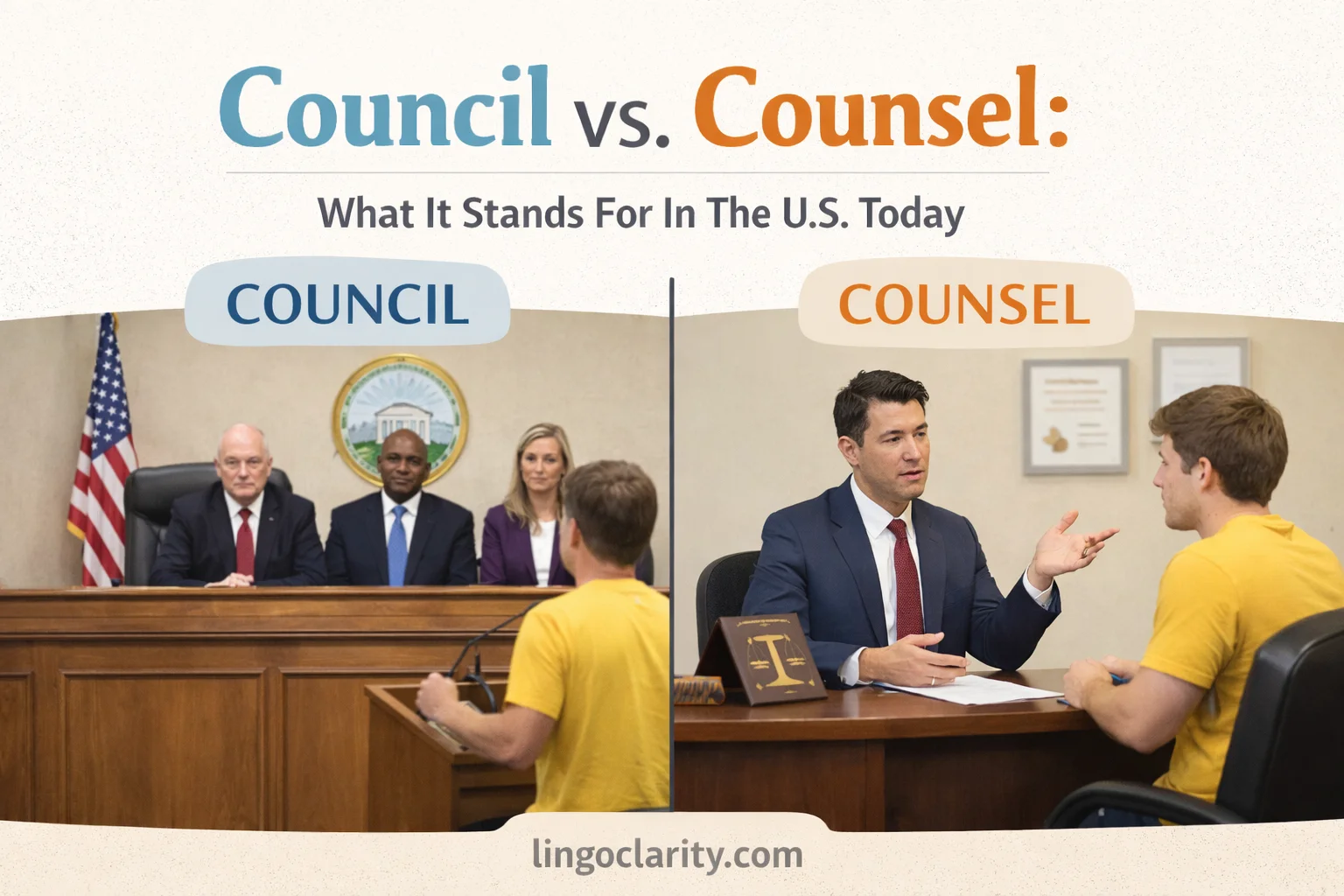
These two words sound the same, but they do different jobs. Use council when you mean a group that meets, represents others, or makes decisions. Use counsel when you mean advice, legal representation, or the act of advising. In standard American English, they are not interchangeable.
Quick Answer
If you mean a group, write council. If you mean advice, a lawyer, or to advise, write counsel. That is the distinction most writers need, and it holds across everyday, legal, academic, and professional American English.
| Word | What It Means | Part Of Speech | Common Examples |
|---|---|---|---|
| Council | A group or governing body | Noun | city council, student council, advisory council |
| Counsel | Advice; a lawyer; to advise | Noun and verb | seek counsel, legal counsel, general counsel, counsel a client |
A fast test helps: if you can replace the word with board, committee, or governing body, use council. If you can replace it with advice, lawyer, or advise, use counsel.
Why These Words Get Confused
The confusion is easy to understand. Council and counsel are homophones, so they are pronounced alike in standard English. They are also historically related, which helps explain why they look and sound similar. On top of that, both can appear in situations involving guidance or decision-making. A council may offer recommendations as a group, while counsel is the advice itself or the professional giving it.
That overlap is what traps writers. In speech, the difference often disappears. In writing, the spelling decides the meaning.
What Council Means
Council is a noun that refers to a body of people chosen or elected to deliberate, advise, represent, or govern. Dictionaries consistently define it as a group assembled for consultation, advice, discussion, or official decisions. In real life, that includes bodies such as a city council, student council, advisory council, or security council.
In American English, council often appears in public, institutional, and organizational settings:
- city council
- school council
- tribal council
- advisory council
- council meeting
- council member
It also shows up as an attributive noun, which is why phrases like council meeting and council member sound natural and correct.
Examples:
- The city council approved the zoning change.
- She ran for student council during her junior year.
- The advisory council meets every quarter.
- Residents spoke during the council meeting before the vote.
What Counsel Means
Counsel has a wider range than council. As a noun, it can mean advice or guidance. In legal and business English, it can also mean a lawyer or lawyers representing a party or organization. As a verb, it means to advise. That noun-and-verb flexibility is one of the most important differences between the two words.
Common correct uses include:
- seek counsel
- legal counsel
- general counsel
- outside counsel
- counsel for the defense
- counsel a client
- counsel a student
In the advice sense, counsel is often more formal than advice. Cambridge marks the noun as formal in American usage, and that matches real writing patterns: in casual speech, many people say advice, but in legal, therapeutic, religious, academic, and executive contexts, counsel often sounds more natural.
Examples:
- Before signing the agreement, she sought legal counsel.
- The company’s general counsel reviewed the contract.
- The therapist counsels teens after school.
- His mentor offered wise counsel during the transition.
A useful grammar note: when counsel means advice, it is usually treated as an uncountable noun in modern English, so seek counsel sounds more natural than seek a counsel. When it refers to a lawyer, it can refer to one lawyer or a team of lawyers depending on context.
Council Vs. Counsel In Real Sentences
One of the best ways to lock in the difference is to see both words in the same sentence.
- The city council hired outside counsel before the lawsuit moved forward.
- The student council sought faculty counsel on the policy change.
- Good counsel kept the council from making a costly mistake.
- The neighborhood council met after receiving legal counsel.
These examples work because the roles are clear: the council is the group, and the counsel is the advice or the lawyer.
How To Choose The Right Word Fast
When you are editing a sentence, ask three simple questions.
Are You Talking About A Group?
If yes, use council.
That covers elected bodies, committees with formal standing, advisory groups, and representative boards.
Examples:
- city council
- student council
- employee council
- arts council
Are You Talking About Advice Or A Lawyer?
If yes, use counsel.
That covers guidance, professional recommendation, legal representation, and lawyer titles.
Examples:
- wise counsel
- legal counsel
- defense counsel
- general counsel
Do You Need A Verb?
If the word means to advise, the correct choice is counsel. Merriam-Webster’s usage guidance is especially clear here: council does not have a standard verb form in this comparison, but counsel does.
Examples:
- She counseled him to wait.
- The social worker counsels families.
- The attorney counseled the client against signing.
Not this:
- She counciled him to wait.
When Advice Is Better Than Counsel
Even when counsel is correct, it is not always the best stylistic choice.
In plain American English, advice is usually simpler and more natural in casual writing:
- Better for everyday tone: She asked for advice.
- Better for formal or professional tone: She sought counsel.
Use counsel when the context is legal, therapeutic, executive, religious, or deliberately formal. Use advice when you want a more conversational tone. That gives you cleaner, more natural copy without sacrificing precision.
Common Phrases That Use Each Word
Some phrases strongly signal one spelling over the other.
With Council
- city council
- student council
- advisory council
- council member
- council meeting
With Counsel
- legal counsel
- general counsel
- outside counsel
- defense counsel
- seek counsel
- keep your own counsel
These fixed phrases matter because readers recognize them instantly. For example, general counsel is the standard title for a company’s lead lawyer, while city council is the standard term for a municipal governing body. Writing general council or city counsel will usually look like a mistake.
There is a narrow exception in theory: legal council could describe a council devoted to legal matters. But if you mean a lawyer or legal advice, the normal phrase in American English is legal counsel.
Common Mistakes To Avoid
Writers usually make one of four mistakes.
Using Council When They Mean Advice
Incorrect: She asked for council before signing the lease.
Correct: She asked for counsel before signing the lease.
Using Council When They Mean A Lawyer
Incorrect: Our general council reviewed the agreement.
Correct: Our general counsel reviewed the agreement.
Using Counsel When They Mean A Governing Body
Incorrect: The city counsel passed the ordinance.
Correct: The city council passed the ordinance.
Using Council As A Verb
Incorrect: The therapist councils teens after school.
Correct: The therapist counsels teens after school.
The quickest way to catch these is to swap in a simpler word. If board fits, use council. If advise, advice, or lawyer fits, use counsel.
Counselor Vs. Councilor
This word pair causes the next layer of confusion.
A counselor gives advice or guidance. A councilor is a member of a council. That is why a school counselor helps students, while a city councilor serves in local government. If you want to avoid any extra spelling friction in general-audience writing, city council member is often even clearer.
Because this article is written for American English, it is also worth noting that the usual American verb forms are counseled and counseling. British English often uses counselled and counselling.
A Simple Memory Trick
Use this shortcut:
- Council = a collective body
- Counsel = consultation, advice, or a counselor/lawyer
Or use the swap test:
- committee / board → council
- advice / advise / lawyer → counsel
That rule is simple, fast, and accurate for nearly every real-world sentence.
Conclusion
If you mean a group, write council.
If you mean advice, a lawyer, or to advise, write counsel.
A simple memory rule is this: council sits together; counsel says something helpful.
FAQ
What is the difference between council and counsel?
Council means a group assembled to advise, represent, or make decisions. Counsel means advice, a lawyer in legal contexts, or the act of advising.
Is counsel a noun or a verb?
It is both. As a noun, counsel means advice or a lawyer. As a verb, it means to advise.
Is council ever a verb?
Not in standard usage for this word pair. When you need a verb meaning “advise,” use counsel.
Do I write city council or city counsel?
Write city council when you mean the municipal governing body. City counsel is generally a mistake unless you are using a very unusual phrasing that does not mean the governing body.
Do I write general counsel or general council?
Write general counsel when you mean a company’s chief lawyer or legal department head. That is the standard legal and business term.
Can counsel mean a lawyer?
Yes. In legal usage, counsel can mean one lawyer or a group of lawyers representing a party in court or advising a client on legal matters.
What is the easiest way to remember the right word?
If the sentence is about a group, use council. If it is about advice, a lawyer, or advising, use counsel. That simple distinction will get you the right answer almost every time.
